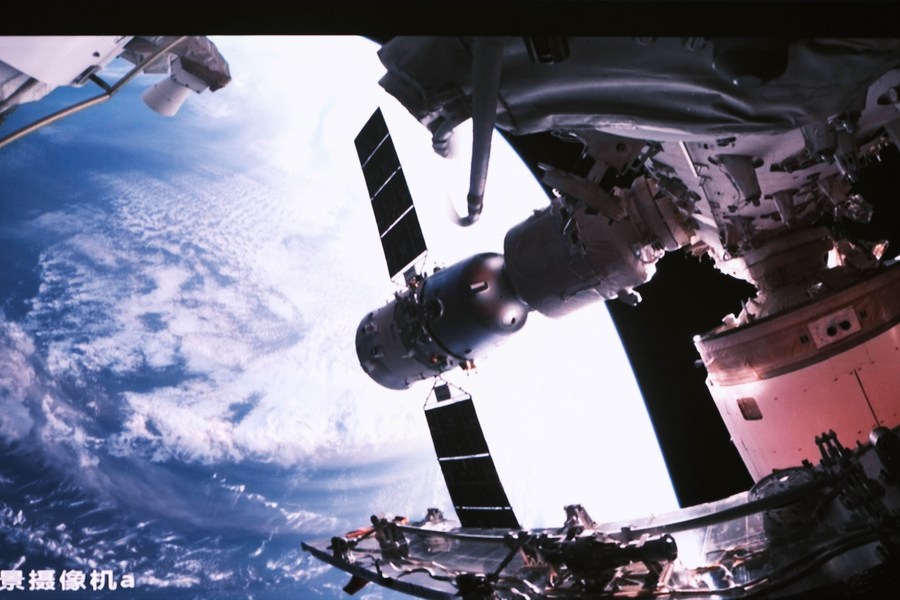
This screen image captured at Beijing Aerospace Control Center on May 30, 2023 shows Shenzhou-16 crewed spaceship successfully docking with the radial port of core module Tianhe of the space station.(Xinhua/Li Jie)
BEIJING, Aug. 19 (Xinhua) -- China's orbiting Tiangong space station, which functions as a national space laboratory, has been put into operation, pushing forward space applications and achieving fruitful results, according to the China Manned Space Agency.
A total of 110 in-orbit science research and application projects have been implemented, involving space life science and human body research, microgravity physics, and new space technologies, making multiple world's firsts, said Lin Xiqiang, the agency's deputy director, at a press conference on Friday.
The space lab also led to the establishment of a Chinese near-Earth space science and application system. Lin highlighted some system features, including its advanced lab platform for research and application of many space science-related disciplines and its strong in-orbit experimental support that allows taikonauts, especially payload experts, to conduct various operations.
Almost 100 TB of original experimental data have been acquired, and nearly 300 experimental samples returned, including the seeds of rice that had undergone a 120-day life cycle in the space station, he added.
The life-cycle growth experiment of rice is the first in the world, and the discovery of functional gene regulation would promote the breeding of new rice varieties, said Wang Qiang, deputy commander-in-chief of the space application system of China's manned space program.
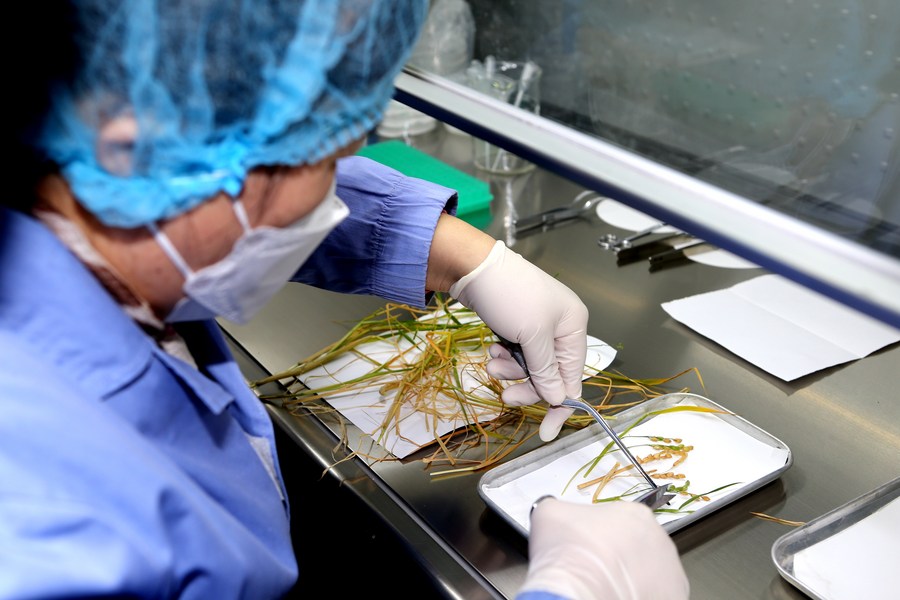
Zheng Huiqiong, a researcher at the Center for Excellence in Molecular Plant Sciences under the Chinese Academy of Sciences (CAS), processes rice samples from China's Tiangong space station at a biology lab of the Technology and Engineering Center for Space Utilization under the CAS in Beijing, capital of China, Dec. 5, 2022. Chinese scientists have completed the life-cycle growth experiments of rice and Arabidopsis in the Chinese space station and successfully obtained their seeds. (Xinhua)
A new alloy material was another breakthrough obtained on the space station, which might be applied in aerospace, nuclear power and other industries, said Wang.
In space medical experiments, the artificial vascular-tissue chip research and a visualization study on the influence of weightlessness on intracellular calcium signals have been made, both of them for the first time in the world, said Li Yinghui, deputy chief designer of the astronaut system of China's manned space program.
The experiment of the Stirling thermoelectric converter has laid a technical foundation for the country's future manned lunar exploration and deep space missions, said Guo Pei, a China Academy of Space Technology designer.
A two-photon microscope was used to obtain three-dimensional images of the astronaut's skin during spaceflight, also for the first time in the world, forming a new tool for in-orbit health monitoring, said Lin.
Many research results obtained in the space lab have brought benefits to Earth.
According to Lin, over 4,000 items of achievements obtained through China's manned space program have been used to serve the national economy and people's livelihood.
Lin added the study results of space life science now apply to biomaterials, medicine, medical treatment, and agricultural technologies.
Also, the research results in microgravity fluids, combustion and materials science contribute to improving manufacturing and processing techniques.
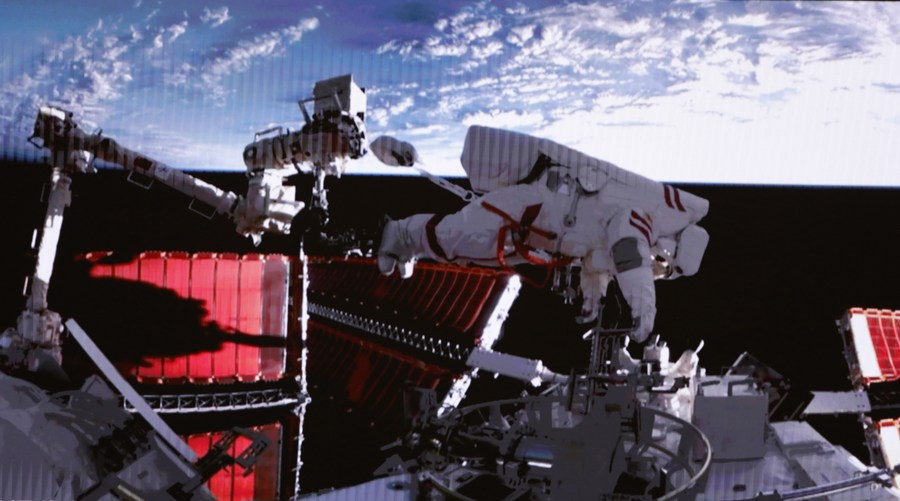
This screen image captured at Beijing Aerospace Control Center on Feb. 9, 2023 shows Shenzhou-15 taikonaut Fei Junlong returning to space station lab module Wentian with equipment.(Xinhua/Liu Fang)
More than 3,000 space breeding experiments have been carried out on spaceflight missions, cultivating 240-plus varieties of staple grains and 400-plus new vegetable, fruit, plant and flower varieties. This has resulted in an annual grain output increase of 2.6 billion kilograms.
Achievements of the project are also widely applied in natural resources and ecological environment protection, disaster prevention and reduction, and public services, helping sustain the modernization of social governance, Lin said. ■