
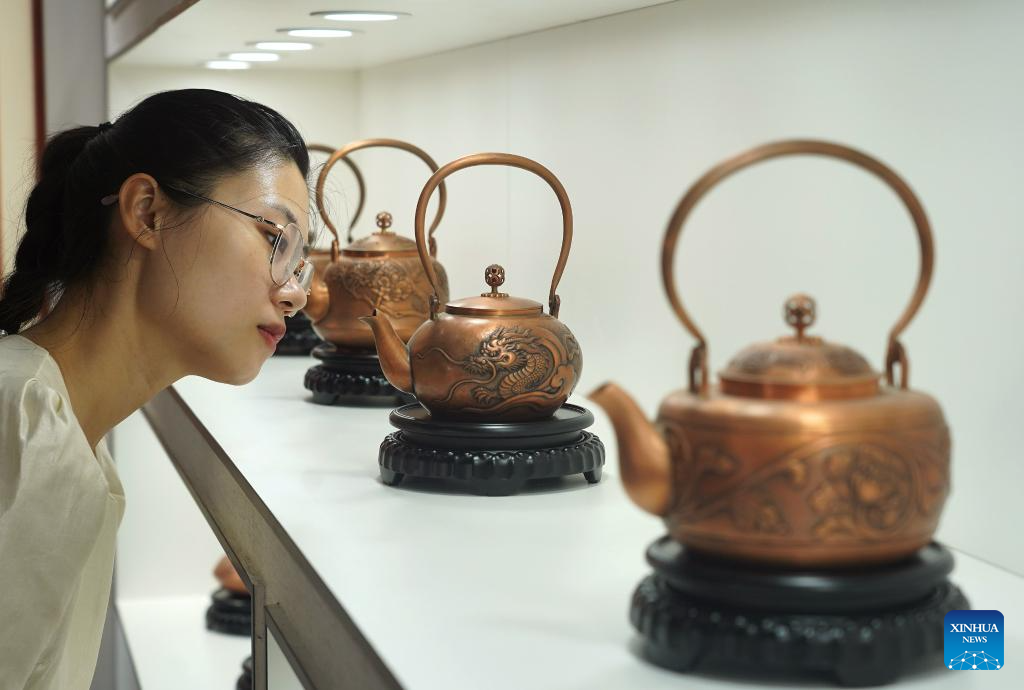
A visitor watches copper engraving teapots displayed at an exhibition hall of Huang Junjun's company in Guixi City, east China's Jiangxi Province, July 13, 2023. Copper engraving, or copper carving, a craft of using knives to carve patterns on copper wares, has a history of about 1,000 years. In 2021, Guixi copper engraving was listed as one of the national-level intangible cultural heritages. The craft needs over 150 different kinds of knives and a dozen of carving skills to create a complete artwork, and the copper ware has to go through over 100,000 times of hammering before being turned into an exquisite artwork. Huang Junjun, 55 years old, is a representative inheritor of Guixi copper engraving, who has been taking the work for 36 years. "My grandpa was a copper ware craftsman, for whom I often acted as an assistant during childhood. I was fascinated with the ancient art," said Huang. As from 1989, he travelled all over the country to seek for masters to study the art, and also worked at factories in Shanghai and Nanchang to sharpen his skills. He also integrated copper engraving methods of Japan and South Korea into his own. "I was thinking during work that if the craft can't be applied to industry, people can't see its value, not to say preserve and inherit it," said Huang Junjun. In 2000, he set up a copper artwork studio, receiving orders from all over the country. For his excellent craftsmanship, Huang won fame in the circle and even received orders from Japan and Singapore. In 2012, with the help of local government of Guixi City, which strove to develop itself under the name of "city of copper", Huang founded the Jiangxi Zhongding metal artwork company. In order to improve the work efficiency, he created a production mode which combines the work of machines with that of craftsmen. Nowadays, Huang Junjun has cultivated over 200 professional craftsmen in copper engraving, and has over 30 artworks honored in various national and provincial exhibitions. His copper artworks are sold worldwide. He is confident in the future of his craft, "I hope my artworks not only embody the ancient styles of handmade metal accessories, but also reflect the aesthetic concepts of modern life, so as to let the art into the daily life of our common people." (Xinhua/Wan Xiang)
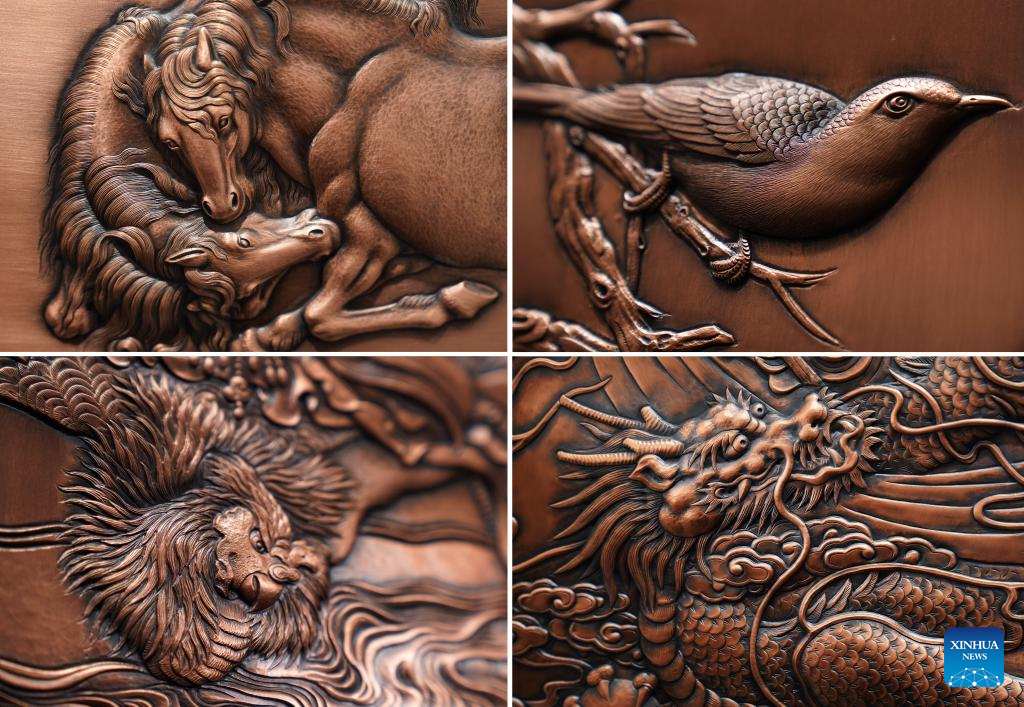
This combo photo taken on Aug. 9, 2023 shows details on Huang Junjun's copper engraving artwork displayed at an exhibition hall of his company in Guixi City, east China's Jiangxi Province. Copper engraving, or copper carving, a craft of using knives to carve patterns on copper wares, has a history of about 1,000 years. In 2021, Guixi copper engraving was listed as one of the national-level intangible cultural heritages. The craft needs over 150 different kinds of knives and a dozen of carving skills to create a complete artwork, and the copper ware has to go through over 100,000 times of hammering before being turned into an exquisite artwork. Huang Junjun, 55 years old, is a representative inheritor of Guixi copper engraving, who has been taking the work for 36 years. "My grandpa was a copper ware craftsman, for whom I often acted as an assistant during childhood. I was fascinated with the ancient art," said Huang. As from 1989, he travelled all over the country to seek for masters to study the art, and also worked at factories in Shanghai and Nanchang to sharpen his skills. He also integrated copper engraving methods of Japan and South Korea into his own. "I was thinking during work that if the craft can't be applied to industry, people can't see its value, not to say preserve and inherit it," said Huang Junjun. In 2000, he set up a copper artwork studio, receiving orders from all over the country. For his excellent craftsmanship, Huang won fame in the circle and even received orders from Japan and Singapore. In 2012, with the help of local government of Guixi City, which strove to develop itself under the name of "city of copper", Huang founded the Jiangxi Zhongding metal artwork company. In order to improve the work efficiency, he created a production mode which combines the work of machines with that of craftsmen. Nowadays, Huang Junjun has cultivated over 200 professional craftsmen in copper engraving, and has over 30 artworks honored in various national and provincial exhibitions. His copper artworks are sold worldwide. He is confident in the future of his craft, "I hope my artworks not only embody the ancient styles of handmade metal accessories, but also reflect the aesthetic concepts of modern life, so as to let the art into the daily life of our common people." (Xinhua/Wan Xiang)
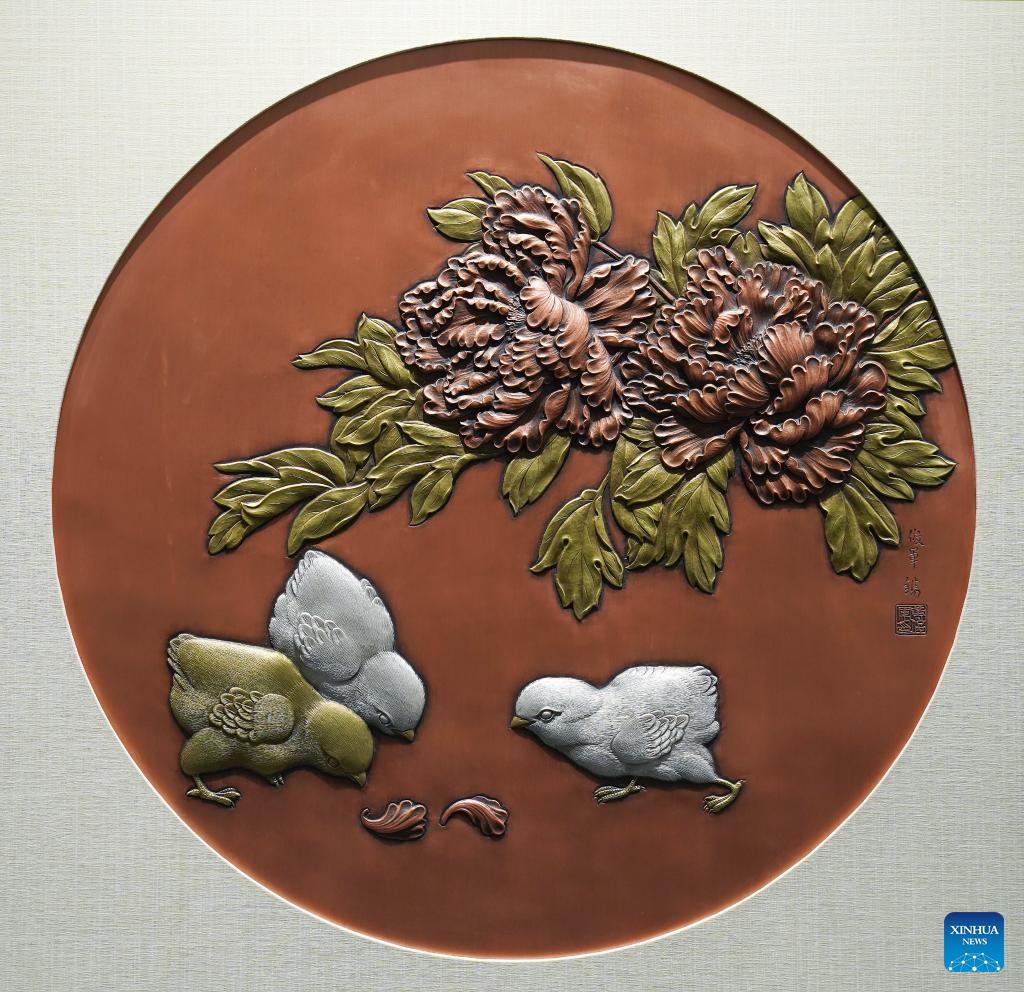
This photo taken on Aug. 9, 2023 shows Huang Junjun's copper engraving artwork, inlaid with colorful metals, displayed at an exhibition hall of his company in Guixi City, east China's Jiangxi Province. Copper engraving, or copper carving, a craft of using knives to carve patterns on copper wares, has a history of about 1,000 years. In 2021, Guixi copper engraving was listed as one of the national-level intangible cultural heritages. The craft needs over 150 different kinds of knives and a dozen of carving skills to create a complete artwork, and the copper ware has to go through over 100,000 times of hammering before being turned into an exquisite artwork. Huang Junjun, 55 years old, is a representative inheritor of Guixi copper engraving, who has been taking the work for 36 years. "My grandpa was a copper ware craftsman, for whom I often acted as an assistant during childhood. I was fascinated with the ancient art," said Huang. As from 1989, he travelled all over the country to seek for masters to study the art, and also worked at factories in Shanghai and Nanchang to sharpen his skills. He also integrated copper engraving methods of Japan and South Korea into his own. "I was thinking during work that if the craft can't be applied to industry, people can't see its value, not to say preserve and inherit it," said Huang Junjun. In 2000, he set up a copper artwork studio, receiving orders from all over the country. For his excellent craftsmanship, Huang won fame in the circle and even received orders from Japan and Singapore. In 2012, with the help of local government of Guixi City, which strove to develop itself under the name of "city of copper", Huang founded the Jiangxi Zhongding metal artwork company. In order to improve the work efficiency, he created a production mode which combines the work of machines with that of craftsmen. Nowadays, Huang Junjun has cultivated over 200 professional craftsmen in copper engraving, and has over 30 artworks honored in various national and provincial exhibitions. His copper artworks are sold worldwide. He is confident in the future of his craft, "I hope my artworks not only embody the ancient styles of handmade metal accessories, but also reflect the aesthetic concepts of modern life, so as to let the art into the daily life of our common people." (Xinhua/Wan Xiang)
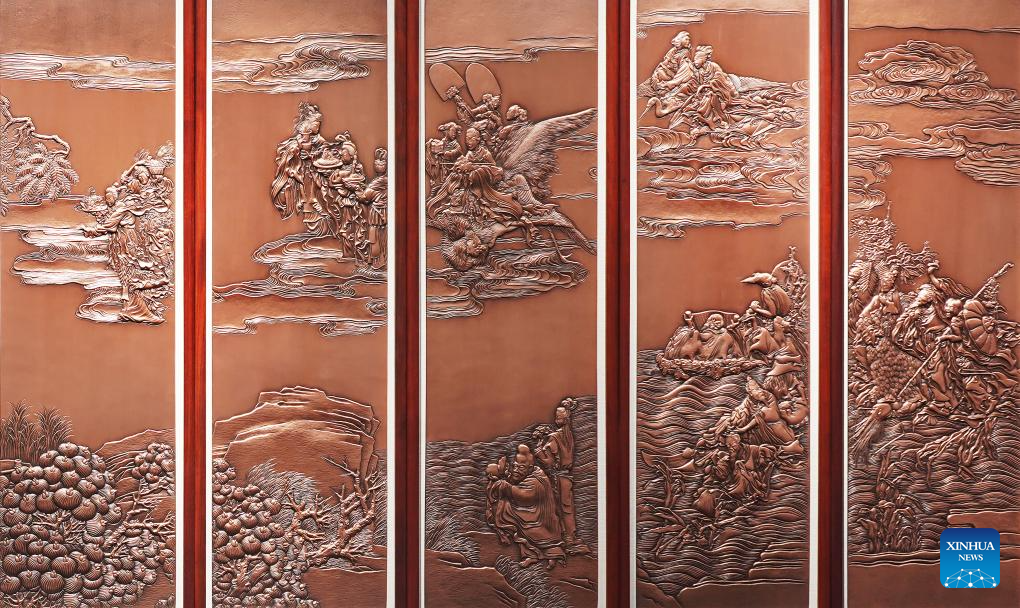
This photo taken on July 13, 2023 shows Huang Junjun's copper engraving artwork displayed at an exhibition hall of his company in Guixi City, east China's Jiangxi Province. Copper engraving, or copper carving, a craft of using knives to carve patterns on copper wares, has a history of about 1,000 years. In 2021, Guixi copper engraving was listed as one of the national-level intangible cultural heritages. The craft needs over 150 different kinds of knives and a dozen of carving skills to create a complete artwork, and the copper ware has to go through over 100,000 times of hammering before being turned into an exquisite artwork. Huang Junjun, 55 years old, is a representative inheritor of Guixi copper engraving, who has been taking the work for 36 years. "My grandpa was a copper ware craftsman, for whom I often acted as an assistant during childhood. I was fascinated with the ancient art," said Huang. As from 1989, he travelled all over the country to seek for masters to study the art, and also worked at factories in Shanghai and Nanchang to sharpen his skills. He also integrated copper engraving methods of Japan and South Korea into his own. "I was thinking during work that if the craft can't be applied to industry, people can't see its value, not to say preserve and inherit it," said Huang Junjun. In 2000, he set up a copper artwork studio, receiving orders from all over the country. For his excellent craftsmanship, Huang won fame in the circle and even received orders from Japan and Singapore. In 2012, with the help of local government of Guixi City, which strove to develop itself under the name of "city of copper", Huang founded the Jiangxi Zhongding metal artwork company. In order to improve the work efficiency, he created a production mode which combines the work of machines with that of craftsmen. Nowadays, Huang Junjun has cultivated over 200 professional craftsmen in copper engraving, and has over 30 artworks honored in various national and provincial exhibitions. His copper artworks are sold worldwide. He is confident in the future of his craft, "I hope my artworks not only embody the ancient styles of handmade metal accessories, but also reflect the aesthetic concepts of modern life, so as to let the art into the daily life of our common people." (Xinhua/Wan Xiang)
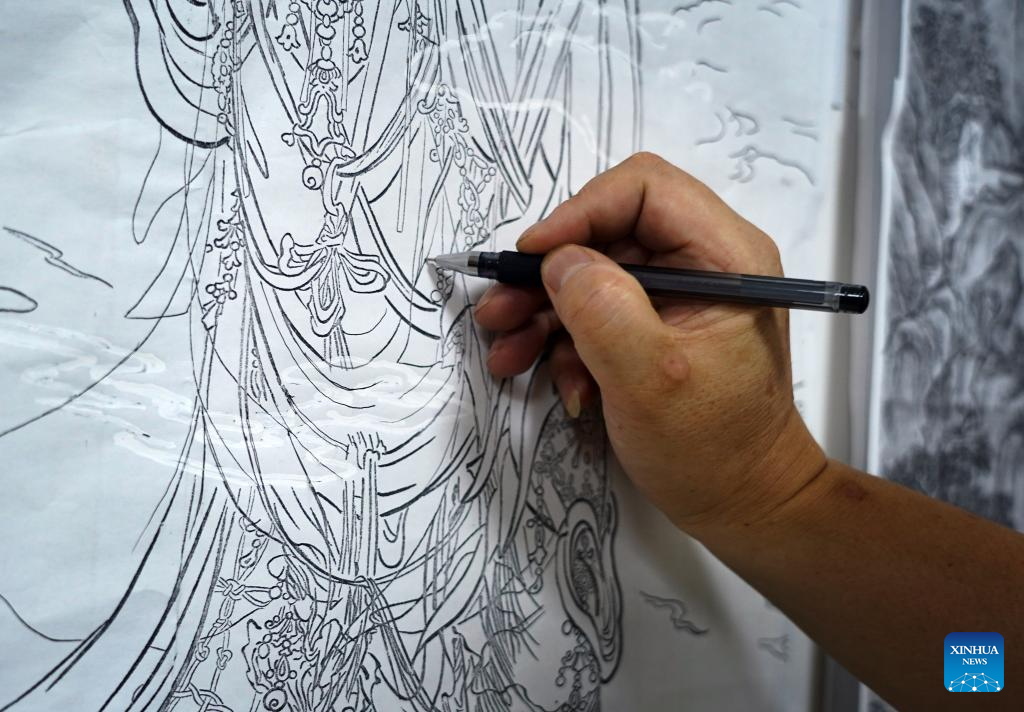
Huang Junjun draws draft of a copper engraving artwork at his studio in Guixi City, east China's Jiangxi Province, July 13, 2023. Copper engraving, or copper carving, a craft of using knives to carve patterns on copper wares, has a history of about 1,000 years. In 2021, Guixi copper engraving was listed as one of the national-level intangible cultural heritages. The craft needs over 150 different kinds of knives and a dozen of carving skills to create a complete artwork, and the copper ware has to go through over 100,000 times of hammering before being turned into an exquisite artwork. Huang Junjun, 55 years old, is a representative inheritor of Guixi copper engraving, who has been taking the work for 36 years. "My grandpa was a copper ware craftsman, for whom I often acted as an assistant during childhood. I was fascinated with the ancient art," said Huang. As from 1989, he travelled all over the country to seek for masters to study the art, and also worked at factories in Shanghai and Nanchang to sharpen his skills. He also integrated copper engraving methods of Japan and South Korea into his own. "I was thinking during work that if the craft can't be applied to industry, people can't see its value, not to say preserve and inherit it," said Huang Junjun. In 2000, he set up a copper artwork studio, receiving orders from all over the country. For his excellent craftsmanship, Huang won fame in the circle and even received orders from Japan and Singapore. In 2012, with the help of local government of Guixi City, which strove to develop itself under the name of "city of copper", Huang founded the Jiangxi Zhongding metal artwork company. In order to improve the work efficiency, he created a production mode which combines the work of machines with that of craftsmen. Nowadays, Huang Junjun has cultivated over 200 professional craftsmen in copper engraving, and has over 30 artworks honored in various national and provincial exhibitions. His copper artworks are sold worldwide. He is confident in the future of his craft, "I hope my artworks not only embody the ancient styles of handmade metal accessories, but also reflect the aesthetic concepts of modern life, so as to let the art into the daily life of our common people." (Xinhua/Wan Xiang)
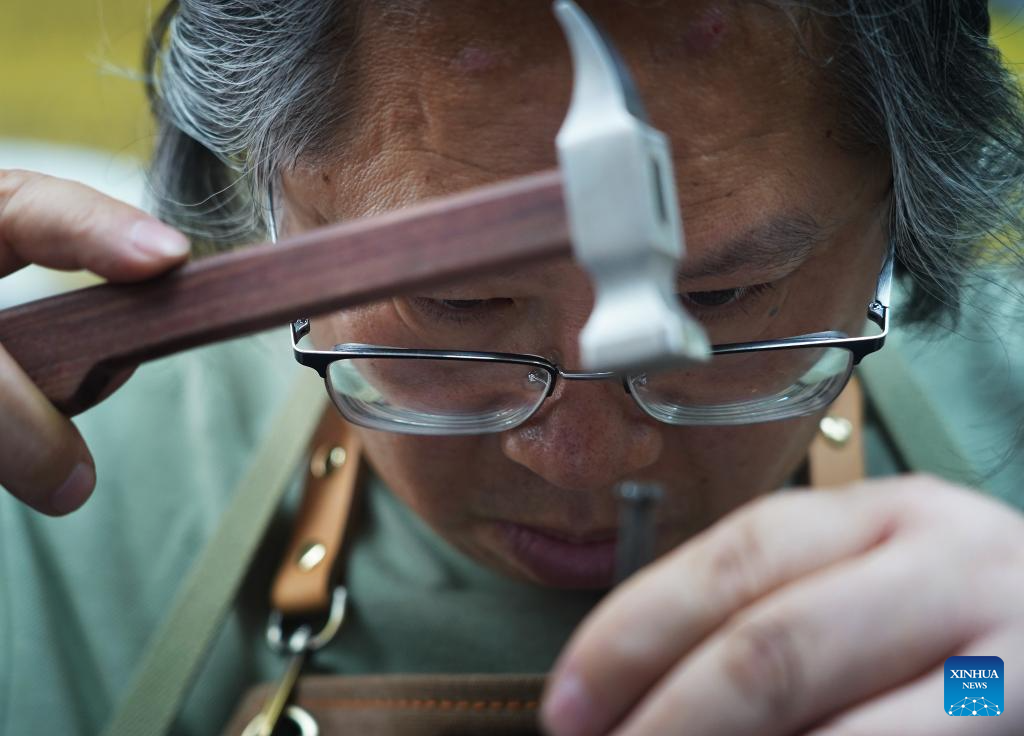
Huang Junjun makes a copper engraving artwork at a workshop of his company in Guixi City, east China's Jiangxi Province, July 13, 2023. Copper engraving, or copper carving, a craft of using knives to carve patterns on copper wares, has a history of about 1,000 years. In 2021, Guixi copper engraving was listed as one of the national-level intangible cultural heritages. The craft needs over 150 different kinds of knives and a dozen of carving skills to create a complete artwork, and the copper ware has to go through over 100,000 times of hammering before being turned into an exquisite artwork. Huang Junjun, 55 years old, is a representative inheritor of Guixi copper engraving, who has been taking the work for 36 years. "My grandpa was a copper ware craftsman, for whom I often acted as an assistant during childhood. I was fascinated with the ancient art," said Huang. As from 1989, he travelled all over the country to seek for masters to study the art, and also worked at factories in Shanghai and Nanchang to sharpen his skills. He also integrated copper engraving methods of Japan and South Korea into his own. "I was thinking during work that if the craft can't be applied to industry, people can't see its value, not to say preserve and inherit it," said Huang Junjun. In 2000, he set up a copper artwork studio, receiving orders from all over the country. For his excellent craftsmanship, Huang won fame in the circle and even received orders from Japan and Singapore. In 2012, with the help of local government of Guixi City, which strove to develop itself under the name of "city of copper", Huang founded the Jiangxi Zhongding metal artwork company. In order to improve the work efficiency, he created a production mode which combines the work of machines with that of craftsmen. Nowadays, Huang Junjun has cultivated over 200 professional craftsmen in copper engraving, and has over 30 artworks honored in various national and provincial exhibitions. His copper artworks are sold worldwide. He is confident in the future of his craft, "I hope my artworks not only embody the ancient styles of handmade metal accessories, but also reflect the aesthetic concepts of modern life, so as to let the art into the daily life of our common people." (Xinhua/Wan Xiang)
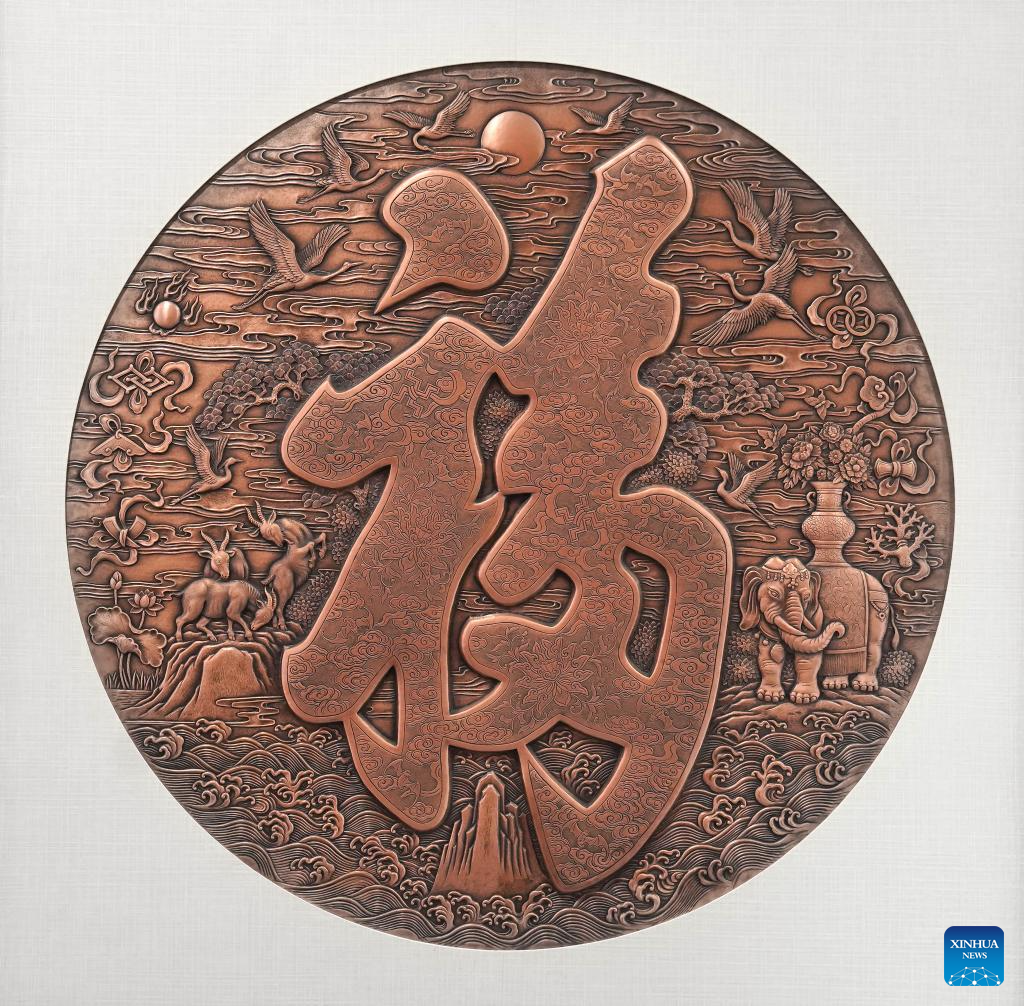
This photo taken on Aug. 9, 2023 shows Huang Junjun's copper engraving artwork displayed at an exhibition hall of his company in Guixi City, east China's Jiangxi Province. Copper engraving, or copper carving, a craft of using knives to carve patterns on copper wares, has a history of about 1,000 years. In 2021, Guixi copper engraving was listed as one of the national-level intangible cultural heritages. The craft needs over 150 different kinds of knives and a dozen of carving skills to create a complete artwork, and the copper ware has to go through over 100,000 times of hammering before being turned into an exquisite artwork. Huang Junjun, 55 years old, is a representative inheritor of Guixi copper engraving, who has been taking the work for 36 years. "My grandpa was a copper ware craftsman, for whom I often acted as an assistant during childhood. I was fascinated with the ancient art," said Huang. As from 1989, he travelled all over the country to seek for masters to study the art, and also worked at factories in Shanghai and Nanchang to sharpen his skills. He also integrated copper engraving methods of Japan and South Korea into his own. "I was thinking during work that if the craft can't be applied to industry, people can't see its value, not to say preserve and inherit it," said Huang Junjun. In 2000, he set up a copper artwork studio, receiving orders from all over the country. For his excellent craftsmanship, Huang won fame in the circle and even received orders from Japan and Singapore. In 2012, with the help of local government of Guixi City, which strove to develop itself under the name of "city of copper", Huang founded the Jiangxi Zhongding metal artwork company. In order to improve the work efficiency, he created a production mode which combines the work of machines with that of craftsmen. Nowadays, Huang Junjun has cultivated over 200 professional craftsmen in copper engraving, and has over 30 artworks honored in various national and provincial exhibitions. His copper artworks are sold worldwide. He is confident in the future of his craft, "I hope my artworks not only embody the ancient styles of handmade metal accessories, but also reflect the aesthetic concepts of modern life, so as to let the art into the daily life of our common people." (Xinhua/Wan Xiang)
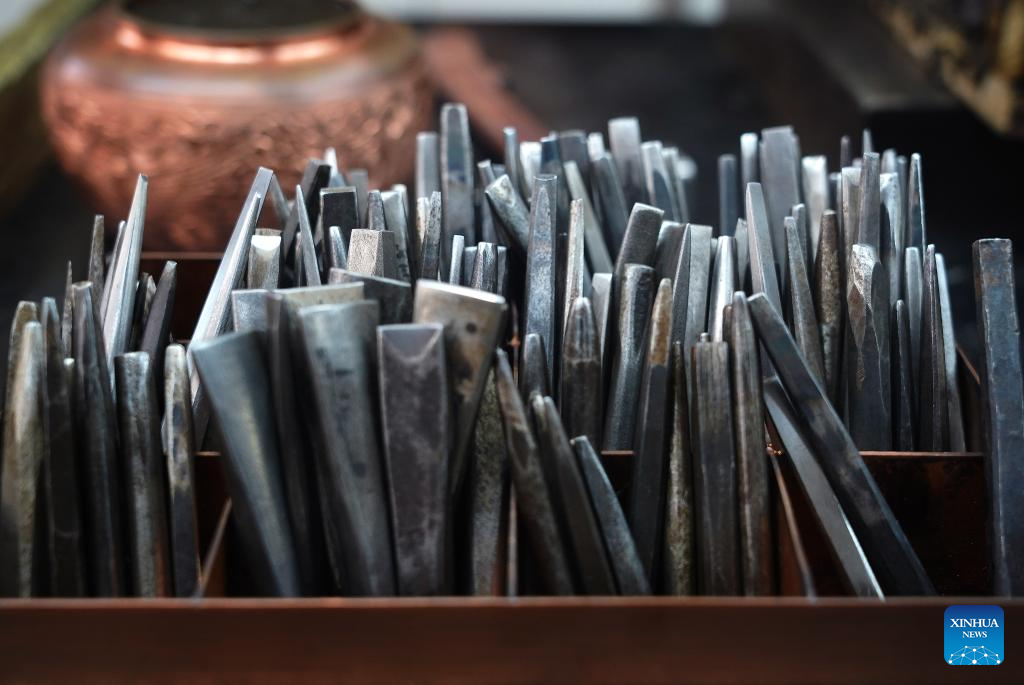
This photo taken on July 13, 2023 shows knives used to make copper engraving artworks at Huang Junjun's company in Guixi City, east China's Jiangxi Province, July 13, 2023. Copper engraving, or copper carving, a craft of using knives to carve patterns on copper wares, has a history of about 1,000 years. In 2021, Guixi copper engraving was listed as one of the national-level intangible cultural heritages. The craft needs over 150 different kinds of knives and a dozen of carving skills to create a complete artwork, and the copper ware has to go through over 100,000 times of hammering before being turned into an exquisite artwork. Huang Junjun, 55 years old, is a representative inheritor of Guixi copper engraving, who has been taking the work for 36 years. "My grandpa was a copper ware craftsman, for whom I often acted as an assistant during childhood. I was fascinated with the ancient art," said Huang. As from 1989, he travelled all over the country to seek for masters to study the art, and also worked at factories in Shanghai and Nanchang to sharpen his skills. He also integrated copper engraving methods of Japan and South Korea into his own. "I was thinking during work that if the craft can't be applied to industry, people can't see its value, not to say preserve and inherit it," said Huang Junjun. In 2000, he set up a copper artwork studio, receiving orders from all over the country. For his excellent craftsmanship, Huang won fame in the circle and even received orders from Japan and Singapore. In 2012, with the help of local government of Guixi City, which strove to develop itself under the name of "city of copper", Huang founded the Jiangxi Zhongding metal artwork company. In order to improve the work efficiency, he created a production mode which combines the work of machines with that of craftsmen. Nowadays, Huang Junjun has cultivated over 200 professional craftsmen in copper engraving, and has over 30 artworks honored in various national and provincial exhibitions. His copper artworks are sold worldwide. He is confident in the future of his craft, "I hope my artworks not only embody the ancient styles of handmade metal accessories, but also reflect the aesthetic concepts of modern life, so as to let the art into the daily life of our common people." (Xinhua/Wan Xiang)
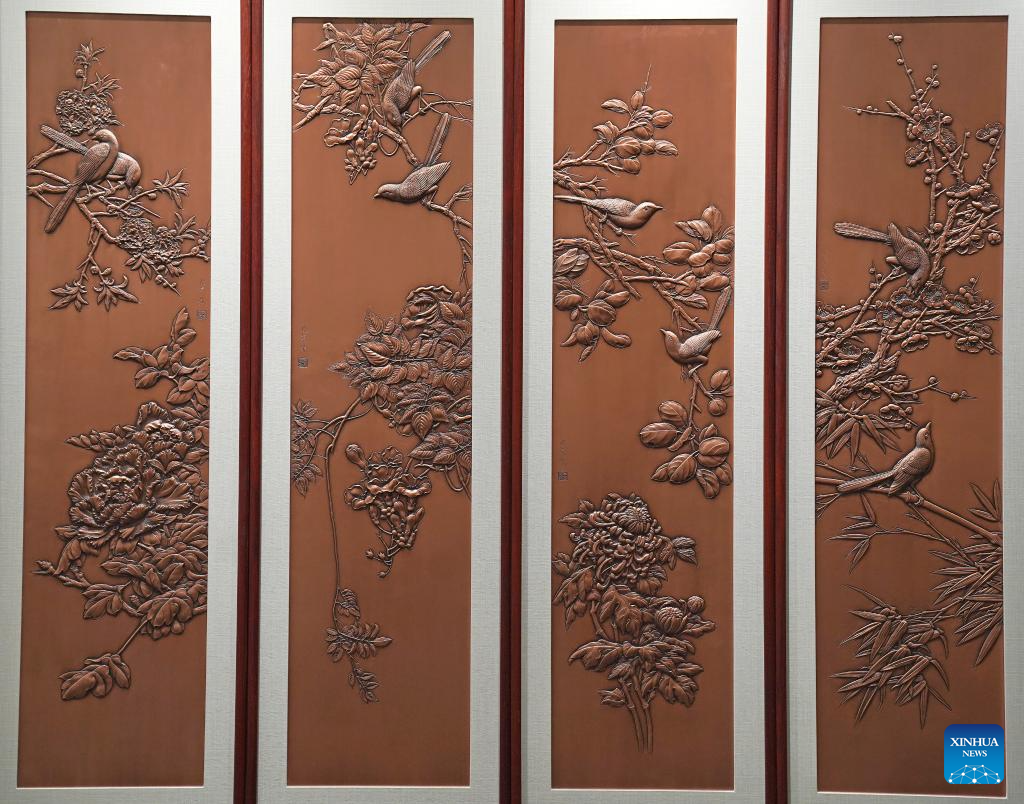
This photo taken on Aug. 9, 2023 shows Huang Junjun's copper engraving artwork displayed at an exhibition hall of his company in Guixi City, east China's Jiangxi Province. Copper engraving, or copper carving, a craft of using knives to carve patterns on copper wares, has a history of about 1,000 years. In 2021, Guixi copper engraving was listed as one of the national-level intangible cultural heritages. The craft needs over 150 different kinds of knives and a dozen of carving skills to create a complete artwork, and the copper ware has to go through over 100,000 times of hammering before being turned into an exquisite artwork. Huang Junjun, 55 years old, is a representative inheritor of Guixi copper engraving, who has been taking the work for 36 years. "My grandpa was a copper ware craftsman, for whom I often acted as an assistant during childhood. I was fascinated with the ancient art," said Huang. As from 1989, he travelled all over the country to seek for masters to study the art, and also worked at factories in Shanghai and Nanchang to sharpen his skills. He also integrated copper engraving methods of Japan and South Korea into his own. "I was thinking during work that if the craft can't be applied to industry, people can't see its value, not to say preserve and inherit it," said Huang Junjun. In 2000, he set up a copper artwork studio, receiving orders from all over the country. For his excellent craftsmanship, Huang won fame in the circle and even received orders from Japan and Singapore. In 2012, with the help of local government of Guixi City, which strove to develop itself under the name of "city of copper", Huang founded the Jiangxi Zhongding metal artwork company. In order to improve the work efficiency, he created a production mode which combines the work of machines with that of craftsmen. Nowadays, Huang Junjun has cultivated over 200 professional craftsmen in copper engraving, and has over 30 artworks honored in various national and provincial exhibitions. His copper artworks are sold worldwide. He is confident in the future of his craft, "I hope my artworks not only embody the ancient styles of handmade metal accessories, but also reflect the aesthetic concepts of modern life, so as to let the art into the daily life of our common people." (Xinhua/Wan Xiang)
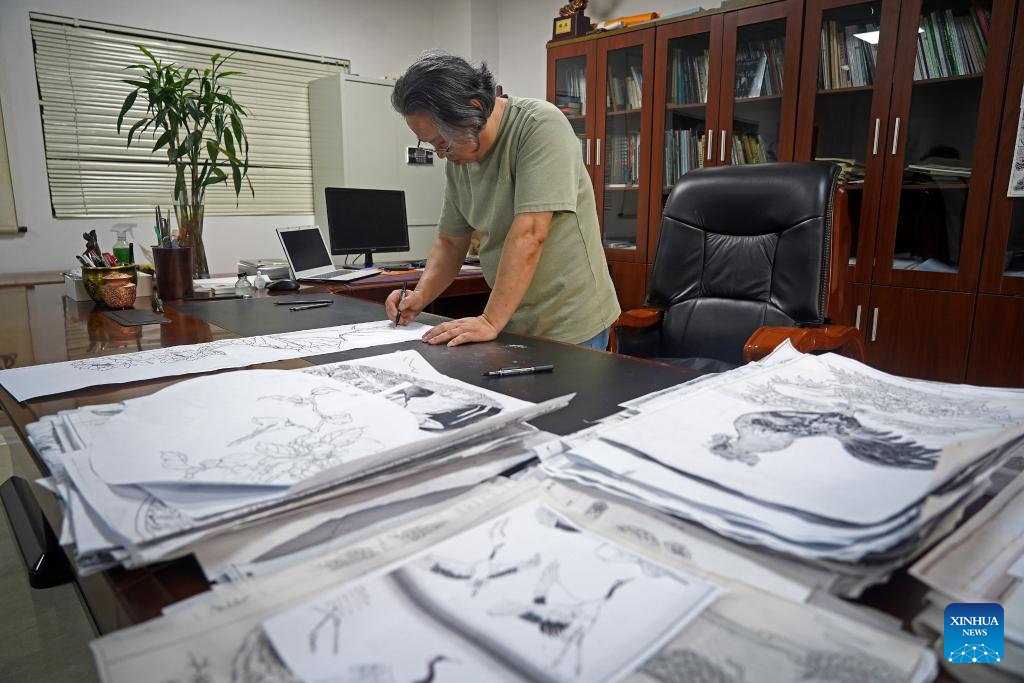
Huang Junjun draws draft of a copper engraving artwork at his studio in Guixi City, east China's Jiangxi Province, July 13, 2023. Copper engraving, or copper carving, a craft of using knives to carve patterns on copper wares, has a history of about 1,000 years. In 2021, Guixi copper engraving was listed as one of the national-level intangible cultural heritages. The craft needs over 150 different kinds of knives and a dozen of carving skills to create a complete artwork, and the copper ware has to go through over 100,000 times of hammering before being turned into an exquisite artwork. Huang Junjun, 55 years old, is a representative inheritor of Guixi copper engraving, who has been taking the work for 36 years. "My grandpa was a copper ware craftsman, for whom I often acted as an assistant during childhood. I was fascinated with the ancient art," said Huang. As from 1989, he travelled all over the country to seek for masters to study the art, and also worked at factories in Shanghai and Nanchang to sharpen his skills. He also integrated copper engraving methods of Japan and South Korea into his own. "I was thinking during work that if the craft can't be applied to industry, people can't see its value, not to say preserve and inherit it," said Huang Junjun. In 2000, he set up a copper artwork studio, receiving orders from all over the country. For his excellent craftsmanship, Huang won fame in the circle and even received orders from Japan and Singapore. In 2012, with the help of local government of Guixi City, which strove to develop itself under the name of "city of copper", Huang founded the Jiangxi Zhongding metal artwork company. In order to improve the work efficiency, he created a production mode which combines the work of machines with that of craftsmen. Nowadays, Huang Junjun has cultivated over 200 professional craftsmen in copper engraving, and has over 30 artworks honored in various national and provincial exhibitions. His copper artworks are sold worldwide. He is confident in the future of his craft, "I hope my artworks not only embody the ancient styles of handmade metal accessories, but also reflect the aesthetic concepts of modern life, so as to let the art into the daily life of our common people." (Xinhua/Wan Xiang)
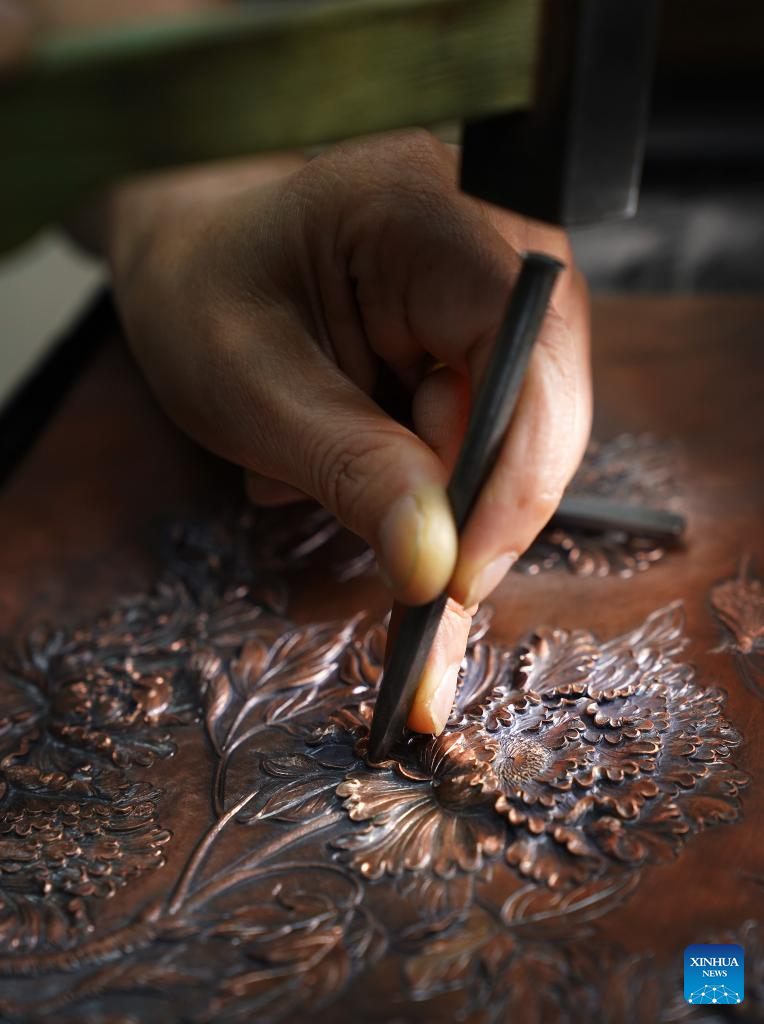
Huang Junjun makes a copper engraving artwork at a workshop of his company in Guixi City, east China's Jiangxi Province, Aug. 9, 2023. Copper engraving, or copper carving, a craft of using knives to carve patterns on copper wares, has a history of about 1,000 years. In 2021, Guixi copper engraving was listed as one of the national-level intangible cultural heritages. The craft needs over 150 different kinds of knives and a dozen of carving skills to create a complete artwork, and the copper ware has to go through over 100,000 times of hammering before being turned into an exquisite artwork. Huang Junjun, 55 years old, is a representative inheritor of Guixi copper engraving, who has been taking the work for 36 years. "My grandpa was a copper ware craftsman, for whom I often acted as an assistant during childhood. I was fascinated with the ancient art," said Huang. As from 1989, he travelled all over the country to seek for masters to study the art, and also worked at factories in Shanghai and Nanchang to sharpen his skills. He also integrated copper engraving methods of Japan and South Korea into his own. "I was thinking during work that if the craft can't be applied to industry, people can't see its value, not to say preserve and inherit it," said Huang Junjun. In 2000, he set up a copper artwork studio, receiving orders from all over the country. For his excellent craftsmanship, Huang won fame in the circle and even received orders from Japan and Singapore. In 2012, with the help of local government of Guixi City, which strove to develop itself under the name of "city of copper", Huang founded the Jiangxi Zhongding metal artwork company. In order to improve the work efficiency, he created a production mode which combines the work of machines with that of craftsmen. Nowadays, Huang Junjun has cultivated over 200 professional craftsmen in copper engraving, and has over 30 artworks honored in various national and provincial exhibitions. His copper artworks are sold worldwide. He is confident in the future of his craft, "I hope my artworks not only embody the ancient styles of handmade metal accessories, but also reflect the aesthetic concepts of modern life, so as to let the art into the daily life of our common people." (Xinhua/Wan Xiang)
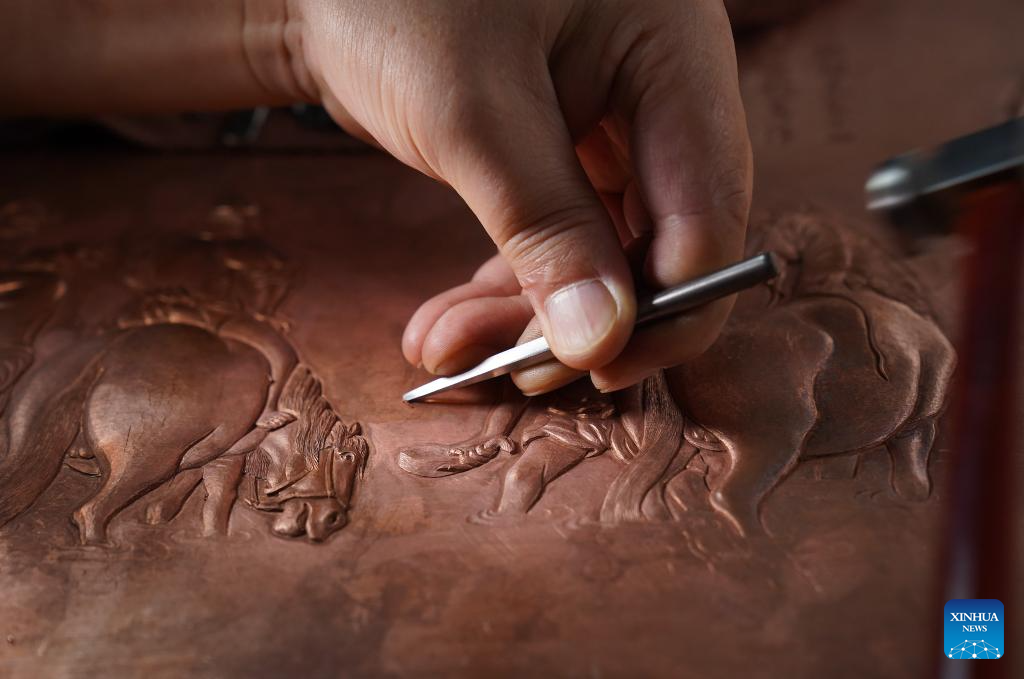
A craftsman makes a copper engraving artwork at Huang Junjun's company in Guixi City, east China's Jiangxi Province, Aug. 9, 2023. Copper engraving, or copper carving, a craft of using knives to carve patterns on copper wares, has a history of about 1,000 years. In 2021, Guixi copper engraving was listed as one of the national-level intangible cultural heritages. The craft needs over 150 different kinds of knives and a dozen of carving skills to create a complete artwork, and the copper ware has to go through over 100,000 times of hammering before being turned into an exquisite artwork. Huang Junjun, 55 years old, is a representative inheritor of Guixi copper engraving, who has been taking the work for 36 years. "My grandpa was a copper ware craftsman, for whom I often acted as an assistant during childhood. I was fascinated with the ancient art," said Huang. As from 1989, he travelled all over the country to seek for masters to study the art, and also worked at factories in Shanghai and Nanchang to sharpen his skills. He also integrated copper engraving methods of Japan and South Korea into his own. "I was thinking during work that if the craft can't be applied to industry, people can't see its value, not to say preserve and inherit it," said Huang Junjun. In 2000, he set up a copper artwork studio, receiving orders from all over the country. For his excellent craftsmanship, Huang won fame in the circle and even received orders from Japan and Singapore. In 2012, with the help of local government of Guixi City, which strove to develop itself under the name of "city of copper", Huang founded the Jiangxi Zhongding metal artwork company. In order to improve the work efficiency, he created a production mode which combines the work of machines with that of craftsmen. Nowadays, Huang Junjun has cultivated over 200 professional craftsmen in copper engraving, and has over 30 artworks honored in various national and provincial exhibitions. His copper artworks are sold worldwide. He is confident in the future of his craft, "I hope my artworks not only embody the ancient styles of handmade metal accessories, but also reflect the aesthetic concepts of modern life, so as to let the art into the daily life of our common people." (Xinhua/Wan Xiang)
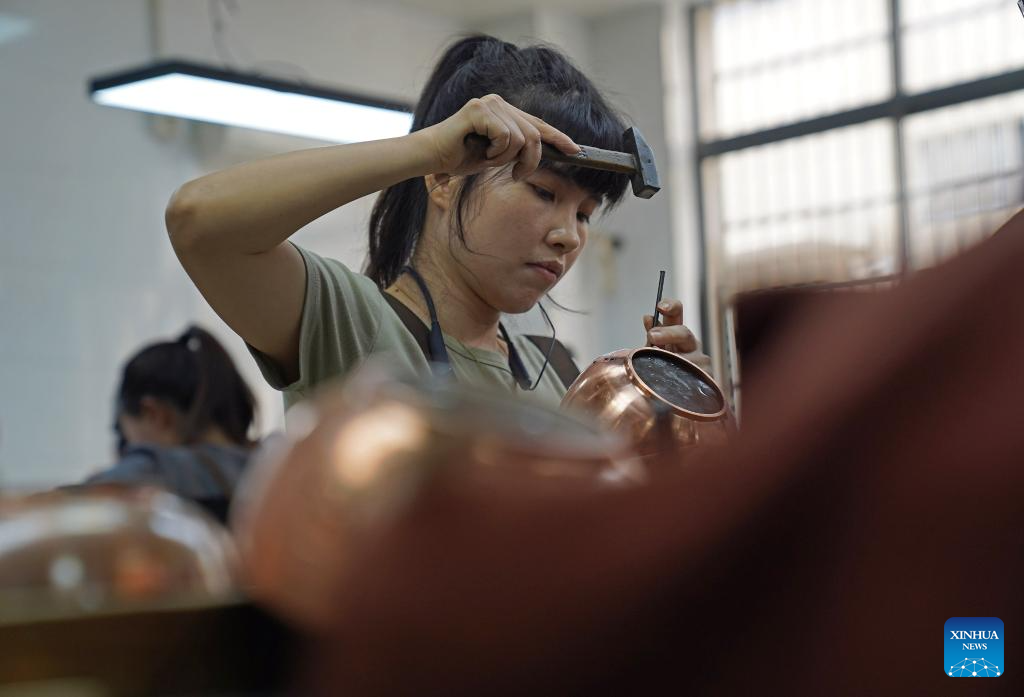
A craftsman makes a copper engraving artwork at Huang Junjun's company in Guixi City, east China's Jiangxi Province, Aug. 9, 2023. Copper engraving, or copper carving, a craft of using knives to carve patterns on copper wares, has a history of about 1,000 years. In 2021, Guixi copper engraving was listed as one of the national-level intangible cultural heritages. The craft needs over 150 different kinds of knives and a dozen of carving skills to create a complete artwork, and the copper ware has to go through over 100,000 times of hammering before being turned into an exquisite artwork. Huang Junjun, 55 years old, is a representative inheritor of Guixi copper engraving, who has been taking the work for 36 years. "My grandpa was a copper ware craftsman, for whom I often acted as an assistant during childhood. I was fascinated with the ancient art," said Huang. As from 1989, he travelled all over the country to seek for masters to study the art, and also worked at factories in Shanghai and Nanchang to sharpen his skills. He also integrated copper engraving methods of Japan and South Korea into his own. "I was thinking during work that if the craft can't be applied to industry, people can't see its value, not to say preserve and inherit it," said Huang Junjun. In 2000, he set up a copper artwork studio, receiving orders from all over the country. For his excellent craftsmanship, Huang won fame in the circle and even received orders from Japan and Singapore. In 2012, with the help of local government of Guixi City, which strove to develop itself under the name of "city of copper", Huang founded the Jiangxi Zhongding metal artwork company. In order to improve the work efficiency, he created a production mode which combines the work of machines with that of craftsmen. Nowadays, Huang Junjun has cultivated over 200 professional craftsmen in copper engraving, and has over 30 artworks honored in various national and provincial exhibitions. His copper artworks are sold worldwide. He is confident in the future of his craft, "I hope my artworks not only embody the ancient styles of handmade metal accessories, but also reflect the aesthetic concepts of modern life, so as to let the art into the daily life of our common people." (Xinhua/Wan Xiang)
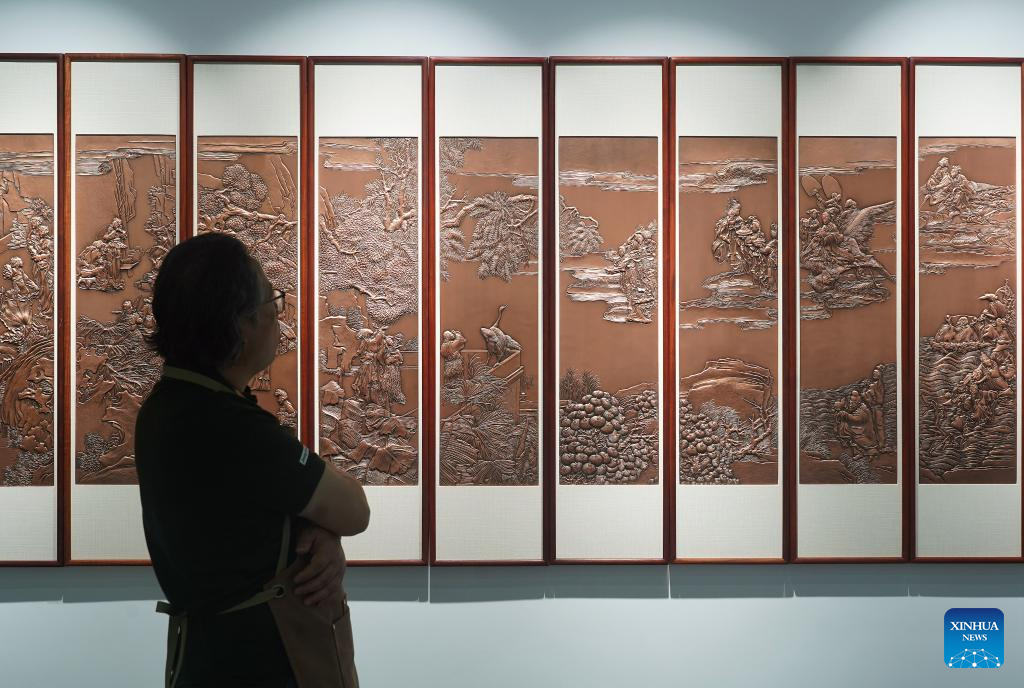
Huang Junjun watches his copper engraving artworks at an exhibition hall of his company in Guixi City, east China's Jiangxi Province, July 13, 2023. Copper engraving, or copper carving, a craft of using knives to carve patterns on copper wares, has a history of about 1,000 years. In 2021, Guixi copper engraving was listed as one of the national-level intangible cultural heritages. The craft needs over 150 different kinds of knives and a dozen of carving skills to create a complete artwork, and the copper ware has to go through over 100,000 times of hammering before being turned into an exquisite artwork. Huang Junjun, 55 years old, is a representative inheritor of Guixi copper engraving, who has been taking the work for 36 years. "My grandpa was a copper ware craftsman, for whom I often acted as an assistant during childhood. I was fascinated with the ancient art," said Huang. As from 1989, he travelled all over the country to seek for masters to study the art, and also worked at factories in Shanghai and Nanchang to sharpen his skills. He also integrated copper engraving methods of Japan and South Korea into his own. "I was thinking during work that if the craft can't be applied to industry, people can't see its value, not to say preserve and inherit it," said Huang Junjun. In 2000, he set up a copper artwork studio, receiving orders from all over the country. For his excellent craftsmanship, Huang won fame in the circle and even received orders from Japan and Singapore. In 2012, with the help of local government of Guixi City, which strove to develop itself under the name of "city of copper", Huang founded the Jiangxi Zhongding metal artwork company. In order to improve the work efficiency, he created a production mode which combines the work of machines with that of craftsmen. Nowadays, Huang Junjun has cultivated over 200 professional craftsmen in copper engraving, and has over 30 artworks honored in various national and provincial exhibitions. His copper artworks are sold worldwide. He is confident in the future of his craft, "I hope my artworks not only embody the ancient styles of handmade metal accessories, but also reflect the aesthetic concepts of modern life, so as to let the art into the daily life of our common people." (Xinhua/Wan Xiang)
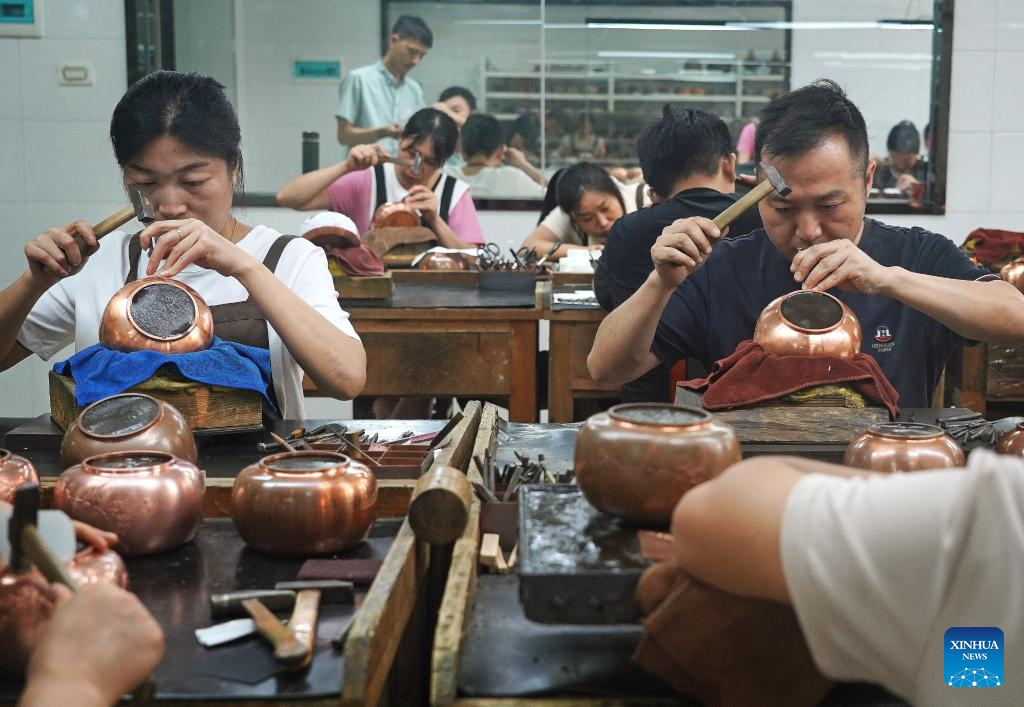
Craftsmen make copper engraving teapots at Huang Junjun's company in Guixi City, east China's Jiangxi Province, July 13, 2023. Copper engraving, or copper carving, a craft of using knives to carve patterns on copper wares, has a history of about 1,000 years. In 2021, Guixi copper engraving was listed as one of the national-level intangible cultural heritages. The craft needs over 150 different kinds of knives and a dozen of carving skills to create a complete artwork, and the copper ware has to go through over 100,000 times of hammering before being turned into an exquisite artwork. Huang Junjun, 55 years old, is a representative inheritor of Guixi copper engraving, who has been taking the work for 36 years. "My grandpa was a copper ware craftsman, for whom I often acted as an assistant during childhood. I was fascinated with the ancient art," said Huang. As from 1989, he travelled all over the country to seek for masters to study the art, and also worked at factories in Shanghai and Nanchang to sharpen his skills. He also integrated copper engraving methods of Japan and South Korea into his own. "I was thinking during work that if the craft can't be applied to industry, people can't see its value, not to say preserve and inherit it," said Huang Junjun. In 2000, he set up a copper artwork studio, receiving orders from all over the country. For his excellent craftsmanship, Huang won fame in the circle and even received orders from Japan and Singapore. In 2012, with the help of local government of Guixi City, which strove to develop itself under the name of "city of copper", Huang founded the Jiangxi Zhongding metal artwork company. In order to improve the work efficiency, he created a production mode which combines the work of machines with that of craftsmen. Nowadays, Huang Junjun has cultivated over 200 professional craftsmen in copper engraving, and has over 30 artworks honored in various national and provincial exhibitions. His copper artworks are sold worldwide. He is confident in the future of his craft, "I hope my artworks not only embody the ancient styles of handmade metal accessories, but also reflect the aesthetic concepts of modern life, so as to let the art into the daily life of our common people." (Xinhua/Wan Xiang)
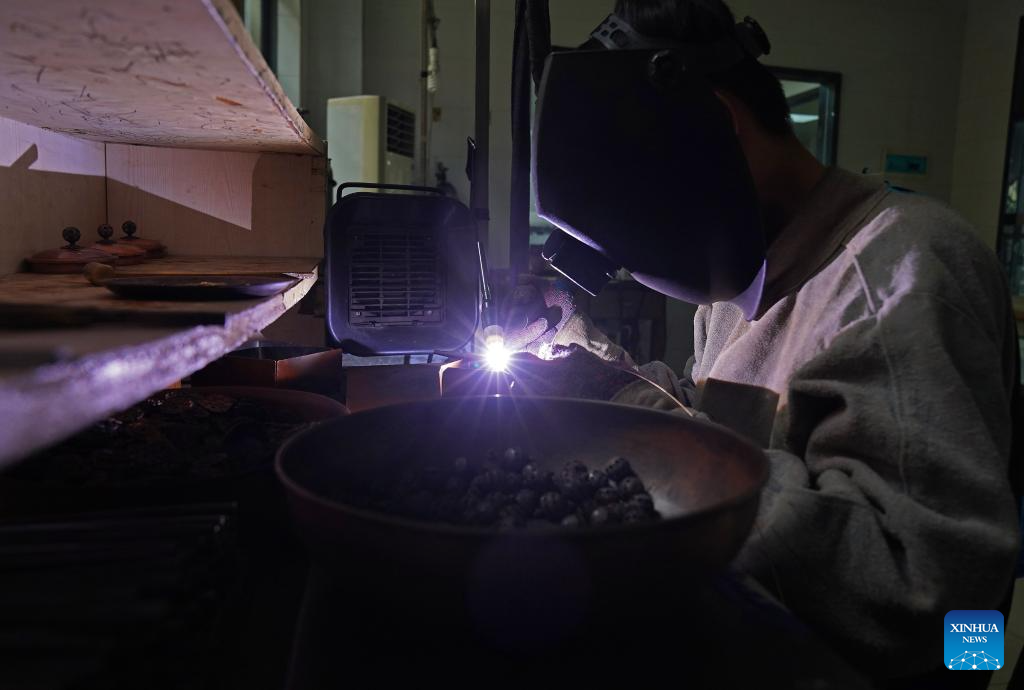
A craftsman welds a copper engraving artwork at Huang Junjun's company in Guixi City, east China's Jiangxi Province, Aug. 9, 2023. Copper engraving, or copper carving, a craft of using knives to carve patterns on copper wares, has a history of about 1,000 years. In 2021, Guixi copper engraving was listed as one of the national-level intangible cultural heritages. The craft needs over 150 different kinds of knives and a dozen of carving skills to create a complete artwork, and the copper ware has to go through over 100,000 times of hammering before being turned into an exquisite artwork. Huang Junjun, 55 years old, is a representative inheritor of Guixi copper engraving, who has been taking the work for 36 years. "My grandpa was a copper ware craftsman, for whom I often acted as an assistant during childhood. I was fascinated with the ancient art," said Huang. As from 1989, he travelled all over the country to seek for masters to study the art, and also worked at factories in Shanghai and Nanchang to sharpen his skills. He also integrated copper engraving methods of Japan and South Korea into his own. "I was thinking during work that if the craft can't be applied to industry, people can't see its value, not to say preserve and inherit it," said Huang Junjun. In 2000, he set up a copper artwork studio, receiving orders from all over the country. For his excellent craftsmanship, Huang won fame in the circle and even received orders from Japan and Singapore. In 2012, with the help of local government of Guixi City, which strove to develop itself under the name of "city of copper", Huang founded the Jiangxi Zhongding metal artwork company. In order to improve the work efficiency, he created a production mode which combines the work of machines with that of craftsmen. Nowadays, Huang Junjun has cultivated over 200 professional craftsmen in copper engraving, and has over 30 artworks honored in various national and provincial exhibitions. His copper artworks are sold worldwide. He is confident in the future of his craft, "I hope my artworks not only embody the ancient styles of handmade metal accessories, but also reflect the aesthetic concepts of modern life, so as to let the art into the daily life of our common people." (Xinhua/Wan Xiang)
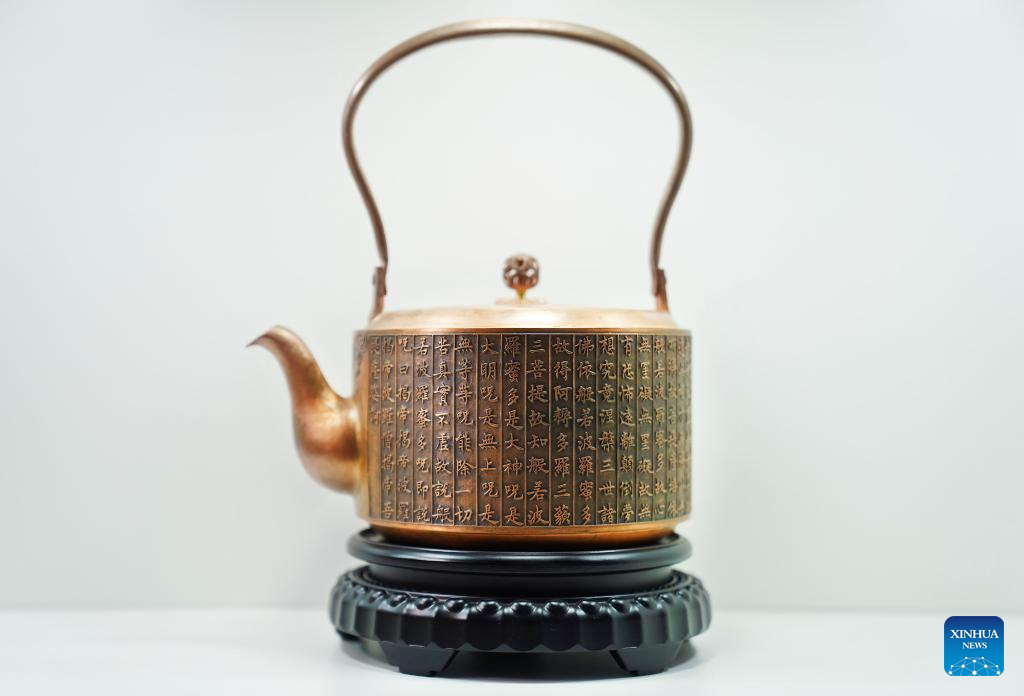
This photo taken on Aug. 9, 2023 shows Huang Junjun's copper engraving teapot displayed at an exhibition hall of his company in Guixi City, east China's Jiangxi Province. Copper engraving, or copper carving, a craft of using knives to carve patterns on copper wares, has a history of about 1,000 years. In 2021, Guixi copper engraving was listed as one of the national-level intangible cultural heritages. The craft needs over 150 different kinds of knives and a dozen of carving skills to create a complete artwork, and the copper ware has to go through over 100,000 times of hammering before being turned into an exquisite artwork. Huang Junjun, 55 years old, is a representative inheritor of Guixi copper engraving, who has been taking the work for 36 years. "My grandpa was a copper ware craftsman, for whom I often acted as an assistant during childhood. I was fascinated with the ancient art," said Huang. As from 1989, he travelled all over the country to seek for masters to study the art, and also worked at factories in Shanghai and Nanchang to sharpen his skills. He also integrated copper engraving methods of Japan and South Korea into his own. "I was thinking during work that if the craft can't be applied to industry, people can't see its value, not to say preserve and inherit it," said Huang Junjun. In 2000, he set up a copper artwork studio, receiving orders from all over the country. For his excellent craftsmanship, Huang won fame in the circle and even received orders from Japan and Singapore. In 2012, with the help of local government of Guixi City, which strove to develop itself under the name of "city of copper", Huang founded the Jiangxi Zhongding metal artwork company. In order to improve the work efficiency, he created a production mode which combines the work of machines with that of craftsmen. Nowadays, Huang Junjun has cultivated over 200 professional craftsmen in copper engraving, and has over 30 artworks honored in various national and provincial exhibitions. His copper artworks are sold worldwide. He is confident in the future of his craft, "I hope my artworks not only embody the ancient styles of handmade metal accessories, but also reflect the aesthetic concepts of modern life, so as to let the art into the daily life of our common people." (Xinhua/Wan Xiang)
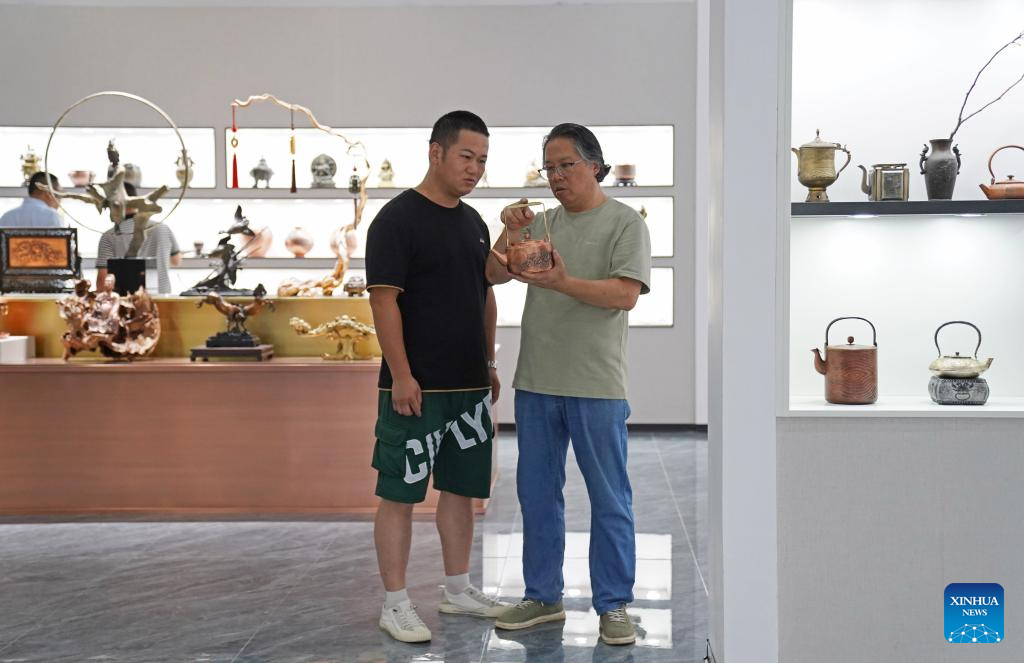
Huang Junjun (R) talks with a visitor at an exhibition hall of copper engraving artworks at his company in Guixi City, east China's Jiangxi Province, Aug. 9, 2023. Copper engraving, or copper carving, a craft of using knives to carve patterns on copper wares, has a history of about 1,000 years. In 2021, Guixi copper engraving was listed as one of the national-level intangible cultural heritages. The craft needs over 150 different kinds of knives and a dozen of carving skills to create a complete artwork, and the copper ware has to go through over 100,000 times of hammering before being turned into an exquisite artwork. Huang Junjun, 55 years old, is a representative inheritor of Guixi copper engraving, who has been taking the work for 36 years. "My grandpa was a copper ware craftsman, for whom I often acted as an assistant during childhood. I was fascinated with the ancient art," said Huang. As from 1989, he travelled all over the country to seek for masters to study the art, and also worked at factories in Shanghai and Nanchang to sharpen his skills. He also integrated copper engraving methods of Japan and South Korea into his own. "I was thinking during work that if the craft can't be applied to industry, people can't see its value, not to say preserve and inherit it," said Huang Junjun. In 2000, he set up a copper artwork studio, receiving orders from all over the country. For his excellent craftsmanship, Huang won fame in the circle and even received orders from Japan and Singapore. In 2012, with the help of local government of Guixi City, which strove to develop itself under the name of "city of copper", Huang founded the Jiangxi Zhongding metal artwork company. In order to improve the work efficiency, he created a production mode which combines the work of machines with that of craftsmen. Nowadays, Huang Junjun has cultivated over 200 professional craftsmen in copper engraving, and has over 30 artworks honored in various national and provincial exhibitions. His copper artworks are sold worldwide. He is confident in the future of his craft, "I hope my artworks not only embody the ancient styles of handmade metal accessories, but also reflect the aesthetic concepts of modern life, so as to let the art into the daily life of our common people." (Xinhua/Wan Xiang)
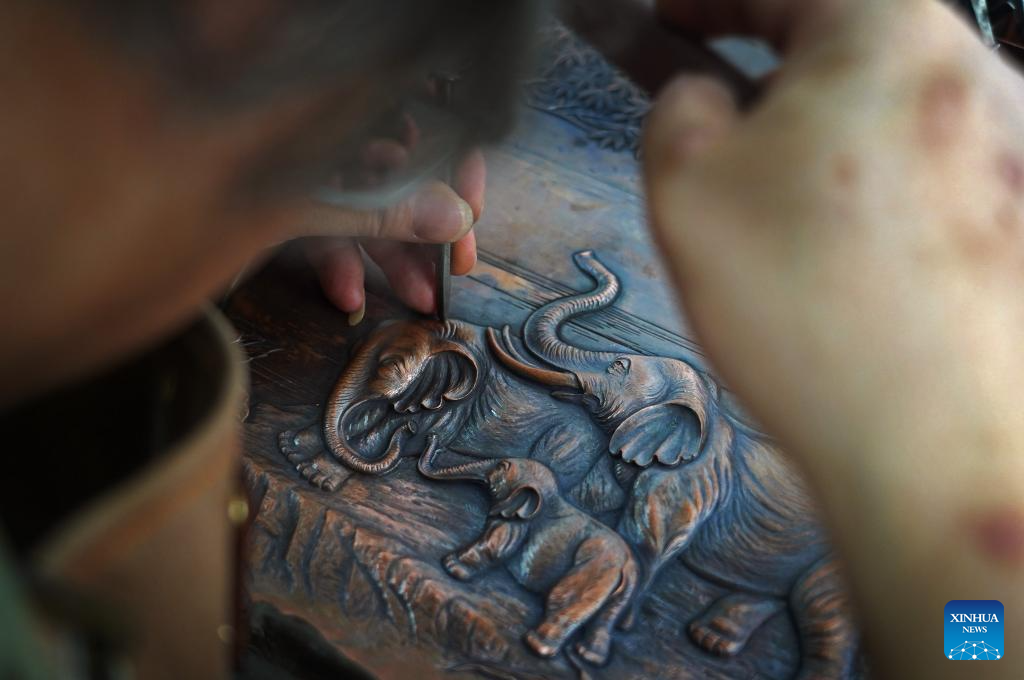
Huang Junjun makes a copper engraving artwork at a workshop of his company in Guixi City, east China's Jiangxi Province, July 13, 2023. Copper engraving, or copper carving, a craft of using knives to carve patterns on copper wares, has a history of about 1,000 years. In 2021, Guixi copper engraving was listed as one of the national-level intangible cultural heritages. The craft needs over 150 different kinds of knives and a dozen of carving skills to create a complete artwork, and the copper ware has to go through over 100,000 times of hammering before being turned into an exquisite artwork. Huang Junjun, 55 years old, is a representative inheritor of Guixi copper engraving, who has been taking the work for 36 years. "My grandpa was a copper ware craftsman, for whom I often acted as an assistant during childhood. I was fascinated with the ancient art," said Huang. As from 1989, he travelled all over the country to seek for masters to study the art, and also worked at factories in Shanghai and Nanchang to sharpen his skills. He also integrated copper engraving methods of Japan and South Korea into his own. "I was thinking during work that if the craft can't be applied to industry, people can't see its value, not to say preserve and inherit it," said Huang Junjun. In 2000, he set up a copper artwork studio, receiving orders from all over the country. For his excellent craftsmanship, Huang won fame in the circle and even received orders from Japan and Singapore. In 2012, with the help of local government of Guixi City, which strove to develop itself under the name of "city of copper", Huang founded the Jiangxi Zhongding metal artwork company. In order to improve the work efficiency, he created a production mode which combines the work of machines with that of craftsmen. Nowadays, Huang Junjun has cultivated over 200 professional craftsmen in copper engraving, and has over 30 artworks honored in various national and provincial exhibitions. His copper artworks are sold worldwide. He is confident in the future of his craft, "I hope my artworks not only embody the ancient styles of handmade metal accessories, but also reflect the aesthetic concepts of modern life, so as to let the art into the daily life of our common people." (Xinhua/Wan Xiang)
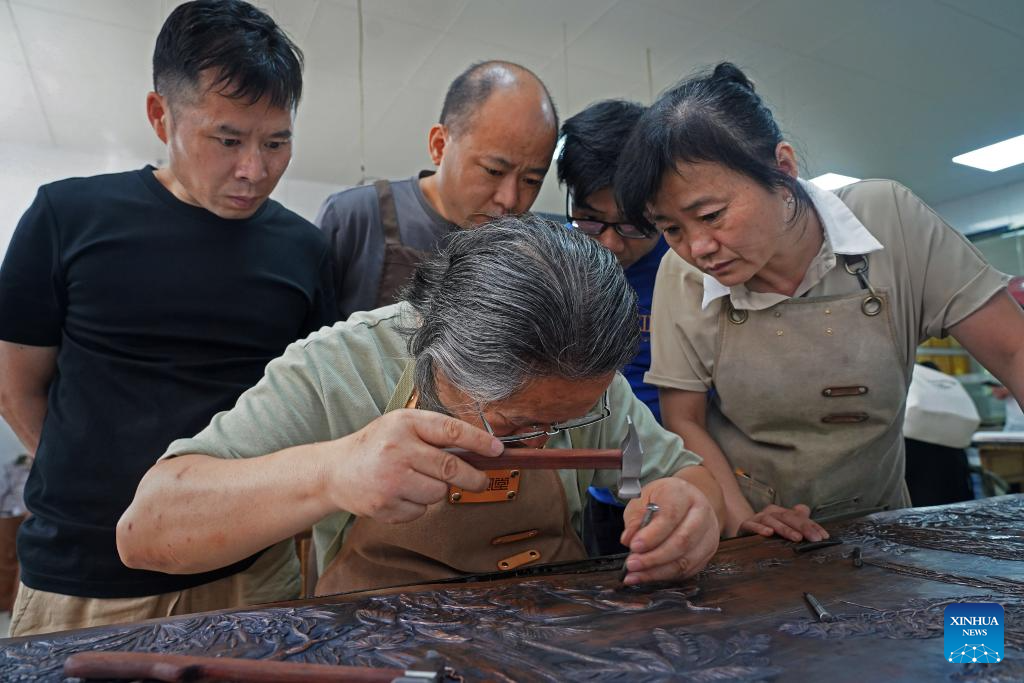
Huang Junjun shows skills of copper engraving to his apprentices at a workshop of his company in Guixi City, east China's Jiangxi Province, July 13, 2023. Copper engraving, or copper carving, a craft of using knives to carve patterns on copper wares, has a history of about 1,000 years. In 2021, Guixi copper engraving was listed as one of the national-level intangible cultural heritages. The craft needs over 150 different kinds of knives and a dozen of carving skills to create a complete artwork, and the copper ware has to go through over 100,000 times of hammering before being turned into an exquisite artwork. Huang Junjun, 55 years old, is a representative inheritor of Guixi copper engraving, who has been taking the work for 36 years. "My grandpa was a copper ware craftsman, for whom I often acted as an assistant during childhood. I was fascinated with the ancient art," said Huang. As from 1989, he travelled all over the country to seek for masters to study the art, and also worked at factories in Shanghai and Nanchang to sharpen his skills. He also integrated copper engraving methods of Japan and South Korea into his own. "I was thinking during work that if the craft can't be applied to industry, people can't see its value, not to say preserve and inherit it," said Huang Junjun. In 2000, he set up a copper artwork studio, receiving orders from all over the country. For his excellent craftsmanship, Huang won fame in the circle and even received orders from Japan and Singapore. In 2012, with the help of local government of Guixi City, which strove to develop itself under the name of "city of copper", Huang founded the Jiangxi Zhongding metal artwork company. In order to improve the work efficiency, he created a production mode which combines the work of machines with that of craftsmen. Nowadays, Huang Junjun has cultivated over 200 professional craftsmen in copper engraving, and has over 30 artworks honored in various national and provincial exhibitions. His copper artworks are sold worldwide. He is confident in the future of his craft, "I hope my artworks not only embody the ancient styles of handmade metal accessories, but also reflect the aesthetic concepts of modern life, so as to let the art into the daily life of our common people." (Xinhua/Wan Xiang)
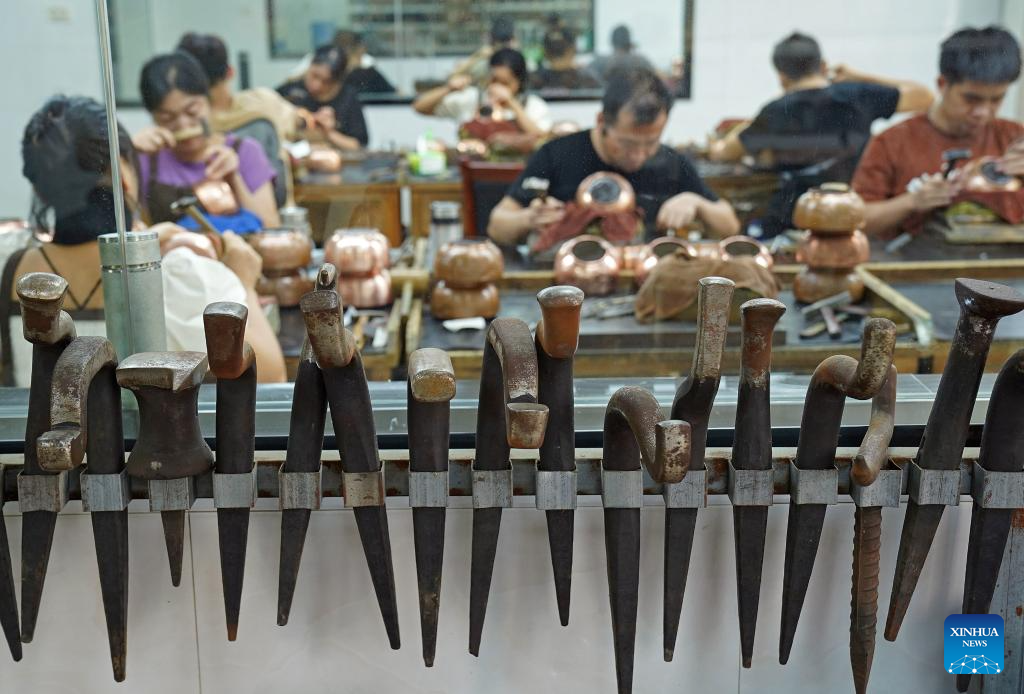
This photo taken on Aug. 9, 2023 shows various iron racks, which are used to hold copper wares while engraving, displayed at Huang Junjun's company in Guixi City, east China's Jiangxi Province. Copper engraving, or copper carving, a craft of using knives to carve patterns on copper wares, has a history of about 1,000 years. In 2021, Guixi copper engraving was listed as one of the national-level intangible cultural heritages. The craft needs over 150 different kinds of knives and a dozen of carving skills to create a complete artwork, and the copper ware has to go through over 100,000 times of hammering before being turned into an exquisite artwork. Huang Junjun, 55 years old, is a representative inheritor of Guixi copper engraving, who has been taking the work for 36 years. "My grandpa was a copper ware craftsman, for whom I often acted as an assistant during childhood. I was fascinated with the ancient art," said Huang. As from 1989, he travelled all over the country to seek for masters to study the art, and also worked at factories in Shanghai and Nanchang to sharpen his skills. He also integrated copper engraving methods of Japan and South Korea into his own. "I was thinking during work that if the craft can't be applied to industry, people can't see its value, not to say preserve and inherit it," said Huang Junjun. In 2000, he set up a copper artwork studio, receiving orders from all over the country. For his excellent craftsmanship, Huang won fame in the circle and even received orders from Japan and Singapore. In 2012, with the help of local government of Guixi City, which strove to develop itself under the name of "city of copper", Huang founded the Jiangxi Zhongding metal artwork company. In order to improve the work efficiency, he created a production mode which combines the work of machines with that of craftsmen. Nowadays, Huang Junjun has cultivated over 200 professional craftsmen in copper engraving, and has over 30 artworks honored in various national and provincial exhibitions. His copper artworks are sold worldwide. He is confident in the future of his craft, "I hope my artworks not only embody the ancient styles of handmade metal accessories, but also reflect the aesthetic concepts of modern life, so as to let the art into the daily life of our common people." (Xinhua/Wan Xiang)
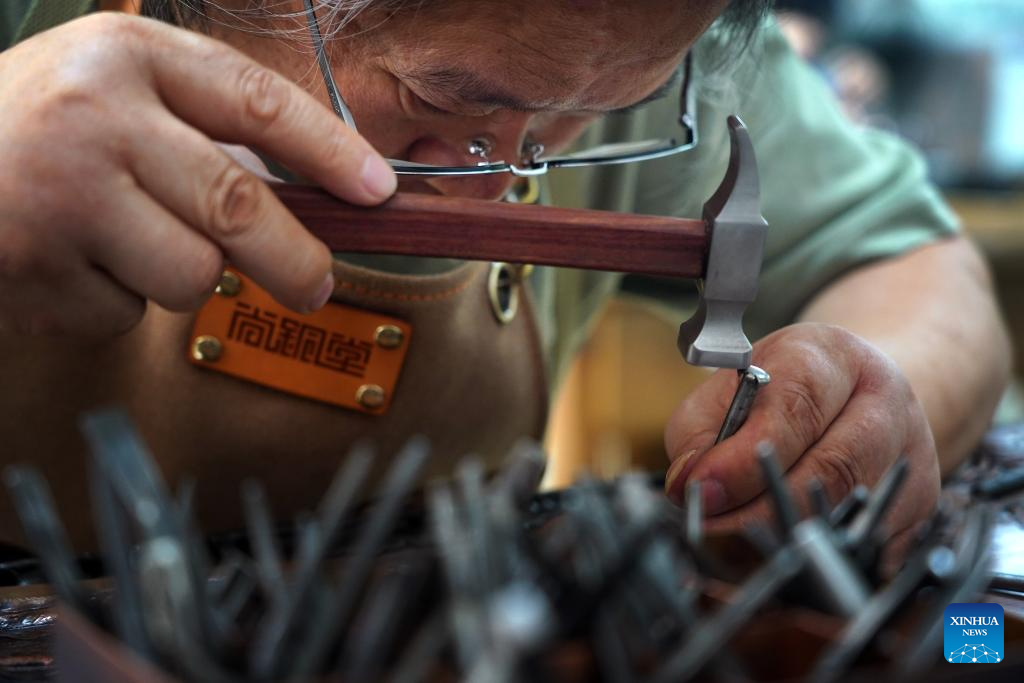
Huang Junjun makes a copper engraving artwork at a workshop of his company in Guixi City, east China's Jiangxi Province, July 13, 2023. Copper engraving, or copper carving, a craft of using knives to carve patterns on copper wares, has a history of about 1,000 years. In 2021, Guixi copper engraving was listed as one of the national-level intangible cultural heritages. The craft needs over 150 different kinds of knives and a dozen of carving skills to create a complete artwork, and the copper ware has to go through over 100,000 times of hammering before being turned into an exquisite artwork. Huang Junjun, 55 years old, is a representative inheritor of Guixi copper engraving, who has been taking the work for 36 years. "My grandpa was a copper ware craftsman, for whom I often acted as an assistant during childhood. I was fascinated with the ancient art," said Huang. As from 1989, he travelled all over the country to seek for masters to study the art, and also worked at factories in Shanghai and Nanchang to sharpen his skills. He also integrated copper engraving methods of Japan and South Korea into his own. "I was thinking during work that if the craft can't be applied to industry, people can't see its value, not to say preserve and inherit it," said Huang Junjun. In 2000, he set up a copper artwork studio, receiving orders from all over the country. For his excellent craftsmanship, Huang won fame in the circle and even received orders from Japan and Singapore. In 2012, with the help of local government of Guixi City, which strove to develop itself under the name of "city of copper", Huang founded the Jiangxi Zhongding metal artwork company. In order to improve the work efficiency, he created a production mode which combines the work of machines with that of craftsmen. Nowadays, Huang Junjun has cultivated over 200 professional craftsmen in copper engraving, and has over 30 artworks honored in various national and provincial exhibitions. His copper artworks are sold worldwide. He is confident in the future of his craft, "I hope my artworks not only embody the ancient styles of handmade metal accessories, but also reflect the aesthetic concepts of modern life, so as to let the art into the daily life of our common people." (Xinhua/Wan Xiang)
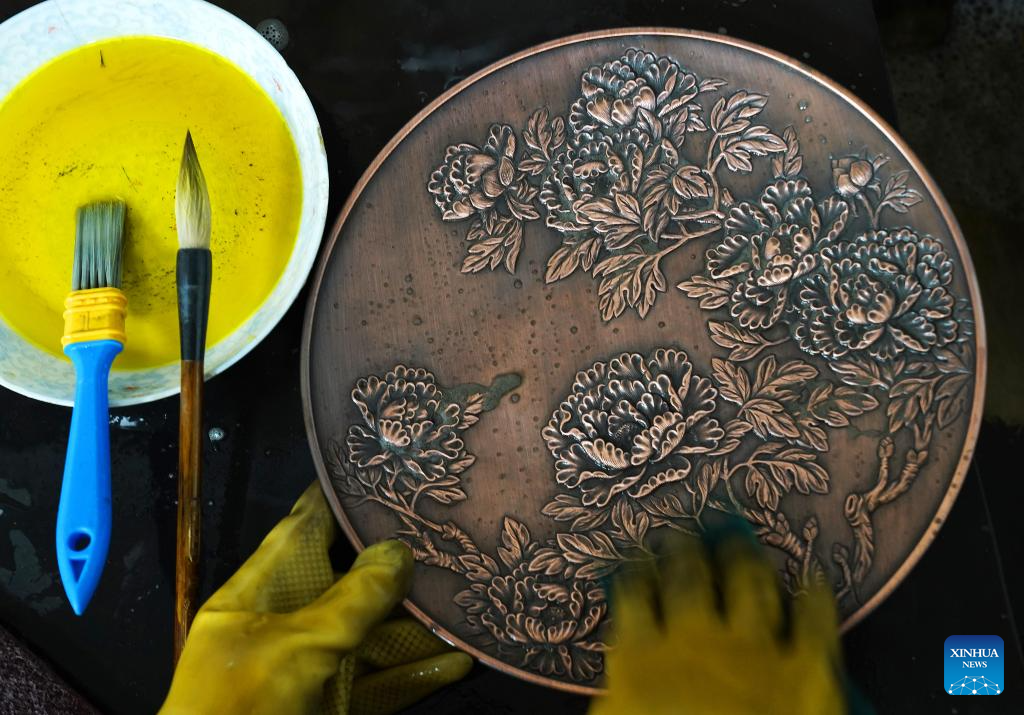
A craftsman tints a copper engraving artwork at Huang Junjun's company in Guixi City, east China's Jiangxi Province, Aug. 9, 2023. Copper engraving, or copper carving, a craft of using knives to carve patterns on copper wares, has a history of about 1,000 years. In 2021, Guixi copper engraving was listed as one of the national-level intangible cultural heritages. The craft needs over 150 different kinds of knives and a dozen of carving skills to create a complete artwork, and the copper ware has to go through over 100,000 times of hammering before being turned into an exquisite artwork. Huang Junjun, 55 years old, is a representative inheritor of Guixi copper engraving, who has been taking the work for 36 years. "My grandpa was a copper ware craftsman, for whom I often acted as an assistant during childhood. I was fascinated with the ancient art," said Huang. As from 1989, he travelled all over the country to seek for masters to study the art, and also worked at factories in Shanghai and Nanchang to sharpen his skills. He also integrated copper engraving methods of Japan and South Korea into his own. "I was thinking during work that if the craft can't be applied to industry, people can't see its value, not to say preserve and inherit it," said Huang Junjun. In 2000, he set up a copper artwork studio, receiving orders from all over the country. For his excellent craftsmanship, Huang won fame in the circle and even received orders from Japan and Singapore. In 2012, with the help of local government of Guixi City, which strove to develop itself under the name of "city of copper", Huang founded the Jiangxi Zhongding metal artwork company. In order to improve the work efficiency, he created a production mode which combines the work of machines with that of craftsmen. Nowadays, Huang Junjun has cultivated over 200 professional craftsmen in copper engraving, and has over 30 artworks honored in various national and provincial exhibitions. His copper artworks are sold worldwide. He is confident in the future of his craft, "I hope my artworks not only embody the ancient styles of handmade metal accessories, but also reflect the aesthetic concepts of modern life, so as to let the art into the daily life of our common people." (Xinhua/Wan Xiang)
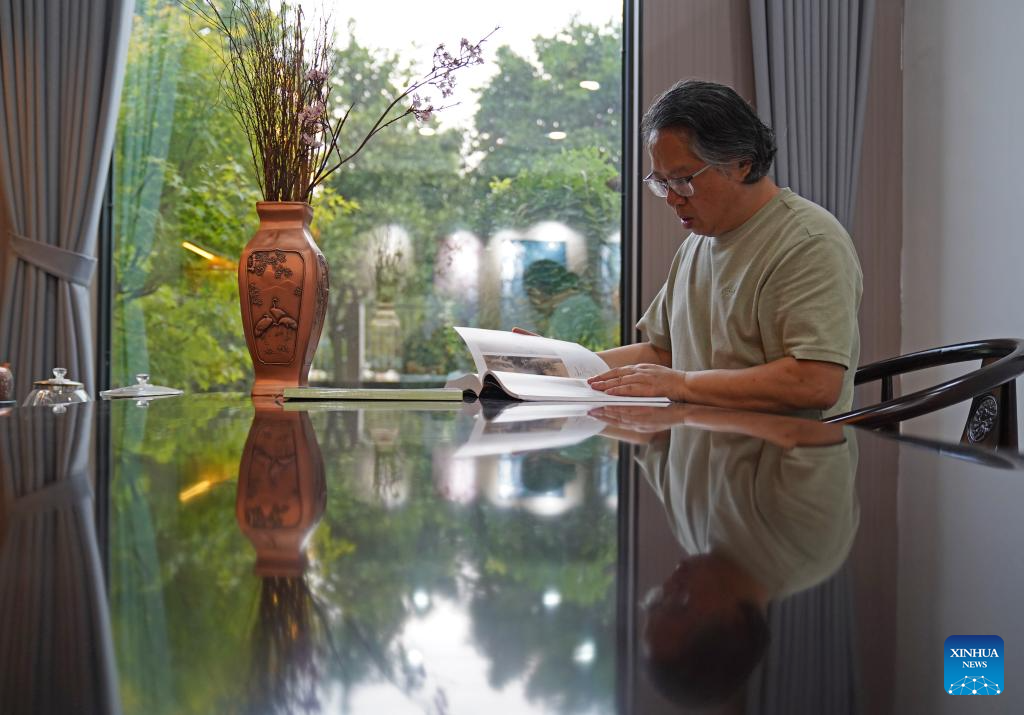
Huang Junjun reads books on arts and crafts at his company in Guixi City, east China's Jiangxi Province, Aug. 9, 2023. Copper engraving, or copper carving, a craft of using knives to carve patterns on copper wares, has a history of about 1,000 years. In 2021, Guixi copper engraving was listed as one of the national-level intangible cultural heritages. The craft needs over 150 different kinds of knives and a dozen of carving skills to create a complete artwork, and the copper ware has to go through over 100,000 times of hammering before being turned into an exquisite artwork. Huang Junjun, 55 years old, is a representative inheritor of Guixi copper engraving, who has been taking the work for 36 years. "My grandpa was a copper ware craftsman, for whom I often acted as an assistant during childhood. I was fascinated with the ancient art," said Huang. As from 1989, he travelled all over the country to seek for masters to study the art, and also worked at factories in Shanghai and Nanchang to sharpen his skills. He also integrated copper engraving methods of Japan and South Korea into his own. "I was thinking during work that if the craft can't be applied to industry, people can't see its value, not to say preserve and inherit it," said Huang Junjun. In 2000, he set up a copper artwork studio, receiving orders from all over the country. For his excellent craftsmanship, Huang won fame in the circle and even received orders from Japan and Singapore. In 2012, with the help of local government of Guixi City, which strove to develop itself under the name of "city of copper", Huang founded the Jiangxi Zhongding metal artwork company. In order to improve the work efficiency, he created a production mode which combines the work of machines with that of craftsmen. Nowadays, Huang Junjun has cultivated over 200 professional craftsmen in copper engraving, and has over 30 artworks honored in various national and provincial exhibitions. His copper artworks are sold worldwide. He is confident in the future of his craft, "I hope my artworks not only embody the ancient styles of handmade metal accessories, but also reflect the aesthetic concepts of modern life, so as to let the art into the daily life of our common people." (Xinhua/Wan Xiang)
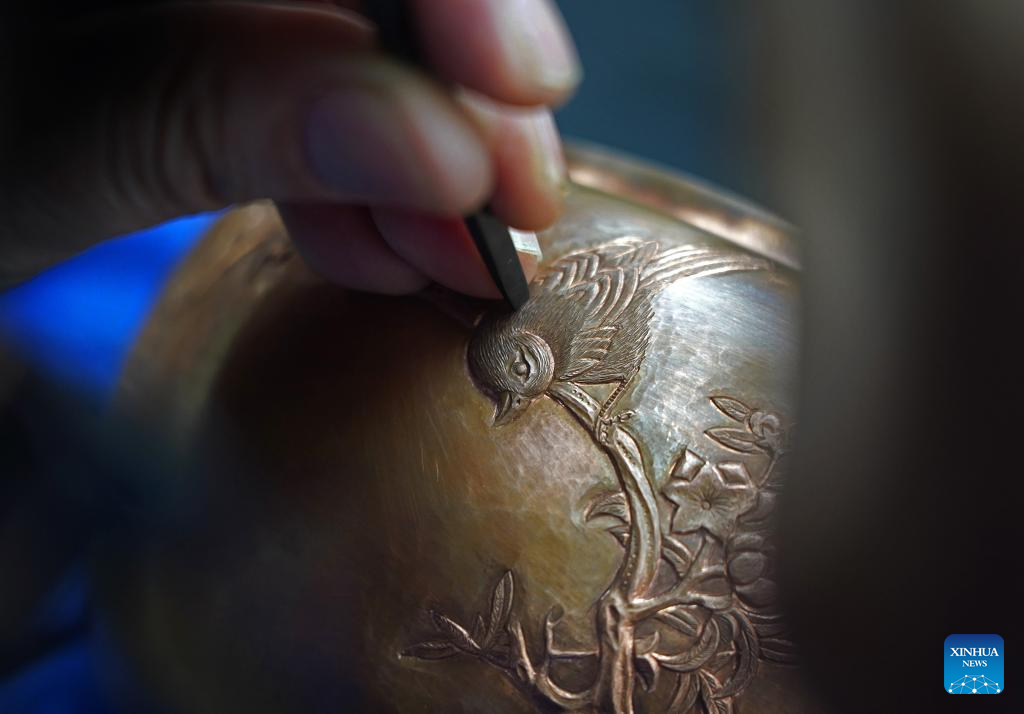
Huang Junjun makes a copper engraving artwork at a workshop of his company in Guixi City, east China's Jiangxi Province, July 13, 2023. Copper engraving, or copper carving, a craft of using knives to carve patterns on copper wares, has a history of about 1,000 years. In 2021, Guixi copper engraving was listed as one of the national-level intangible cultural heritages. The craft needs over 150 different kinds of knives and a dozen of carving skills to create a complete artwork, and the copper ware has to go through over 100,000 times of hammering before being turned into an exquisite artwork. Huang Junjun, 55 years old, is a representative inheritor of Guixi copper engraving, who has been taking the work for 36 years. "My grandpa was a copper ware craftsman, for whom I often acted as an assistant during childhood. I was fascinated with the ancient art," said Huang. As from 1989, he travelled all over the country to seek for masters to study the art, and also worked at factories in Shanghai and Nanchang to sharpen his skills. He also integrated copper engraving methods of Japan and South Korea into his own. "I was thinking during work that if the craft can't be applied to industry, people can't see its value, not to say preserve and inherit it," said Huang Junjun. In 2000, he set up a copper artwork studio, receiving orders from all over the country. For his excellent craftsmanship, Huang won fame in the circle and even received orders from Japan and Singapore. In 2012, with the help of local government of Guixi City, which strove to develop itself under the name of "city of copper", Huang founded the Jiangxi Zhongding metal artwork company. In order to improve the work efficiency, he created a production mode which combines the work of machines with that of craftsmen. Nowadays, Huang Junjun has cultivated over 200 professional craftsmen in copper engraving, and has over 30 artworks honored in various national and provincial exhibitions. His copper artworks are sold worldwide. He is confident in the future of his craft, "I hope my artworks not only embody the ancient styles of handmade metal accessories, but also reflect the aesthetic concepts of modern life, so as to let the art into the daily life of our common people." (Xinhua/Wan Xiang)
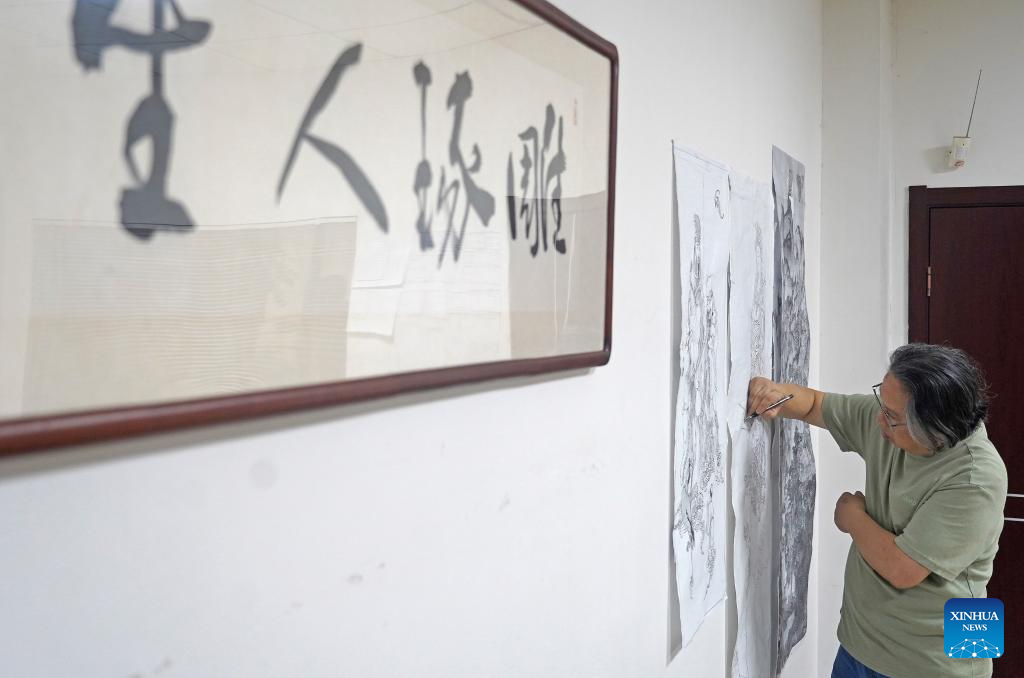
Huang Junjun draws draft of a copper engraving artwork at his studio in Guixi City, east China's Jiangxi Province, July 13, 2023. Copper engraving, or copper carving, a craft of using knives to carve patterns on copper wares, has a history of about 1,000 years. In 2021, Guixi copper engraving was listed as one of the national-level intangible cultural heritages. The craft needs over 150 different kinds of knives and a dozen of carving skills to create a complete artwork, and the copper ware has to go through over 100,000 times of hammering before being turned into an exquisite artwork. Huang Junjun, 55 years old, is a representative inheritor of Guixi copper engraving, who has been taking the work for 36 years. "My grandpa was a copper ware craftsman, for whom I often acted as an assistant during childhood. I was fascinated with the ancient art," said Huang. As from 1989, he travelled all over the country to seek for masters to study the art, and also worked at factories in Shanghai and Nanchang to sharpen his skills. He also integrated copper engraving methods of Japan and South Korea into his own. "I was thinking during work that if the craft can't be applied to industry, people can't see its value, not to say preserve and inherit it," said Huang Junjun. In 2000, he set up a copper artwork studio, receiving orders from all over the country. For his excellent craftsmanship, Huang won fame in the circle and even received orders from Japan and Singapore. In 2012, with the help of local government of Guixi City, which strove to develop itself under the name of "city of copper", Huang founded the Jiangxi Zhongding metal artwork company. In order to improve the work efficiency, he created a production mode which combines the work of machines with that of craftsmen. Nowadays, Huang Junjun has cultivated over 200 professional craftsmen in copper engraving, and has over 30 artworks honored in various national and provincial exhibitions. His copper artworks are sold worldwide. He is confident in the future of his craft, "I hope my artworks not only embody the ancient styles of handmade metal accessories, but also reflect the aesthetic concepts of modern life, so as to let the art into the daily life of our common people." (Xinhua/Wan Xiang)
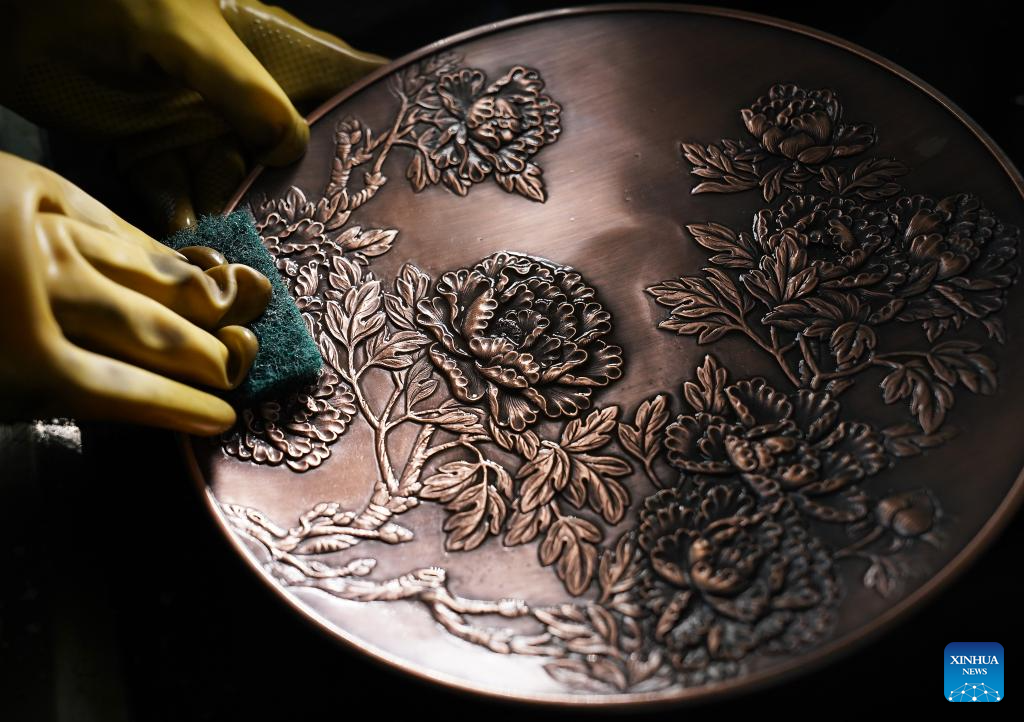
A craftsman tints a copper engraving artwork at Huang Junjun's company in Guixi City, east China's Jiangxi Province, Aug. 9, 2023. Copper engraving, or copper carving, a craft of using knives to carve patterns on copper wares, has a history of about 1,000 years. In 2021, Guixi copper engraving was listed as one of the national-level intangible cultural heritages. The craft needs over 150 different kinds of knives and a dozen of carving skills to create a complete artwork, and the copper ware has to go through over 100,000 times of hammering before being turned into an exquisite artwork. Huang Junjun, 55 years old, is a representative inheritor of Guixi copper engraving, who has been taking the work for 36 years. "My grandpa was a copper ware craftsman, for whom I often acted as an assistant during childhood. I was fascinated with the ancient art," said Huang. As from 1989, he travelled all over the country to seek for masters to study the art, and also worked at factories in Shanghai and Nanchang to sharpen his skills. He also integrated copper engraving methods of Japan and South Korea into his own. "I was thinking during work that if the craft can't be applied to industry, people can't see its value, not to say preserve and inherit it," said Huang Junjun. In 2000, he set up a copper artwork studio, receiving orders from all over the country. For his excellent craftsmanship, Huang won fame in the circle and even received orders from Japan and Singapore. In 2012, with the help of local government of Guixi City, which strove to develop itself under the name of "city of copper", Huang founded the Jiangxi Zhongding metal artwork company. In order to improve the work efficiency, he created a production mode which combines the work of machines with that of craftsmen. Nowadays, Huang Junjun has cultivated over 200 professional craftsmen in copper engraving, and has over 30 artworks honored in various national and provincial exhibitions. His copper artworks are sold worldwide. He is confident in the future of his craft, "I hope my artworks not only embody the ancient styles of handmade metal accessories, but also reflect the aesthetic concepts of modern life, so as to let the art into the daily life of our common people." (Xinhua/Wan Xiang)
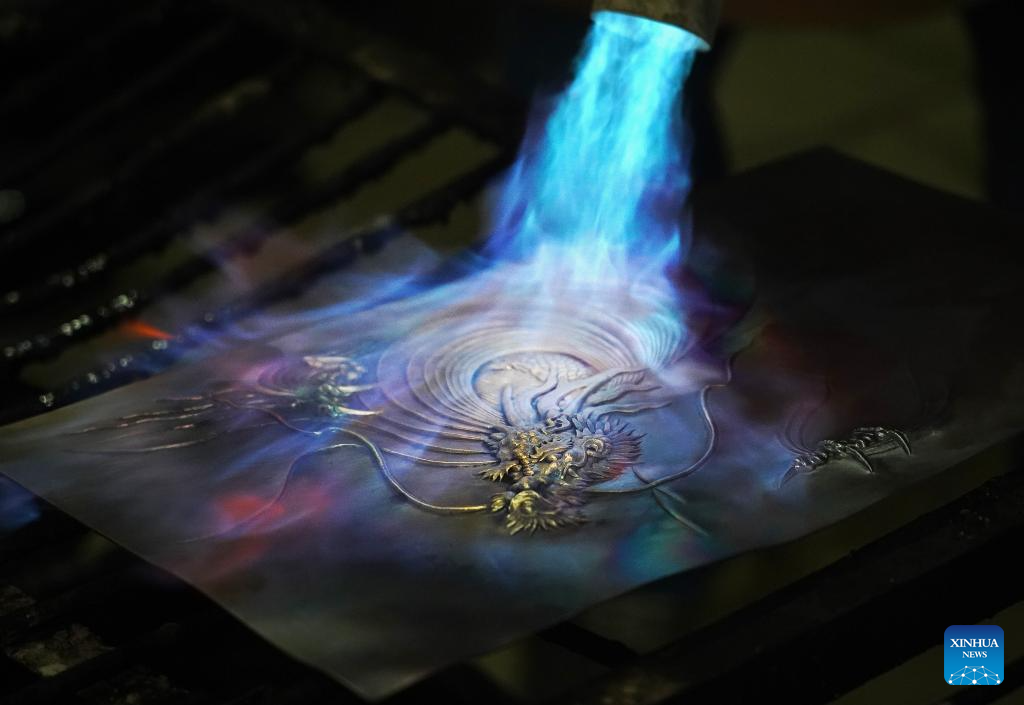
Huang Junjun quenches a copper engraving artwork at a workshop of his company in Guixi City, east China's Jiangxi Province, July 13, 2023. Copper engraving, or copper carving, a craft of using knives to carve patterns on copper wares, has a history of about 1,000 years. In 2021, Guixi copper engraving was listed as one of the national-level intangible cultural heritages. The craft needs over 150 different kinds of knives and a dozen of carving skills to create a complete artwork, and the copper ware has to go through over 100,000 times of hammering before being turned into an exquisite artwork. Huang Junjun, 55 years old, is a representative inheritor of Guixi copper engraving, who has been taking the work for 36 years. "My grandpa was a copper ware craftsman, for whom I often acted as an assistant during childhood. I was fascinated with the ancient art," said Huang. As from 1989, he travelled all over the country to seek for masters to study the art, and also worked at factories in Shanghai and Nanchang to sharpen his skills. He also integrated copper engraving methods of Japan and South Korea into his own. "I was thinking during work that if the craft can't be applied to industry, people can't see its value, not to say preserve and inherit it," said Huang Junjun. In 2000, he set up a copper artwork studio, receiving orders from all over the country. For his excellent craftsmanship, Huang won fame in the circle and even received orders from Japan and Singapore. In 2012, with the help of local government of Guixi City, which strove to develop itself under the name of "city of copper", Huang founded the Jiangxi Zhongding metal artwork company. In order to improve the work efficiency, he created a production mode which combines the work of machines with that of craftsmen. Nowadays, Huang Junjun has cultivated over 200 professional craftsmen in copper engraving, and has over 30 artworks honored in various national and provincial exhibitions. His copper artworks are sold worldwide. He is confident in the future of his craft, "I hope my artworks not only embody the ancient styles of handmade metal accessories, but also reflect the aesthetic concepts of modern life, so as to let the art into the daily life of our common people." (Xinhua/Wan Xiang)
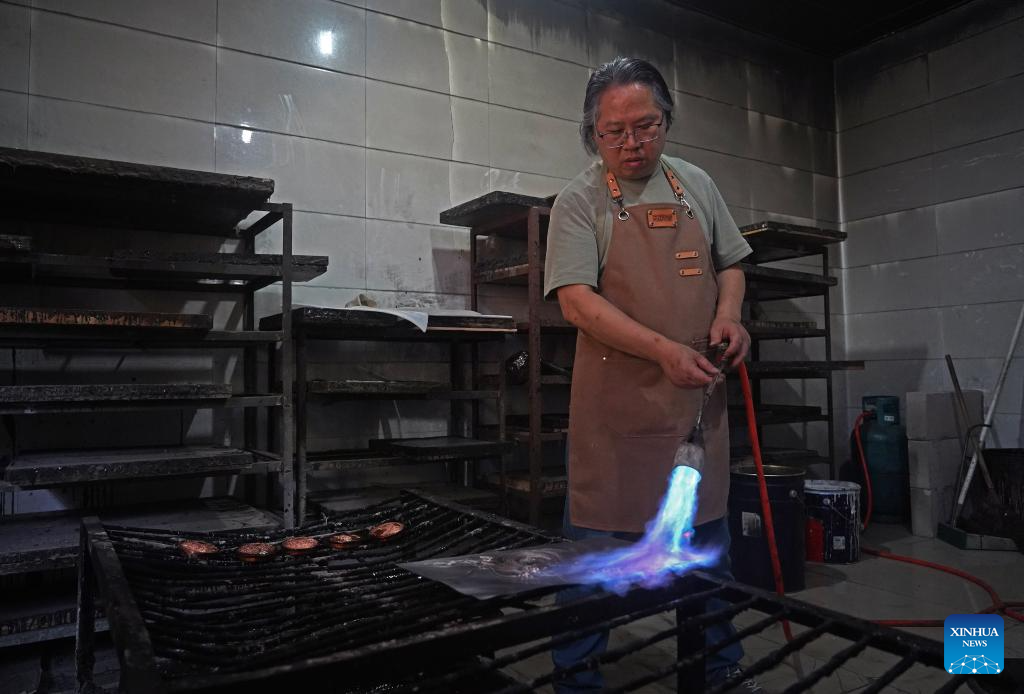
Huang Junjun quenches a copper engraving artwork at a workshop of his company in Guixi City, east China's Jiangxi Province, July 13, 2023. Copper engraving, or copper carving, a craft of using knives to carve patterns on copper wares, has a history of about 1,000 years. In 2021, Guixi copper engraving was listed as one of the national-level intangible cultural heritages. The craft needs over 150 different kinds of knives and a dozen of carving skills to create a complete artwork, and the copper ware has to go through over 100,000 times of hammering before being turned into an exquisite artwork. Huang Junjun, 55 years old, is a representative inheritor of Guixi copper engraving, who has been taking the work for 36 years. "My grandpa was a copper ware craftsman, for whom I often acted as an assistant during childhood. I was fascinated with the ancient art," said Huang. As from 1989, he travelled all over the country to seek for masters to study the art, and also worked at factories in Shanghai and Nanchang to sharpen his skills. He also integrated copper engraving methods of Japan and South Korea into his own. "I was thinking during work that if the craft can't be applied to industry, people can't see its value, not to say preserve and inherit it," said Huang Junjun. In 2000, he set up a copper artwork studio, receiving orders from all over the country. For his excellent craftsmanship, Huang won fame in the circle and even received orders from Japan and Singapore. In 2012, with the help of local government of Guixi City, which strove to develop itself under the name of "city of copper", Huang founded the Jiangxi Zhongding metal artwork company. In order to improve the work efficiency, he created a production mode which combines the work of machines with that of craftsmen. Nowadays, Huang Junjun has cultivated over 200 professional craftsmen in copper engraving, and has over 30 artworks honored in various national and provincial exhibitions. His copper artworks are sold worldwide. He is confident in the future of his craft, "I hope my artworks not only embody the ancient styles of handmade metal accessories, but also reflect the aesthetic concepts of modern life, so as to let the art into the daily life of our common people." (Xinhua/Wan Xiang)
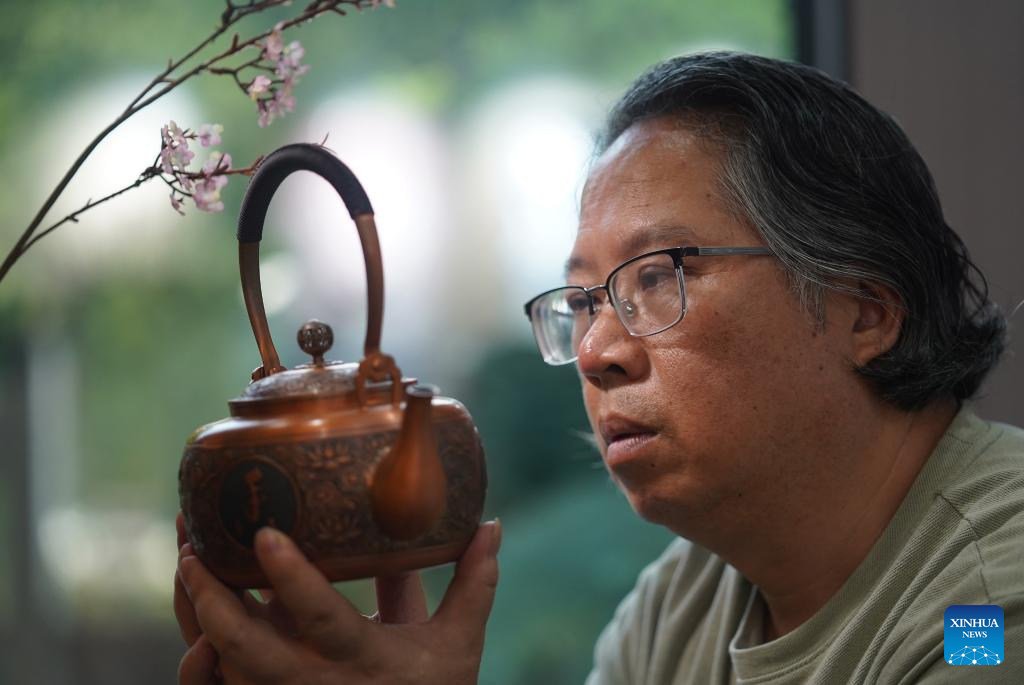
Huang Junjun watches a copper engraving teapot at his company in Guixi City, east China's Jiangxi Province, Aug. 9, 2023. Copper engraving, or copper carving, a craft of using knives to carve patterns on copper wares, has a history of about 1,000 years. In 2021, Guixi copper engraving was listed as one of the national-level intangible cultural heritages. The craft needs over 150 different kinds of knives and a dozen of carving skills to create a complete artwork, and the copper ware has to go through over 100,000 times of hammering before being turned into an exquisite artwork. Huang Junjun, 55 years old, is a representative inheritor of Guixi copper engraving, who has been taking the work for 36 years. "My grandpa was a copper ware craftsman, for whom I often acted as an assistant during childhood. I was fascinated with the ancient art," said Huang. As from 1989, he travelled all over the country to seek for masters to study the art, and also worked at factories in Shanghai and Nanchang to sharpen his skills. He also integrated copper engraving methods of Japan and South Korea into his own. "I was thinking during work that if the craft can't be applied to industry, people can't see its value, not to say preserve and inherit it," said Huang Junjun. In 2000, he set up a copper artwork studio, receiving orders from all over the country. For his excellent craftsmanship, Huang won fame in the circle and even received orders from Japan and Singapore. In 2012, with the help of local government of Guixi City, which strove to develop itself under the name of "city of copper", Huang founded the Jiangxi Zhongding metal artwork company. In order to improve the work efficiency, he created a production mode which combines the work of machines with that of craftsmen. Nowadays, Huang Junjun has cultivated over 200 professional craftsmen in copper engraving, and has over 30 artworks honored in various national and provincial exhibitions. His copper artworks are sold worldwide. He is confident in the future of his craft, "I hope my artworks not only embody the ancient styles of handmade metal accessories, but also reflect the aesthetic concepts of modern life, so as to let the art into the daily life of our common people." (Xinhua/Wan Xiang)
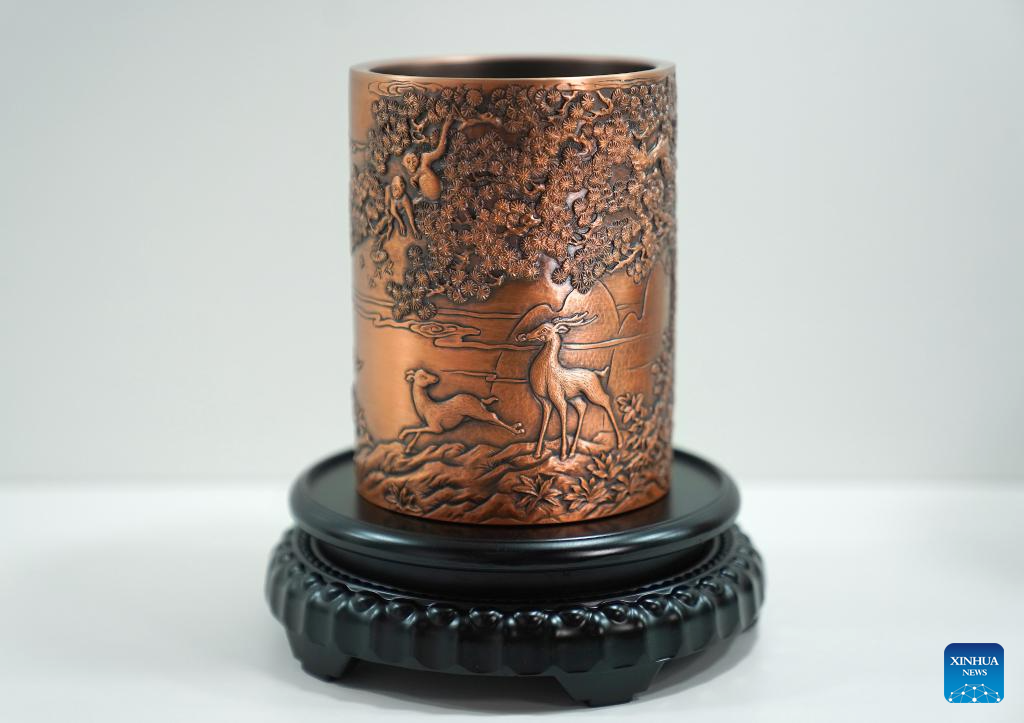
This photo taken on Aug. 9, 2023 shows Huang Junjun's copper engraving pen pot displayed at an exhibition hall of his company in Guixi City, east China's Jiangxi Province. Copper engraving, or copper carving, a craft of using knives to carve patterns on copper wares, has a history of about 1,000 years. In 2021, Guixi copper engraving was listed as one of the national-level intangible cultural heritages. The craft needs over 150 different kinds of knives and a dozen of carving skills to create a complete artwork, and the copper ware has to go through over 100,000 times of hammering before being turned into an exquisite artwork. Huang Junjun, 55 years old, is a representative inheritor of Guixi copper engraving, who has been taking the work for 36 years. "My grandpa was a copper ware craftsman, for whom I often acted as an assistant during childhood. I was fascinated with the ancient art," said Huang. As from 1989, he travelled all over the country to seek for masters to study the art, and also worked at factories in Shanghai and Nanchang to sharpen his skills. He also integrated copper engraving methods of Japan and South Korea into his own. "I was thinking during work that if the craft can't be applied to industry, people can't see its value, not to say preserve and inherit it," said Huang Junjun. In 2000, he set up a copper artwork studio, receiving orders from all over the country. For his excellent craftsmanship, Huang won fame in the circle and even received orders from Japan and Singapore. In 2012, with the help of local government of Guixi City, which strove to develop itself under the name of "city of copper", Huang founded the Jiangxi Zhongding metal artwork company. In order to improve the work efficiency, he created a production mode which combines the work of machines with that of craftsmen. Nowadays, Huang Junjun has cultivated over 200 professional craftsmen in copper engraving, and has over 30 artworks honored in various national and provincial exhibitions. His copper artworks are sold worldwide. He is confident in the future of his craft, "I hope my artworks not only embody the ancient styles of handmade metal accessories, but also reflect the aesthetic concepts of modern life, so as to let the art into the daily life of our common people." (Xinhua/Wan Xiang)
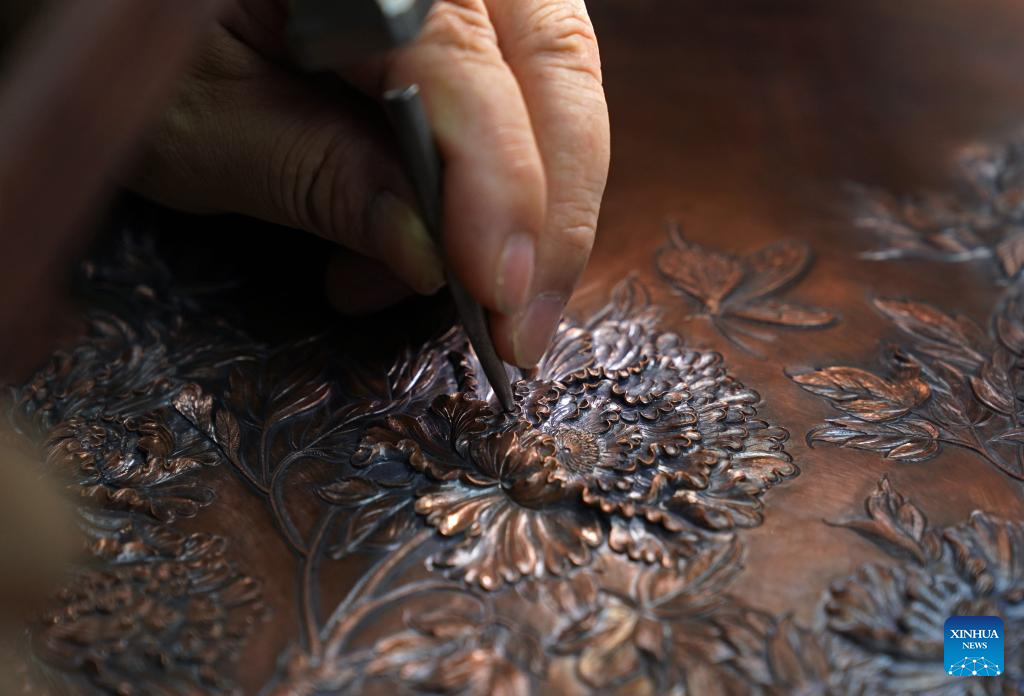
Huang Junjun makes a copper engraving artwork at a workshop of his company in Guixi City, east China's Jiangxi Province, Aug. 9, 2023. Copper engraving, or copper carving, a craft of using knives to carve patterns on copper wares, has a history of about 1,000 years. In 2021, Guixi copper engraving was listed as one of the national-level intangible cultural heritages. The craft needs over 150 different kinds of knives and a dozen of carving skills to create a complete artwork, and the copper ware has to go through over 100,000 times of hammering before being turned into an exquisite artwork. Huang Junjun, 55 years old, is a representative inheritor of Guixi copper engraving, who has been taking the work for 36 years. "My grandpa was a copper ware craftsman, for whom I often acted as an assistant during childhood. I was fascinated with the ancient art," said Huang. As from 1989, he travelled all over the country to seek for masters to study the art, and also worked at factories in Shanghai and Nanchang to sharpen his skills. He also integrated copper engraving methods of Japan and South Korea into his own. "I was thinking during work that if the craft can't be applied to industry, people can't see its value, not to say preserve and inherit it," said Huang Junjun. In 2000, he set up a copper artwork studio, receiving orders from all over the country. For his excellent craftsmanship, Huang won fame in the circle and even received orders from Japan and Singapore. In 2012, with the help of local government of Guixi City, which strove to develop itself under the name of "city of copper", Huang founded the Jiangxi Zhongding metal artwork company. In order to improve the work efficiency, he created a production mode which combines the work of machines with that of craftsmen. Nowadays, Huang Junjun has cultivated over 200 professional craftsmen in copper engraving, and has over 30 artworks honored in various national and provincial exhibitions. His copper artworks are sold worldwide. He is confident in the future of his craft, "I hope my artworks not only embody the ancient styles of handmade metal accessories, but also reflect the aesthetic concepts of modern life, so as to let the art into the daily life of our common people." (Xinhua/Wan Xiang)


