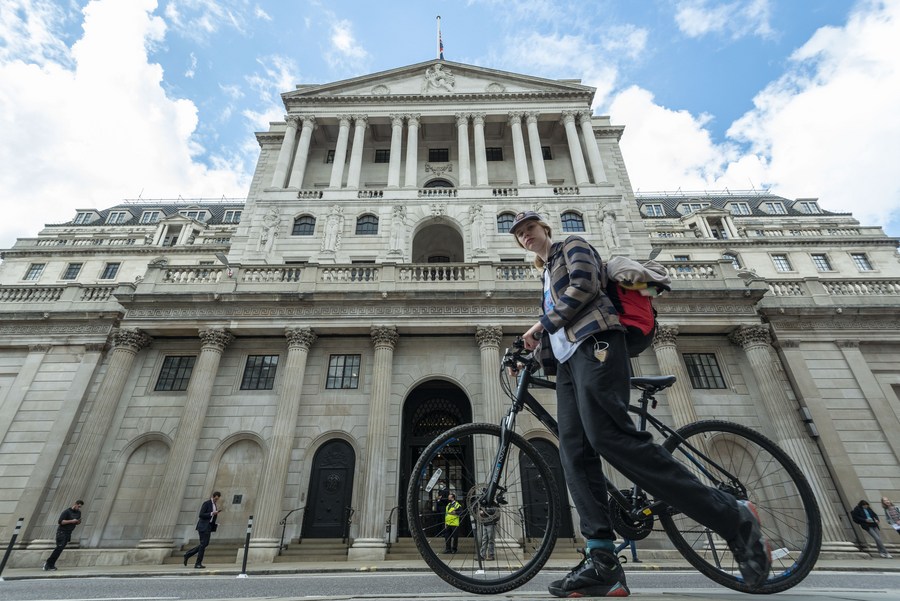
A woman walks past the Bank of England in London, Britain, on April 13, 2022. (Photo by Stephen Chung/Xinhua)
The impact on financial markets is going to be relatively minor because the rate hike was long overdue, while the impact on households that are exposed to burdens like high levels of mortgage debt on home loans will be quite substantial, the professor noted.
LONDON, Aug. 4 (Xinhua) -- The decision by the Bank of England (BoE) to raise Britain's interest rate to 5.25 percent on Thursday should have been made months ago, academic economist John Bryson told Xinhua.
Professor Bryson, chair in Enterprise and Economic Geography at Birmingham Business School of the University of Birmingham, made such comments in an exclusive interview with Xinhua after the BoE increased its benchmark interest rate by 0.25 percentage points.
The central bank made the 14th consecutive rate hike since December 2021 to battle stubbornly high inflation across the United Kingdom (UK).
The BoE's decision was very much expected, said Bryson. "It's a significant move in an upward direction."
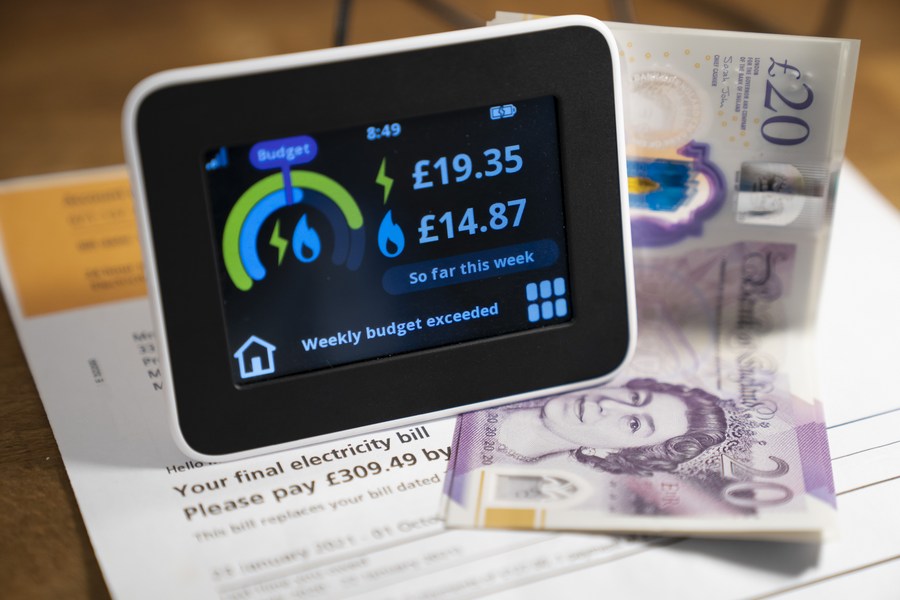
An energy meter, an electricity bill and some notes are seen in a family in Manchester, Britain, March 18, 2022. (Photo by Jon Super/Xinhua)
However, the impact on financial markets is going to be relatively minor because the move was long overdue, while the impact on households that are exposed to burdens like high levels of mortgage debt on home loans will be quite substantial, the professor noted.
The UK has been in the grip of high inflation for more than a year. Its Consumer Price Index (CPI) rose by 7.9 percent in the 12 months to June, far above BoE's 2 percent target. Inflation has begun to fall, but it is still too high, said the BoE.
The signs of the UK economy are quite complex to read for the moment, which led to a very divided committee on the rate decision, said Bryson.
In BoE's nine-member Monetary Policy Committee, two voted for a half-point hike, one wanted no change, while the remaining six were in the majority and voted for the quarter-point increase.
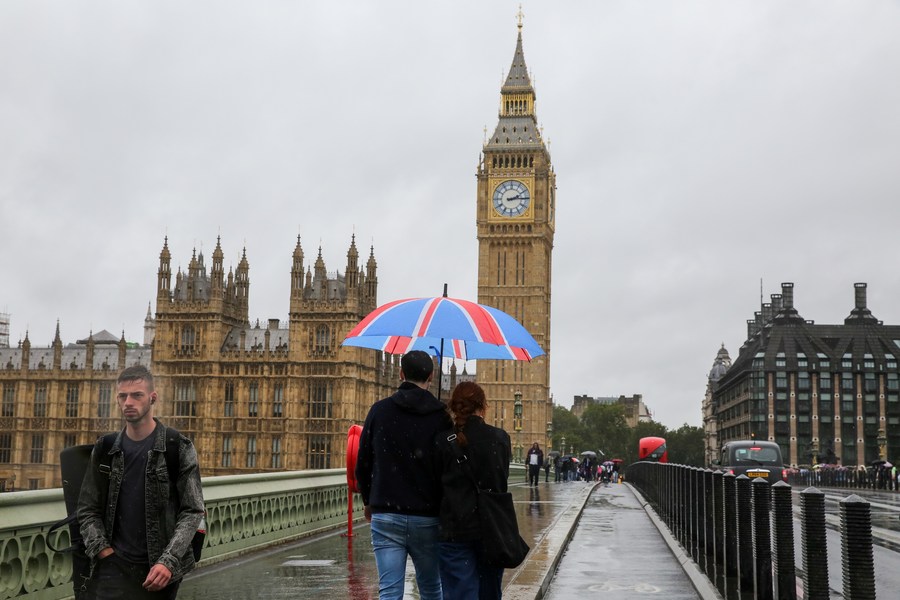
A couple shelters from the rain on Westminster Bridge in London, Britain, on Aug. 2, 2023. (Xinhua)
"Now, one can always argue with the Bank of England that they're being too conservative. And by being too conservative, what I would mean by that is that interest rates should have been much higher much earlier," said Bryson.
The scholar said the 5.25 percent level that was announced on Thursday should have come in perhaps two months ago rather than now, and then that might have had a greater impact on the soaring inflation.
The BoE forecast UK inflation rate to fall to around 5 percent by the end of the year but also warned that high interest rates may last longer than expected.
Bryson stressed that the key problem the UK faces, just like many other countries do, is controlling inflation and people will have to live with that level of interest rates for a long period. "Life will be harder, and life will be more difficult," he said.
But Bryson also noted some of the inflationary pressures the UK is facing are not within the country.
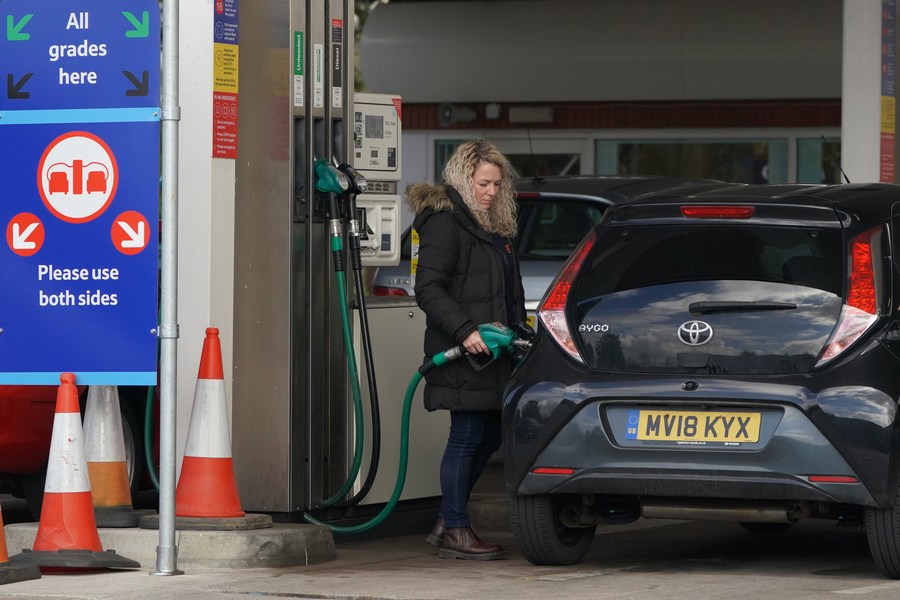
A woman fills up a vehicle at a petrol station in Manchester, Britain, on April 13, 2022. (Photo by Jon Super/Xinhua)
"Things like energy inflation linked to Russia and Ukraine, wheat, grain inflation we're going to see with the Black Sea grain deal being stopped -- all of that are outside the control of the UK government, but will reflect perhaps on UK inflationary pressures," said Bryson.
Referring to the next BoE meeting on interest rates in early fall, Bryson said the key is the upcoming inflation figures. "I would assume that there may be a threshold of 6 percent. Interest rates may not go beyond 6 percent in the UK," said the economist. ■