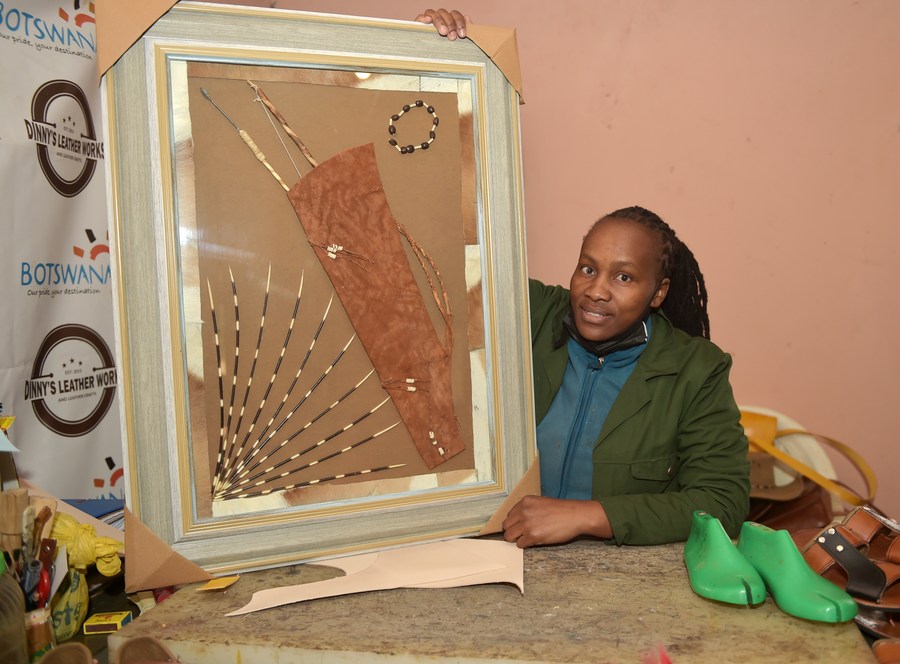
Dineo Gobatilwe, founder of Dinny Leather Works, displays a leather product framed for hanging on the wall in Palapye, Botswana, on July 20, 2023. (Photo by Tshekiso Tebalo/Xinhua)
Botswana, with a cattle population about 2.1 million, has an abundance of raw hides and skins. One small business owner has discovered a niche in the market in producing finished leather products.
GABORONE, July 28 (Xinhua) -- In the vast landscapes of Botswana, where the cattle population is estimated at 2.1 million, and raw hides and skins are abundant, one small business owner has discovered a niche in the market in producing finished leather products.
Based in Palapye, about 270 km from Gaborone, the capital of Botswana, Dineo Gobatilwe, a 34-year-old mother of two, operates a leather works company named Dinny Leather Works that produces goods such as school shoes, sandals, belts, hats, and leather frames.
In 2014, the company was created with government financial support of 98,000 Botswana pula (7,504 U.S. dollars). Gobatilwe has since bought equipment from China and deployed the machinery for manufacturing.
In an interview with Xinhua, Gobatilwe said she chose to pursue leather works after noticing a gap in the leather industry.
"I wanted to be unique because only Pilane leatherworks and the Basarwa tribe were involved in making traditional leather products, so I decided to combine Pilane and Basarwa skills to make modern products," she said.
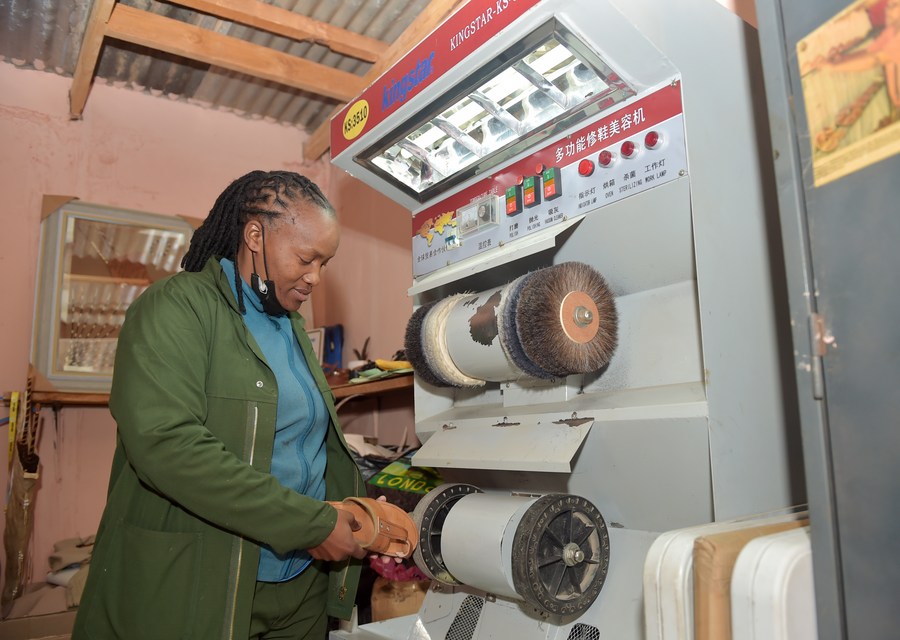
Dineo Gobatilwe, founder of Dinny Leather Works, operates a leather-processing machine she bought from China in Palapye, Botswana, on July 20, 2023. (Photo by Tshekiso Tebalo/Xinhua)
To make better products, Gobatilwe uses vegetable-tanned leather, which is known for its natural feel, sweet scent, patina over time, and toughness. And she picks the right leather without cracks. "That's why my products look quality and last longer."
Gobatilwe studied fashion design in Limkokwing University, which has a presence across Africa, Europe, and Asia.
Her company, which has three workers, is able to sustain itself through a partnership with Palapye District Council, where she provides more than 500 pairs of shoes to orphans and underprivileged students in the Palapye region and surrounding areas.
While the local market is promising, Gobatilwe already has her sights set on the international market.
"I've had the opportunity to go to Dubai to exhibit my products. I also work with the Botswana Investment and Trade Center and participated in their workshop," she said.
Her firm also received support from the Visual Arts Office with the Ministry of Youth, Gender, Sports, and Culture.
However, Gobatilwe said, running a leather company in Botswana is not without difficulties. Even though the country produces about 300,000 hides each year, it does not have the means to process its hides into fine leather.
Botswana sells 50 percent of its raw hides and 100 percent of its raw skins, with half of the hides treated to wet-blue (moist chrome-tanned leather), according to Botswana Meat Commission.
Despite the difficulties, Gobatilwe has capitalized on the tremendous opportunity given by the local cattle and leather industries and helped to contribute to Botswana's economy by seizing the potential in both local and export markets.
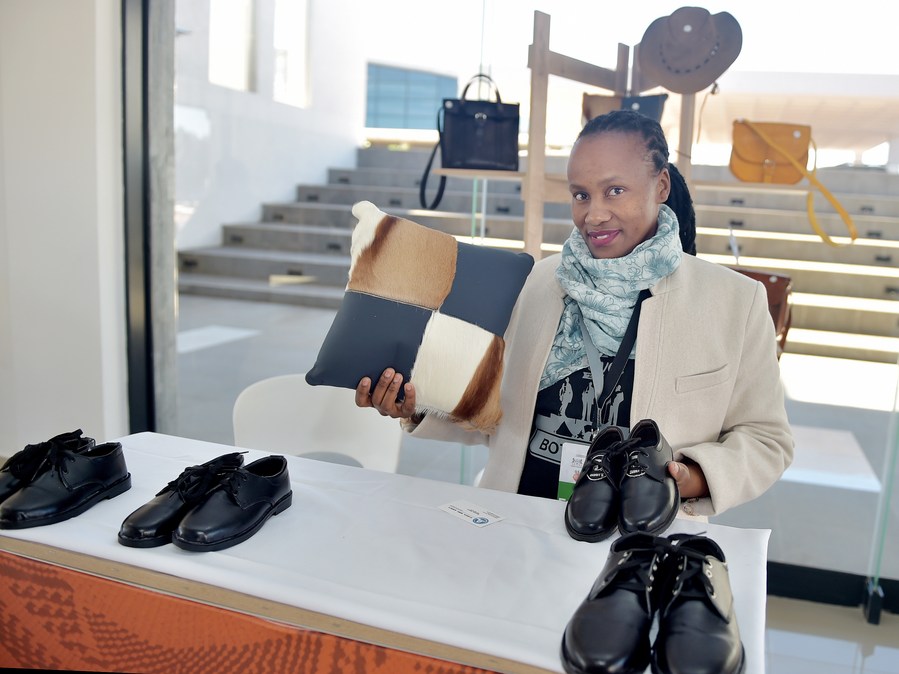
Dineo Gobatilwe, founder of Dinny Leather Works, showcases leather products in Tlokweng, some 5.9 km from Gaborone, Botswana, on July 12, 2023. (Photo by Tshekiso Tebalo/Xinhua)
The Botswanan government has taken steps to help small enterprises in the industry, providing financial assistance, training, and advice on market access, best practices and export laws, according to the Ministry of Investment, Trade and Industry.
Botswana intends to establish a thriving leather cluster, beginning with the construction of a leather park in Lobatse, a town 72 km southeast of Gaborone, the ministry said. ■