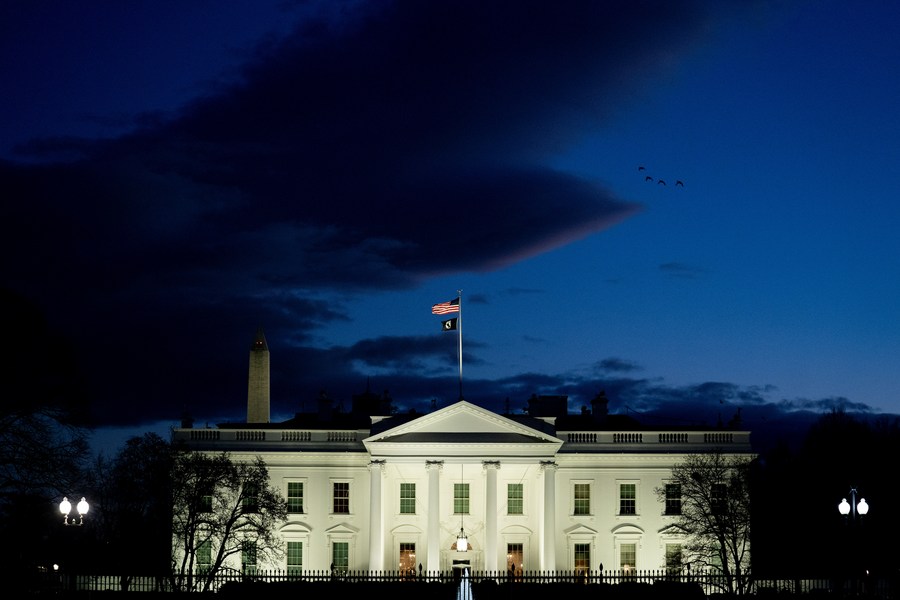
This photo taken on Jan. 20, 2023 shows the White House in Washington, D.C., the United States. (Xinhua/Liu Jie)
The United States has chosen to turn a deaf ear to the global outcry for closure of the camp, which remains one of the many disgraceful stains on the notorious human rights record of the United States.
"Around the world, Guantanamo is a symbol of racial and religious injustice, abuse, and disregard for the rule of law," said Hina Shamsi, director of the National Security Project at the nonprofit American Civil Liberties Union, in a statement.
BEIJING, June 30 (Xinhua) -- A UN investigator who recently visited the Guantanamo Bay detention camp urged the United States to apologize for the "ongoing cruel, inhuman and degrading treatment" there, citing details of the deep insecurity, suffering and anxiety all detainees experienced due to violent abuse.
The U.S. military prison, situated on the coast of Guantanamo Bay in Cuba, has drawn widespread condemnation for its flagrant breach of human rights. Numerous reports revealed the brutal torture the detainees underwent and their deteriorating physical and mental conditions.
The United States has chosen to turn a deaf ear to the global outcry for closure of the camp, which remains one of the many disgraceful stains on the notorious human rights record of the United States.
WHY IN CUBA?
The Guantanamo Bay detention facility was set up in 2002 by the then U.S. President George W. Bush administration after the United States launched a global military campaign against terrorism in the wake of the 9/11 attacks a year earlier.
Its primary purpose was to hold and interrogate individuals suspected of involvement in terrorism or having links to terrorist organizations, particularly those associated with al-Qaida.
The U.S. government picked the location, which was outside the U.S. territory, to evade legal complications and potential charges of human rights violations from the international community.
Consequently, detainees there were placed beyond the reach of the U.S. jurisdiction and were deprived of their fundamental human rights.
In January 2002, the first 20 detainees were held outdoors in wire mesh cages immediately upon arrival at Guantanamo Bay. In the 20 years afterward, roughly 780 people have been held at Guantanamo.
WHAT HAPPENED THERE?
Since its inception, the detention camp has been widely denounced by activists worldwide for its violation of human rights, including the indefinite detention without proper legal processes and the cruel torture of the inmates during interrogations.
A joint letter written by military jurors condemning the U.S. government's abuse of prisoners disclosed the experience of Majid Khan, a Pakistani imprisoned over alleged links to al-Qaida.
Khan had been detained without charges for nine years and had been denied access to a lawyer for the first four and a half years.
He also suffered inhuman and brutal treatment while in custody. In 2021, Khan told the public the "enhanced interrogation" he was subjected to at the U.S. "black site," which included repeated beatings, waterboarding, forced enemas, sexual assault, and prolonged sleep deprivation.
The abuse of detainees at the camp came under harsh criticism from human rights organizations and legal experts.
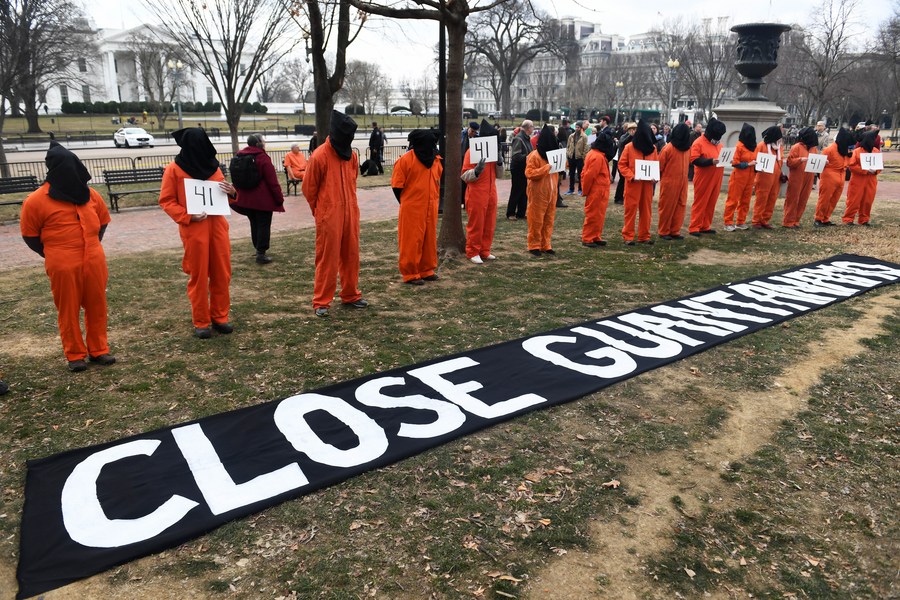
Protesters dressed as detainees of the Guantanamo Bay detention camp rally to demand the closing of the Guantanamo Bay detention camp outside the White House in Washington D.C., the United States, on Jan. 11, 2018. (Xinhua/Yin Bogu)
In April, Patrick Hamilton, head of delegation for the United States and Canada at the International Committee of the Red Cross, visited the camp and described that he was "struck by how those who are still detained today are experiencing the symptoms of accelerated ageing, worsened by the cumulative effects of their experiences and years spent in detention."
In 2006, the United Nations released a report on Guantanamo urging the U.S. government to either place the detainees on trial or release them immediately, the recommendation of which was rejected by the United States.
The arbitrary detention and abuse at Guantanamo is a typical example of the U.S. trampling on rule of law and infringing on human rights.
"Around the world, Guantanamo is a symbol of racial and religious injustice, abuse, and disregard for the rule of law," said Hina Shamsi, director of the National Security Project at the nonprofit American Civil Liberties Union, in a statement.
WHEN WILL IT CLOSE?
Despite the pledges of U.S. presidents to close it during their presidential campaigns, the facility has remained operational and shows no sign of closure in near future.
In 2016, former U.S. President Barack Obama, who had vowed to close the camp during his running for president, unveiled a long-stalled closure plan for the detention facility.
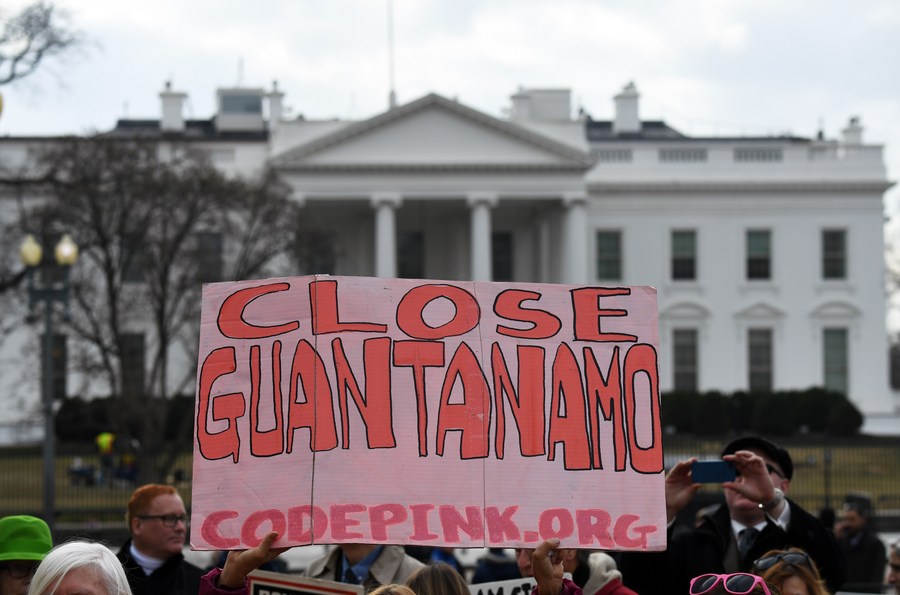
Protesters rally to demand the closing of the Guantanamo Bay detention camp outside the White House in Washington D.C., the United States, on Jan. 11, 2018. (Xinhua/Yin Bogu)
The proposal, which included transfer of some detainees to the United States, failed due to opposition from Congress members, who argued the relocation of the detainees to the United States might pose a threat to national security.
In 2018, then U.S. President Donald Trump said that he had signed an order to reexamine the U.S. military detention policy and to keep the Guantanamo detention facility open.
Incumbent U.S. President Joe Biden announced shortly after he took office that his administration will move to put an end to the Guantanamo Bay detention camp, promising to close it before the end of his tenure.
According to analysts, major obstacles to the shutdown of the camp include laws that ban the entry of the detainees to the United States, opposition from Congress, and difficulties in finding third countries willing to accept relocated detainees.
Lee Wolosky, former U.S. special envoy for Guantanamo closure, published an op-ed piece in January last year in Politico looking back at the "legal and policy morass" that had developed around the prison.
"A task that many saw as a matter of decisively turning the page on a dark chapter in American history turned out to be much messier, more tedious and more legally and politically fraught than I anticipated," Wolosky observed. "Our longest war has ended, yet Guantanamo endures."■