
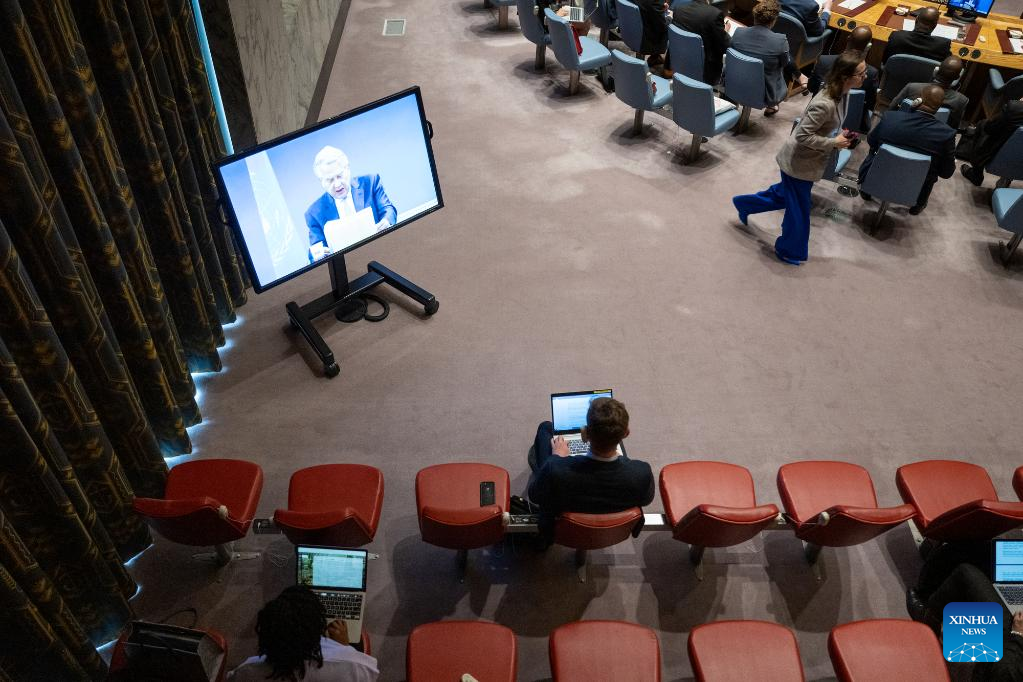
UN Special Coordinator for the Middle East Peace Process Tor Wennesland (on the screen) speaks via a video link at a Security Council meeting at the UN headquarters in New York, on June 27, 2023. Wennesland warned Tuesday that the violence in West Bank may escalate. (Manuel Elias/UN Photo/Handout via Xinhua)
UNITED NATIONS, June 27 (Xinhua) -- UN Special Coordinator for the Middle East Peace Process Tor Wennesland warned Tuesday that the violence in West Bank may escalate.
The past two weeks have seen an alarming spike in violence across the northern and central occupied West Bank, leading to numerous Palestinian and Israeli casualties, he told the Security Council.
Military operations, including airstrikes in the West Bank, and clashes, attacks as well as extremely high levels of settler-related violence have continued and intensified dramatically, alongside the use of more sophisticated weapons by Palestinians, including advanced improvised explosive devices and rockets launched toward Israel, he said.
"Unless decisive steps are taken now to rein in the violence, there is a significant risk that events could deteriorate further," warned Wennesland.
The mounting violence is taking place against the backdrop of deeply worrying settlement-related developments that alter the already fragile dynamics on the ground, as well as a worrying deterioration in relations between Israel and the Palestinian Authority, he noted.
"I remain gravely concerned by the escalating spiral of violence we are witnessing in the occupied West Bank. I condemn all acts of violence against civilians, including all acts of terror, which exacerbate mistrust and undermine a peaceful resolution to the conflict. The violence must stop and all perpetrators must be held accountable," said Wennesland.
He said he was particularly alarmed by the extreme levels of settler violence, including large numbers of settlers, many armed, systematically attacking Palestinian villages, terrorizing communities, sometimes in the proximity of Israeli security forces.
Israel, as the occupying power, has an obligation to protect Palestinians and their property in the occupied Palestinian territory and to ensure prompt, independent, impartial, and transparent investigations into all acts of violence, he said.
He reiterated that security forces must exercise maximum restraint, apply proportional use of force and use lethal force only when it is strictly unavoidable in order to protect life, and conduct thorough, independent, impartial, and prompt investigations into all instances of possible excessive use of force. Children, in particular, must never be the target of violence, used or put in harm's way.
He strongly condemned inciteful, provocative statements from officials on both sides that further enflame the volatile situation on the ground.
Wennesland said he remained deeply troubled by the relentless expansion of Israeli settlements in the occupied West Bank, including East Jerusalem, that fuels violence and is impeding access by Palestinians to their land and resources, reshaping the geography of the occupied West Bank and threatening the viability of a future Palestinian state.
"Israeli settlements constitute a flagrant violation of United Nations resolutions and international law. I call on the government of Israel to cease the advancement of all settlement activity immediately," he said. "I call on the Israeli government to end the demolition of Palestinian-owned property and prevent the possible displacement and eviction of Palestinians, in line with its obligations under international humanitarian and international human rights law."
Wennesland underscored that the speed and intensity of the security deterioration on the ground are extremely dangerous.
The unfolding events seriously challenge broader stability and undermine the Palestinian Authority. While the cease-fire following the Gaza escalation in May has held, there is a constant risk that events in the West Bank could spill over to Gaza, he warned.
The Palestinian Authority's fiscal and institutional challenges, exacerbated by funding shortages, including for UN agencies, that impact the delivery of crucial basic services, remain concerning and may further aggravate the deterioration on the ground, he added.
In recent days and weeks, the United Nations has remained in close contact with all parties to help restore a relative calm and change the current disastrous trajectory, he said. "We must urgently act collectively to stop the violence. At the same time, it is crucial to bring the parties back onto a path that addresses the political issues driving the current dynamics, so that a process to resolve the core issues can begin."
The deepening occupation, settlement expansion, the high levels of violence against civilians, including acts of terror, and, critically, the absence of a political horizon, are rapidly eroding hope among Palestinians and Israelis, and particularly among youth, that a resolution of the conflict is achievable, he said.
"I urge all leaders to put on the brakes and rethink the options. The choice is clear: either continue along the downward spiral of violence and provocations leading to a political vacuum; or turn toward constructive dialogue linked to concrete actions that can create hope and a political horizon," he said.
The United Nations remains committed to assisting peace efforts and to supporting Palestinians and Israelis to resolve the conflict and end the occupation through the achievement of a two-state solution, in line with relevant United Nations resolutions, international law and bilateral agreements, said Wennesland. Enitem


