
People shop at a store in Stockholm, Sweden, on Feb. 6, 2023. (Photo by Wei Xuechao/Xinhua)
In a fresh report the authority said that several years of low inflation and low interest rates have led to high risk-taking among households and companies, which has resulted in high prices for housing and commercial properties -- as well as in rapidly rising debts.
STOCKHOLM, May 30 (Xinhua) -- High inflation and rising interest rates have been pressing Sweden's businesses and households hard and are exposing vulnerabilities in the country's financial system, the financial supervisory authority (Finansinspektionen, FI) said on Tuesday.
In a fresh report the authority said that several years of low inflation and low interest rates have led to high risk-taking among households and companies, which has resulted in high prices for housing and commercial properties -- as well as in rapidly rising debts.
Now, when households and companies are instead pressured by high inflation and rising interest rates, vulnerabilities quickly become apparent.

This photo taken on Oct. 28, 2022 shows an empty premise in central Stockholm, Sweden. (Xinhua/He Miao)
"We see in our studies that households have never been under as much pressure as they are now. Inflation and interest rates have forced them to cut back on consumption to afford housing and increased food costs," FI's Director General Daniel Barr told Swedish Television (SVT).
According to the report reviewed by SVT, this new economic situation has increased the risk of turmoil in the financial market.
Several highly leveraged property companies and large listed ventures are under pressure to reduce their indebtedness, it said.
However, small or medium-sized property companies face major risks, according to FI.
"The big risk lies in small or medium-sized property companies. There may certainly be individual companies that may have problems, but we see no major risk for the system as such," Barr told SVT.
FI said that the adaptations that households and companies are now making may in the long run lead to a reduction in vulnerabilities.
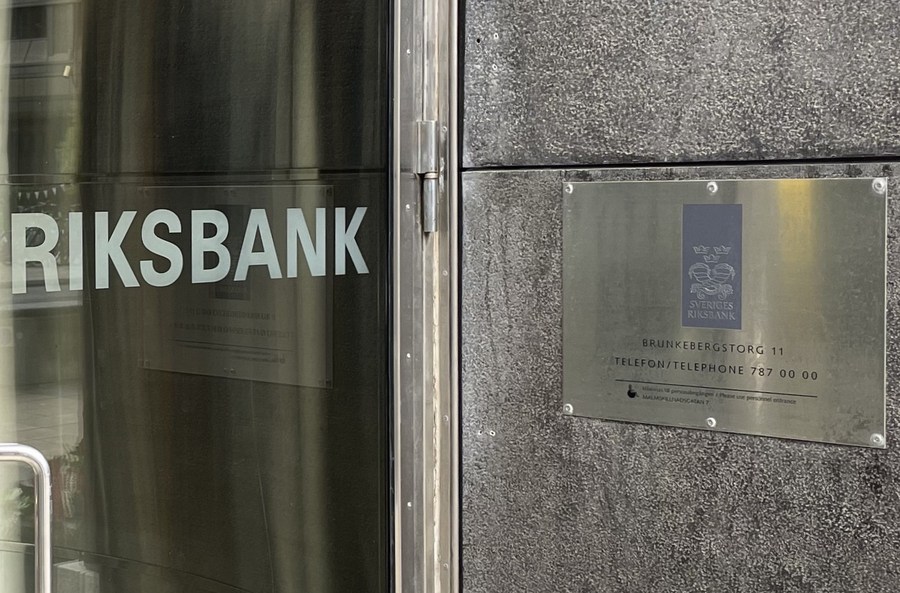
This photo taken on Sept. 27, 2022 shows the logo of Sweden's central bank Riksbank in Stockholm, Sweden. (Xinhua/Fu Yiming)
"But we need to follow the developments and remain vigilant," Barr told SVT. Over the last year, Sweden's inflation rate was considerably higher than the 2-percent target of its central bank (Riksbank), and according to the figures released by Statistics Sweden earlier this month, year-on-year inflation stood at 10.5 percent in April.
After keeping the policy interest rate at zero or sub-zero levels for over seven years, the Riksbank has been continuously raising the rate since last May to 3.5 percent to curb the rampant inflation. ■