

Julius Bitok (6th L, Front), principal secretary in Kenya's State Department for Immigration and Citizen Services, takes part during a meeting in Nairobi, the capital of Kenya, on May 23, 2023. (Photo by John Okoyo/Xinhua)
Delegates from 50 African countries gather in Nairobi, Kenya, at a meeting to accelerate the uptake of biometric IDs with embedded electronic chips that enable citizens to have easier access to education, health and social security services.
NAIROBI, May 24 (Xinhua) -- African states on Tuesday kicked off a three-day meeting in the Kenyan capital of Nairobi to discuss ways of accelerating the uptake of national digital IDs in order to boost the delivery of government services.
The 7th ID4Africa Augmented General Meeting (AGM) brought together government officials, development partners and innovators to focus on an inclusive, secure and respectful digital identity that prioritizes the needs of individuals.
In his opening remarks, Julius Bitok, principal secretary in Kenya's State Department for Immigration and Citizen Services, said that Kenya is currently in the middle of transitioning the national digital identity from the second to third-generation ID.
Bitok said that a reliable digital identification regime will provide the government with reliable statistics to plan for the funding of adequate essential public services.
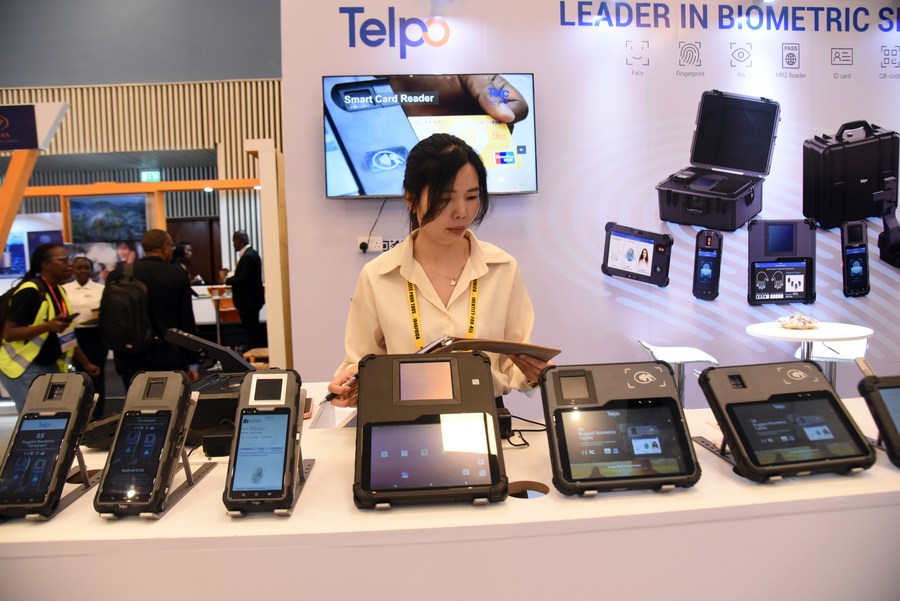
Kuki Zheng, sales director at Africa Telepower Communication Company, displays biometric fingerprint identification tablets during a meeting in Nairobi, the capital of Kenya, on May 23, 2023. (Photo by John Okoyo/Xinhua)
The event brought together delegates drawn from 50 African countries to accelerate the uptake of biometric IDs with embedded electronic chips that enable citizens to have easier access to education, health and social security services.
Kenneth Attafuah, executive secretary of Ghana's National Identification Authority, said that Ghana has already rolled out a digital ID that is issued to its nationals as well as qualified foreign residents in Ghana.
Attafuah said that the digital Ghana card which has a biometric chip embedded has advantages because it allows for real-time verification of personal identity for cardholders who want to access public services. ■