
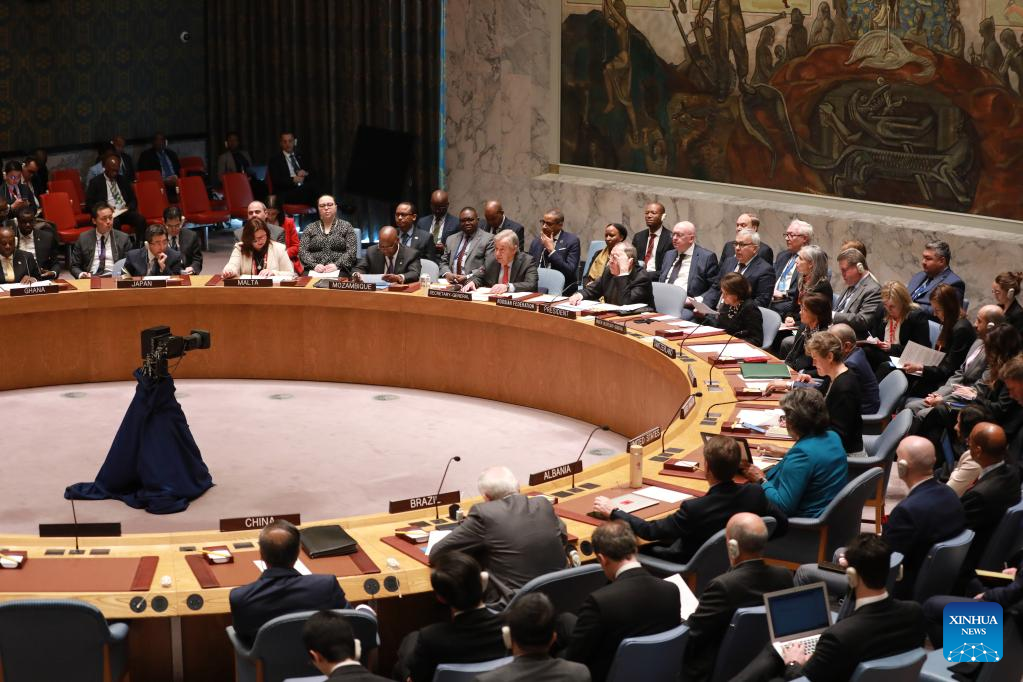
The United Nations Security Council holds an open debate on multilateralism at the UN headquarters in New York, on April 24, 2023. UN Secretary-General Antonio Guterres said on Monday that competition between states should not rule out cooperation. (Xinhua/Xie E)
UNITED NATIONS, April 24 (Xinhua) -- UN Secretary-General Antonio Guterres said on Monday that competition between states should not rule out cooperation.
The world faces unprecedented and interlocking crises. Yet the multilateral system is under greater strain than at any time since the creation of the United Nations. Tensions between major powers are at a historic high, so are the risks of conflict, Guterres told a UN Security Council open debate on multilateralism.
"Competition between states is inevitable. But that should not rule out cooperation where shared interests and the greater good are at stake," he said.
When competition escalates to confrontation, the multilateral system, founded on the UN Charter and international law, is the most effective means to manage disputes peacefully, he noted.
"We must cooperate. We must adapt multilateral institutions and foster trust where it is most needed. The urgency of global challenges demands bold and swift action," said Guterres.
The United Nations was created for crises. Throughout its history, the world body has overcome seemingly intractable conflicts and deep divisions, he said. "We must find a way forward and act now, as we have done before, to stop the slide toward chaos and conflict. It is time to deepen cooperation and to strengthen multilateral institutions, to find common solutions to common challenges."
Members of the Security Council, particularly the permanent ones, have a particular responsibility to make multilateralism work, rather than contribute to its dismemberment, said the UN chief.
Effective multilateral responses are urgently needed to prevent and resolve conflicts, manage economic uncertainty, rescue the Sustainable Development Goals, and address challenges to the global norms against the use and possession of nuclear weapons, he said.
The world is witnessing a deepening climate crisis, soaring inequalities, a rising threat from terrorism, a global pushback against human rights and gender equality, and the unregulated development of dangerous technologies. All these global challenges can only be solved through respect for international law, adherence to global commitments, and the adoption of appropriate frameworks of multilateral governance, he stressed.
Guterres called on states to recommit to their obligations under the UN Charter, putting human rights and dignity first, and prioritizing the prevention of conflict and crises.
The principles enshrined in the UN Charter, including respect for sovereignty, territorial integrity, and political independence of all states, and non-interference in the affairs of other states, are bulwarks against uncertainty and fragmentation, and are the foundation of all international cooperation to end conflicts, save lives, protect human rights, and promote social and economic progress, he said.
Guterres urged member states to use the full range of diplomatic tools that the UN Charter provides for the peaceful resolution of conflicts, and to commit to tackling new and emerging challenges and filling gaps in global governance to achieve the promise of the UN Charter in the 21st century.
Multilateral cooperation is the beating heart of the United Nations, its raison d'etre and guiding vision, said Guterres.
Over the past 78 years since the establishment of the United Nations, the multilateral system has held together and delivered some notable successes, he said.
The tools and mechanisms established by the UN Charter have played their part in averting a third world war. Peacemaking and preventive diplomacy by the United Nations have helped end conflicts around the world. UN peacekeeping operations have helped societies move away from conflict, saving perhaps millions of lives. Collective disarmament and non-proliferation efforts have helped to confine nuclear weapons to a handful of states, said the UN chief.
The United Nations was central to the decolonization process and the independence of 80 former colonies -- today members of the United Nations; and has helped to advance economic and social progress, and contributed to reducing poverty and hunger, eradicating diseases and building recognition and respect for fundamental human rights, he noted.
The global humanitarian system coordinated by the United Nations saves millions of lives each year. Multilateral solutions to global problems, from the ozone layer to the eradication of polio, are tried, tested, and proven to work, he said.
None of this progress would have been possible without countries standing together, as a multilateral human family, said Guterres. ■


