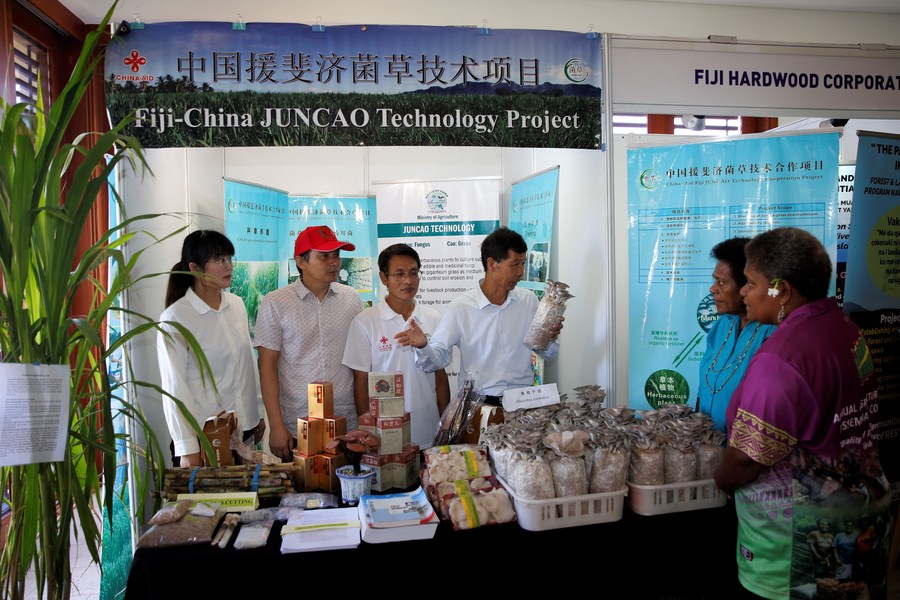
This photo taken on March 10, 2023 in Nadi, Fiji, shows Chinese technicians introducing agricultural technology to Fijian people. (Xinhua/Zhang Yongxing)
China has launched multiple agricultural technical assistance projects in countries including Samoa and Fiji.
NADI, Fiji, March 13 (Xinhua) -- Samoa and Fiji warmly welcomed the China-aided agricultural technical assistance projects as they have helped the South Pacific island nations to further boost their economic and social development in recent years.
Located at the southward extension of the Belt and Road Initiative (BRI), the Pacific island nations (PICs) are important economic and trade partners of China. Currently, China has inked Memorandums of Understanding on the Belt and Road Initiative (BRI) cooperation with all 10 PICs with diplomatic relations with China.
China has launched multiple agricultural technical assistance projects in these countries, including Samoa and Fiji. It has helped PICs improve agricultural production capacity and food security by sending agricultural experts, building demonstration farms, training model farmers, promoting improved crop varieties and providing technical support.
According to Liu Zhiwen, leader of the China-Samoa Agricultural Technical Aid Project, agriculture is a key economic pillar in Samoa with over 80 percent of families engaged in different forms of agricultural production.
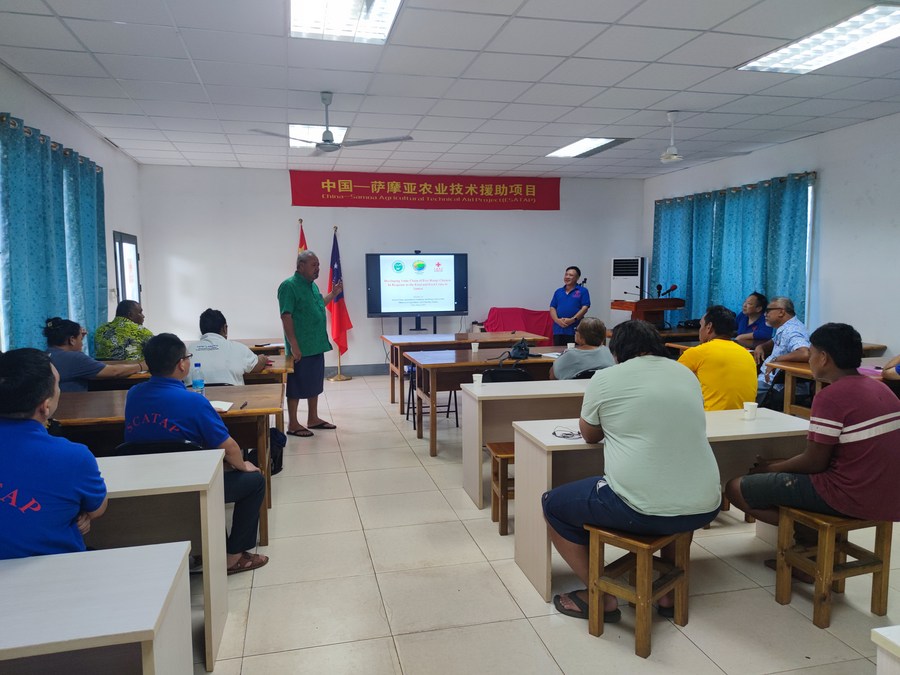
This photo taken on March 1,2023 shows an agricultural technology training course in Apia, Samoa. (Xinhua/Zhang Yongxing)
Initiated in 2010, the project, which was divided into five phases with the latest being launched in March 2022, aimed to help Samoan farmers enhance their sustainable livelihoods. China has sent experts from Hunan province to Samoa to set up demonstration farms so that Samoans could learn how to increase productivity and promote sustainable agriculture.
On the sidelines of this year's Pacific Week of Agriculture and Forest, which was just concluded in Fiji's third largest city of Nadi on Friday night, Liu told Xinhua that the project has so far proven to be a great success because through the project, modern agricultural technology facilities on greenhouse cultivation, high-yield fruit cultivation, organic fertilizer and soil improvement were set up in Samoa.
Besides the demonstration farm near Samoa's capital city of Apia, Chinese experts have also established nine agricultural stations, cultivated over 100 model farms and provided agricultural training to over 10,000 farmers, he said.
For his part, Samoa's Minister of Agriculture and Fisheries Laauli Leuatea Polataivao Fosi told Xinhua that the island nation is so pleased to have the support from the Chinese government to develop its agricultural sector.
The minister voiced his satisfaction over the project which has led to the great improvement of Samoa's agricultural production.
While believing that Samoa will benefit from the BRI, he thanked China for being Samoa's brother and hoped to expand areas of cooperation which can help Samoa's economic and social development.
Meanwhile, China has set up a Juncao technical demonstration center in Nadi, Fiji, and provided Juncao technical assistance to Fiji and Papua New Guinea.

This photo taken on March 10, 2023 in Nadi, Fiji, shows Chinese technicians introducing agricultural technology to Fijian people. (Xinhua/Zhang Yongxing)
According to Lin Zhansen, the former leader of the Chinese experts team in Fiji and now the leader of the Juncao technology cooperation's regional center set up in Fiji in 2014, the China-Fiji Juncao technology cooperation project has been warmly welcomed by the island nation as it not only helps develop a low-cost mushroom cultivation industry, but also produces cattle feed and minimizes soil erosion.
In Fiji, Juncao has become a household name and is known as "the happy grass from China" after two phases of the project have witnessed a sound success. Now the third phase of the project is being implemented as scheduled.
"We have so far trained more than 1,700 Fijians, including female farmers and disabled persons, with 39 training workshops conducted throughout the country. In addition, we have also helped establish two model villages of mushroom cultivation in Fiji, which now has an accumulatively number of 600 mushroom farmers across the country," Lin told Xinhua.
He believed that the Juncao project will benefit not only Fiji, but also the Pacific region as a whole.
Tagiyaco Vakaloloma, 29, is a senior technical assistant for mushroom research and development from Fiji's Ministry of Agriculture. She has worked together with the Chinese experts over the past five years and looks forward to cooperating closely with them in the third phase of the project in the coming three years.
"I know Juncao is a very interesting and warmly welcomed project in Fiji for the sake of food sources, food security, income and also for the livestock farms in Fiji. We are looking forward to working with them in the next three years to help all the farmers in Fiji, to make them commercial and produce mushroom as a source of food and also the source of income for them," she told Xinhua.
Chinese Ambassador to Fiji Zhou Jian also inspected the project recently, saying that the project has become a symbol of the mutually beneficial cooperation between China and PICs including Fiji.
He hoped that the Chinese experts can take advantage of the platform to make a greater contribution to the region's poverty alleviation, sustainable development and efforts to fight against climate change.■