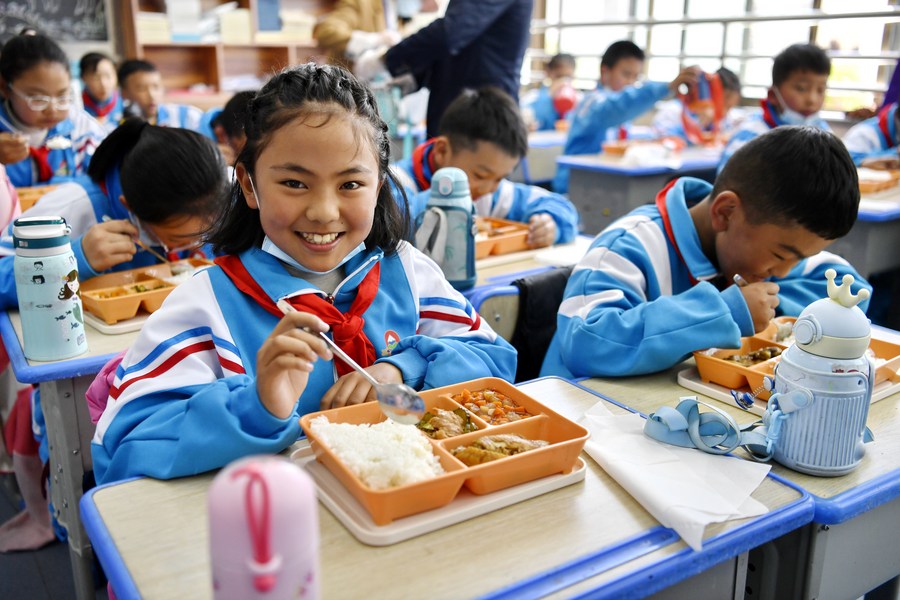
Students of a branch school of Lhasa Experimental Primary School have lunch in Lhasa, southwest China's Tibet Autonomous Region, May 12, 2022. (Xinhua/Zhang Rufeng)
Zhaluo, an expert with the China Tibetology Research Center, said that the boarding schools maximally guarantee that children of farmers and herders in Xizang's remote areas enjoy the right to education, and thanks to the implementation of the boarding school system, both rural and urban students can share high-quality educational resources and receive school education equally, thus narrowing the rural-urban educational gap.
GENEVA, March 12 (Xinhua) -- Boarding schools in China's Xizang Autonomous Region are totally different from those "colonial-era residential schools in Canada, Australia, and the United States," where "astonishing tragedies once happened," a professor said at a human rights conference on Thursday.
Did boarding schools in Xizang "separate Tibetan children from their families" and "force them to receive assimilation education in boarding schools"? Zhaluo, an expert with the China Tibetology Research Center, asked at a side-event of the 52nd session of the UN Human Rights Council.
Those with a positive answer either know little about Xizang or purposely stigmatize China, Zhaluo said at the event themed "The Concept and Practice of Human Rights in China."

This photo taken on Feb. 27, 2023 shows the 52nd session of the United Nations Human Rights Council (UNHRC) taking place at the Palais des Nations in Geneva, Switzerland. (Xinhua/Lian Yi)
"I once studied at a boarding school. Besides, over the past 30 years I have been committed to researching Xizang's development, so I am familiar with boarding schools in the autonomous region," he said at the meeting organized by the China Society for Human Rights Studies.
The main reasons that Xizang established and developed boarding schools are as follows: First, the population is widely dispersed, making it difficult to attend a school close to home; Second, the mountainous geographical conditions render transportation inconvenient.
"Boarding schools that allow school-age children to study and live together are the best way to promote school education," he noted.
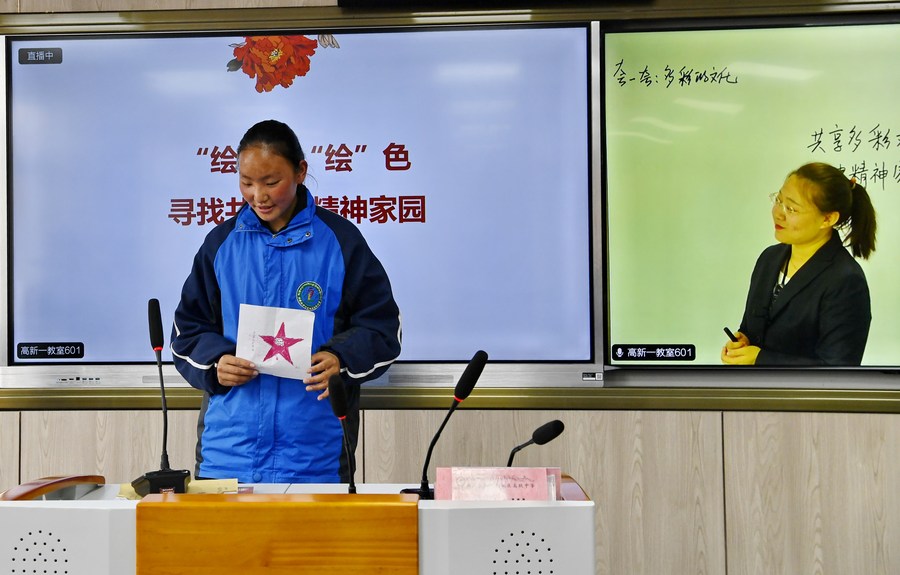
A student of Lhasa Ali high school interacts with a teacher of Xi 'an Gaoxin No. 1 High School via an online education system in Lhasa, southwest China's Tibet Autonomous Region, April 8, 2022. (Xinhua/Zhang Rufeng)
The expert told attendees that based on his observations in the past 30 years, the infrastructure of boarding schools in Xizang and students' living allowance standards have seen obvious improvements, and the student management and care system has become increasingly mature and standardized.
He said that the boarding schools maximally guarantee that children of farmers and herders in Xizang's remote areas enjoy the right to education, and thanks to the implementation of the boarding school system, both rural and urban students can share high-quality educational resources and receive school education equally, thus narrowing the rural-urban educational gap.
"As a matter of fact, a variety of boarding schools full of humanism and vitality have provided a favorable environment for the growth of numerous students in many parts of the world, including China's Xizang Autonomous Region, and offered them the golden key to a splendid life," he stressed. ■