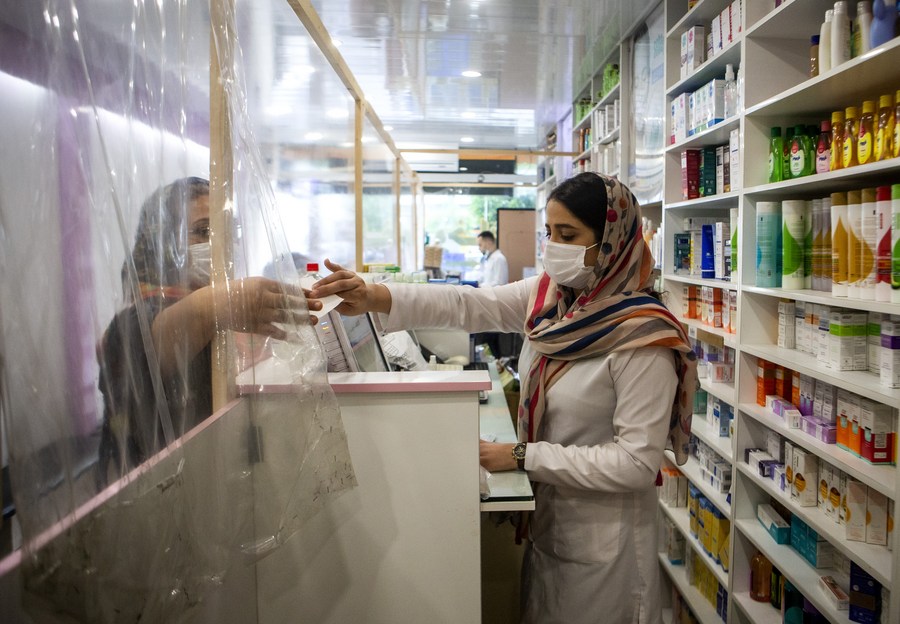
A staff member wearing a face mask works at a pharmacy in Tonekabon, Iran, on April 26, 2021. (Photo by Ahmad Halabisaz/Xinhua)
TEHRAN, Oct. 10 (Xinhua) -- Even epidermolysis bullosa or EB children were "not exempted from the unilateral, illegal and cruel U.S. sanctions," Iranian Foreign Ministry Spokesman Nasser Kanaani recently said, denouncing U.S. sanctions against Iran.
EB patients are often referred to as "butterfly children" because their skin is as fragile as a butterfly's wings. According to official statistics, about 800 EB patients have been known in Iran.
In healthy people, epidermis, or the outer layers of the skin, are connected by protein hooks made of creatine or collagen, and these hooks prevent different layers from moving separately, but because of production defects, these hooks in people with EB are not made properly.
For this reason, "the slightest action that causes friction between two layers of skin, such as rubbing or squeezing, causes blisters and even dangerous wounds," Hadi Kaykhosravi, an Iranian EB patient, was quoted by the portal of Iran's High Council for Human Rights as saying.
If the life of normal human beings depends on the existence of climate, the survival of patients with the butterfly disease depends entirely on the timely use of special dressings, "equally necessary, important and fundamental," he noted, adding dressings act as "insulation to protect patients' wounds and blisters," making them less likely to suffer during the day.
Yet, the U.S. sanctions against Iran have intensified since 2018, the year when Washington pulled out of a nuclear deal between Tehran and world powers, causing a great shock to the community of Iranian special patients.
Although the United States claims that humanitarian items, including medicine and foodstuff, are not included in the sanctions list, its embargoes on Iran's oil exports and banking sector have, in practice, prevented the country from importing such goods.
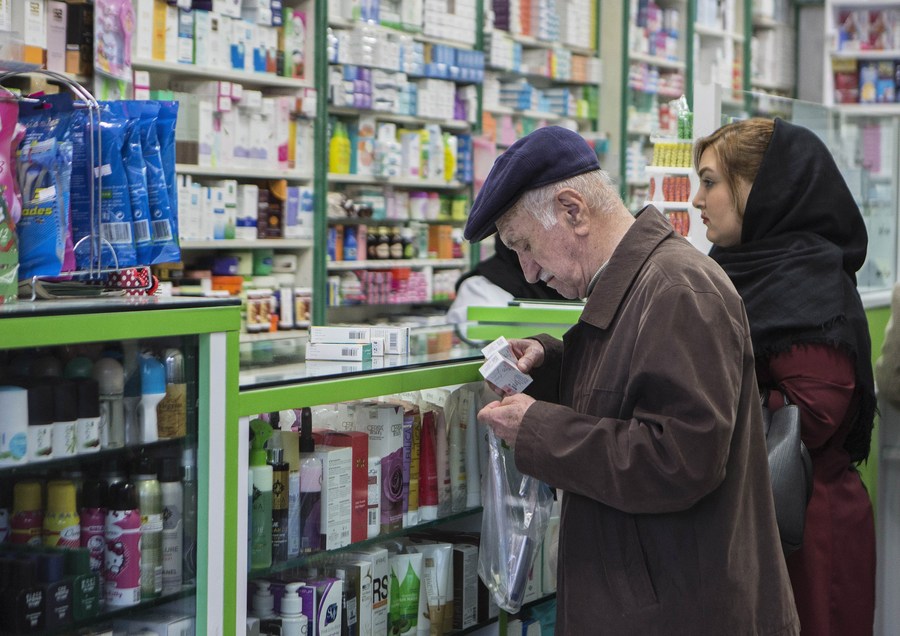
A man checks his medicines at a pharmacy in Tonekabon, Iran, Dec. 22, 2019. (Photo by Ahmad Halabisaz/Xinhua)
"This global deception of excluding medicine from the list of sanctions in practice causes the death of our compatriots," Kaykhosravi said, citing an example of a Swedish company that announced in an official letter to Iran's EB House that it would not be able to provide the dressings needed for Iranian patients because of U.S. sanctions.
More than a dozen EB patients in Iran have reportedly died of the disease in the absence of the needed medical supplies while others have suffered from severe physical injuries, including amputation.
Similarly, Younes Arab, director of the Iranian Thalassemia Association, said "some medical necessities and equipment have become a dream for the loved ones of Iranian thalassemia," because Iran has been "cowardly sanctioned" by the United States.
"This is nothing but an obvious crime against humanity and thalassemia patients in Iran," Arab added.
He noted that the shortage of drugs and medical supplies were due to the lack of sales of drugs by pharmaceutical companies for fear of U.S. sanctions, the impossibility of financial exchange, and the increase in drug and equipment costs.
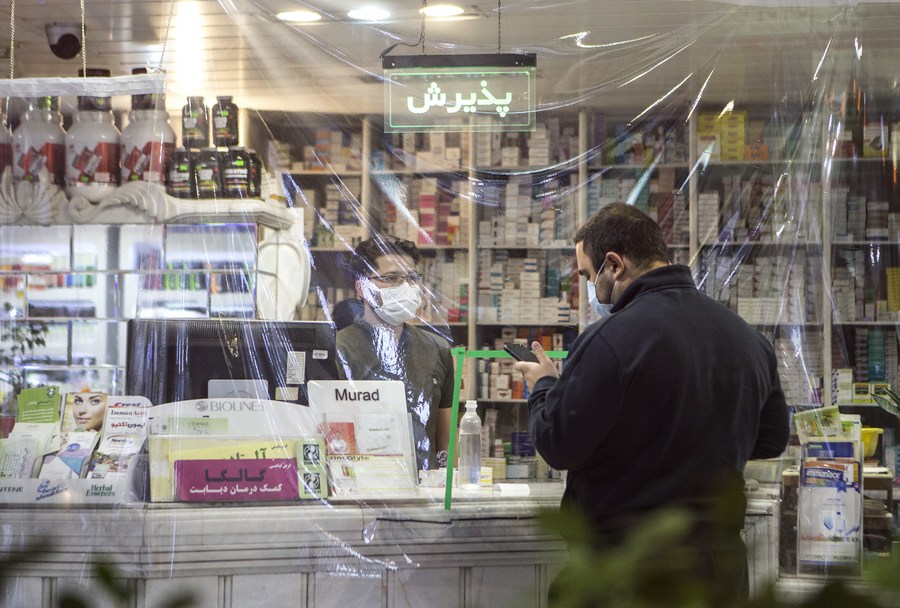
A seller wearing a face mask works at a pharmacy in Mashhad, Iran, Nov. 7, 2020. (Photo by Ahmad Halabisaz/Xinhua)
Because of the sanctions, 70 thalassemia patients lost their lives in 2018, 90 in 2019, 140 in 2020, and 180 in 2021, the Iranian government spokesman Ali Bahadori Jahromi said in a late Saturday tweet.
In addition, 220 thalassemia patients could die this year for the same reason, he added.
Kazem Gharibabadi, the Iranian Judiciary chief's deputy for international affairs and secretary of the country's High Council for Human Rights, dismissed as "a big lie" the U.S. claims that humanitarian items are not included in the list of sanctions, saying such claims fail to be based on the realities on the ground.
He noted that U.S. sanctions have directly targeted Iran's main source of income, oil sales, and banking sector, and thus the people's right to development and welfare.
"This has seriously endangered Iranian patients' right to life and health," Gharibabadi regretted. ■