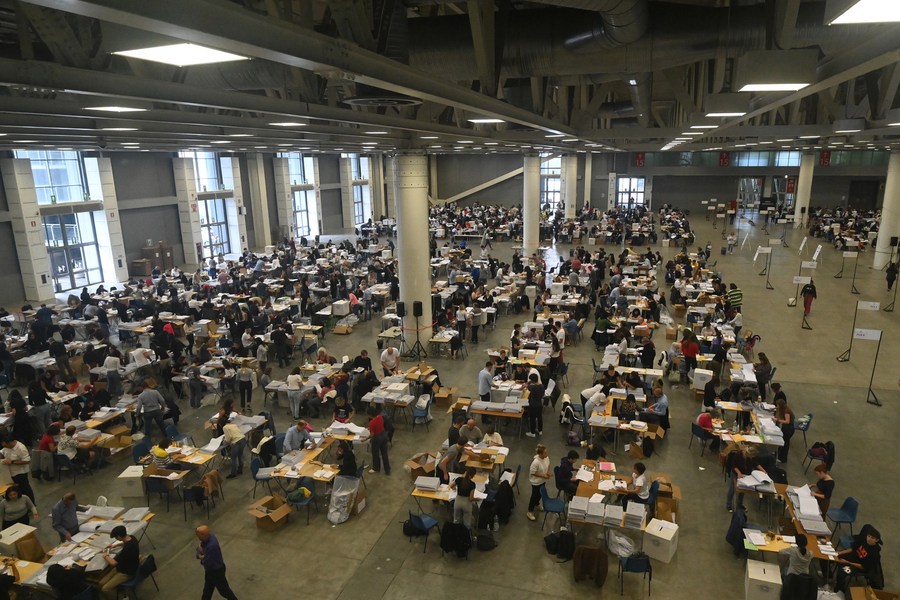
Staff members count ballots voted by Italian citizens living abroad in Bologna, Italy, Sept. 25, 2022. (Photo by Gianni Schicchi/Xinhua)
Observers have expressed concern over how the next leadership will tackle an array of pressing economic and social issues.
ROME, Sept. 27 (Xinhua) -- A right-wing coalition led by Brothers of Italy scored a broad victory in Italy's general election, as vote counting as of late Monday showed the party won 26 percent of the vote and the coalition secured a majority in parliament.
The outcome makes Giorgia Meloni, leader of Brothers of Italy, the odds-on favorite to head Italy's next government, the most right-wing government the country would have in more than 70 years.
As voters set the stage for Italy's lurch to the right, markets weakened after the election results unnerved investors. Observers have expressed concern over how the next leadership will tackle an array of pressing economic and social issues.
MARKETS WEAKENED
Though the election result was widely expected and markets already turned some of its concerns into trading prices after opinion polls pointed to a likely right-wing victory, markets showed weak performance after opening this week.
The blue-chip index on the Italian Stock Exchange in Milan opened in negative territory on Monday before climbing higher to finish the day up by 0.3 percent. It gave back those gains on Tuesday.
Bond yields climbed higher in Italy, where the benchmark 10-year bond closed trading on Tuesday at 4.74 percent, up from 4.53 percent on Monday and 4.29 percent last Friday.
Perhaps most significantly, the spread between Italian bonds and those in Germany, the EU's largest economy, surpassed 250 basis points on Tuesday. The spread shows that Italy's yields are growing faster than other key markets, and are now at a point as high as in early 2020.
Higher bond yields, which increase a country's cost for borrowing money, are a reflection of lower investor confidence in an economy.
Citizens prepare to cast their ballots at a polling station in Rome, Italy, Sept. 25, 2022. Polls opened to renew the parliament in Italy early on Sunday, in a snap election seen as crucial for the country. (Xinhua/Jin Mamengni)
Meanwhile, the euro currency fell to a new low against the U.S. dollar on Monday, and continued to edge slightly lower on Tuesday. At the end of Tuesday's trading, the dollar was traded at 1.042 euros.
"Investors are worried about the impact a leader like Meloni could have on EU unity on a variety of fronts, ranging from near-term energy policy to support for Ukraine," Gian Franco Gallo, a political affairs analyst with ABS Securities in Milan, told Xinhua.
"The EU is already suffering from rising energy prices and broad inflation, and this is another big factor," Gallo said.
PRESSING CHALLENGES
After the election, the new parliament will gather for lawmakers to elect the two houses' speakers. Then political consultations will begin between President Sergio Mattarella and all party leaders to form the next government.
Observers pointed out that the focus is how the next government will deal with the economic challenges that pose a threat to Italians' welfare.
With the weather turning colder, a top priority is addressing energy supply issues called into question by the reduced natural gas supplies from Russia amid the ongoing Ukraine crisis.
Choices for the next government are limited as it "has to do what the (caretaker) government has already been doing: diversifying energy generation and finding new sources to replace Russian gas," Oreste Massari, a political science professor at Rome's La Sapienza University, told Xinhua.
Reducing energy prices is another pressing need of Italian households and businesses as they have felt the pressure of rising inflation. Increased public spending on aid packages has pushed the country's huge public debt to a new high, according to official data in August.
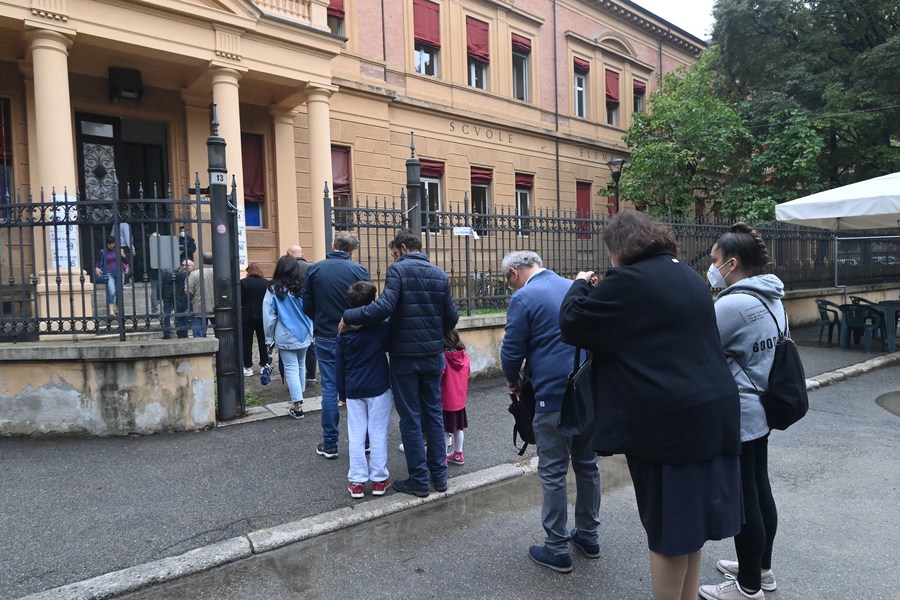
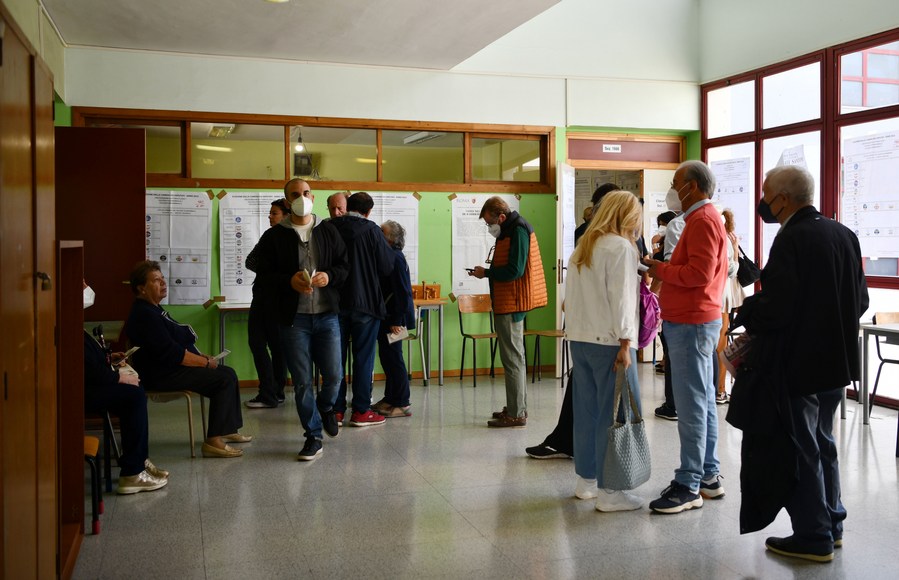
Residents line up to vote at a polling station in Bologna, Italy, Sept. 25, 2022. (Photo by Gianni Schicchi/Xinhua)
During her campaign, Meloni vowed not to increase public debt, something that media reports said could be a challenge as the government seeks to address such issues as shoring up the public pension system and others.
Meloni has also suggested that the next government re-allocate part of the post-COVID recovery funds from the EU to help Italian consumers cushion the impact of spiking energy prices. There are concerns that the new government might fail to fulfill all reform objectives required by the EU to receive the remaining tranches of some 200 billion euros (193.9 billion dollars) by 2026.
On Tuesday, the European Commission said it gave the green light to a new tranche of 21 billion euros (20.16 billion dollars) for Italy's national recovery and resilience plan, after the country had met 45 reform milestones and targets.
In a press release, European Commissioner for Economy Paolo Gentiloni urged "the next Italian government to ensure that this opportunity (Next Generation EU) is seized."
Fulfilling the remaining commitments "is key to delivering the structural change needed to shift the Italian economy onto a path of strong and durable growth," said Gentiloni. ■