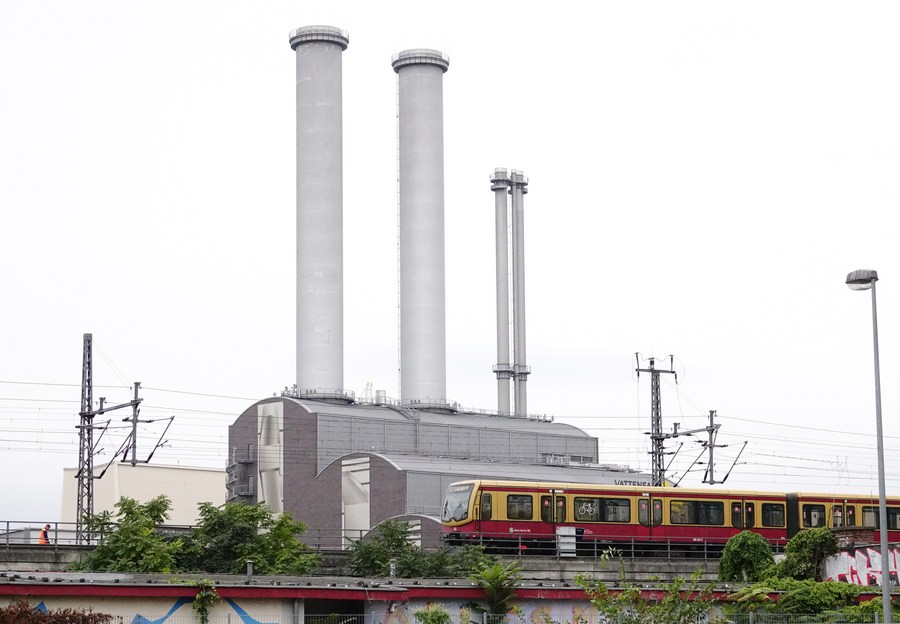
A train passes a thermal power plant in Berlin, Germany, Sept. 8, 2022. (Xinhua/Ren Pengfei)
The package "is necessary and it should help shield consumers and businesses from the higher costs," Chancellor Olaf Scholz said when presenting the package. With the latest relief, the German government will have spent around 95 billion euros on economic aid measures.
By Vanessa Lett
BERLIN, Sept. 9 (Xinhua) -- As Europe is hit by soaring gas prices and record inflation, Germany has just presented its third inflation relief package worth 65 billion euros (65 billion U.S. dollars) to help citizens and companies get through the coming winter.
The package "is necessary and it should help shield consumers and businesses from the higher costs," Chancellor Olaf Scholz said when presenting the package. With the latest relief, the German government will have spent around 95 billion euros on economic aid measures.
Since the start of the Russia-Ukraine conflict, gas prices in Europe have soared as supplies to Germany via the important Nord Stream 1 pipeline were repeatedly reduced. Last week, Russia's energy giant Gazprom cut off supplies altogether citing an oil leak.
Germany is bracing for a situation in which Russia might not resume deliveries via the pipeline. "Nord Stream 1 being reopened is not one of the scenarios I am assuming," Minister for Economic Affairs Robert Habeck told public broadcaster ZDF on Monday.
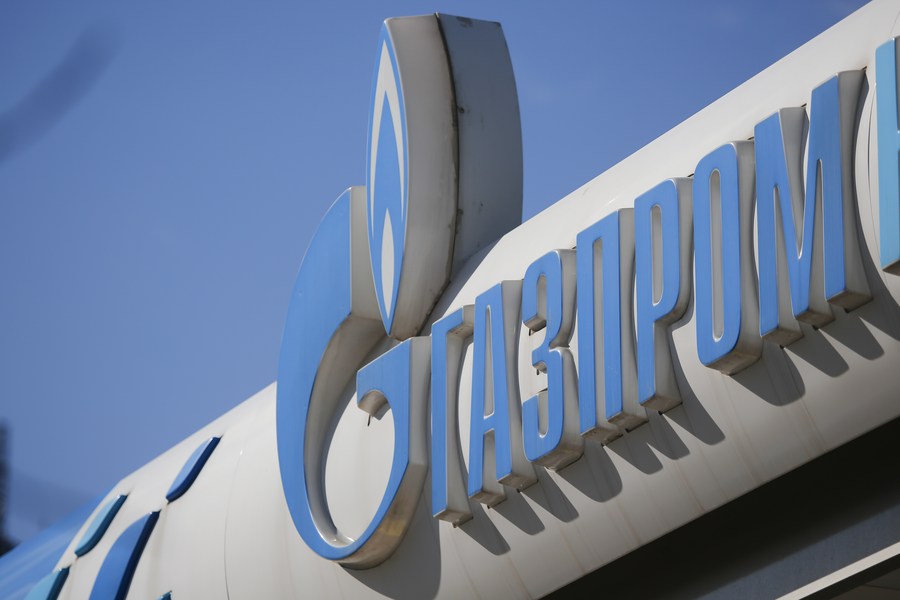
The logo of Russia's energy giant Gazprom is seen at a petrol station in Moscow, Russia, on April 28, 2022. (Photo by Alexander Zemlianichenko Jr/Xinhua)
TAXES ON WINDFALL PROFITS
Although most sectors of Germany's economy as well as consumers are suffering from high inflation, certain utilities have seen a significant spike in profits. Record gas prices are also driving up the cost of other energy sources, including coal and renewables.
As other countries in Europe, such as Italy or the United Kingdom (UK) have already done, the German government is planning to introduce a special tax on such extraordinary profits. "The first task is to use such windfall profits to ease the burden on citizens and to ensure that energy prices fall," Scholz said.
Germany is in "close dialogue" with the European Union (EU), but it would also implement the plans without the bloc if necessary, Scholz added. It is not clear yet how quickly the tax can or will be introduced.
"I assume that new proposals and rules will be made quickly, which we can then implement," Scholz said.
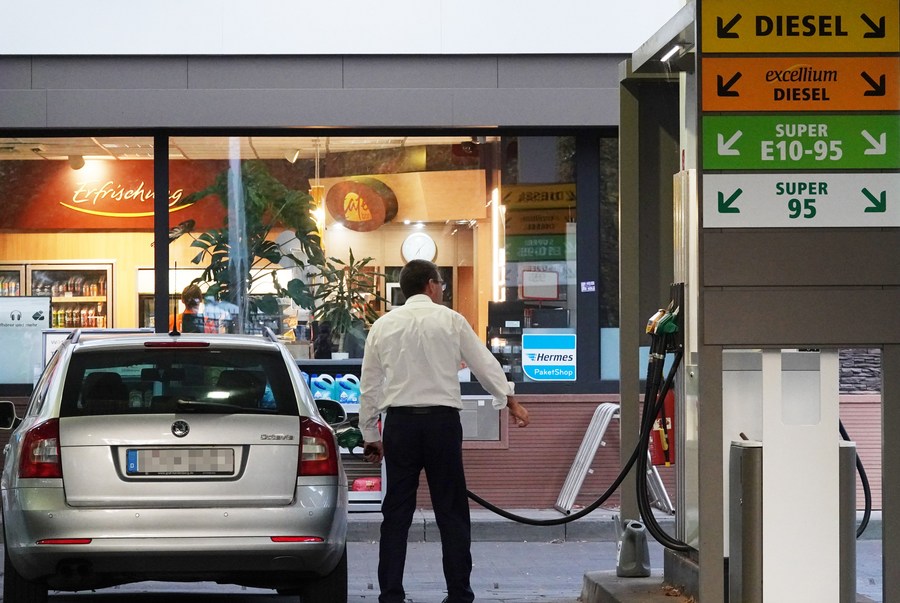
A man fuels a vehicle up at a gas station in Berlin, Germany, Sept. 5, 2022.(Xinhua/Ren Pengfei)
WILL ENERGY SUPPLIES BE SUFFICIENT?
Germany has been trying to fill up its storage facilities as much as possible before the winter. Despite Russia's decision to cut gas supplies, the country has already reached the interim target of 85 percent for October, according to the Federal Network Agency (BNetzA).
"As a result of the increased precautionary measures taken in recent months, Germany is now better prepared for a loss of Russian supplies than it was a few months ago," the agency said, adding that "good progress" had also been made in finding alternative gas supply options.
Private households will most likely not be affected by actual gas shortages but there could be cases where industry and other economic sectors will see supplies limited or even cut regionally, according to the country's national gas market operator Trading Hub Europe (THE).
"I am very confident that households will not have to freeze this winter," Torsten Frank, managing director of THE, said in late August.
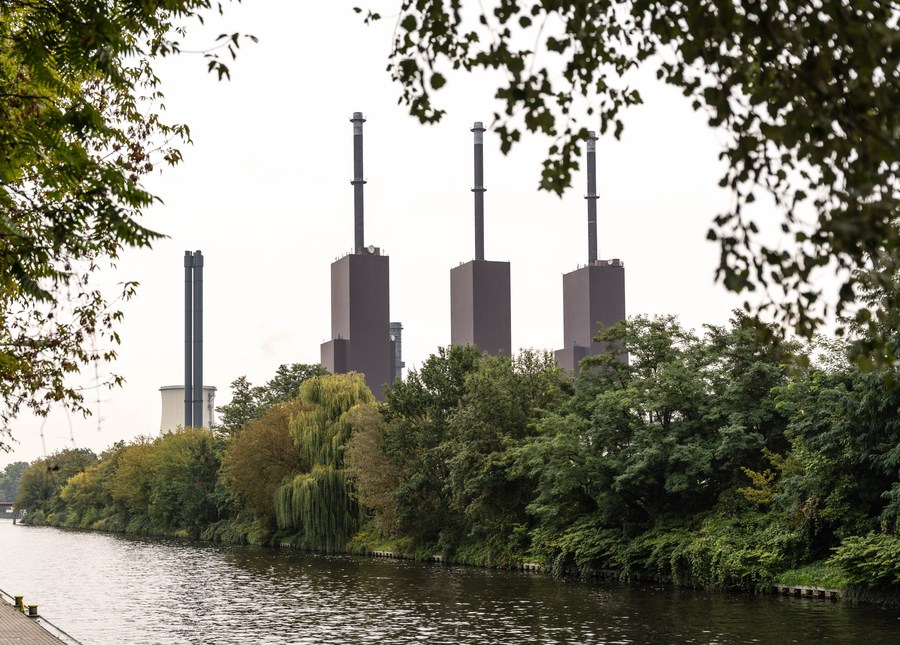
Photo taken on Sept. 8, 2022 shows a thermal power plant in Berlin, Germany. (Photo by Stefan Zeitz/Xinhua)
RETURN OF COAL & NUCLEAR
To ensure energy security, the German government has allowed coal-fired power plants to be reactivated to replace gas in electricity generation.
The first coal plants are already connected to the grid again. Despite the temporary comeback of coal, the government is still sticking to its target of phasing out coal by 2030.
As the gas shortage is causing electricity prices to skyrocket, Germany's nuclear phase-out by the end of the year is also being questioned.
Not abandoning the general course, Habeck is planning to keep two of the country's last three nuclear power plants in reserve for emergencies until April 2023.
"It remains very unlikely that crisis situations and extreme scenarios will occur, but as the minister responsible for security of supply, I am doing everything that is necessary to fully guarantee security of supply," Habeck said.
For many politicians and economic experts, this does not go far enough. "The fact that the nuclear power plants are only to be kept in reserve is absolutely incomprehensible given the critical situation on the electricity market," Veronika Grimm of the German Council of Economic Experts commented, proposing a five-year lifespan for the last three plants.
UNPAID BILLS
High energy prices are already putting a considerable burden on businesses. In August, insolvencies were up 26 percent year-on-year, according to the Leibniz Institute for Economic Research in Halle (IWH).
"After a long period of low insolvency figures, a trend reversal has now set in," IWH expert Steffen Mueller said.
Bakeries across Germany are particularly suffering from high electricity costs. "Unlike other industries and private households, the bakery trade can hardly save energy," Daniel Schneider of the country's bakery association warned in August, calling for greater political support for the "systemically important industry."
At the same time, gas providers are worried that many consumers will not be able to pay their bills. Some municipal utilities are now pricing default payments as high as 15 percent.
"That is becoming threatening," Ingbert Liebing, general manager of the Association of Municipal Enterprises (VKU), said.
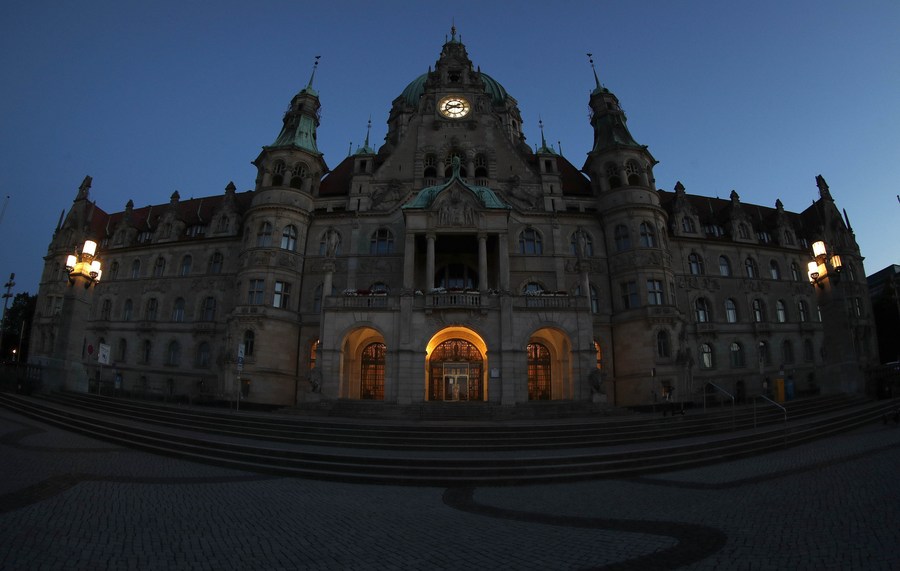
Photo taken on Aug. 1, 2022 shows a night view of the city hall in Hanover, Germany. Some landmark structures across the country have reduced their night illumination to save electricity. (Photo by Joachim Sielski/Xinhua)
SUPPORTING CITIZENS
As one of this summer's first short-term relief measures, a monthly 9-euro public transport ticket became a huge success and was sold around 52 million times. However, it was not possible to maintain this particularly low price, Minister of Transport Volker Wissing said.
The successor ticket will have a much higher price tag -- between 49 euros and 69 euros per month -- and is to be introduced by the turn of the year at the latest. Germany's federal government has offered to provide 1.5 billion euros for this purpose on condition that the states do the same.
As with previous measures, the 65-billion-euro aid package also includes one-time payments for households. This time, pensioners and students are also included.
Germany's basic subsistence benefits, known as "Hartz IV," will also see a reform. As already announced in the coalition agreement, the so-called "citizen's dividend" is to be introduced next year. The payout is to be increased from 449 euros to 500 euros.
"The strength of the relief package lies in the increase in benefits for the most vulnerable people," Marcel Fratzscher, president of the German Institute for Economic Research (DIW Berlin), said.
However, the one-off payments would only last for two months and in the meantime higher earners would benefit most from the relief package, Fratzscher said. (1 euro = 1 U.S. dollar) ■