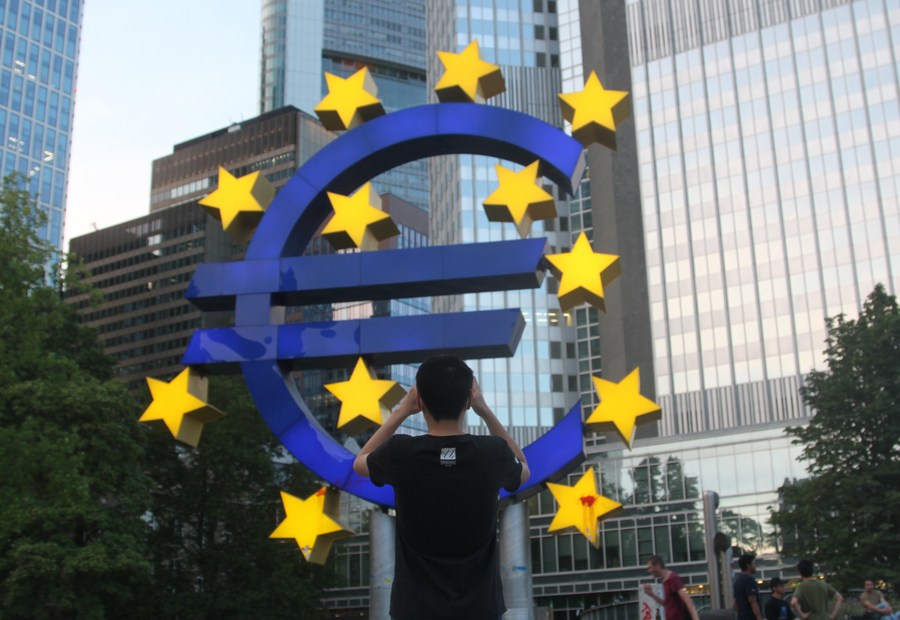
A man takes pictures of the Euro sculpture in Frankfurt, Germany, on July 12, 2022. (Xinhua/Shan Weiyi)
The GDP increased by 0.7 percent in the eurozone and by 0.6 percent in the EU in the second quarter of 2022. Tourism rebound after the removal of travel restrictions linked to COVID-19 has contributed to the growth.
BRUSSELS, July 29 (Xinhua) -- The gross domestic product (GDP) increased by 0.7 percent in the eurozone and by 0.6 percent in the European Union (EU) in the second quarter of 2022, compared with the first quarter, according to a preliminary flash estimate published by Eurostat, Europe's statistics office, on Friday.
In the first quarter of 2022, GDP grew by 0.5 percent quarter-on-quarter in the eurozone and 0.6 percent in the EU.
Tourism rebound after the removal of travel restrictions linked to COVID-19 has contributed to the growth. However, it is also masking "underlying weakness due to high inflation and manufacturing problems," according to Bert Colijn, a senior economist for the eurozone at the global financial institution ING.
These weaknesses include supply chain problems which in turn affect manufacturing, as well as high inflation that affects goods consumption. Retail sales are particularly suffering, he said.

A consumer shops at a supermarket in Brussels, Belgium, April 1, 2022. (Xinhua/Zheng Huansong)
According to Eurostat, annual inflation for July in the eurozone was up by 8.9 percent, mainly driven by the roaring price of energy. The price of energy should be up by 39.7 percent year-on-year in July, compared to 42 percent in June.
"Energy inflation was only slightly down at 39.7 percent as gas supply concerns are keeping prices elevated. The market prices for natural gas reached new peaks this month, translating into high consumer prices once again," said Colijn.
Yearly inflation for food and alcohol should go up 9.8 percent in July, compared to 8.9 percent the previous month.
"Food inflation also continues to trend up as higher transport costs, shortages and uncertainty around Ukrainian supply have pushed up producer prices which are still being priced through to the consumer," according to Colijn.
The price of non-energy industrial goods should go up by 4.5 percent year-on-year in July, compared to 4.3 percent in June. Yearly inflation for services is expected to reach 3.7 percent in July from June's 3.4 percent.
"Despite rising core inflation, very little of this is demand-driven. High input costs are therefore likely to be the main driver behind the rapidly rising consumer prices with some service sectors like tourism perhaps being the exception," according to Colijn.
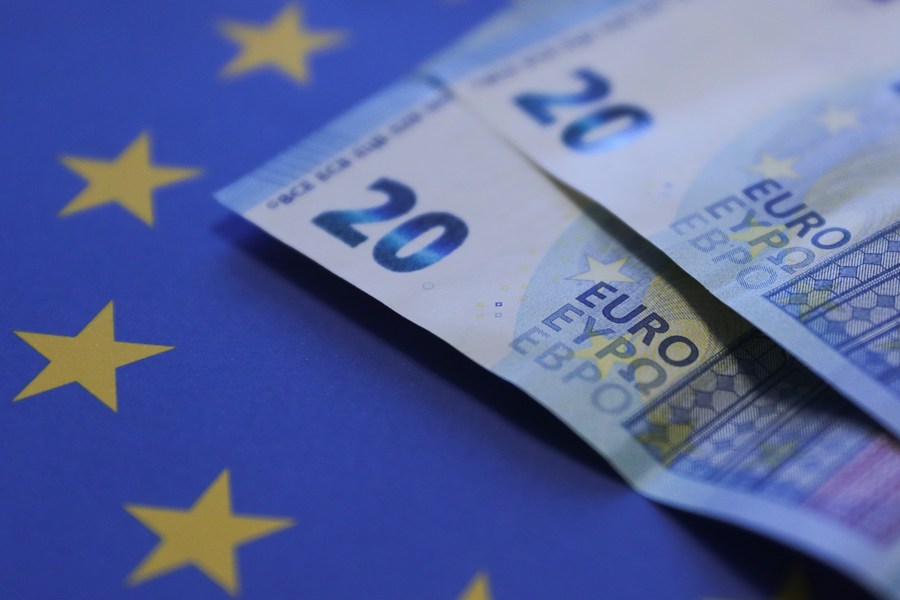
The 20-Euro banknotes are seen in Brussels, Belgium, Dec. 30, 2021. (Xinhua/Zheng Huansong)■