
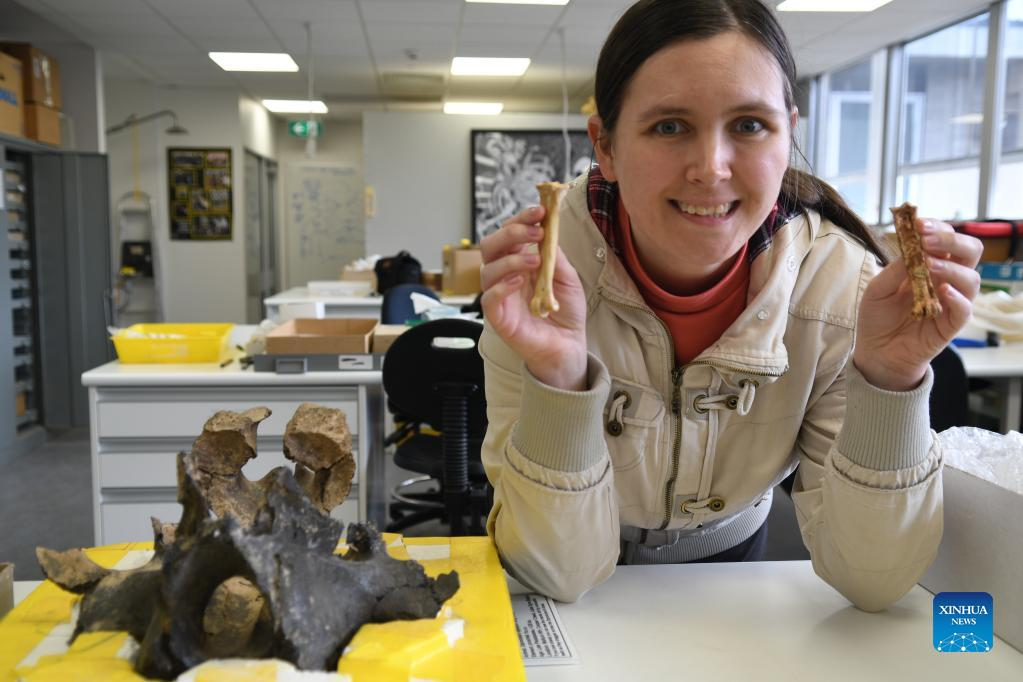
Photo provided by Flinders University on July 20, 2022 shows Ellen Mather, a palaeontology researcher from Flinders University and lead author of a study on ice age fossils, displaying a lower leg bone (L) of an old world vulture. Scientists studying ice age fossils have discovered vultures once lived in Australia. (Flinders University/Handout via Xinhua)
CANBERRA, July 20 (Xinhua) -- Scientists studying ice age fossils have discovered vultures once lived in Australia.
In a study published on Wednesday, the team from Flinders University and the South Australian Museum confirmed the discovery of Australia's first vulture species.
The extinct raptor, named Cryptogyps Lacertosus, roamed the Australian skies during the late Pleistocene period.
Its fossil was discovered in 1901 and wrongly classified as an eagle.
The new analysis found the fossil was an old world vulture, 16 species of which are still living outside of Australia.
"We compared the fossil material to birds of prey from around the world and it became clear right away this bird was not adapted to being a hunter, and so was not a hawk or an eagle," Ellen Mather, a palaeontology researcher from Flinders University and lead author of the study, said in a media release.
"The features of the lower leg bone are too underdeveloped to support the musculature needed for killing prey. When we placed Cryptogyps in an evolutionary tree, this confirmed our suspicions that the bird was a vulture."
Based on the leg bones, they inferred that Cryptogyps did not actively hunt but scavenged dead animals left behind by other predators.
"This discovery also reveals that the diversity of our predatory birds was much greater in the past. More significantly, the extinction of vultures in Australia has major ecological implications," Mather said.
"Vultures play a very important role in ecosystems by accelerating the consumption of carcasses and reducing the spread of diseases." ■


