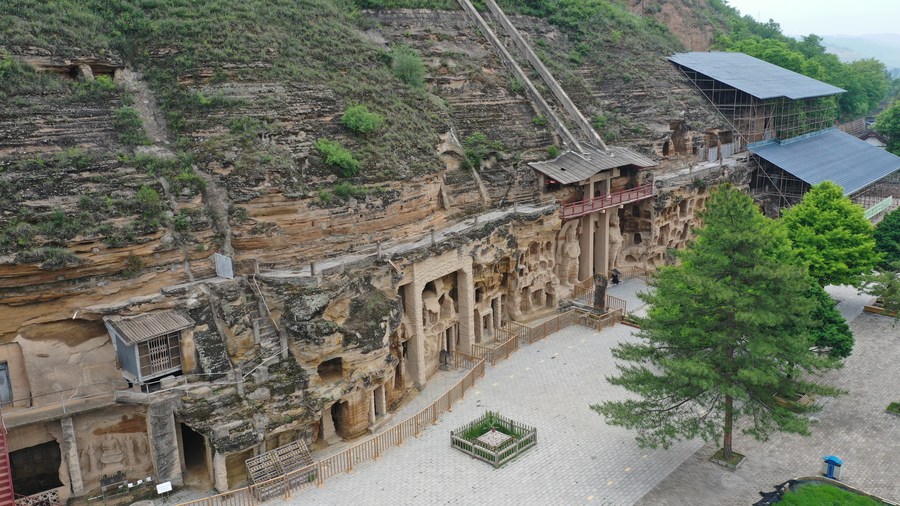
Aerial photo taken on May 26, 2022 shows a view of the North Grotto Temple in Qingyang, northwest China's Gansu Province. The North Grotto Temple in Qingyang consists of 308 ancient Buddhist caves that date back to the early sixth century. Featuring more than 2,000 statues, the site is considered as a vault of art in Chinese Buddhism. (Xinhua/Du Zheyu)
LANZHOU, June 6 (Xinhua) -- Ahead of the upcoming rainy season, waterproof sheds and enhanced monitoring systems have been set up to protect the North Grotto Temple, dating back over 1,500 years, located on the loess hills in northwest China's Gansu Province.
Nestled on yellow sandstones on the outskirts of Qingyang, a city along the ancient Silk Road, the grottoes of the temple were initially built in the late Northern Wei Dynasty (368-534). The temple, featuring Chinese Buddhism art, comprises 308 caves and more than 2,000 statues.
Sandstones absorb a vast amount of water, which can cause dampness and induce chemical reactions, damaging the strength of the grottoes, said Li Liang, deputy director of the cultural heritage preservation institute at Dunhuang Academy.
The area around the temple was lashed by rain for 28 consecutive days last September, and the precipitation surpassed 900 mm last year, posing challenges to the protection of the grottoes, according to the institute.
A pilot project was launched in 2021 to set up temporary waterproof sheds in the southern part of the temple. "The waterproof sheds can drain water from cliffs, preventing rainwater from penetrating sandstone crevices," Li said.
The validity of the project has been proved by monitoring results on humidity and penetration over the past year, Li said, adding that more sheds will be built this year to shield the entire temple area. To date, the temple has established 155 monitoring spots, which collect information on meteorology, microbes and the micro-environment.
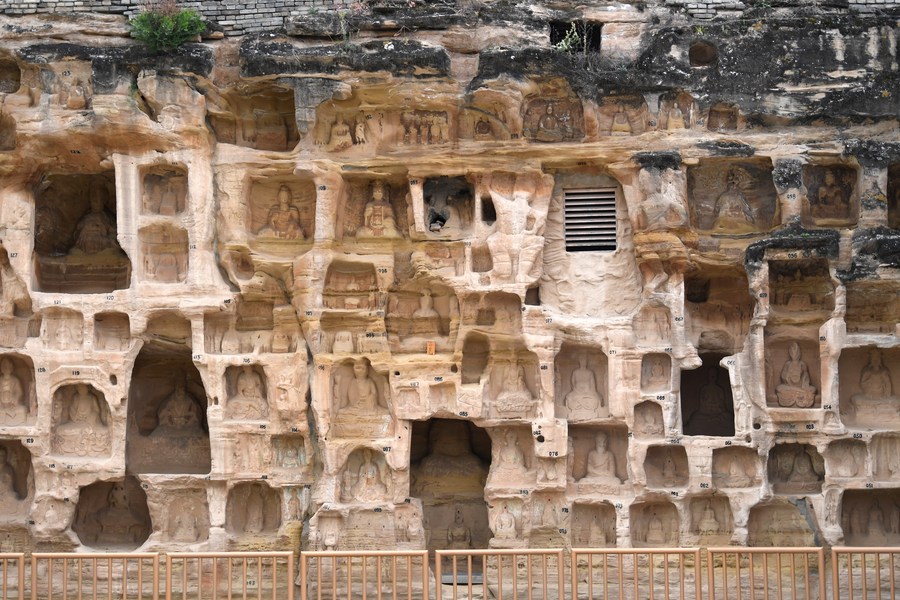
Photo taken on May 26, 2022 shows a view of the North Grotto Temple in Qingyang, northwest China's Gansu Province. The North Grotto Temple in Qingyang consists of 308 ancient Buddhist caves that date back to the early sixth century. Featuring more than 2,000 statues, the site is considered as a vault of art in Chinese Buddhism. (Xinhua/Chen Bin)
College students are also invited to conduct field surveys at the temple. During one such visit, Liu Dan, a PhD student from Lanzhou University, specializing in Dunhuangology, recorded the conditions of the statutes, carved stones and murals with her peers at cave No. 165.
She said the conservation of grottoes in China is gradually becoming more comprehensive and professional. "I hope I can fully utilize my expertise to protect the charm of the ancient grottoes with the help of advanced technology." ■