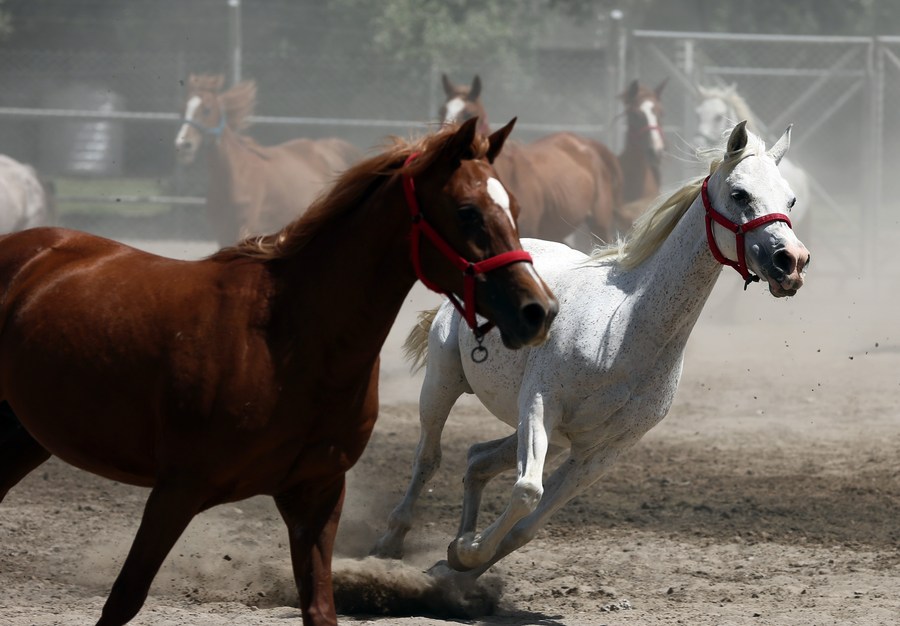
Arabian horses are seen running on a field at the al-Zawraa Park in Baghdad, Iraq, on May 26, 2022. (Xinhua/Khalil Dawood)
An Iraqi veterinarian in the Iraqi capital Baghdad has been working hard for nearly 20 years in hope to realize his dream of resurrecting the horse industry in Iraq.
BAGHDAD, June 4 (Xinhua) -- Back in 2003 during the U.S-led invasion of Iraq, Bakr Farouq, an Iraqi veterinarian, managed to save 16 rare purebred Arabian horses owned by former Iraqi leader Saddam Hussein.
Farouq, now the head of Arabian Horse Care Department in Baghdad's al-Zawraa Park, then risked his life in evacuating the horses, owned by Hussein's Arabian Knight Club, from the presidential palace to the Iraqi Equestrian Club in the al-Ameriyah neighborhood in the capital Baghdad.
Farouq concealed the documentation of the horses in his house to protect them from looting, after the American soldiers reached Baghdad and ousted Saddam's regime.
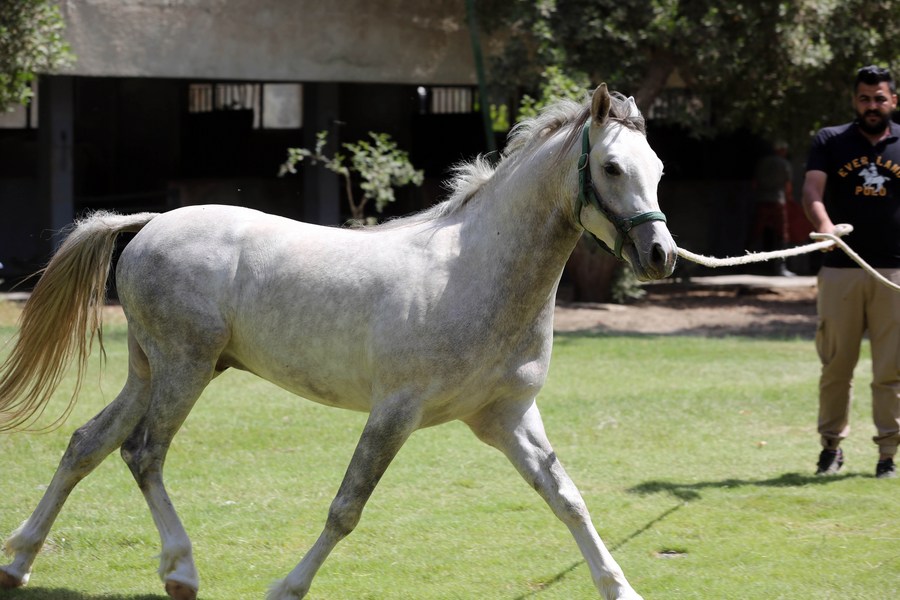
A horse trainer trains a purebred Arabian horse at the al-Zawraa Park in Baghdad, Iraq, on May 26, 2022. (Xinhua/Khalil Dawood)
"Most of the horses were killed, starved, stolen, or smuggled and sold abroad," he recalled.
Farouq, helped by the director of al-Zawraa Park, saved only 16 of more than 100 horses from the Arabian Knight Club with the assistance of security forces.
There were offers from both inside and outside Iraq for buying the 16 horses with offers reaching up to 50 million U.S. dollars, "but we rejected all of these offers because we believe the horses are the country's wealth," Farouq said.
With the 16 horses, the Iraqi government later opened a horse care department in the al-Zawraa Park to preserve the horses' bloodlines. The horses later produced more foals, bringing the total number of purebred Arabian horses in the park to 48 now.
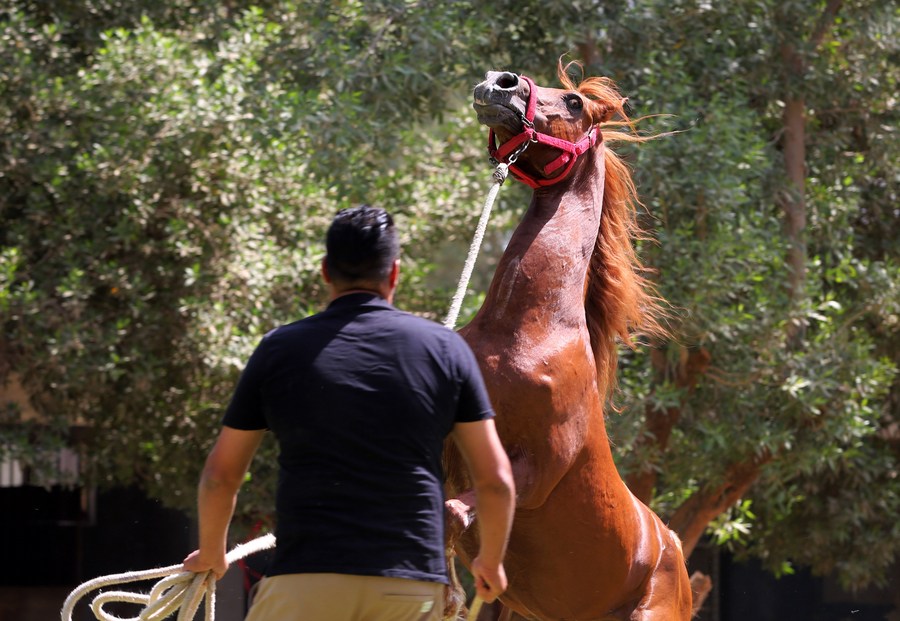
A horse trainer trains a purebred Arabian horse at the al-Zawraa Park in Baghdad, Iraq, on May 26, 2022. (Xinhua/Khalil Dawood)
Arabian horses serve as a link to thousands of years of equine history in the Middle East, which is intertwined with the region's Arab heritage.
Arabian horses were bred by the Bedouins, a nomadic people who valued their horses and carefully chose breeds. They are beautiful, friendly, and devoted to their owners, as well as robust and agile, qualities that make them suitable for tough desert circumstances and wars.
Baghdad's once-thriving horse racing industry was one of the most successful in the Middle East, attracting the city's elite to the old location in the capital's upscale Mansour area.
However, three wars beginning in the 1980s, 13 years of economic sanctions, and more than 30 years of international horse racing bans due to Iraq's failure to meet the conditions set by the World Organization for Animal Health have left the country's horse racing in shambles, with many breeders leaving and many horses dying.
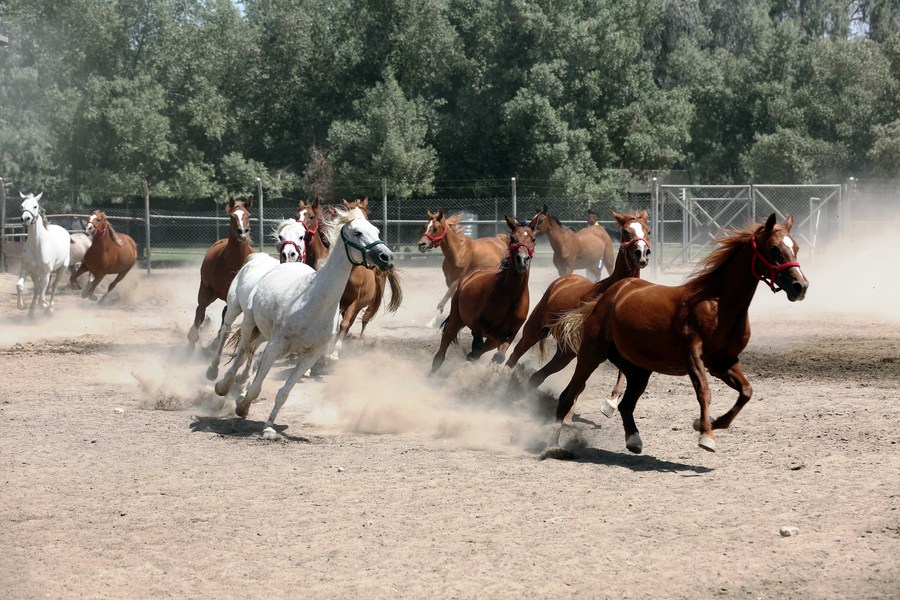
Arabian horses are seen running on a field at the al-Zawraa Park in Baghdad, Iraq, on May 26, 2022. (Xinhua/Khalil Dawood)
In the Iraqi Equestrian Club in western Baghdad, a few dozen men gathered in groups either at a makeshift spectator stand or in a nearby hall overlooking one end of the dusty track, watching the jockeys in white pants and colorful silky shirts racing to the finish line.
Jamal Rasheed, 55, a veterinarian and director of the Iraqi Equestrian Club's Arabian Horse Registration Department, told Xinhua that UN sanctions and wars in Iraq had a severe impact on the club and horse breeding.
"We still have a lot of work to do to rehabilitate the horse racing," Rasheed said, adding that the club lacks a stadium and other infrastructure, including a good racing track.
There is also a need to support the breeders, many of whom are using the club's stables, according to Rasheed. The club has 146 stables, each with 16 stalls.
Being a self-supporting and independent organization, the club's capacities were limited, he said, adding he hoped that the Iraqi government would support the club, allowing it to contribute to the restoration of a part of Iraq's national heritage.
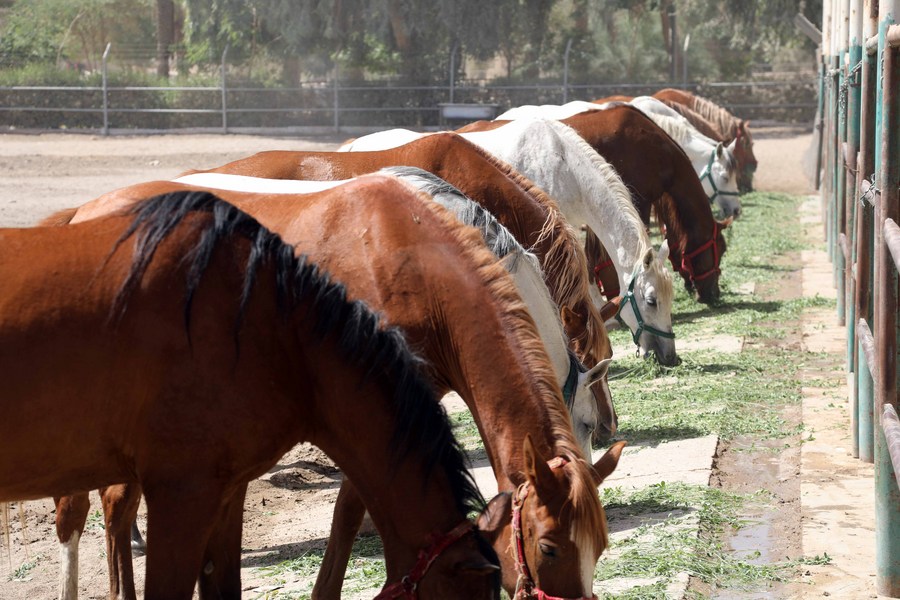
Arabian horses are seen being fed at the al-Zawraa Park in Baghdad, Iraq, on May 26, 2022. (Xinhua/Khalil Dawood)
"Horses have long been associated with the Iraqi society, and Iraqis have cared for their horses since ancient times. They have a fondness for horses and even named them after their sons and daughters in the past," said Kadhim Mohammad Ali, director of the Iraqi Central School for Equestrian Education.
"Sometimes horse breeders are more concerned with feeding their horses than feeding their sons," he noted, adding that such passion even leads to conflicts in horse lovers' families.
Farouq, who has been working hard over the past years to preserve the purebred Arabian horses, hoped his efforts to preserve and revive the horse industry in Iraq will not be in vain.
"All of our horses are purebred Arabian horses registered with the World Arabian Horse Organization in the United Kingdom, and they are now up to both international and Iraqi standards," Farouq said. ■