
People cool off in a water pool on a hot summer day in Prayagraj district of India's northern state of Uttar Pradesh, May 15, 2022. (Xinhua/Stringer)
The extreme heat in India is consistent with a changing climate, and heatwaves are more frequent and more intense and now start earlier than they did in the past, the World Meteorological Organization said.
NEW DELHI, June 1 (Xinhua) -- An ongoing heatwave has taken large swathes of India in its grip. In March and April, it was recorded as the warmest in 122 years in India.
However, the driving-up temperatures beyond normal in the majority parts of India in March and April is emerging as a cause of concern. The heatwave forced millions of people indoors during the daytime.
The heatwave pushed temperatures past 50 degrees Celsius in some areas. According to a local newspaper report, heatstroke claimed 25 lives in Maharashtra this year, the highest in six years.
"Data from the health department showed over 374 cases of heat stroke have been reported in March and April, although experts say the actual number could be much higher," the newspaper said.
Doctors say heatstroke is a serious heat-related emergency that occurs when the body is unable to control its internal temperature due to exposure to heat.
India is already hard-hit by climate change. Extreme heat is common in May, and the past months were the hottest across much of the country for more than a century.
"The month of May always used to be hot in Delhi. But this year it was totally unbearable in March as well as April," said Tanveer Alam, a Delhi resident. "It was smoldering hot and humid, which made it difficult to bear."
However, a large part of the population in India still works outside in the fields, on building construction, and in factories without air conditioning facilities. Images from India's capital city showed hundreds of poor people, who could not afford air conditioning, taking refuge under flyovers and bridges.
"We live in a hutment and to fight the heatwave, we used to soak clothes in water and hang them on doors and windows to get a whiff of cold breeze inside," said Satish Rajan, a daily wage worker. "During the break in work, we either sit inside the shade of trees or take refuge under the buildings."
The heatwave came at a time when India witnessed a power outage due to a shortage of coal stocks at the thermal power plants. The electric fans and air conditioners pushed India's electricity demand to a record high.
About 70 percent of India's electricity is generated by coal. The authorities canceled hundreds of passenger trains to allow faster movement of coal carriages to tackle critically low stocks at power plants.

People cool off in a water pool on a hot summer day in Prayagraj district of India's northern state of Uttar Pradesh, May 15, 2022. (Xinhua/Stringer)
UNYIELDING HEATWAVES
The unbearable weather may have been caused by a combination of meteorological factors, the British meteorological office explained.
Entire central India is currently the sub-solar point of Earth (region directly under the sun at mid-day), according to the agency, "The largely dry landmass as the dry northeast monsoon continues is baked by the directly overhead sun," it added.
The temperatures predicted by the office are 5-7 degrees above normal for this time of the year.
It said that the blistering heatwave in northwest India and Pakistan was made over 100 times more likely because of human-caused climate change.
IMPACT ON WHEAT HARVEST
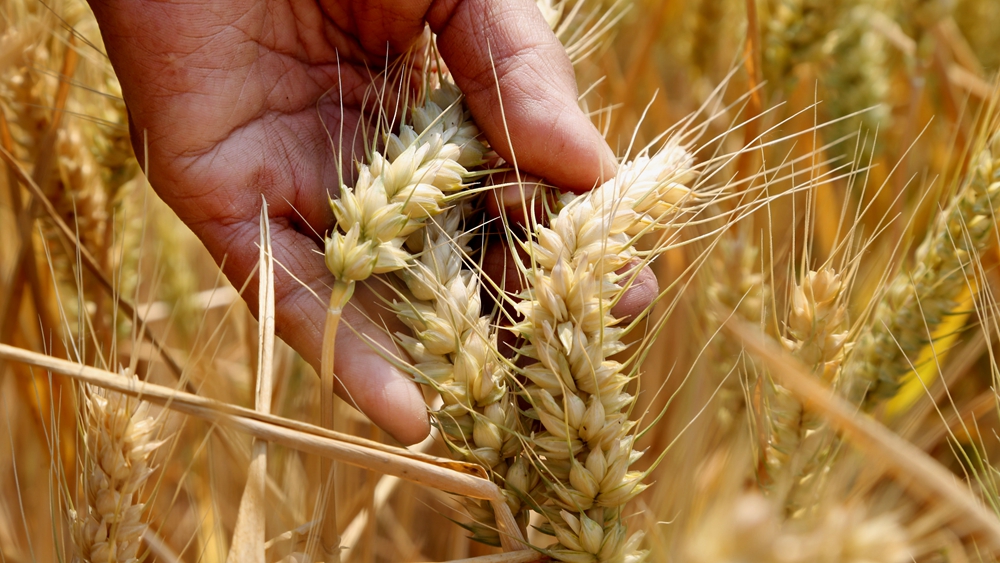
The ongoing heatwave has led the Indian government last month to limit wheat exports. The step was taken after reports said that the heatwave has cut down yields by roughly 20 percent.
India is the world's second-biggest wheat producer and was hoping to boost wheat exports to help make up for a shortfall in global grain supplies.
Farmers in the northern state of Punjab - the country's breadbasket- complain of reduced crop yields.
"The grain that we harvested was shriveled due to intense heat," said Kartar Singh, a farmer. "Predictions are being made that crop may drop by 10-12 million tonnes. However, the estimates will get clear in a couple of months down the line."

People cool off in a pool on a hot summer day in Prayagraj district of India's northern state of Uttar Pradesh, May 15, 2022. (Xinhua/Stringer)
HEATWAVE BLUES
A heatwave is declared when an area logs a maximum temperature of 45 degrees Celsius or is at least 4.5 notches above normal.
According to India Meteorological Department (IMD), a severe heatwave is declared if the departure from normal temperature is more than 6.4 notches or the maximum temperature crosses the 47-degree Celsius mark.
Weather experts have attributed the high temperature across the country to the absence of periodic light rainfall and thundershowers, typical for this time of the year, due to the lack of active western disturbances.
Northwest India saw at least four western disturbances in March and April, but they were not strong enough to cause a significant change in the weather.
The region did not see any significant pre-monsoon activity from March 1 to April 20 which compounded the severity of the successive heatwave spells, thereby casting a ripple effect on central India too.
Experts say anticyclones over western parts of Rajasthan in March and the absence of western disturbances had triggered the early and extreme heatwaves. Anticyclones cause hot and dry weather by sinking winds around high-pressure systems in the atmosphere.
The extreme heat in India is consistent with a changing climate, and heatwaves are more frequent and more intense and now start earlier than they did in the past, the World Meteorological Organization (WMO) stated.■