In a month we can weave up to 70 baskets of different sizes and each member can receive about 15,000 shillings (about 129 U.S. dollars), says Peninah Mueni, leader of a women weavers' group in Machakos County, east of Nairobi, the Kenyan capital.
NAIROBI, May 8 (Xinhua) -- A group of women deftly weave sisal baskets under the cover of a tree in a sleepy Katangi village in Machakos County, east of Nairobi, the Kenyan capital.
For these women, weaving has become a crucial source of economic empowerment and a significant part of their cultural heritage.
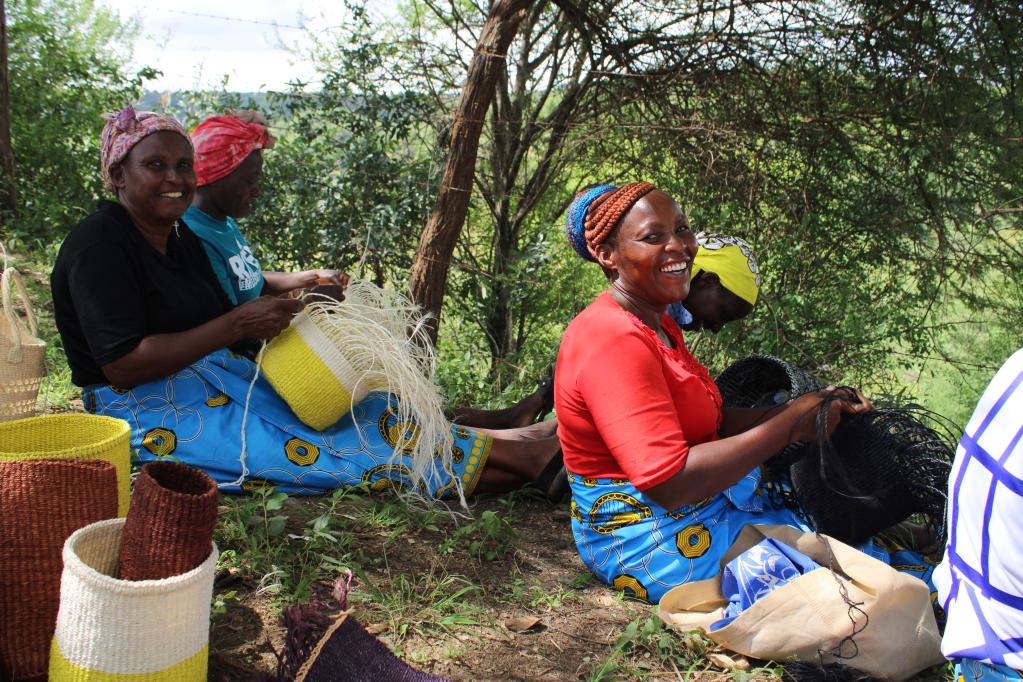
Women weave baskets at Katangi village in Machakos County, Kenya, on May 3, 2022. (Photo by Chrispinus Omar/Xinhua)
"The way I am dressed and the way I look is because of doing this kiondo (basket) business. I do not have anyone helping me," Peninah Mueni, the group's chairlady, told Xinhua in a recent interview. "Weaving has seen me educate my children and do other things which would have been impossible if I were not weaving."
Mueni's association of weavers which was founded in 2015, hails from the Kamba tribe, a Bantu-speaking community that resides in the vast southeastern Kenyan lowlands.
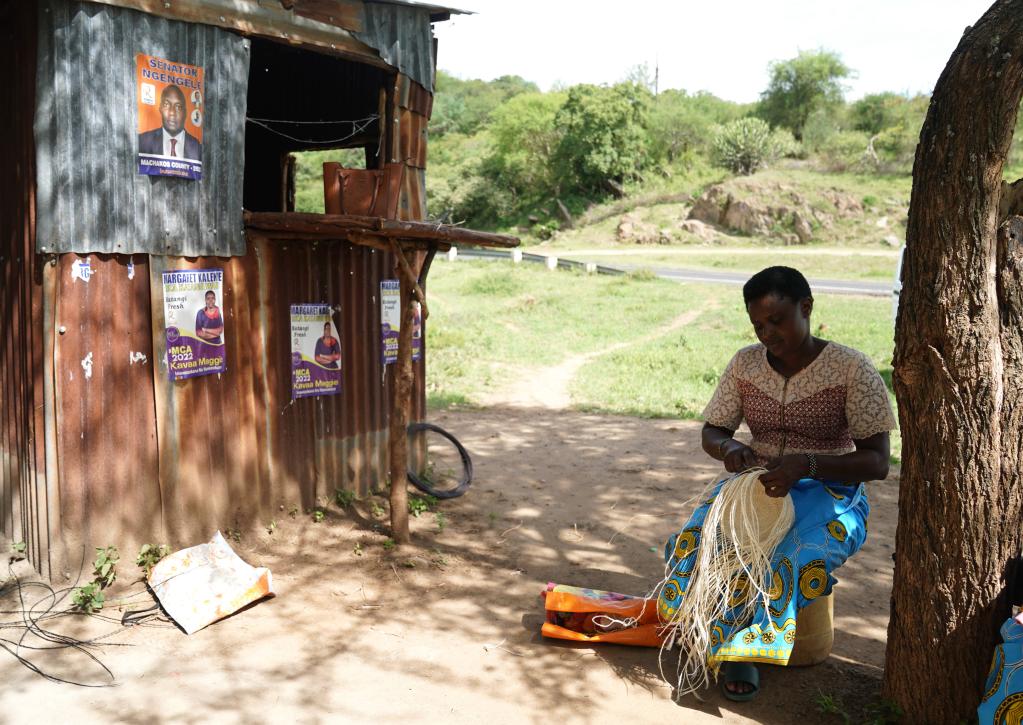
A woman weaves a basket at Katangi village in Machakos County, Kenya, on May 3, 2022. (Xinhua/Dong Jianghui)
The name of the group in translated English means to love your neighbor. It constitutes 30 women of mixed ages who identified a need to generate income amid scarce employment opportunities and low levels of education.
"In a month we can weave up to 70 baskets of different sizes; each member can receive about 15,000 shillings (about 129 U.S. dollars). After we fulfill an order, each member is paid according to the number of baskets they have weaved," said Mueni.
Their most recent order came from South Africa, where they sold 100 small baskets. Other international markets that they have penetrated include Ghana and China. Word of mouth has proven a successful marketing strategy for the women weavers.
The women unanimously agree that the group has been supportive when one of them falls into misfortune.
"We are like sisters here, we support each other with what we can, if one of us is sick we pool resources to support them. If someone has fallen sick in the middle of weaving we take up their project and still pay them," said Mueni.
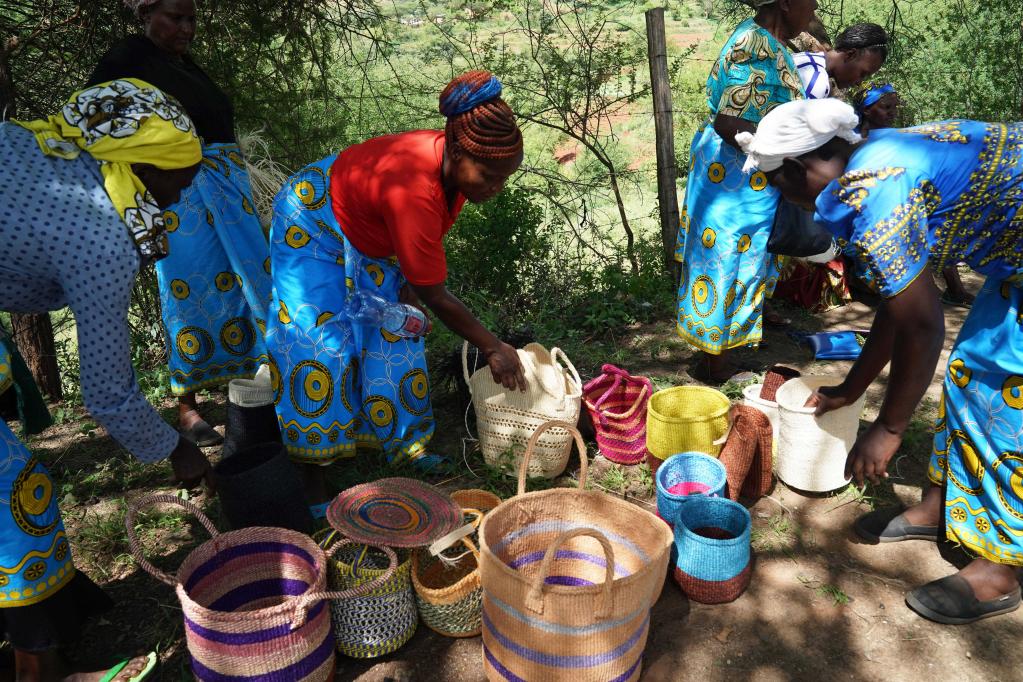
Women sort baskets at Katangi village in Machakos County, Kenya, on May 3, 2022. (Xinhua/Dong Jianghui)
The group's business acumen is demonstrated in their subsequent investments. They have bought 100 goats which they dispose of during important holidays such as Christmas. In addition, they are the title deed holders of a small piece of land within their locality.
"The goats are distributed among the members with each receiving a certain number to look after," Mueni told Xinhua.
Jecinta Kimeu loops over one sisal fiber over the other, unheeding the exhaustion in her hands. It is an activity she has been doing since she joined the group at its inception.
"I can weave around 10 bags in a month and earn some money to fulfill family and personal needs. The group has helped me and I see myself continuing with this trade for a long time to come," said Kimeu.
In Kenya, the art of basket weaving is a long-standing tradition practiced by the Kamba, Kikuyu, and Giriama ethnic communities. It is an enduring undertaking that forms the identity of these Bantu tribes.
The preferred materials for weaving include sisal, reed, papyrus, bamboo and banana leaves.
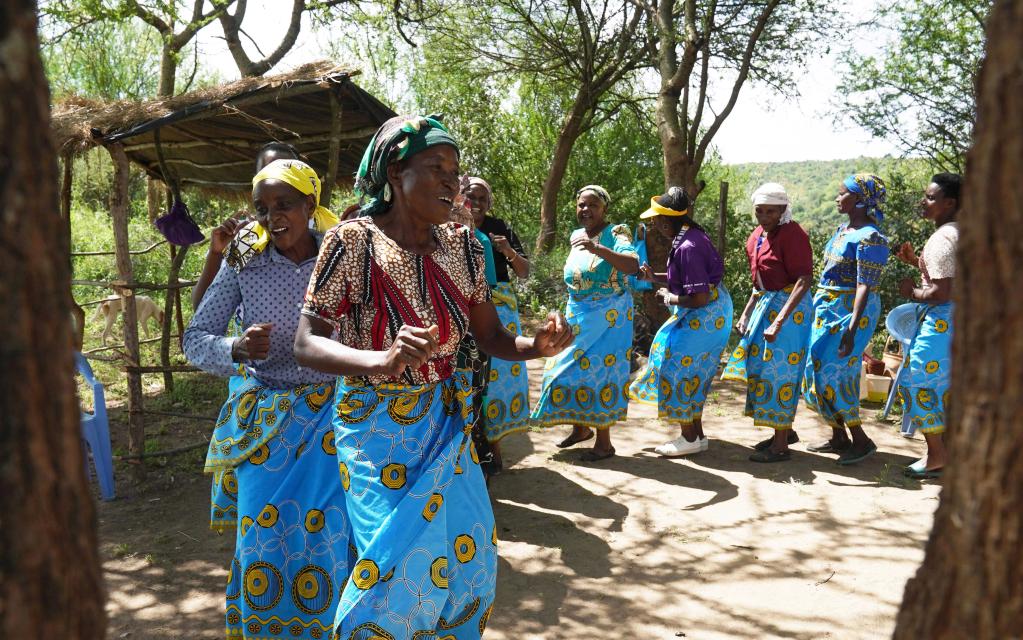
Women dance at Katangi village in Machakos County, Kenya. (Xinhua/Dong Jianghui)
At present, weavers line the inside of the baskets with a cloth and add leather straps as handles among other modern embellishments to resonate with the modern-day customer.
Kimeu affirms that the women have been compelled to tweak their weaving techniques to create better contemporary designs.
At only 24 years, Irene Syombua is the youngest in the group. She joined the women after witnessing their lives changed by weaving.
"As I sat with the women I saw that they made money and that changed their lives whereas I did not have anything to do. I am currently in the process of learning how to weave," said Syombua.
She offers advice to young people to desist from favoring white-collar jobs and instead try out whatever legal income-generating opportunity they stumble upon.
With the entry of young people such as Syombua, Mueni, the chairlady, says that the art is likely to enjoy longevity and prosperity.
Among the challenges endured by these women include difficulties in market access, highly-priced raw materials, and exploitative middlemen. ■