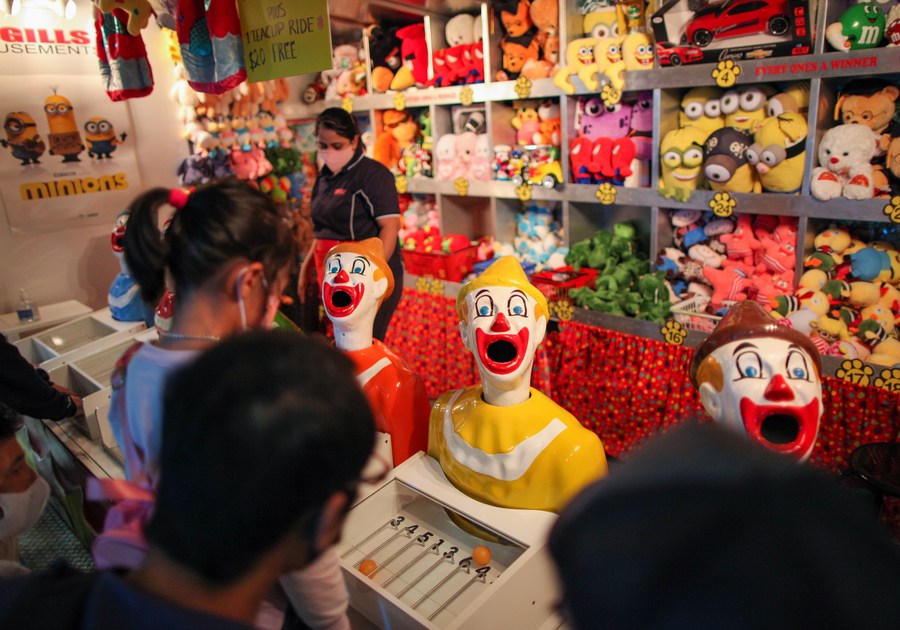
People wearing masks play at Easter Family Fun Festival in Auckland, New Zealand, on April 15, 2022. (Photo by Zhao Gang/Xinhua)
"I am literally losing 200 dollars a day now," says Sonny Sun who owns a small retail shop in Auckland CBD as New Zealand has relaxed COVID-19 restrictions.
WELLINGTON, April 26 (Xinhua) -- Sonny Sun who owns a small retail shop located in the central business district (CBD) in New Zealand's largest city Auckland, is not sure of the business outlook.
Small businesses have suffered a lot amid COVID-19 in New Zealand, and they are still struggling as New Zealand has loosened COVID-19 restrictions nationwide.
Sun's business used to be brisk before the pandemic when white-collar workers, tourists and international students were swarming across the busy commercial area.
"Business was very good in 2017 and 2018. I used to have four employees working for me," Sun said.
To avoid being infected amid COVID-19, many people in New Zealand have worked at home to reduce social activities. Now walking down the once busy Queen Street in Auckland CBD, it is not uncommon to find homeless people and rough sleepers sheltering themselves in front of many of the empty shops. News of crime was heard now and then.
"I have to shorten the business hour of my shop. It is very unsafe at night time here. I can't risk my employees' or my safety for just several dollars of income," said Sun.
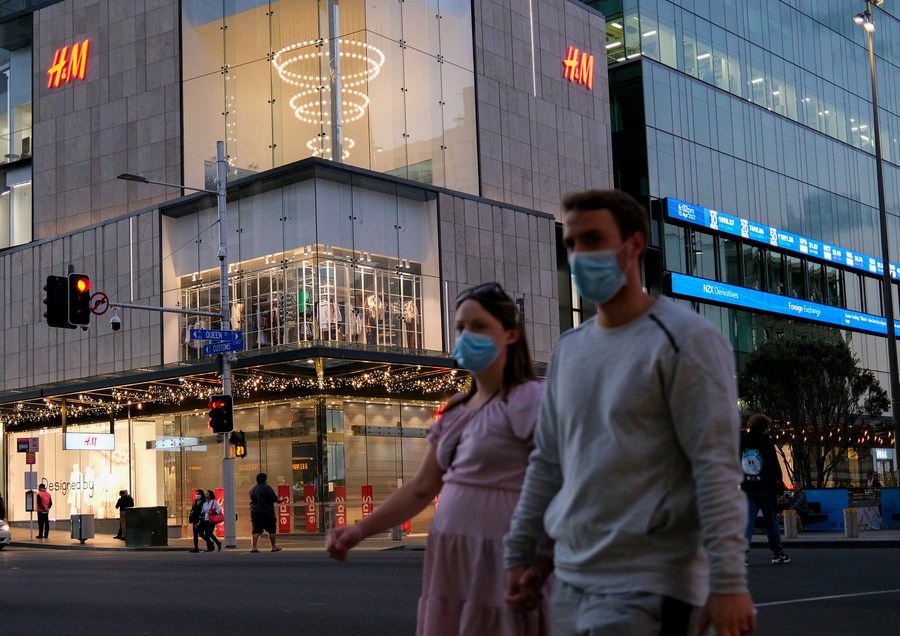
People wearing masks walk in downtown Auckland, New Zealand, on April 15, 2022. (Photo by Zhao Gang/Xinhua)
Sun has already lost most of his customers, some employees and revenue amid the pandemic. "My deficit reached 70,000 New Zealand dollars in 2020," said Sun.
Sun got wage subsidy and business support from the government during the lockdowns and the highest Red settings under the country's COVID-19 Protection Framework. "Even with subsidies, incomes can't cover the rent costs," Sun said. "I am literally losing 200 dollars a day now."
With the easing of COVID-19 restrictions, there will be no subsidy to businesses, and the relaxation of COVID-19 restrictions has not yet worked to bring many customers to Sun's business. "People just don't visit the CBD anymore," he said.
Earlier this month, New Zealand moved down to the second highest Orange settings under the COVID-19 Protection Framework, which sets no indoor capacity limits. The New Zealand borders are reopening in stages.
However, New Zealand reported its first case of the Omicron XE variant of COVID-19 on Saturday. The Health Ministry said the case was a person who traveled from overseas to New Zealand.
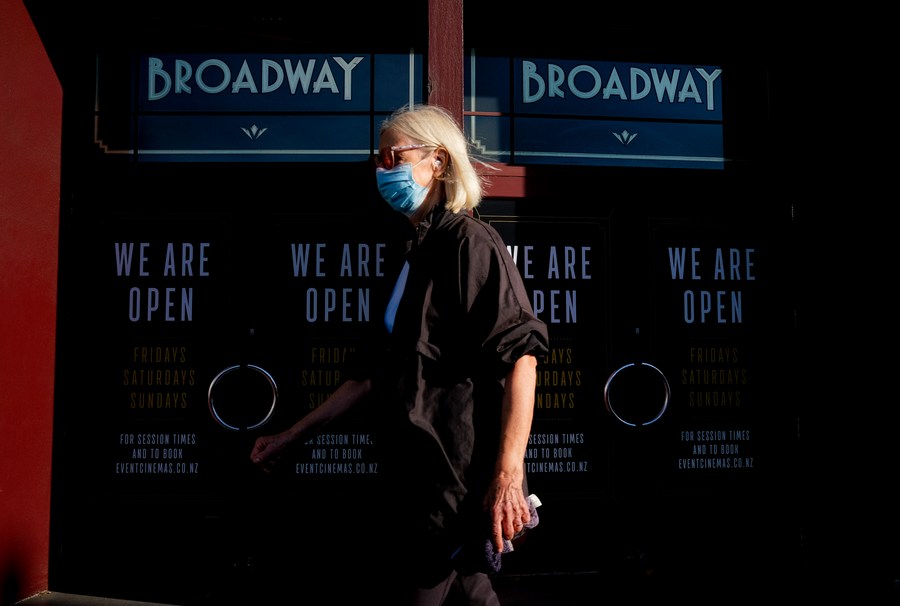
A woman wearing a mask passes by a theater in downtown Auckland, New Zealand, on April 16, 2022. (Photo by Zhao Gang/Xinhua)
Experts have warned that New Zealand could possibly see another spike in cases.
"It's a good approach to not get rid of all our public health measures in one go as some countries have done, because that does create a risk that you get a big rebound, and a second wave," New Zealand COVID-19 modeler Professor Michael Plank told local media.
Professor Michael Baker said, "I think governments have taken too many restrictions off too early. I think we're going to see more waves of omicron -- hopefully not as bad, but I'd strongly recommend that we keep some of the basic restrictions in place, the ones that are not too disruptive."
"Certainly masks in public places, certainly people should make an effort to keep their distance," the New Zealand epidemiologist was quoted as saying.
As uncertainty over COVID-19 looms, and earning money is more difficult, the living expense in New Zealand is soaring for the average people.
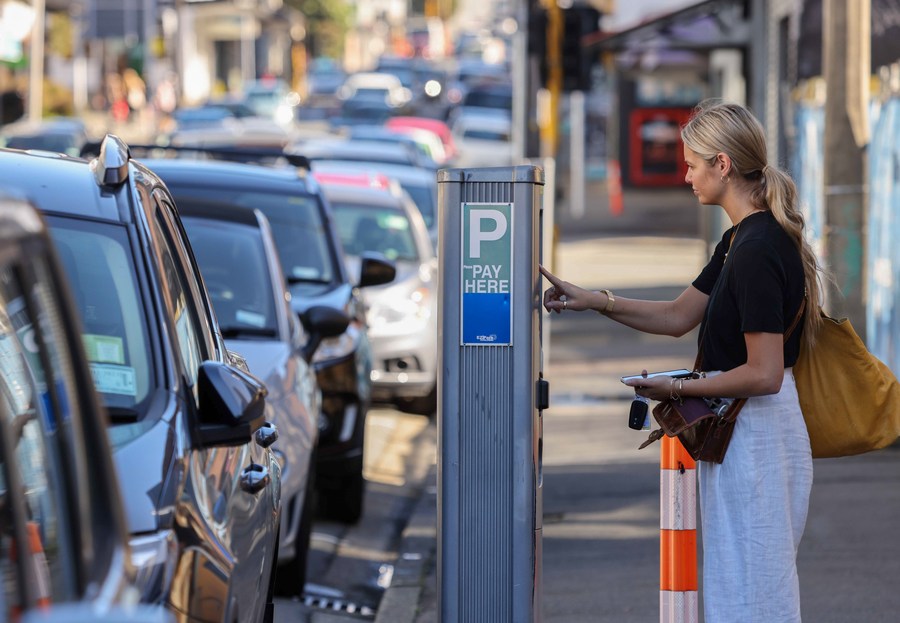
A woman pays for parking fee on a street in Wellington, New Zealand, April 22, 2022. (Photo by Meng Tao/Xinhua)
New Zealand's consumer price index (CPI) increased by 6.9 percent in the March 2022 quarter from a year earlier, the largest movement in about 32 years, showed official data. Meanwhile, consumer confidence is at a low level.
Kenny Teo, a Malaysian Kiwi, sold his motel business in central Auckland last month, just 12 months after he bought it from the previous owner. The spacious and beautiful villa used to be a well-known Airbnb, but in the past two years witnessed three swaps of the business owners.
"We just can't afford to lose more money. We already lost too much. No business here for far too long as nobody comes here. I decided to break losses and to do something else," Teo said.
For now, Sun is still hanging on. When asked about his next move, Sun remained silent for a while, and said, "I don't know."■