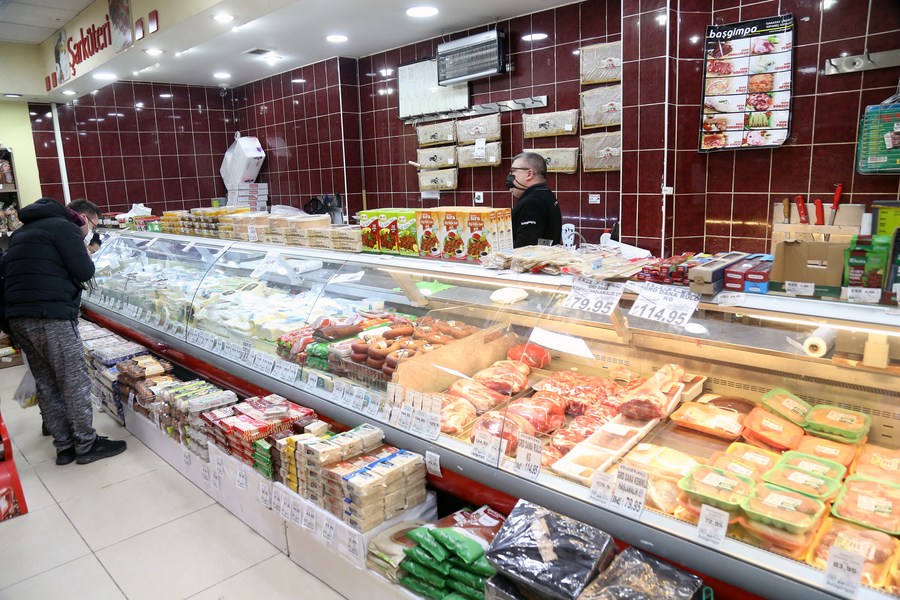
People shop at a supermarket in Ankara, Turkey, on April 4, 2022. Turkey's annual inflation hit a new record high at 61.14 percent in March, featuring rising energy and food prices, the Turkish Statistical Institute announced on Monday. (Photo by Mustafa Kaya/Xinhua)
Beef, lamb, chicken, a wide range of breakfast foods, dried fruits and nuts used to be among the indispensable meals on a modest table for most fasting Turkish people during Ramadan.
However, due to the recent price hikes in almost all food products, many people are now having difficulty setting up a decent Ramadan table this year.
ISTANBUL, April 5 (Xinhua) -- As the Muslims' holy month of Ramadan began on Saturday, many Istanbul residents have flocked to the Eminonu neighborhood, which is filled with food shops, to prepare a delicious Ramadan table.
A retired woman bought one kilo of feta cheese and 500 grams of black olive, paying 100 Turkish liras (6.79 U.S. dollars) at a grocery store where she frequently does her shopping.
"I also wanted to add some sausage to the bag, but its price was insane, so I had to drop it," Refia Arslan told Xinhua.
Beef, lamb, chicken, a wide range of breakfast foods, dried fruits and nuts used to be among the indispensable meals on a modest table for most fasting Turkish people during Ramadan.
However, due to the recent price hikes in almost all food products, many people are now having difficulty setting up a decent Ramadan table this year.
The increase in prices in import-dependent Turkey is mostly prompted by its long-lasting high inflation, which hit a new record high at 61.14 percent in March, and the crisis in Ukraine, which jeopardized the supply of food products, such as cooking oil.
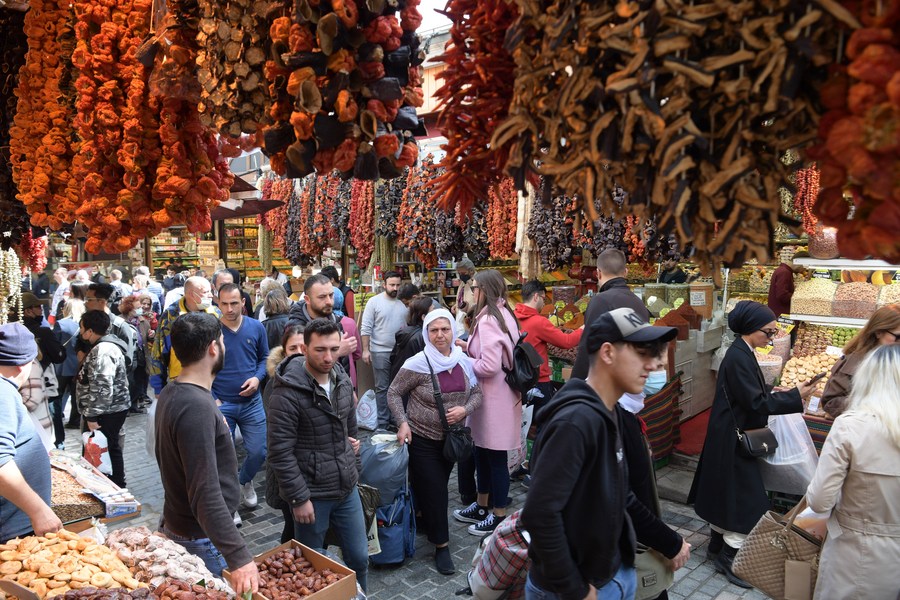
People doing their Ramadan shopping in the Eminonu neighborhood in Istanbul, Turkey, April 2, 2022. (Xinhua/shadati)
The country has also been struggling against the depreciation of its currency against the U.S. dollar. One dollar was traded at 14.70 liras on Tuesday morning.
Last year, flour, salt, sugar, cheese, olives, sausage, eggs, pasta, chicken, rice, and tea were the most preferred products in the Ramadan shopping cart of Turkish people, according to Ipsos, a multinational market research and consulting firm.
However, Ipsos's latest survey in Turkey revealed that most Turks slashed their shopping items, to only flour, salt, sugar, pasta, and a few breakfast products this year due to the high cost of living.
The survey said six out of ten people are worried that they will not be able to set up rich Ramadan tables and that their household expenses for iftar and suhur dinners in Ramadan will increase.
"There is a big difference in prices between last year's Ramadan and this year," Arslan added. "I just paid 72 liras for one kilo of feta cheese. It was 50 liras last year."
Meanwhile, shop owners in Eminonu have been complaining about the low sales.
Gorkem Yavuzer, an owner of a dried fruit and nuts store, said his revenues have dropped by at least 50 percent this Ramadan due to skyrocketing price hikes. "There is a change in the Ramadan tables due to the decline in purchasing power. They are not as lustrous as they used to be," Yavuzer told Xinhua.
Hafiz Muhammed has been selling breakfast food in his store in the neighborhood for about 15 years.
"I have seen many Ramadans and had many beautiful Ramadans, but this one is different. It is stagnant. It is not as busy as it used to be," Muhammed said.
"In the past, we used to fill the counter several times a day with new products," he said, adding that this year the sales have nosedived.
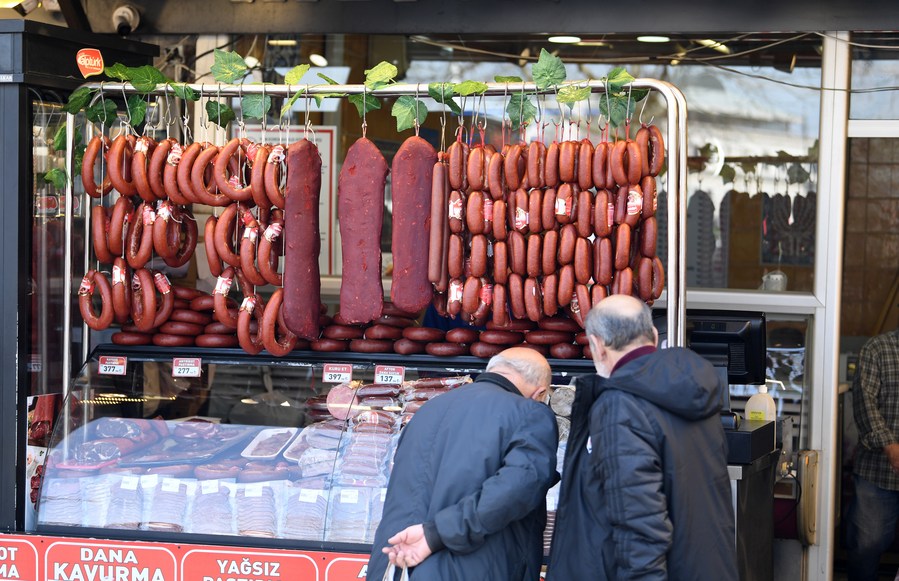
People doing their Ramadan shopping in the Eminonu neighborhood in Istanbul, Turkey, April 2, 2022. (Xinhua/shadati)
Kaan Gizep, 57, an owner of a security firm, was shopping with his wife for Ramadan.
"We are having a hard time. I have never seen such a rapid increase in price in my life, although we have seen previous inflationary periods in the country," he noted.
He said people need to spend at least 500 liras for a reasonable Ramadan table, but for pensioners and workers earning the minimum wage, this is unaffordable.
Meat prices also went up significantly in March, placing most citizens in even greater difficulty.
Turkey's fodder industry is heavily dependent on foreign sources, and the increasing raw material costs, such as wheat, bran, corn, sunflower meal, and soybean, due to the Ukraine crisis, have put an extra burden on producers' shoulders.
To help citizens cope with the rising costs, the Turkish government increased the monthly minimum wage by 50 percent to 4,250 liras, and the pensions of retirees also saw a 30.5-percent hike. ■