For decades, tensions and conflicts have been running high in DR Congo's Ituri province, where many people had no choice but to flee their homes and take refuge in IDP camps scattered across the province.
Survivors of bloodshed are battling trauma and weaving life in camps for internally displaced people (IDP) in Ituri, northeastern Democratic Republic of the Congo, following decades-long conflicts.
BUNIA, DR Congo, March 30 (Xinhua) -- Hundreds of thousands of people, all survivors of bloodshed and militia attacks, are battling trauma and weaving life in camps for internally displaced people (IDP) in Ituri, a northeastern province of the Democratic Republic of the Congo (DRC), following decades-long conflicts.
For decades, tensions and conflicts have been running high in this part of the country, where hundreds of thousands of people had no choice but to flee their homes and take refuge in IDP camps scattered across Ituri.
According to a report released Monday by the United Nations, some 1.9 million people are displaced within Ituri, accounting for one-third of all people displaced in this central African country.
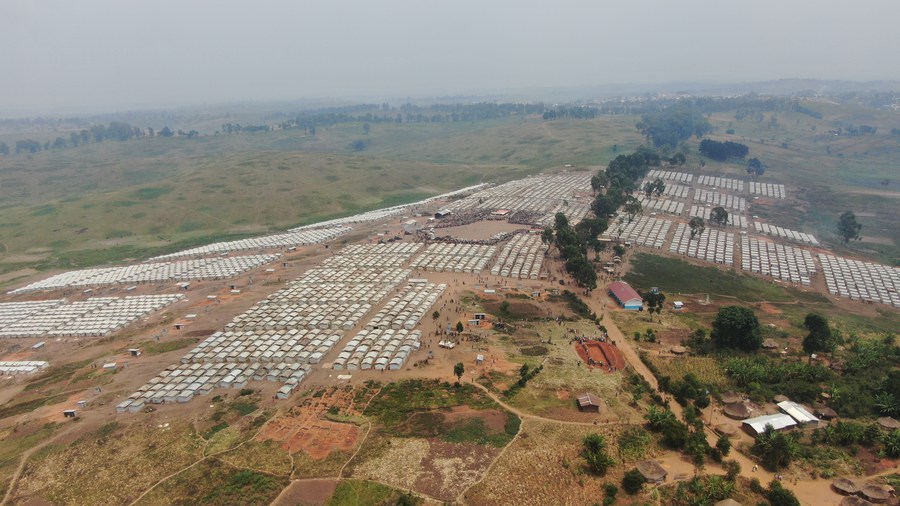
An aerial photo taken on Feb. 4, 2022, shows a camp for internally displaced people (IDP) in Ituri, a northeastern province of the Democratic Republic of the Congo. (Photo by Alain Uaykani/Xinhua)
Buma Annie, a 36-year-old girl who has been internally displaced since last year, now resides in the Kigonze camp in Bunia, capital of the Ituri province. Born and raised in a small village of the Djugu territory, home to the country's largest number of IDP, she recalled the day when she escaped by the skin of their teeth.
"During the attacks in my village, the militiamen first raped me and then massacred the members of my family", she told Xinhua at the Kigonze IDP camp, located on the outskirts of Bunia. In trauma, she managed to crawl his away out despite her legs both brutally amputated.
After months of medical treatment by humanitarian workers, Buma Annie is now able to move on her two knees, noting that battling the trauma now becomes the biggest hurdle of her life.
"It is difficult for me to live with this trauma that remains permanently in my head after what the militia did to me. I have always felt alone in the absence of my family who has all perished in this situation of insecurity which unfortunately still does not end," confessed Annie.
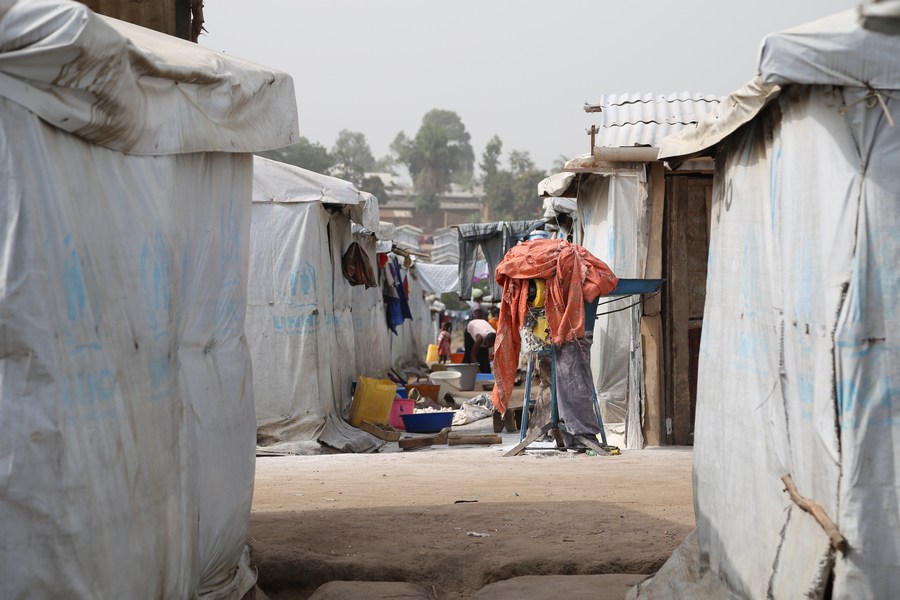
Photo taken on March 17, 2022, shows a view of a camp for internally displaced persons (IDPs) in Ituri province, northeastern Democratic Republic of the Congo. (Photo by Alain Uaykani/Xinhua)
"The militiamen coldly killed my two children with machetes during the attack. These children meant everything to me," said Bernadette Ngadjoy, a 62-year-old mother, who lost both of her children in the attack, adding that she now needs to refind the strength to live in the IDP camp.
Since the beginning of 2022, the escalation in violence in Ituri has led to the killing of an estimated 400 civilians and the displacement of over 83,000 people, said Monday the UN Office for the Coordination of Humanitarian Affairs (OCHA).
As some 80 civilians have been murdered in the second week of March alone, OCHA claimed to have observed an increase in attacks on IDP sites and in areas where displaced people are seeking shelter.
In a recent exclusive interview with Xinhua, Lieutenant-General Johnny Luboya, Ituri's military governor noted that the recent flare-up of violence against civilians mirrors the pressure of the military operations by the DRC authorities, which would last "until the effective restoration of peace".
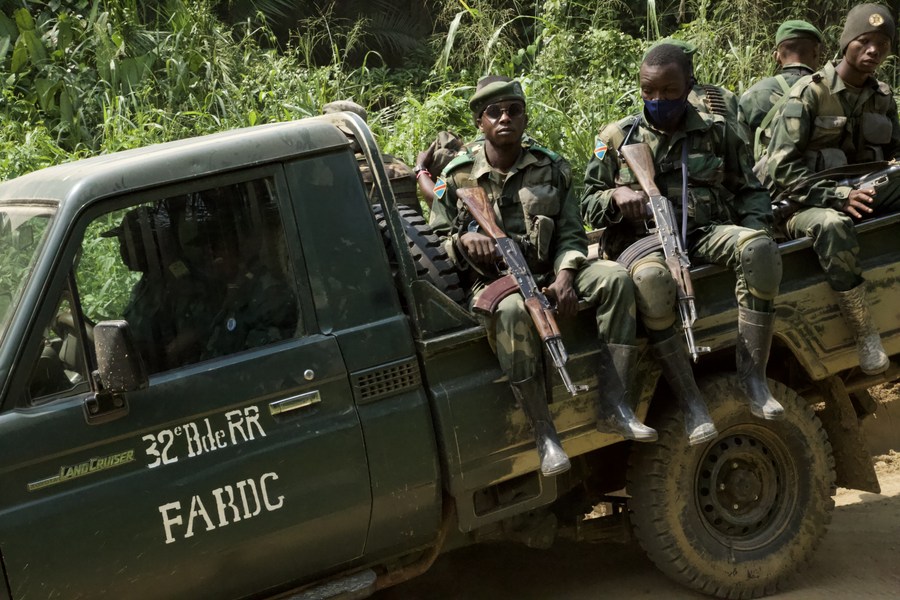
Soldiers are seen on a military vehicle during a joint military operation against armed forces in Beni territory, northeastern Democratic Republic of the Congo, Dec. 11, 2021. (Photo by Alain Uaykani/Xinhua)
"It is indeed the results of the pressure that our forces are exerting against the militiamen. This pressure will continue permanently until the effective restoration of peace," he said, calling on the population to be patient and trust the military operations in progress.
Alongside the ongoing military operations in Ituri, the DRC presidency has also initiated dialogue with the cooperative group for the development of Congo (CODECO), who has been active in Djugu, in an attempt to try to find a peaceful solution.
"We know the challenges are huge on many fronts, but we remain optimistic about the future of this province. We are appealing to our people to trust our ability to restore peace, and we will get there," said the military governor. ■