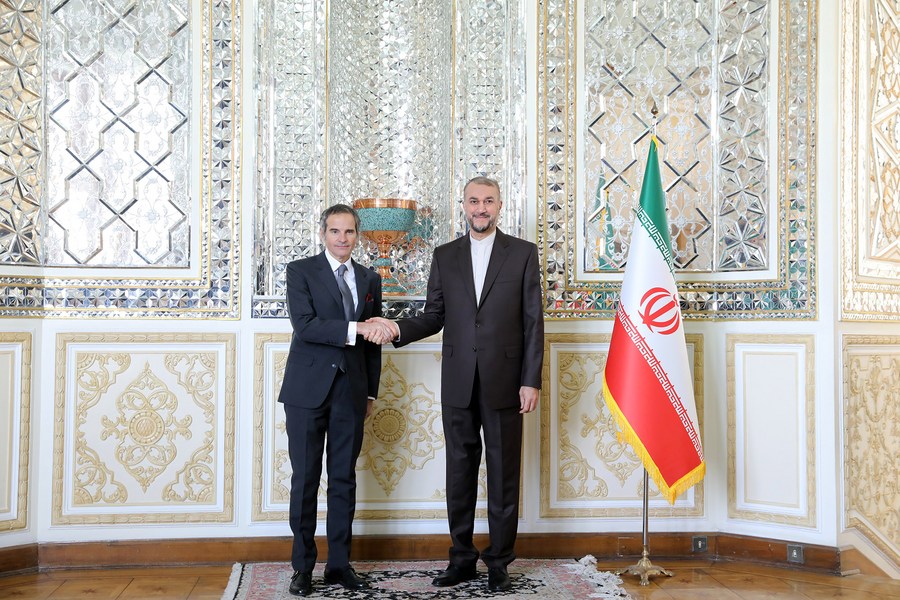
International Atomic Energy Agency (IAEA) Director General Rafael Grossi (L) and Iranian Foreign Minister Hossein Amir Abdollahian (R) pose for pictures in Tehran, Iran, on March 5, 2022. (Iranian Foreign Ministry/Handout via Xinhua)
TEHRAN, March 5 (Xinhua) -- Iranian Foreign Minister Hossein Amir Abdollahian highlighted on Saturday the need for an independent, professional and impartial approach by the International Atomic Energy Agency (IAEA) to Iran, according to the foreign ministry website.
Abdollahian made the remarks during his meeting with visiting Rafael Grossi, director general of the UN nuclear watchdog, where he also stressed the importance of strengthening the agency's relations and cooperation with Iran in areas beyond oversight and inspection of nuclear facilities, including supporting Iran's peaceful nuclear industry.
During the meeting, the two sides described the cooperation between the IAEA and the Atomic Energy Organization of Iran (AEOI) as positive and successful.
In his earlier press conference with Mohammad Eslami, head of the AEOI, Grossi said they have "decided to try a practical, pragmatic approach" to the remaining specific issues that need to be resolved.
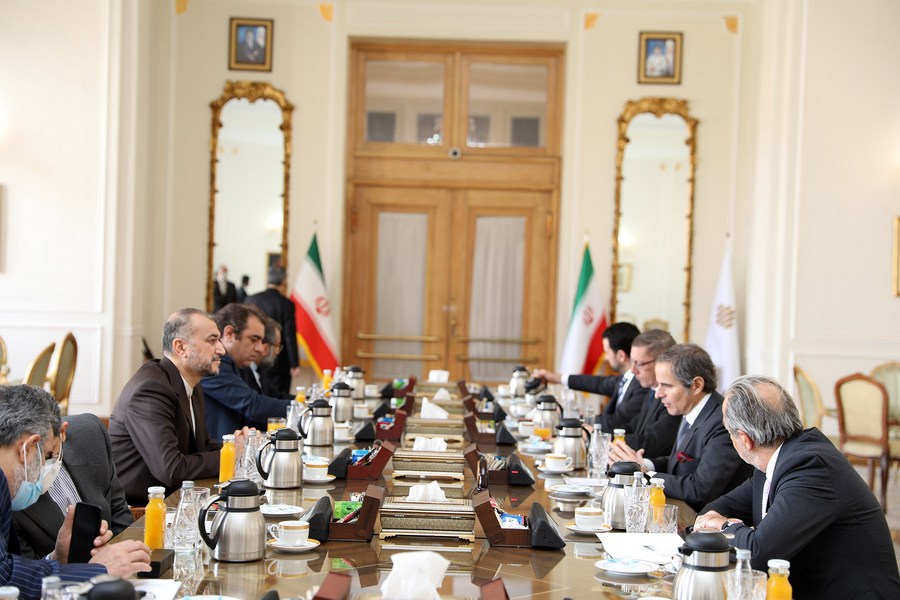
International Atomic Energy Agency (IAEA) Director General Rafael Grossi (2nd R) meets with Iranian Foreign Minister Hossein Amir Abdollahian (3rd L) in Tehran, Iran, on March 5, 2022. (Iranian Foreign Ministry/Handout via Xinhua)
The Vienna talks and the Iran-IAEA cooperation are interrelated, he noted, adding it will be difficult to reach an agreement in the Austrian capital if Iran and the IAEA do not agree on safeguards issues.
Iran and the remaining parties to the 2015 nuclear deal, formally known as the JCPOA, are currently involved in negotiations in Vienna seeking to settle disputes on the revival of the JCPOA.
Iran signed the JCPOA with world powers in July 2015. However, former U.S. President Donald Trump pulled Washington out of the accord in May 2018 and reimposed unilateral sanctions on Iran, which prompted the latter to drop some of its nuclear commitments one year later and advance its halted nuclear program. ■