
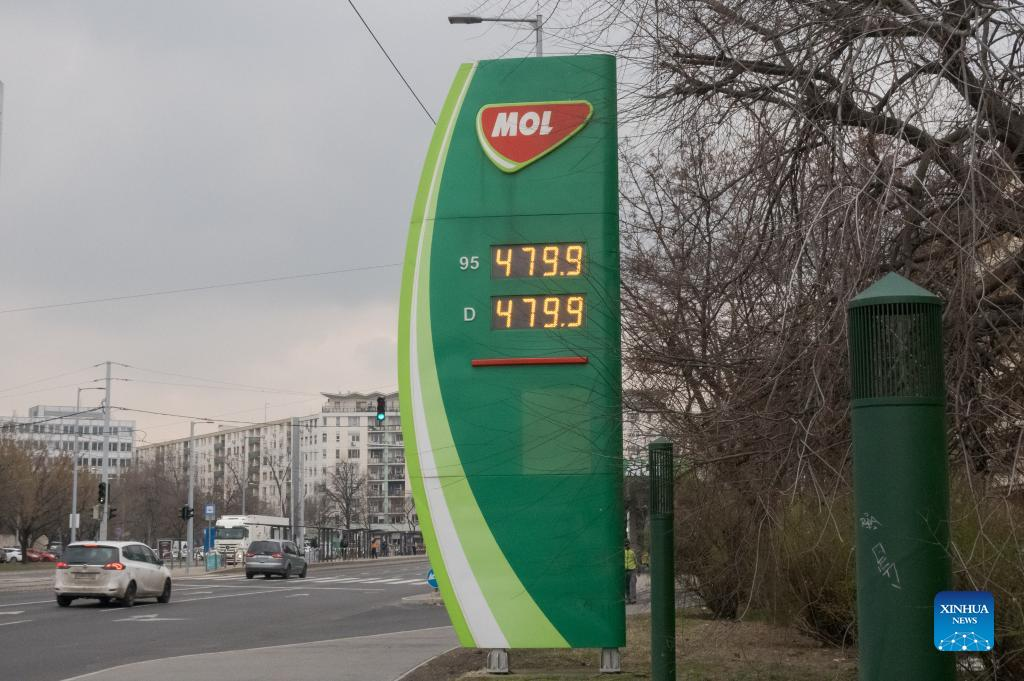
Gas prices are seen at a fuel station in Budapest, Hungary, on March 4, 2022. The military conflict between Russia and Ukraine already had a negative impact on the Hungarian economy. (Photo by Attila Volgyi/Xinhua)
by Geza Molnar
BUDAPEST, March 5 (Xinhua) -- The military conflict between Russia and Ukraine already had a negative impact on the Hungarian economy, as indicated by plummeting prices at Budapest Stock Exchange, a national currency hitting record lows, and a liquidation of a local commercial bank.
"To provide a continuous supply of fuel to all, we maximize the refueling quantity allowed in a single purchase in 100 liters," the largest Hungarian oil and petrol company MOL told its customers in the last few days.
The limitation is imposed due to a price cap of 480 Hungarian forints (1.38 U.S. dollars) that the Hungarian government put on retail fuel prices back in Nov. 15, in order to ease the effects of higher inflation.
The government introduced the price cap for an initial period of three months, but the measure has been extended until May 15.
"Prices without the cap would be at 501.8 forints for a liter of petrol and 521 per liter of diesel from Friday," MOL said Friday in a statement.
Hungary's inflation rate was at 7.9 percent in January, driven by the restart of production after the COVID-19 pandemic, and by shortages in microchip production and disruptions in global supply chains, as countries worldwide adopted different anti-epidemic measures and reopened their economies at different times and levels, Janos Nagy, senior analyst at Erste Bank, told Xinhua.
With the Russia-Ukraine conflict, "financial markets are panicking and in general are dumping their emerging markets portfolios, including their currencies," Nagy said, adding that inflation rate with the effect of the conflict is estimated to climb as much as 9 percent this year.
On Friday, the Hungarian forint hit new record lows at 381.71 against the euro and 346.54 against the dollar, said Hungary's central bank MNB.
"We are looking at an economy that is going to miss Ukrainian wheat, nitrogen, and the price of natural gas is also going to increase, which will have an effect on fertilizers and finally on food products as well," Nagy said.
German automotive manufacturer Audi's factory in the western Hungarian city of Gyor said that an important Ukrainian supplier is in trouble, and its production will thus be affected.
Apart from inflation and exchange rates, foreign trade is also under experts' scrutiny. "The interesting point in foreign trade is also the question of gas and oil, as Hungarian energy consumption relies on Russia at 40 percent at least," Nagy noted.
According to the senior analyst, the largest Hungarian commercial bank OTP, which has branches in both Russia and Ukraine, will be a short-time loser of the Russia-Ukraine conflict, as investors usually flee such shares in times of conflicts.
The shares of the bank that traded at more than 18,000 forints on Feb. 9 plunged to 9,600 on Wednesday. They rose back on Friday morning as OTP leader Sandor Csanyi said the bank would keep its Russian and Ukrainian branches.
"The question of trust is sometimes more important than fundamentals with financial institutions. That is what caused Sberbank's liquidation, which had no fundamental problems, but became the victim of a chain reaction of panicking customers taking out all their assets at the same time because of the Russian mother institution," Nagy noted.
Due to serious liquidity and capital position of Sberbank Hungary, the MNB on Wednesday revoked the activity license of the Hungarian credit institution and ordered its liquidation.
According to Nagy, as a rare positive effect, those people arriving from Ukraine could help ease labor shortages in the country. ■
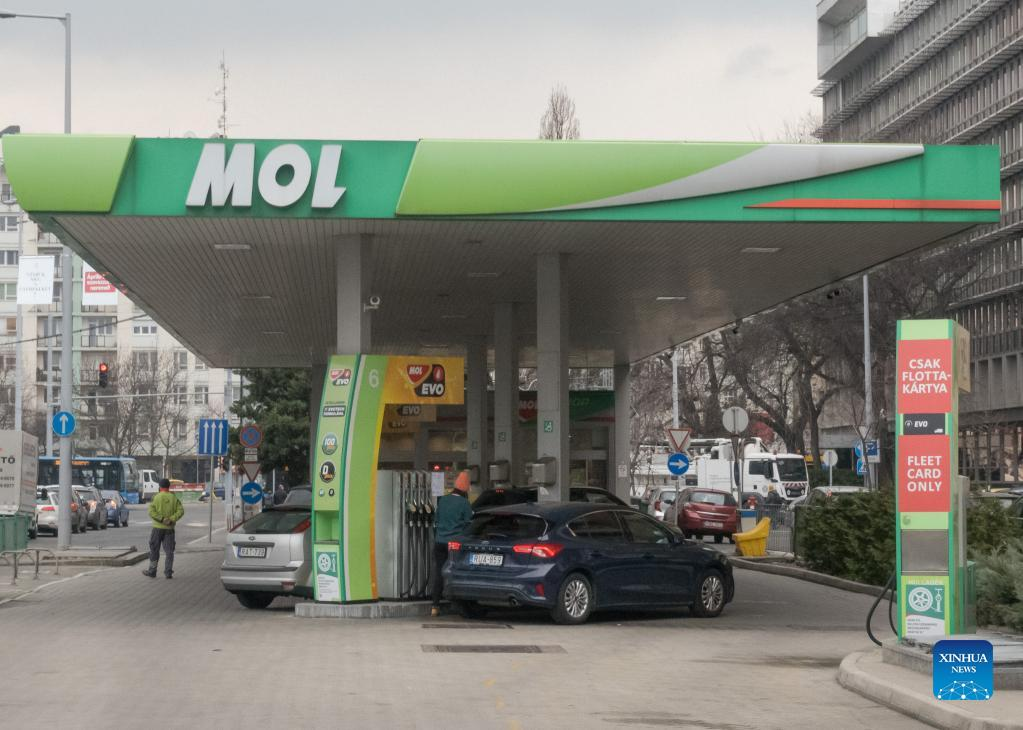
Photo taken on March 4, 2022 shows a fuel station of Hungarian oil and petrol company MOL in Budapest, Hungary. The military conflict between Russia and Ukraine already had a negative impact on the Hungarian economy. (Photo by Attila Volgyi/Xinhua)


