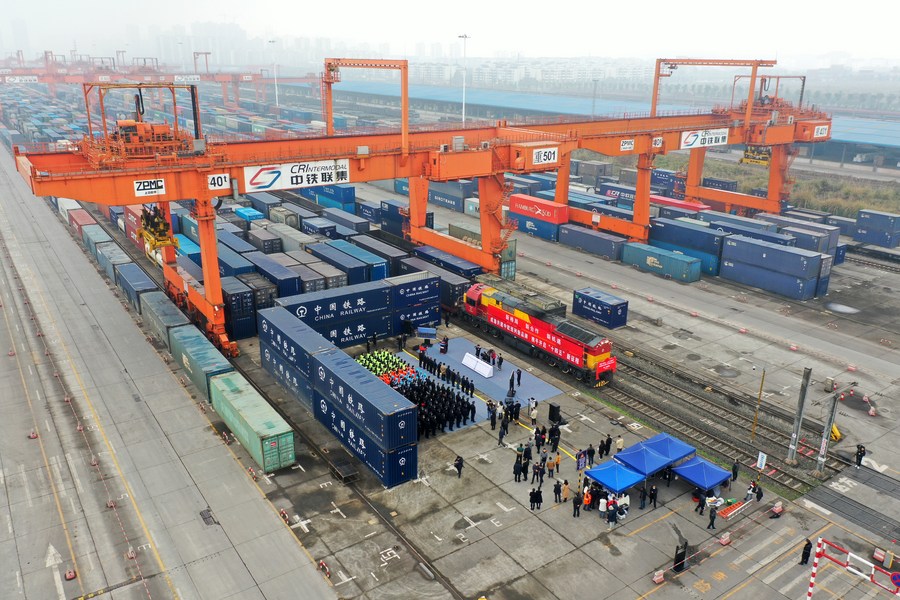
Aerial photo shows a China-Europe freight train bound for Duisburg of Germany preparing for departure at Tuanjiecun Station in southwest China's Chongqing, Jan. 1, 2021. (Xinhua/Tang Yi)
CHONGQING, Feb. 7 (Xinhua) -- With hands maneuvering two joysticks and keen eyes looking for perfect spot, 32-year-old Zheng Yushuang felt much release when he pressed the button and deployed a giant claw right on his target.
Although the near-daily scene was nothing different from a game-binging child controlling a claw machine, what Zheng needs to grab was not a toy, but a 30-tonne container for China-Europe freight trains.
Zheng's "game room" only covers 2 square meters and lies about 16 meters above the ground. He needs to climb six spiral staircases to get into the place, and sometimes he has to do this amid the blowing wind and fierce rain in mid-air.
As tough as it may sound, Zheng has been the "MVP" in this "game" since he came to Tuanjiecun Station, the starting point of China-Europe freight train routes in southwest China's Chongqing Municipality in 2010.
Sitting there for about eight hours a day, Zheng can load over 2,000 containers every month and always ranks top among all the station's crane drivers. For one container, he only needs 1.8 minutes to complete loading, while others need two to three minutes.
"Practice makes perfect," said Zheng.
"I participated in a six-month-long training course in Dalian (a northeastern Chinese city), before I can operate the crane on my own," he added. "As the number of containers for China-Europe freight trains spiked over the years, I have become more and more skilled in operating the equipment."
Zheng used to feel bored sitting in the small room because there were not many goods for China-Europe freight trains to load back then. The turning point came around 2017.
In 2017, the workload had a four-fold increase from 60 containers a day to more than 250 containers. Once, he loaded 350 containers in just one night.
Zheng also bore witness to great changes in the varieties of the loaded cargo. In the beginning, exports were mainly printers, laptops and other electronics, but now more toys, clothes, milk powder, and other varieties are stacked in the heavy containers.
After the COVID-19 outbreak, many containers carrying life-saving medical supplies, such as facial masks and surgical gloves, were sent to far-flung cities like Poland's Malaszewicze, Germany's Duisburg, Spain's Madrid, and France's Paris.
China-Europe freight trains have reinforced the once fragile supply chains in some Eurasian countries and bailed out businesses in both China and Europe, serving as an indispensable lifeline.
In 2021, Chongqing and the neighboring Chengdu, capital of southwest China's Sichuan Province, saw more than 4,800 trips of China-Europe freight trains, accounting for about one-third of China's total. Over 400,000 twenty-foot equivalent units (TEUs) of cargo were transported via the cross-border service from Chongqing and Chengdu to more than 100 European cities.
Zheng feels proud to make his own contribution.
"Knowing that the goods will be sent to Europe, I find my job meaningful and feel content," he said. ■