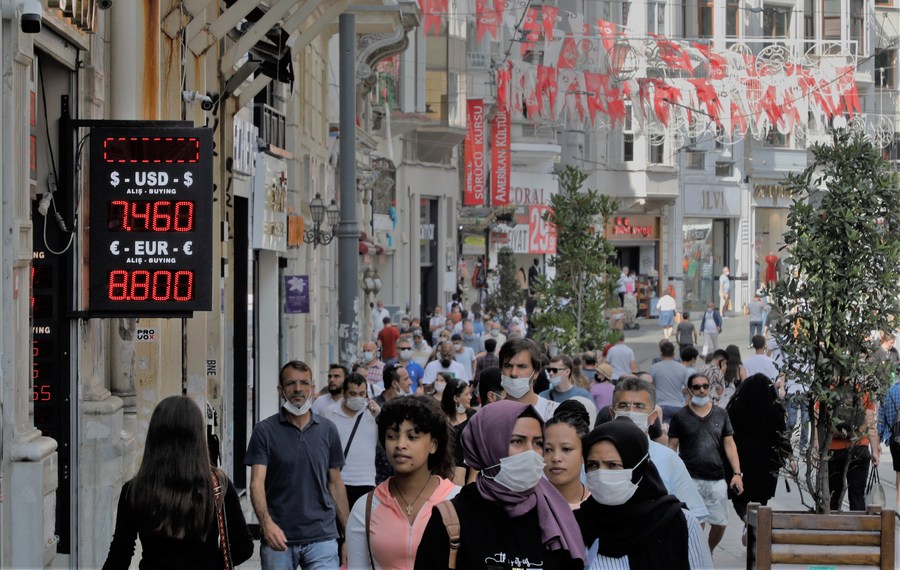
People walk past a board showing the currency exchange rates in Istanbul, Turkey, on Sept. 17, 2020. The Turkish currency dropped to a record low against the U.S. dollar on Thursday, raising concerns of high inflation and unemployment. (Photo by Osman Orsal/Xinhua)
While a senior government official predicted the inflation will peak in April below 50 percent and remain at that level before dropping in the third quarter of 2022, economists believe high inflation will continue during most of this year.
ANKARA, Feb. 4 (Xinhua) -- Turkey is likely to live with high inflation throughout 2022, economists predicted.
The annual inflation rate in Turkey has reached a 20-year high of 48.7 percent in January, according to official data published on Thursday.
While Finance and Treasury Minister Nureddin Nebati predicted the inflation will peak in April below 50 percent and remain at that level before dropping in the third quarter of 2022, economists believe that high inflation will continue during most of this year.
"We think that under current conditions, a significant decline in inflation will not materialize until the fourth quarter of 2022 when the base effect will prevail, and the risks of upward deviations in the forecast path during the year are ahead," Enver Erkan, chief economist at Tera Securities, told Xinhua.
He said that the lira must maintain its stability to prevent the government's predicted path in inflation to deteriorate.
Erkan warned that inflationary risks remain high given the real rates are deeply in the negative territory.
"Turkey's real interest rate (one-week repo rate minus inflation) has dived into negative territory. -34.7 percent is a level that is very inconsistent with the major emerging markets," he pointed out.
The inflation spike was essentially fueled by President Recep Tayyip Erdogan's economic policies in favor of lower borrowing costs last year and an ensuing depreciation in the national currency.
Consumer prices jumped 11.1 percent in January, Food prices jumped 55.6 percent and transport-related prices rose by nearly 70 percent.
The lira lost 44 percent of its value last year after the central bank slashed the benchmark interest rate by 500 points to 14 percent.
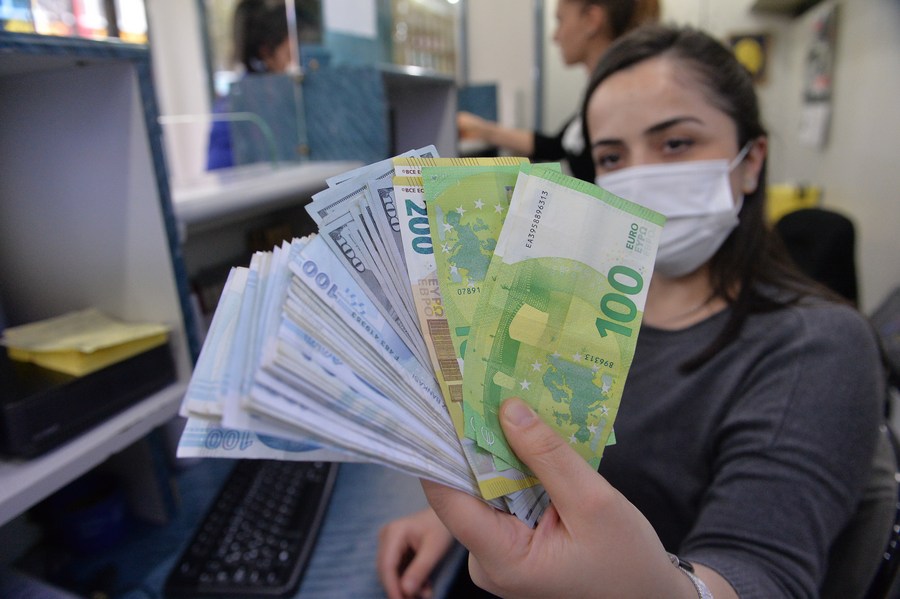
A teller shows banknotes at an exchange office in Ankara, Turkey, on Dec. 16, 2021. (Photo by Mustafa Kaya/Xinhua)
Partly in response to the currency turmoil, the government raised a series of administered prices this year including gas, electricity, road tolls, and bus fares, adding to inflationary pressure.
Meanwhile, the monthly minimum wage was raised by 50 percent -- the sharpest increase so far -- to meet the laborers' demands.
Mustafa Sonmez, an independent economist, said inflation will endure as Turkey is heavily reliant on energy imports amid a global increase in oil and natural gas prices.
Further consumer price increases appear inevitable in the coming months, He added.
Goldman Sachs, the U.S. investment bank, echoed that Turkey's inflation would rise to around 56 percent in May and remain close to that level for much of the year.
The lira crash drove prices of essential goods, food, and utilities sky high, bringing down the living standards of households.
On Monday, Erdogan said the country will have to carry the burden of inflation for some time, asking citizens for patience amid widespread popular discontent.
According to a survey by Turkish leading pollster MetroPoll, nearly 72 percent of respondents think that the country's economy is poorly managed.

A customer exchanges money at an exchange office in Ankara, Turkey, on Dec. 16, 2021. (Photo by Mustafa Kaya/Xinhua)
"We have entered a period where the outlook will improve in the months ahead," Erdogan said on Tuesday, trying to reassure citizens when the presidential and parliamentary elections scheduled for June 2023 are less than 18 months away.
"We will reduce inflation month by month and eventually defeat it," Erdogan insisted.
Nonetheless, the central bank has raised Last week its inflation target for 2022 to 23.2 percent from 11.8 percent, and the figure for 2023 is 8.2 percent.
Although the elevated inflation is putting serious strain on households, the Turkish economy is still achieving positive growth rates. It is worth noting that in 2020, the year of COVID-19 lockdown, Turkey was among the few countries that managed to achieve economic growth.
The public debt is no more than 40 percent of the Turkish GDP and the budget deficit is at 5 percent of the GDP which is in the manageable range, the data showed.
Additionally, the slump of the lira is also offering competitive advantages for Turkish exports which are at an all-time high. ■