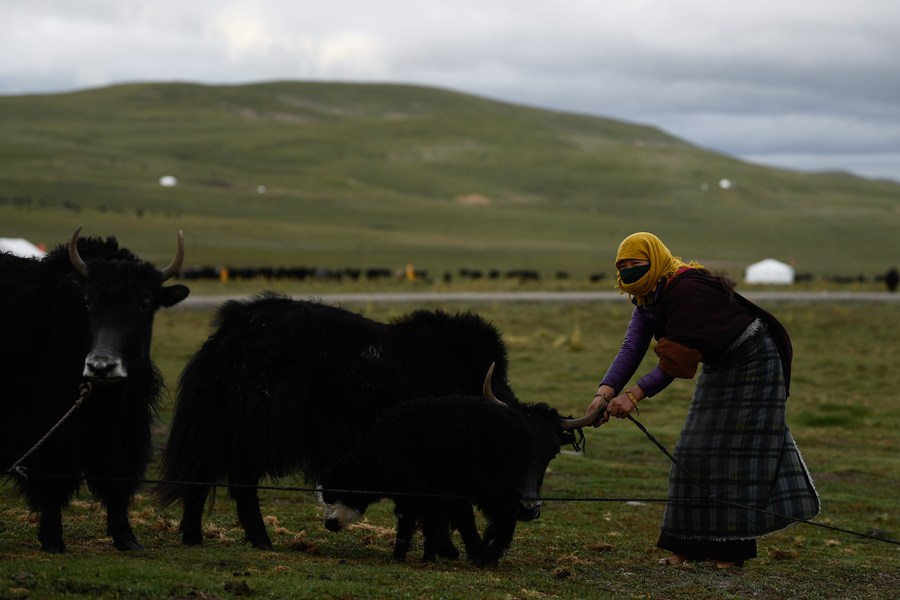
 A herder tethers a yak in a summer pasture in Maqen County of Golog Tibetan Autonomous Prefecture, northwest China's Qinghai Province, Aug. 3, 2021. (Xinhua/Zhang Long)
XINING, Feb. 4 (Xinhua) -- A traceability system has been developed by the agricultural authority in northwest China's plateau province of Qinghai to promote yak and Tibetan sheep husbandry.
Qinghai is China's main production area for yaks and Tibetan sheep, with stocks respectively accounting for approximately 38 percent and 40 percent of the country's total.
Hai Ying, deputy director of the quality and safety supervision of agricultural products at the provincial department of agriculture and rural affairs, said the quality and safety traceability system for yaks and Tibetan sheep covers animal husbandry sectors in four tiers, from the provincial level to the township level.
She said that the whole quality control process can so far be traced for 4 million yaks and sheep raised on 64,185 private farms, cooperatives or ranches.
Traceable information includes breeders, the use of medicine for epidemic prevention, and insurance details.
"Electronic traceable ear tags are required for all calves and sheep 30-90 days after birth in all 39 farming and pastoral counties of Qinghai. The province's traceability platform automatically generates QR codes for consumers to query the product information," Hai said.
According to the department of agriculture and rural affairs, the provincial government allocated 150 million yuan (about 23.6 million U.S. dollars) from 2019 to 2021 to the establishment of the livestock quality traceability system.
Department data shows that by the end of 2020, Qinghai had stocks of 6 million yaks and 11 million Tibetan sheep. ■