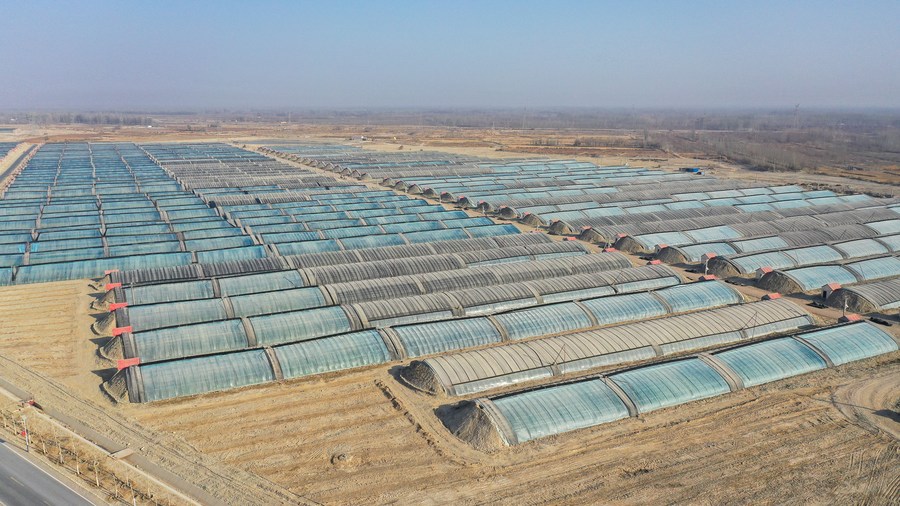
Aerial photo taken on Dec. 12, 2021 shows a view of an industrial park in Shache County of Kashgar, northwest China's Xinjiang Uygur Autonomous Region. Located in the southwestern edge of the Taklimakan Desert, Shache County constructed an agricultural industrial park by taking advantage of the sunlight resources of the vast barren land in 2021. (Xinhua/Ding Lei)
URUMQI, Jan. 12 (Xinhua) -- The roadside shelter forest along a road crossing in Taklimakan, China's largest desert in northwest China's Xinjiang Uygur Autonomous Region, will soon be irrigated using purely solar power, local authorities said.
By March this year, 86 new photovoltaic power stations will go up along the 566-km road, replacing diesel engines as the power source for pumping irrigation water.
The addition will bring the number of irrigation wells powered by solar to 98 along the desert road.
It is estimated that after the power stations are in place, over 1,000 tonnes of diesel consumption and about 3,410 tonnes of carbon dioxide emissions will be reduced every year.
The road that opened to traffic in 1995 cuts the travel distance between regional capital Urumqi and Hotan Prefecture by 500 km.
A 436-km shelterbelt along the road was constructed more than a decade ago to prevent the erosion of the road. ■