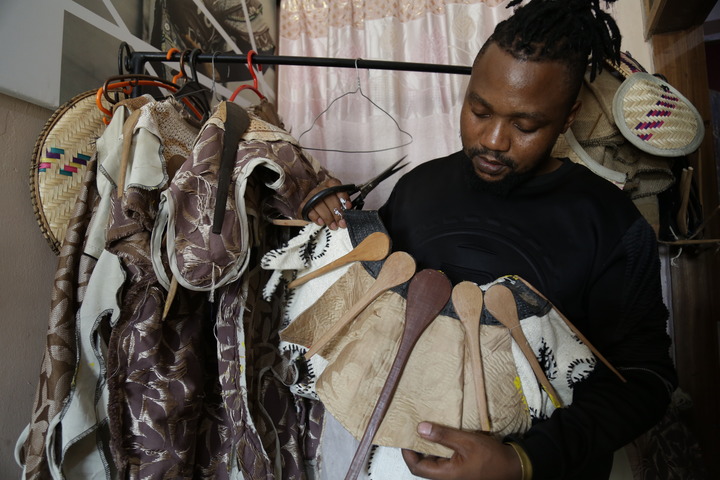
Tanzanian traditional costumes designer Jocktan Makeke shows his work at his workshop in Dar es Salaam, Tanzania, Jan. 4, 2022. (Photo by Herman Emmanuel/Xinhua)
Jocktan Makeke, a designer of traditional costumes in Tanzania, says most of his designs are based on stories from Tanzania's 120 tribes and they are based on pure African culture that prevailed before the coming of Europeans and before colonialism.
DAR ES SALAAM, Jan. 7 (Xinhua) -- His love for Tanzanian culture pressed a 33-year-old university graduate to cultivate interest in designing traditional costumes using animal products such as animal skins and hides, bones, as well as tree leaves and barks.
"To be precise, flora and fauna are my raw materials," said Jocktan Makeke, the chief executive officer of Makeke International, a firm that is designing traditional costumes from Tabata Shule on the outskirts of the commercial capital of Dar es Salaam.
With the firm's slogan -- Your Culture, Your Identity -- which Makeke loosely translated into English as "more than normal," he is really designing traditional costumes that are more than ordinary.
"I came up with the idea of designing traditional costumes about six years ago after I had realized that most of the designs were Western-like suits and dresses," Makeke, who in 2012 graduated with a Bachelor of Arts degree in Fine Arts and Design at the University of Dodoma, told Xinhua. "So I decided to introduce this kind of design and I was the first person doing this traditional costume design in the country."
According to the young designer, most of his designs are based on stories from Tanzania's 120 tribes and they are based on pure African culture that prevailed before the coming of Europeans and before colonialism.
"I am using natural products like those that our forefathers and mothers used. They used animal products, including skins, hides, bones, leaves and barks from trees for making their costumes," said Makeke.
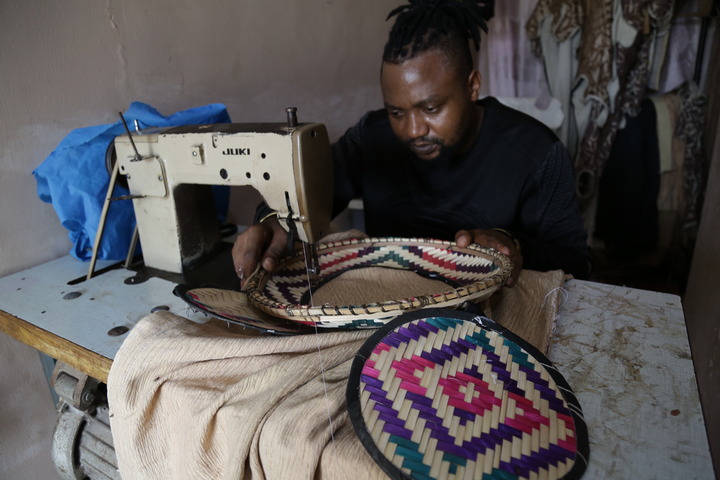
Tanzanian traditional costumes designer Jocktan Makeke works at his workshop in Dar es Salaam, Tanzania, Jan. 4, 2022. (Photo by Herman Emmanuel/Xinhua)
He said before he starts designing, he travels upcountry to different regions where he conducts research through hearing traditional stories and asking questions, mostly from elder people, on the kinds of traditional costumes they used.
"The research is done in tandem with the collection of the animal products, leaves and barks," said Makeke, adding that doing research on one traditional costume could take one year but it takes a day to make about six costumes.
"Traditional costumes have a direct impact on society, a very direct message to the society because when you see this you can't understand what it is but when I tell you the story behind this collection, you will understand what I am talking about," he said.
At the beginning of his designing traditional costumes, the going was rough and tough, because many people did not understand what he was doing but today many people understand.
He said he has so many clients in Tanzania, Africa and Europe, adding that some of his clients are celebrities, including renowned musicians.
Makeke said although he has never been to China, he has admiration for Chinese love for their culture.
"Chinese value their culture. They protect their culture and they are so proud of their culture compared to Africans," he said.
Makeke said when Africans travel abroad they prefer to look like Europeans.
Makeke believed the future of designing traditional costumes is amazing because nowadays people understand as the young generation is fighting to know their history which they can grasp by cultivating interest in traditional costumes.
A glance at Makeke's shelf exposes one to a number of awards that he has won, including a certificate he was awarded on Sept. 25, 2019, after he had successfully climbed Mount Kilimanjaro to Uhuru peak, the highest in Africa standing at 5,895 meters above sea level.
There is also the Cultural Unity Award 2017 for the most creative designer in Africa that he scooped in Abuja, the capital of Nigeria, and the Innovative Designer of the Year 2018 awarded by the Swahili Fashion Week in Dar es Salaam.
In 2019, Makeke attended a three-week course on creative arts at the Cape Town University Institute of Creative Arts in South Africa.
Makeke has also visited almost all the country's 22 national parks, including the renowned Serengeti National Park.
"I decided to climb Mount Kilimanjaro and I visited the national parks to be able to explain about these tourist attractions to foreigners when I visit abroad," he said. ■