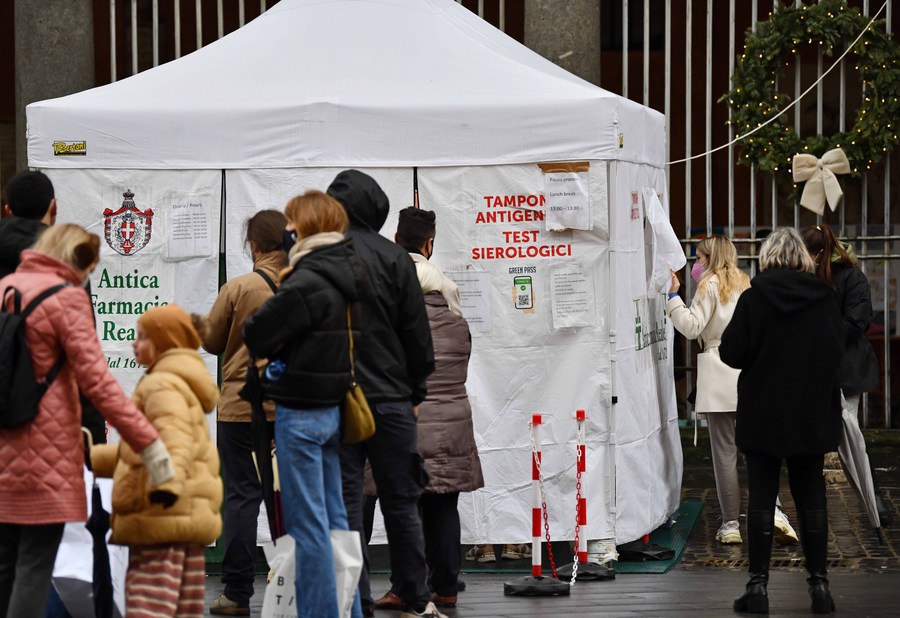
People wait outside a COVID-19 rapid test point in Rome, Italy, Dec. 24, 2021. (Xinhua/Jin Mamengni)
Italy has seen a spike in new coronavirus cases through December, mostly due to the effects of the Omicron variant.
ROME, Jan. 3 (Xinhua) -- Half of Italy was in a moderate pandemic risk starting on Monday, amid a recent surge in COVID-19 infections.
Northern regions of Lombardy and Piedmont, Lazio in central Italy and Sicily in the south turned "yellow" in the day, after the number of people tested positive for COVID-19 in hospital and intensive care units locally rose above national parameters.
These four regions added to Liguria, Friuli Venezia Giulia, Veneto, Marche and Calabria, plus the autonomous provinces of Trento and Bolzano, pushing the total number of yellow zones across the country to 11.
The decision was announced by the health ministry on Friday based on the latest epidemiological survey of the National Health Institute.
In the four-tiered system implemented in Italy since late 2020, the yellow zone indicates a low-intermediate, or moderate risk of virus transmission; the orange and red zones indicate the medium and high risks respectively, while the white zone stands for a low risk.
Considering the success of the vaccination rollout in the country, however, the yellow zone currently entails a low level of restrictions that include wearing facemasks outdoors and using FFP2 face masks only on public transport, cinema and theaters.
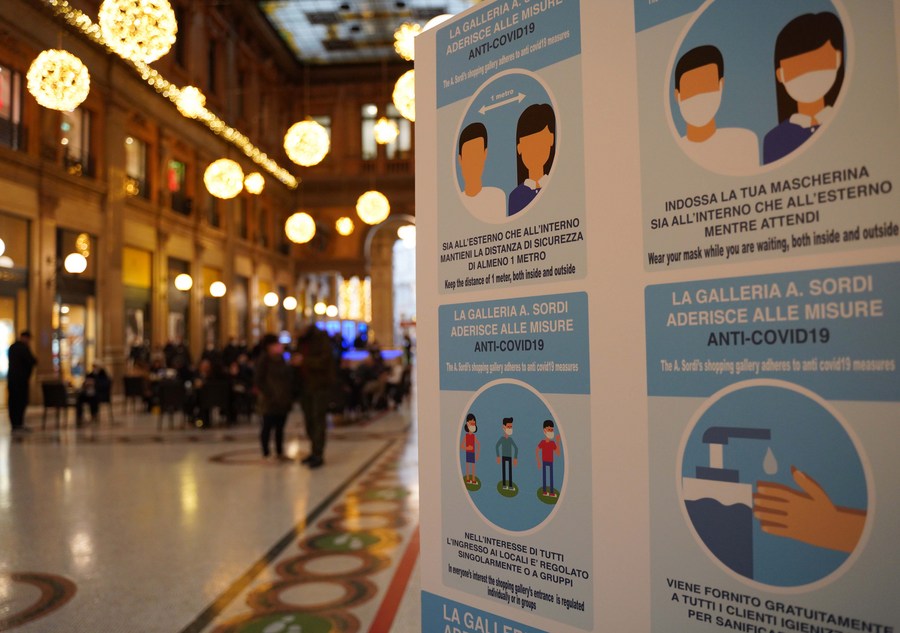
A COVID-19 notice board is seen at Galleria Alberto Sordi in Rome, Italy, Dec. 24, 2021. (Xinhua/Jin Mamengni)
Adding to this, only people holding the "super" green pass -- the certificate showing proof of COVID-19 vaccination or recovery from the infection within 6 months -- are allowed to be served indoors in bars and restaurants in the yellow zone.
Italy's remaining 10 regions are still in the white zone category and under the most relaxed anti-pandemic rules, which still require people to wear facemasks in any indoor place, and ban unvaccinated people from sitting in restaurants and bars, cinemas, sport venues, nightclubs and stadiums.
As in several other European countries, Italy has seen a spike in new coronavirus cases through December, mostly due to the effects of the Omicron variant.
On Dec. 30, Italy recorded 126,888 new cases against the previous day, surpassing the threshold of 100,000 daily cases for the first time in the country.
Over 144,000 daily cases were then registered on Dec. 31, and over 141,000 on Jan. 1, according to data by the health ministry.
However, the surge has come amid a high participation in the vaccination plan, which has so far helped keep the number of serious or deadly cases very low compared to the earlier waves.
As of Monday, nearly 86 percent of people aged over 12 have been fully vaccinated in Italy, and over 64 percent of the target population have received the booster shot. About 9.2 percent of children aged 5-11 have received at least one vaccine dose.
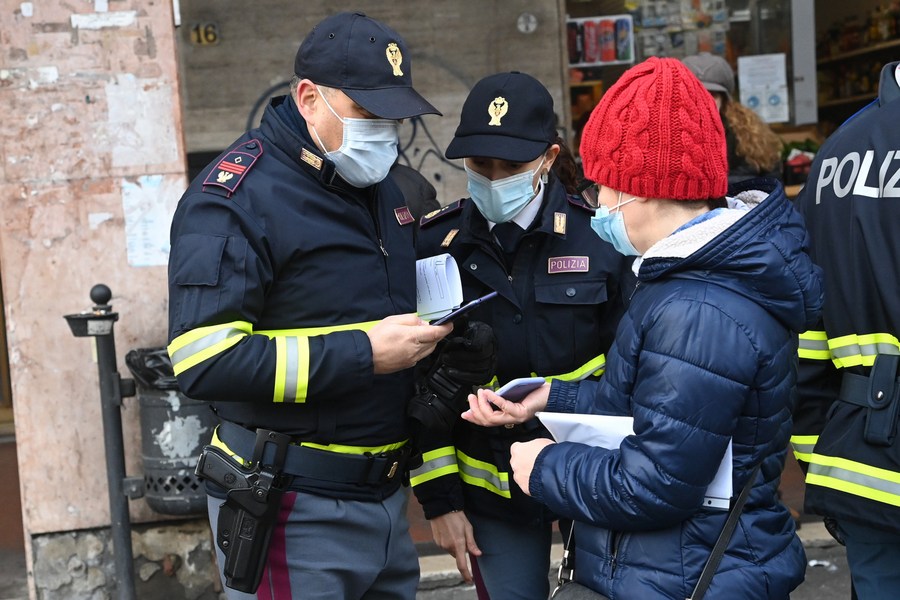
A policeman checks green pass of a passenger at a bus station in Bologna, Italy, Dec. 6, 2021. (Photo by Gianni Schicchi/Xinhua)■