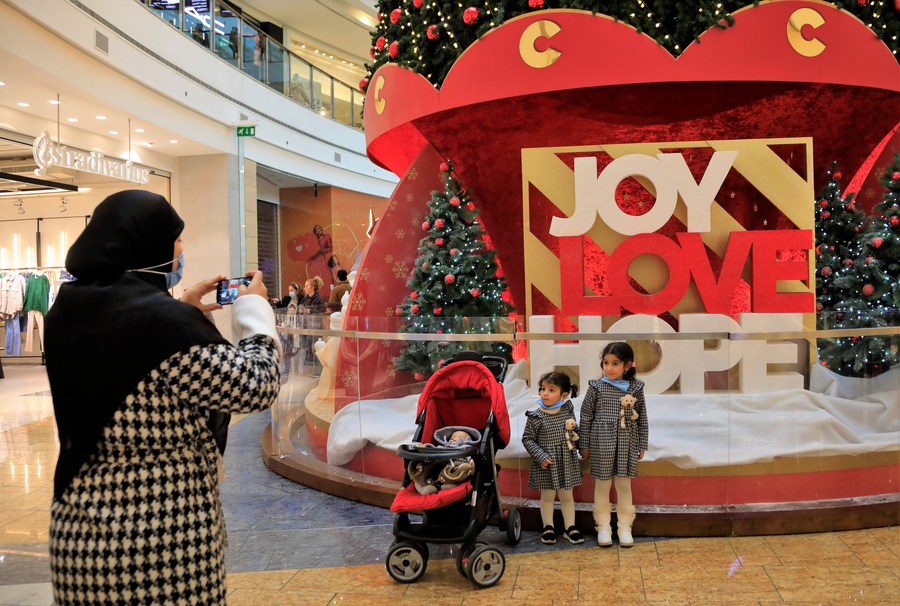
A mother takes photos of her children in front of a big Christmas inside a shopping mall in Beirut, Lebanon, on Dec. 23, 2021. (Xinhua/Liu Zongya)
by Dana Halawi
BEIRUT, Dec. 30 (Xinhua) -- Karim Hajj carefully arranges his cutlery in preparation for the small celebration he will be hosting in his house on the occasion of New Year.
He goes over his to-do-list for the day to make sure he is ready to receive his very few friends for dinner the next day.
Karim told Xinhua that he has rarely celebrated the New Year at home, but the economic crisis and increasing COVID-19 cases in Lebanon forced him to do so this time.
Karim used to pay no less than 300 U.S. dollars to celebrate New Year in some of Beirut's famous clubs. However, he decided to invite some of his friends over this year to save some money in light of the steep devaluation of salaries after the collapse of the local currency.
"This is more convenient and safer as the invitees will be doing COVID-19 PCR tests ahead of the gathering to be able to celebrate guilt-free," he added.
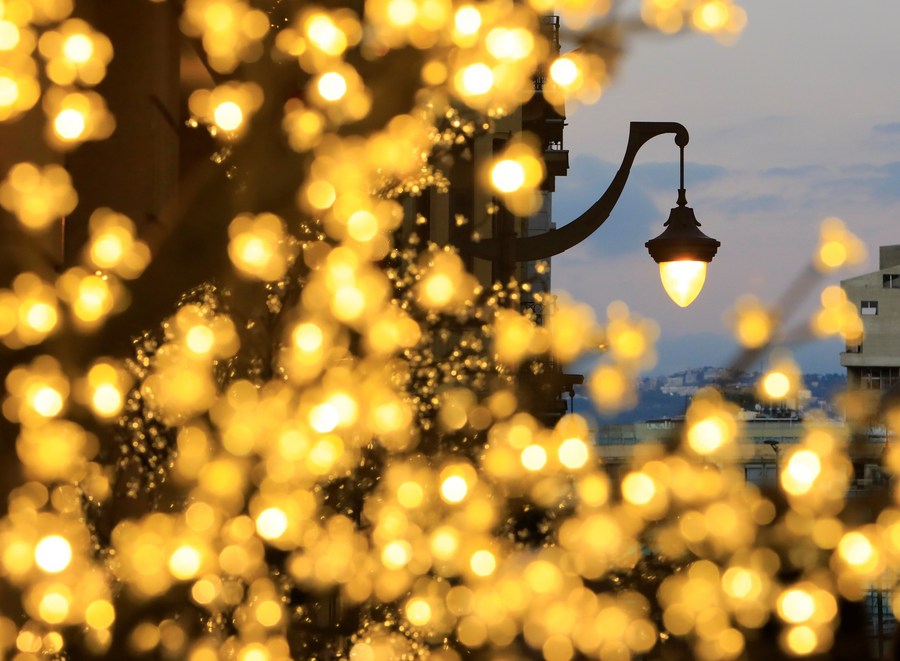
Light installations are seen at a Christmas market in downtown Beirut, Lebanon, on Dec. 25, 2021. (Xinhua/Liu Zongya)
Likewise, Rasha Sabaa told Xinhua that her friends will each cook a dish and gather at her place to celebrate New Year by playing party games and enjoying a joyful Karaoke night.
"I believe that some of our New Year traditions will have to change from now on with the prevailing economic crisis and the outbreak of the COVID-19 pandemic ... It's not a big deal as long as we can still meet with our good friends and have a good time while taking proper precautions," Sabaa said.
For his part, Assem Adra, a Lebanese expatriate who arrived a few days ago from Nigeria, decided to hire a band at his place and invite his friends to drink and dance, which would create an atmosphere that is similar to that of a nightclub.
Adra, who is a successful businessman with good financial means, said he can afford to spend a few hundred dollars to throw a party for his close friends at his place.
"I'll spare my friends the burden of spending money to celebrate New Year as they can no longer afford restaurants in light of the currency collapse," he told Xinhua.
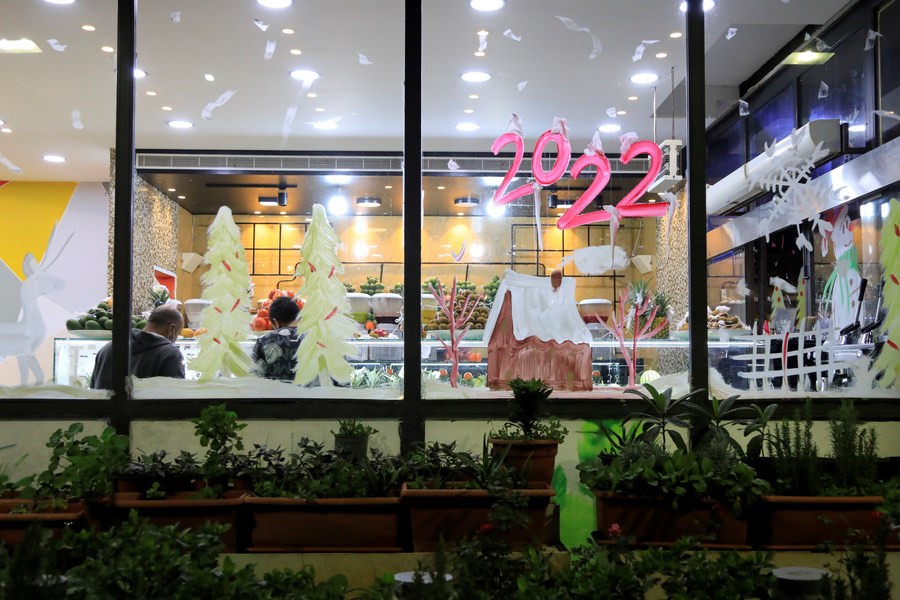
People are seen in a store with New Year decorations in Beirut, Lebanon, on Dec. 23, 2021. (Xinhua/Liu Zongya)
Pierre Ashkar, head of the Syndicate of Hotel Owners in Lebanon, told Xinhua that most people this year have rented chalets in villages, such as Faraya and Fakra, by sharing the cost in order to save money.
"Some chalets can be occupied by only five people, for instance, but they are being used by around eight to ten people each to reduce rental cost," he said, adding this solution is less costly than celebrating at a restaurant or a nightclub.
One more reason behind people's private celebrations is the COVID-19 outbreak, which has limited the capacity of restaurants to 50 percent only, according to the government's measures.
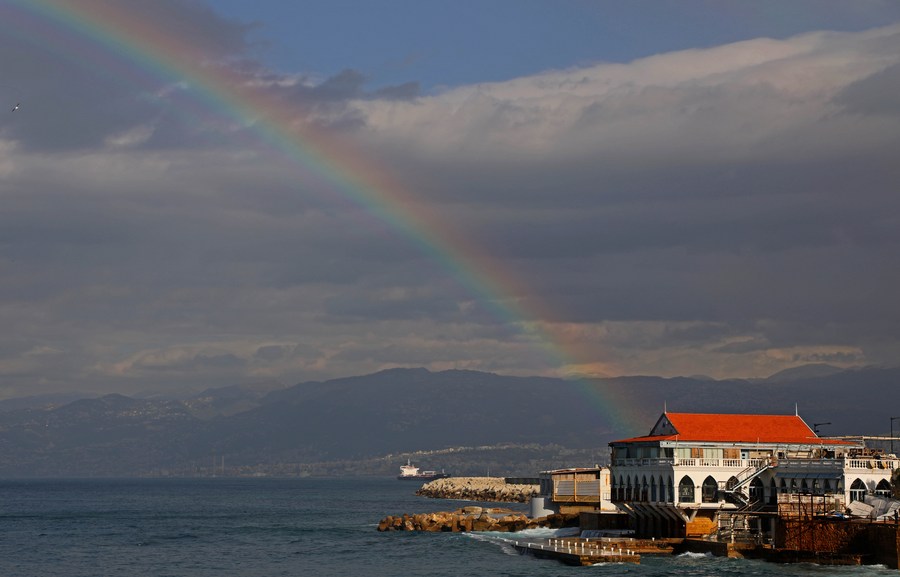
Rainbow is seen at Beirut corniche, Lebanon, on Dec. 19, 2021. (Xinhua/Bilal Jawich)
For her part, Lebanese Economist Layal Mansour told Xinhua that celebrations are no longer an option for most Lebanese who are barely capable of affording their most basic needs.
"The purchasing power of Lebanese people has dropped remarkably with most of them being unable to afford hospitalization costs, medicines, school fees and food in some cases," she said.
Lebanon has been going through the worst financial crisis in its history with the poverty rate hovering over 78 percent, according to the World Bank. ■