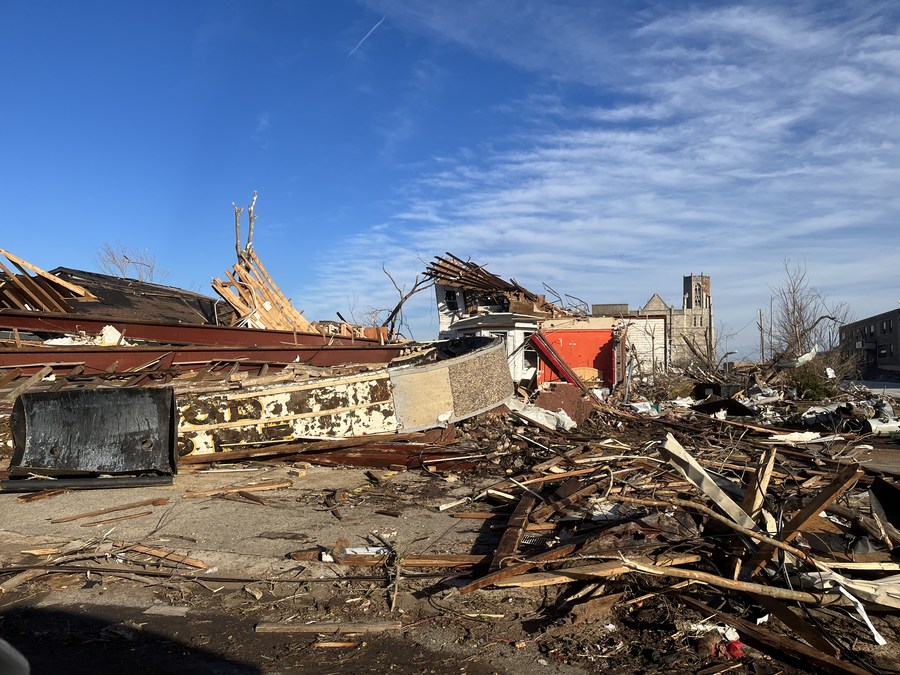
Photo taken on Dec. 11, 2021 shows houses damaged in tornadoes in Mayfield, Kentucky, the United States. (Photo by Caromirna Sanchez/Xinhua)
The traditional "tornado alley" across the Great Plains is drifting east into a region with greater density of industry, people and potential environmental hazards.
NEW YORK, Dec. 28 (Xinhua) -- An accounting must be done for the number of places where the Dec. 10 tornado damaged sensitive facilities that store hazardous materials and wastes, threatening the environment and even survivors left to pick up the pieces in Kentucky, reported USA Today on Tuesday.
Besides the tragic casualty -- over 70 people were killed during the disaster in the state -- there are more than 1,400 sites of potential pollution within a half-mile of the 160-mile path the main tornado cut through Kentucky, according to an analysis by property intelligence and technology firm LightBox.
"Experts cautioned it will take time for a full tally of the tornadoes' ecological effects in Kentucky and surrounding states," said the report, adding that the traditional "tornado alley" across the Great Plains is drifting east into a region with greater density of industry, people and potential environmental hazards.
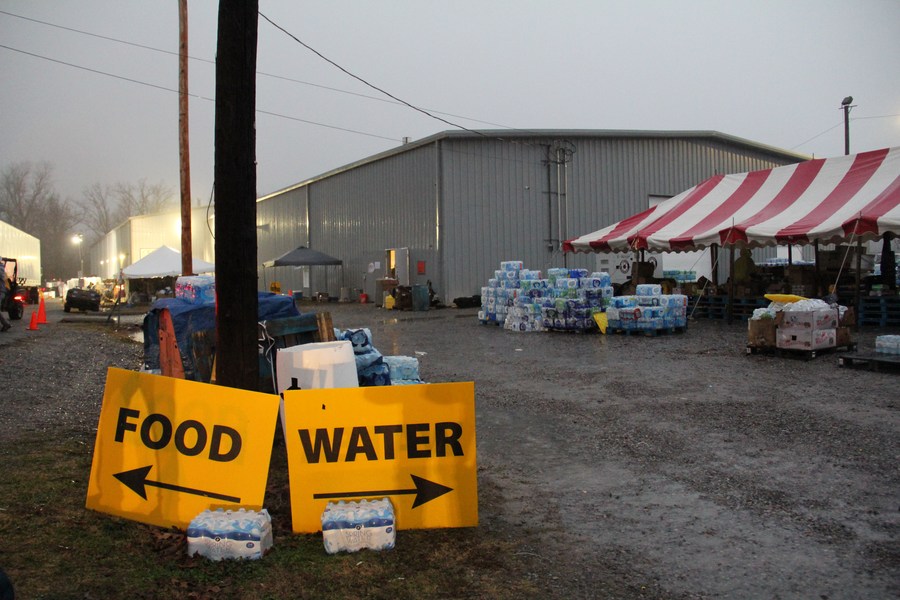
Signposts are seen at the Groves County Football Stadium in the outskirt of Mayfield, Kentucky, the United States, Dec. 17, 2021. The stadium is now a relief materials distribution center for tornado victims nearby. (Photo by Angie Yu/Xinhua)
"The tornado (on) Dec. 10 highlighted the kind of risks that are increasing along with the number of twisters, particularly if the next one strikes an even more sensitive area," it added.
Luckily, "early indications are that Kentucky dodged worst-case scenarios," according to the report. U.S. Environmental Protection Agency spokesperson Allison Wise said no issues had been reported from facilities that use extremely hazardous substances, and the agency had not received any requests for cleanup assistance from facilities that "store large quantities of oil."
It might have been a different story if the tornado hadn't stopped about an hour southwest of Louisville, the state's largest city, Christopher States, a toxicologist and director of the University of Louisville's Center for Integrative Environmental Health Sciences, was quoted as saying.
"Western Louisville includes an area known as Rubbertown with chemical and other industries, not to downplay the much higher population. There also is a large military base south of Louisville," States said. "If it reached Louisville, it would have been far worse." ■