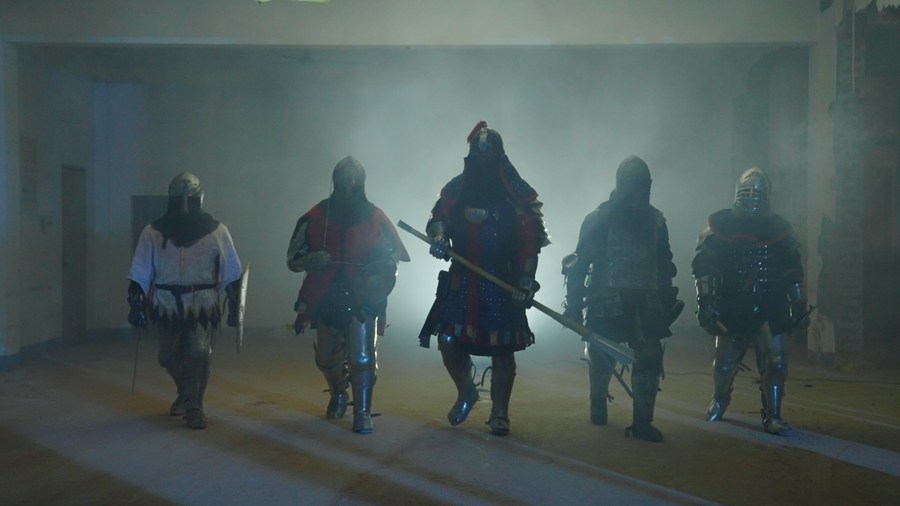
Team Half-ton ranked first in the Asia-Pacific region and top ten in the world in 2020.
Full Contact Fighting in Armor is a niche sport in China, but a group of Chinese warriors strived to demonstrate Chinese culture and raise the national flag in the world's top historical medieval battle event.
BEIJING, Dec. 24 (Xinhua) -- At work, they hide among the thousands of commuters in the city. But after work, they put on their self-made suits of armor and go into battle, embracing ancient warriors and unleashing their passion on the field.
They are Chinese Buhurt enthusiasts, who have represented their country in the international arena many times.
Full-contact fighting in armor, also known as Buhurt, is a sport in which fighters wear all-round protective armor for close combat. The appearance of the armor must be as historically accurate as possible, and the weapons used need to be blunted and beveled. At present, more than 50 countries and regions participate in this sport worldwide.
In 2016, China officially joined the international organization for full-contact fighting in armor - Battles of the Nations (BotN) - and a team was organized to participate in international competitions. There are currently six teams registered with more than 60 participants, among whom Team Half-ton from Shanghai ranked first in the Asia-Pacific region and top ten in the world in 2020.
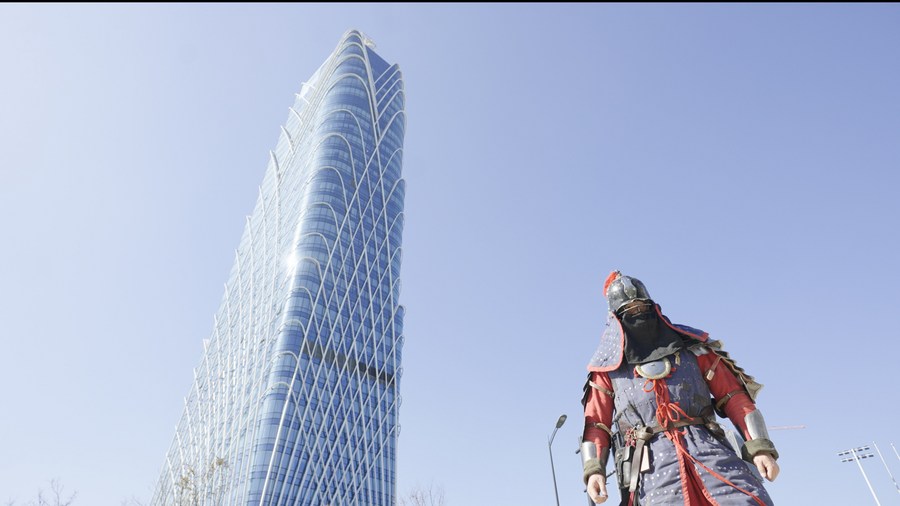
Big Cat, Team Half-ton's captain, presents his armor.
It is not easy to participate in Buhurt competitions. Firstly, a fighter must have his own armor. According to Team Half-ton's captain, known as Big Cat, the rules require participants' armor to be representative of any style from the 13th to 17th centuries. After studying many ancient books, they decided to choose the armor style of the Ming Dynasty.
In a studio located in Jiaxing, Zhejiang Province, the team members each worked on a specific aspect of the armor. Some were responsible for the design, and others were responsible for assembly, striving to find a perfect balance between historical accuracy and protection in competition.
"We must wear armor that represents Chinese characteristics when we compete abroad. China is an ancient civilization, and the heavy weapons and armor on our body contain a glorious history," Big Cat said.
"Buhurt is a special sport. It is a combination of sport and culture. Therefore, the performance on the battlefield is not the most important factor, because as long as you compete tenaciously, you have won the respect of everyone. In addition to competition results, a cultural display is more essential. So, a large part of our energy will be spent on designing and assembling armor."
While preparing for the World Cup of Buhurt-BotN, Team Half-ton faced an unexpected challenge. The Authenticity Committee responsible for reviewing all participants' equipment before the event ruled that Team Half-ton's Ming Dynasty vambrace was not sufficiently restored, and that there were some inconsistencies in its appearance. They recommended that the armor be improved to be as detailed as possible, in order to match with the historical features of the Ming Dynasty.
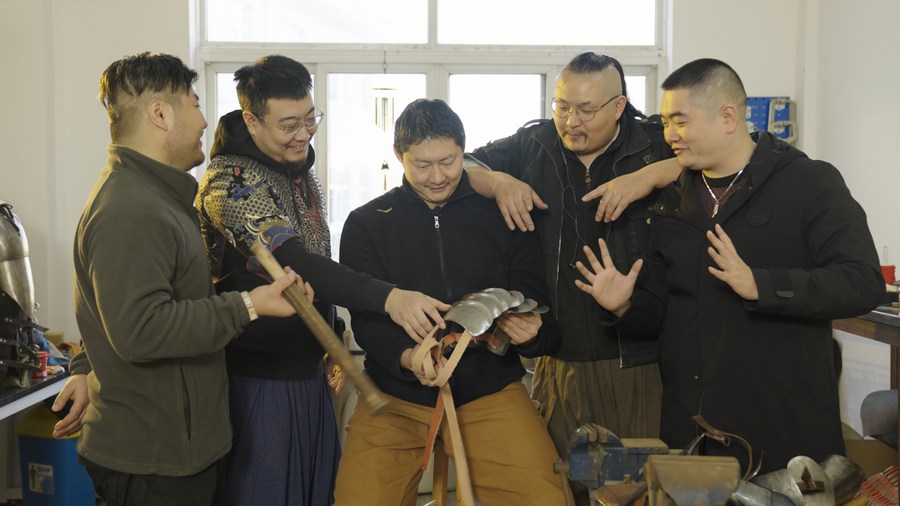
Team Half-ton gathers at their studio in Jiaxing.
"To be honest, it wouldn't be a big problem if we insisted on using the existing armor, the reproduction time was very tight and we would feel very tired. However, we were not completely out of spare energy. After discussion, we still wanted it to be perfect," said Big Cat. "The armor represents Chinese culture on the battlefield."
After deciding to improve the vambrace, the team members searched for information overnight. Overcoming a lot of difficulties, the armor was finally forged before the event, and the results were good. The Historical Medieval Battle International Association gave a high evaluation after the picture was submitted.
"For the first time, there was such a high degree of restoration in the competition, it looked like a perfect replica of Ming Dynasty armor. And they were also very impressed that a Chinese team could achieve such good results in a short time," Big Cat said proudly.
The equipment was ready and the next step was training. Since most of the team members were usually busy with their regular jobs, it was difficult to meet each other frequently during workdays. Therefore, it was usually a personal practice from Monday to Friday, focusing on individual physical fitness and skills.
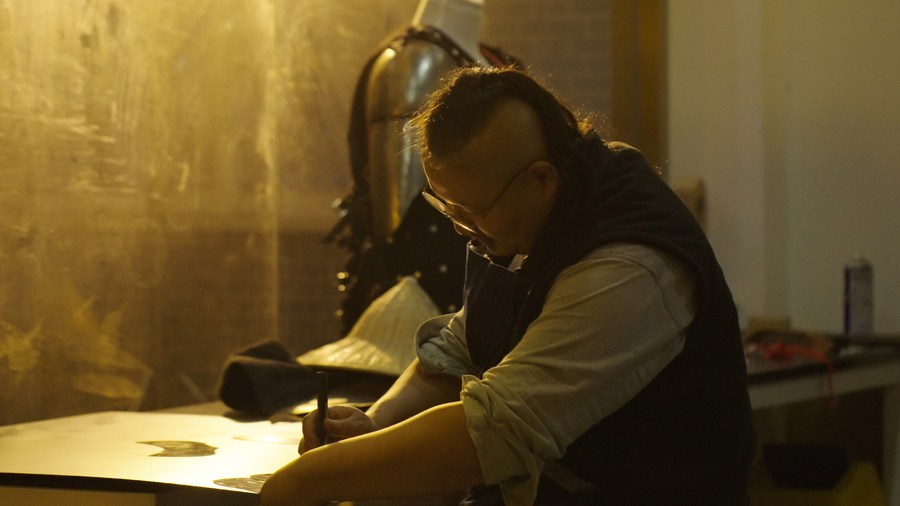
Ku Ma of Team Half-ton works on the armor.
At weekends, team members were able to gather at the training base with helmets and armor to rehearse battle formations and strengthen collaboration. Combining traditional Chinese martial arts and weapon techniques, the players established a set of training systems and methods that suited them, also consulting professional physical trainers and taking the training methods of mixed martial arts and Sanda for reference.
Big Cat is an artistic designer in a games company, and he believes that his work has some intersection with Buhurt. "Since my work would involve some martial arts and war content for nations in various historical periods, I had opportunities to learn about the use of different weapons in various countries through Buhurt, which also benefited my work," he said.
He also admitted that work and hobbies cannot be completely conjoined. After all, Buhurt requires a lot of training time, which inevitably occupies working hours, and at the same time, he also needs to ask for leave to participate in events overseas.
For Big Cat and his teammates, Buhurt has taken up an important part of life, and they are willing to pay for their dream. Big Cat said "as an individual, work is a means of earning a living, but Buhurt is a spiritual pursuit. You can only try your best to coordinate between these two things."■