
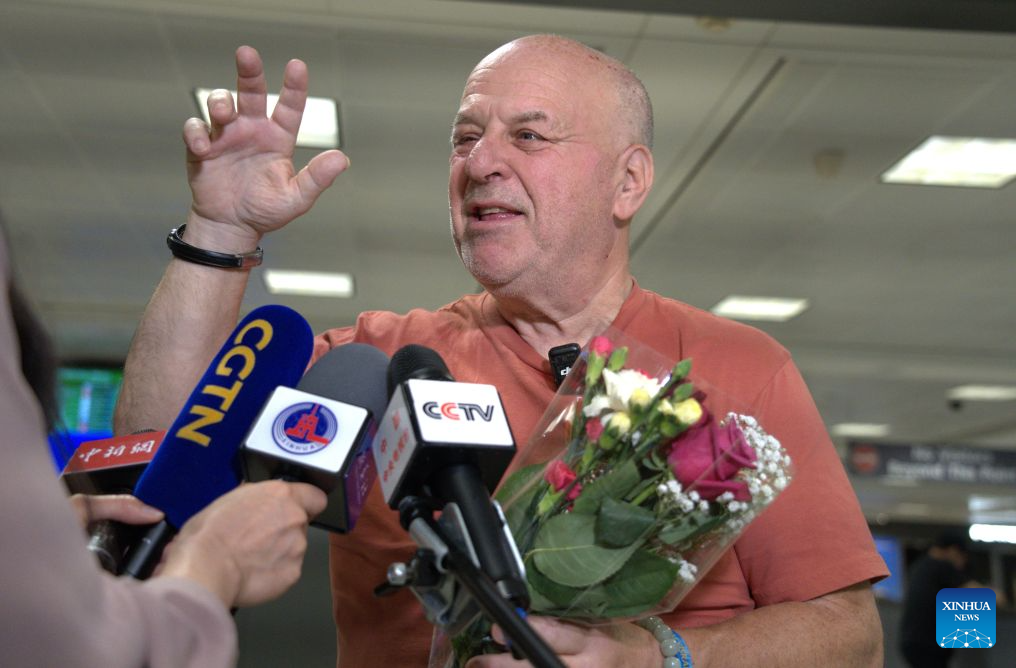
Ronald Sakolsky arrives at Washington Dulles International Airport after his trip to China, near Washington, D.C., the United States, on Sept. 1, 2026. "I came back home today, but I left a part of my heart in China." Retired U.S. teacher Ronald Sakolsky told a small group of reporters after landing at Washington Dulles International Airport late Tuesday, reflecting emotionally on his 10-day trip to China. (Photo by Li Yuanqing/Xinhua)
WASHINGTON, Sept. 3 (Xinhua) -- "I came back home today, but I left a part of my heart in China."
Retired U.S. teacher Ronald Sakolsky told a small group of reporters after landing at Washington Dulles International Airport late Tuesday, reflecting emotionally on his 10-day trip to China.
Returning to China for the first time in 26 years, he reunited with Yin Yuzhen, a farmer and a pioneer in combating desertification.
Their friendship began in 1999, when Sakolsky taught English at a school in central China's Henan Province -- more than 11,000 km from his home in Pittsburgh, Pennsylvania, under a teachers' exchange program between the two countries.
One ordinary evening, a television program caught his eye. On the screen was Yin, planting trees to help hold back the advancing sands of the Maowusu sandy land.
Stretching across parts of Inner Mongolia, Shaanxi and Ningxia, the Maowusu has been one of the front lines in China's fight against desertification in the north -- an effort launched in 1978 and slated to continue through 2050.
"I was so touched that I started to cry," Sakolsky recalled, thinking back to that evening. "I honestly cannot tell you why. Something just happened to me. I just felt like I needed to help."
Moved by her endeavor, he raised 5,000 dollars to help Yin and her husband plant trees and combat desertification. Today, the saplings purchased with the donation have grown into more than 50,000 trees.
In May this year, Yin took to social media to find the American teacher who had once helped her plant the trees. In late August, Sakolsky was invited to return to Inner Mongolia, where he reunited with Yin.
Sakolsky said he had never imagined that trees could be grown in the desert. But Yin's dedication and perseverance turned sand into soil and "made it alive." Sakolsky recalled touching the trees and hearing the soil. "They are my children. Ms. Yin said to me that my children were waving because it was windy and the trees were moving."
After 26 years, Sakolsky and Yin did not need many words when they met again. There were tears, embraces and a sense of familiarity that seemed to bridge the years between them.
Throughout his 10-day trip to China, Sakolsky said, there were many moments when the two understood each other without speaking. "Because we spoke from the heart," he said.
"If a lady that lived in the desert in China, with no telephone, no roads, no television, no electricity, can meet a simple American history teacher, and we can create together a forest ... If one and one can do it, 10 and 10 can do it, 100 and 100 can do it, a million and a million can do it," he said.
For Sakolsky, their story was also a reminder that meaningful change can begin with just two people.
He believes ordinary Americans and Chinese alike want a better relationship between their two countries. Yet fear can grow out of a lack of understanding, he said, while ignorance and prejudice often take root in a lack of education.
That is why he hopes more Americans will learn about China -- by visiting the country, reading about it and opening themselves up to its culture. He likewise encouraged Chinese people to learn about and embrace American culture.
"It is up to the regular common people," he said. "Stop listening to everybody else. Do what you know is the right thing to do."
During his 10-day trip to China, Sakolsky visited Ordos and Hohhot in Inner Mongolia, Luoyang in Henan Province, and Beijing, where he also reunited with some of his former students.
The reunion was among the most memorable moments of his visit. But even as he boarded his flight home, Sakolsky was already thinking about what might come next.
"I would not be here if it was not for a teacher exchange program," he said, adding that to improve relations between the two countries, "start with the children and the students." ■
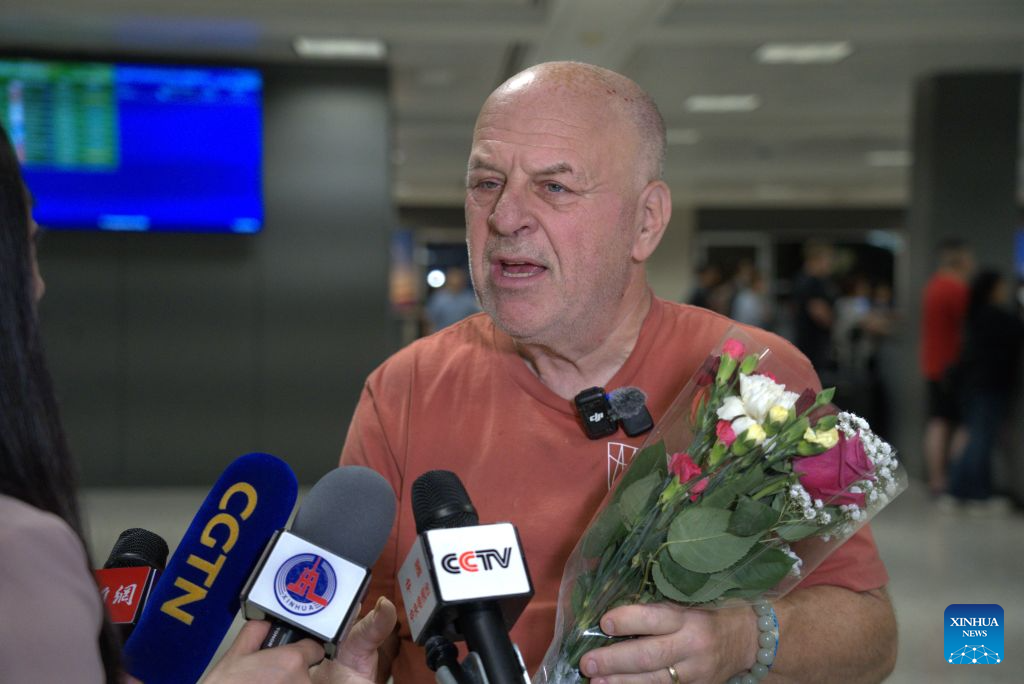
Ronald Sakolsky receives an interview at Washington Dulles International Airport after his trip to China, near Washington, D.C., the United States, on Sept. 1, 2026. "I came back home today, but I left a part of my heart in China."
Retired U.S. teacher Ronald Sakolsky told a small group of reporters after landing at Washington Dulles International Airport late Tuesday, reflecting emotionally on his 10-day trip to China. (Photo by Li Yuanqing/Xinhua)
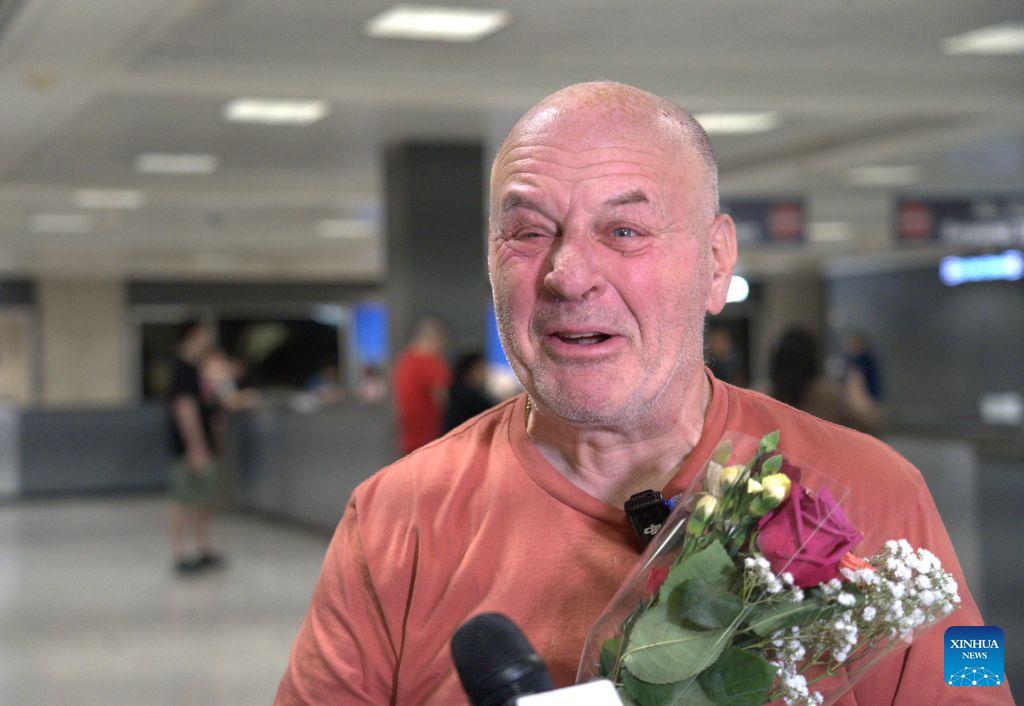
Ronald Sakolsky receives an interview at Washington Dulles International Airport after his trip to China, near Washington, D.C., the United States, on Sept. 1, 2026. "I came back home today, but I left a part of my heart in China."
Retired U.S. teacher Ronald Sakolsky told a small group of reporters after landing at Washington Dulles International Airport late Tuesday, reflecting emotionally on his 10-day trip to China.(Photo by Li Yuanqing/Xinhua)