
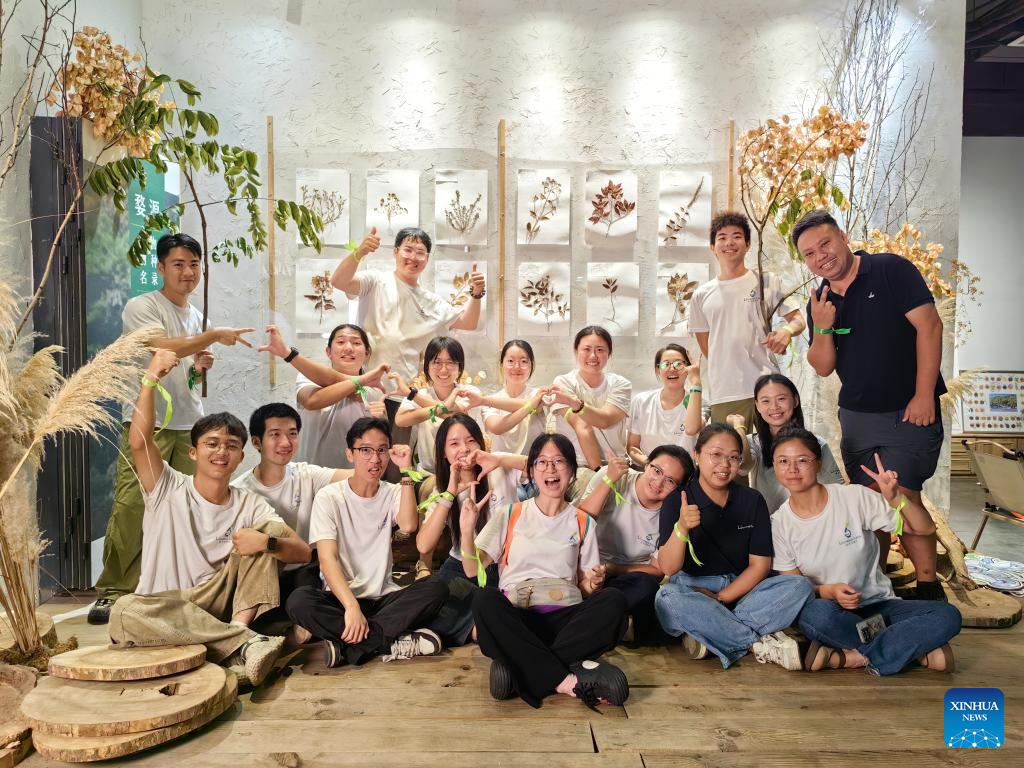
Members of the Linnaeus Laboratory pose for a group photo in Wuyuan, east China's Jiangxi Province, Oct. 8, 2025.(Xinhua)
NANCHANG, May 22 (Xinhua) -- During spring and summer, a group of young researchers would organize local volunteers to patrol farmland and riverbanks three times a week in search of invasive snails in a renowned scenic area in east China's Jiangxi Province.
The work is muddy, repetitive and toilsome, very different from the big-city careers many of the researchers, mostly born in the 1990s and 2000s, could have pursued after earning postgraduate and doctoral degrees.
Over the past eight years, members of the Linnaeus Laboratory in Wuyuan County have worked on tasks ranging from removing invasive species to rescuing injured wildlife and teaching people about nature. Their efforts have helped protect local biodiversity and raise public awareness of ecological conservation through nature education.
Wuyuan, often called "China's most beautiful village," is known for its traditional Huizhou-style houses with white walls and black tiles, as well as vast fields of rapeseed flowers that attract tourists every spring.
Nestled in a quiet corner of the county seat, the Linnaeus Laboratory, named after the Swedish botanist Carl Linnaeus in honor of his work, is an understated yet magical space. Inside, children peer through microscopes, fern spores grow in petri dishes, and rescued wildlife find a temporary home.
The laboratory was founded in 2018 by Liu Zhilong, a post-90s botanist, together with partners from several well-known Chinese universities. Instead of staying in major cities, the young researchers decided to settle in rural Jiangxi.
"At first, villagers thought we were strange people doing strange things. But later, they came to understand exactly what we're doing," Liu said.
One of the team's main seasonal battles is combating golden apple snails, an invasive species that threatens crops and aquatic ecosystems.
Zhou Xinlong, a team member who can identify more than 6,000 plant species, teaches locals how to trap snail eggs by placing bamboo slips into the silt in shallow water. "We wear waterproof trousers and place bamboo strips into the silt in the morning before collecting the snails and removing the eggs later in the day," Zhou said.
The fieldwork can be exhausting and, at times, misunderstood.
Shen Xianhui, who holds a PhD in ecology, recalled going out by boat at 1 a.m. to study snail activity, only to be mistaken for fish thieves by vigilant villagers.
In the second half of each year, the team turns its attention to another ecological threat: Canada goldenrod, an invasive plant that spreads rapidly and crowds out native vegetation.
The researchers rally public participation in invasive-species control through educational campaigns, holding up to nine public lectures in a single day to teach identification skills and launching a mini-program for residents to report sightings. Volunteers also participate in removal and composting activities.
"After participating, I realized this is not just physical work, but a valuable lesson to help understand nature," said Jiang Li, a local resident who joined the activities with her child.
The team also serves as nature educators for local communities, bringing together specialists in veterinary science, plant taxonomy, animal behavior, and even butterfly genome evolution.
Liu said the laboratory offers free or low-cost public classes every week, including indoor lectures, outdoor field trips, and nighttime wildlife observation.
"Nature education is not simply going out for spring outings. It is about helping people build an emotional bond with nature," Liu said.
Over eight years, the laboratory's team of more than 20 members has brought over 55,000 youngsters to its nature classes through programs including the Field Natural History Expeditions, The Magic of Yeast, and Secrets of the Bacterial World.
The laboratory also operates Wuyuan's only wildlife rescue and rehabilitation center. "We are not only rescuing animals but also changing public attitudes towards wildlife," Liu said.
Villagers who once killed snakes on sight or used them to make medicinal liquor are now more willing to protect wildlife.
"We hope to break down the barriers of science," said Ning Zhenzhen, a recent graduate from Nanjing Agricultural University. "Biodiversity protection is not just the responsibility of researchers and authorities. It is a duty for every one of us." ■
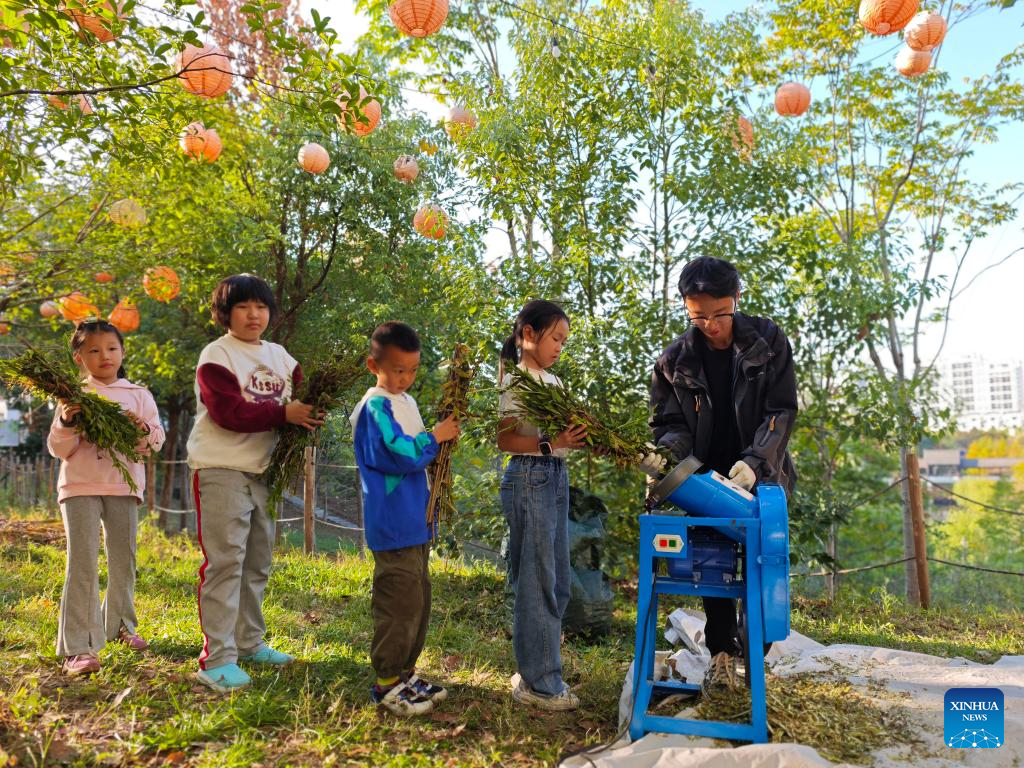
A researcher of the Linnaeus Laboratory instructs local children to remove Canada goldenrod, an invasive plant in Wuyuan, east China's Jiangxi Province, Nov. 2, 2024. (Xinhua)


