
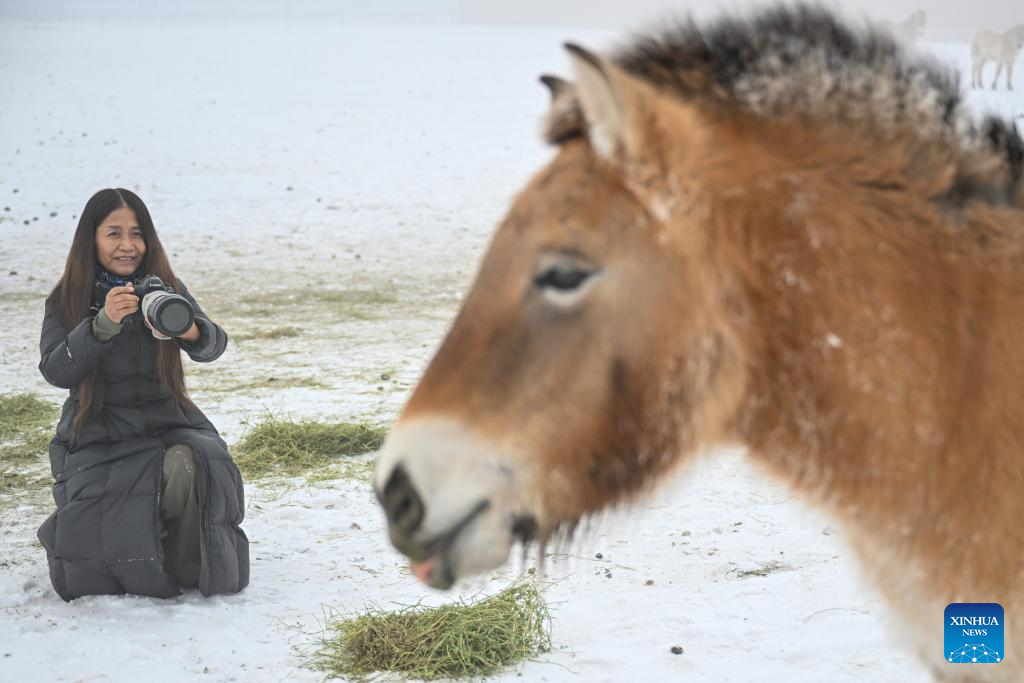
Zhang Hefan takes photos of a Przewalski's horse at a nature reserve in the Kalamaili Mountains in northwest China's Xinjiang Uygur Autonomous Region, Feb. 6, 2026. (Xinhua/Ding Lei)
URUMQI, May 12 (Xinhua) -- For years, Zhang Hefan came to know the horses through the habits that captivity exposed, from the foal that resisted every injection to the mare that did not survive a difficult birth, and the animals whose coats, markings and temperaments became as familiar to her as human faces.
In the wind-scoured Gobi Desert of the Junggar Basin in northwest China, she learned to tell one dun-colored body from another, to remember who had sired whom, which mare had foaled in which season, which young horse carried a family resemblance.
Then came the day when the purpose of all that familiarity was to let them go and set them free into the wild.
In August 2001, 27 Przewalski's horses stood inside an enclosure near the northern edge of the Kalamaili Mountains. The gate opened, but the horses did not immediately run. The lead animal stepped forward, lowered its head and smelled the unfamiliar ground. The others waited, alert and uncertain. After a while, they followed. A few steps became a trot, then the trot became a run. Dust lifted behind them as they moved out into the Gobi Desert.
Zhang watched them leave with the unease of someone who had helped keep them alive precisely so they could one day survive without her.
The contradiction had been there from the beginning. Przewalski's horses, an ancient equine species often described as among the last truly wild horses, had disappeared from China's wild landscapes in the 1970s.
In 1985, China began bringing them back, importing 24 animals from Britain, Germany and the United States, and established a breeding center in Jimsar County in Xinjiang Uygur Autonomous Region. The horses had to be enclosed, fed, treated and monitored. But if they remained too safely confined, the very wildness that conservationists were trying to preserve risked gradually fading away.
Zhang arrived at the center in 1995, when the effort to bring the horses back was still in its early days and the place felt, to her, almost impossibly remote.
She was 21, newly graduated from Xinjiang Agricultural University with a degree in veterinary medicine. The road ran deep into the Gobi Desert. The buildings were low and weathered. Electricity was unreliable. There was no telephone. To buy daily necessities in the county town, more than 60 kilometers away, meant four or five hours of jolting travel.
The seasons announced themselves without mercy. Sand blew through the rooms in winter and spring. In summer, the ground burned underfoot. In winter, water froze solid in the vat and had to be broken with a hammer. Zhang was the only young woman at the base. Some of the young people who came with her soon wanted to leave. So did she. Twice, she wrote resignation letters.
The first time, a foal named Xiao Heitan (Little Black Charcoal) dislocated a joint. It was wild enough to fear every needle and every dose of medicine, and it fought treatment with all its strength. Zhang told herself she would wait until the foal recovered.
That Spring Festival, she did not go home. On Chinese New Year's Eve, while faint firecrackers sounded from distant settlements, she stayed in the cold stable, treating the injured limb, changing dressings, giving injections, and rubbing the stiff joint with hands reddened by the cold.
Gradually, the foal stopped resisting. When she approached, it limped toward her and rubbed its head against her arm. Zhang put away the resignation letter.
The second time, a mare named Banna died of heatstroke, leaving a 21-day-old foal behind. Zhang raised the orphan, Xuelianhua (Snow Lotus), by bottle-feeding her and waking every two or three hours throughout the night. After more than a month, the foal began eating fodder on its own. Watching it run inside the pen, Zhang told herself that she could no longer go. "I have a bond with horses," she later said.
But that bond did not make the work any easier. It made it more exacting. Przewalski's horses were not domestic horses. They were vigilant, stubborn and easily disturbed. Zhang learned from older technicians, closely observing how the horses ate, drank, rested, paced, fought and interacted with one another.
Before identification markings made recognition easier, she memorized them one by one through their sex, age, coat color, stripes, posture and behavior. She gave them names of her own like Big Guy, Red Blossom, Green Blossom, Ugly Duckling, Prince and Princess.
In time, Zhang could identify every horse at the center by sight. She knew, as she put it, "who was the father, who was the mother, who the siblings were, when they fell in love, when they started a family and had foals."
Such familiarity was not merely sentimental. For a species being brought back from the edge, knowing one horse from another could matter as much as medicine or feed. It helped determine how the horses were bred, treated and, eventually, released.
Affection kept Zhang close to the horses, but the work required a colder discipline. The keepers needed pedigrees precise enough to keep the population from weakening through inbreeding, and records detailed enough to show how an animal raised behind fences might one day manage beyond them.
In her first year at the center, Zhang developed a daily habit of recording observations, including changes in herd composition, animals asserting dominance, feeding preferences, estrus cycles, births, injuries, fights and even deaths.
The limits of care became painfully clear in 2000. On May 14 that year, while Zhang was away on a rare break, she received a call. "Junggar No.1 is having a difficult birth," the person on the other end said.
She rushed back, but the mare -- China's first artificially bred Przewalski's horse -- had suffered a severe prolapse during the difficult birth and, after being startled, injured herself beyond saving.
In her diary, Zhang wrote, "She was born on Women's Day and died on Mother's Day." Tears had wet the page, blurring a few characters where the ink had spread.
Over the next two decades and more, Zhang helped release 176 horses in 19 batches into the Junggar Basin. Each release felt less like an ending than the beginning of a new worry. "Every time we release a batch, it feels like marrying off a daughter," she said. "You know she should go, but your heart still feels empty."
After release, the work followed the horses outward. Zhang joined patrols into the Kalamaili wilderness to track migration, breeding and health, and to help provide emergency food or water when drought, snow, or cold made survival harder.
In one winter of heavy snow, she worried that a herd might not find enough to eat. When vehicles could go no farther, the patrol continued on foot, pushing through deep snow until they found the horses sheltering safely in a valley. In her diary, Zhang wrote that the sight of the horses running or grazing safely in the open could turn the exhaustion of a patrol into something like peace.
Her notebooks eventually grew to more than a million Chinese characters.
She wrote books about the horses' return to Kalamaili and about the long effort behind it. Her body also registered the years. Around 2013, after long exposure to ultraviolet light, wind and cold, she developed a difficult case of dermatomyositis, with skin ulcers and muscle pain. At its worst, even the walk from her dormitory to the stables required several stops.
The population that began with 24 imported horses has since grown toward nearly 1,000 animals nationwide. Release sites have expanded from Xinjiang to Gansu, Inner Mongolia and Ningxia. In the wild, the herds have begun to reproduce on their own, and a sixth generation is growing up beyond the enclosures.
For nearly 30 years, Zhang's work had been to notice what others might miss: a limp, a change in appetite, a family resemblance, the first signs of trust in a frightened foal. Yet the point of such attention was never to keep the horses close. It was to prepare them for the day when they would no longer look back. ■
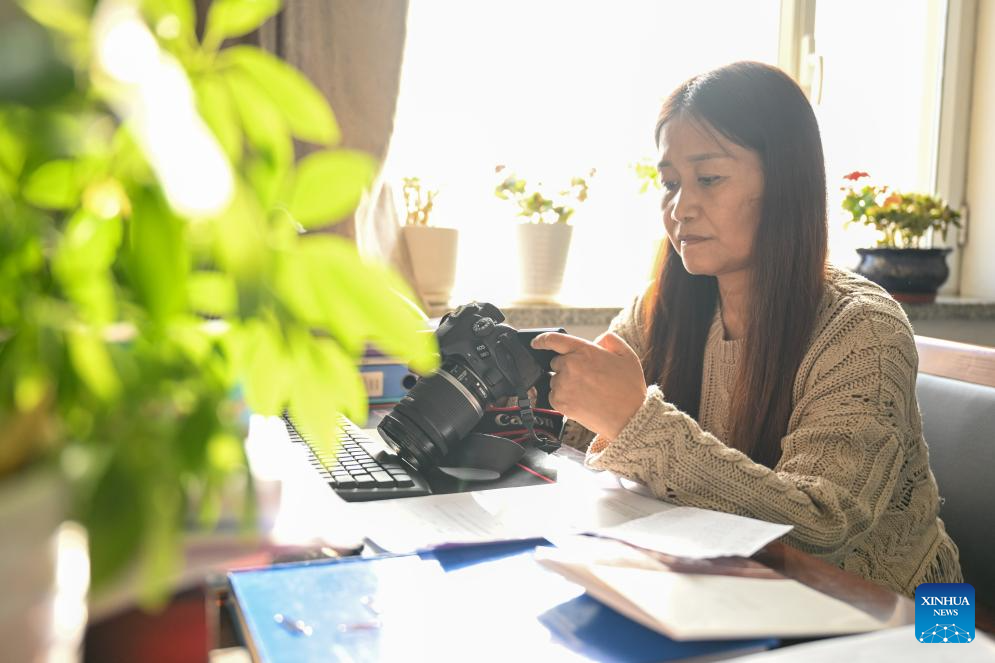
Zhang Hefan checks the photos of Przewalski's horses at a nature reserve in the Kalamaili Mountains in northwest China's Xinjiang Uygur Autonomous Region, Feb. 5, 2026. (Xinhua/Ding Lei)
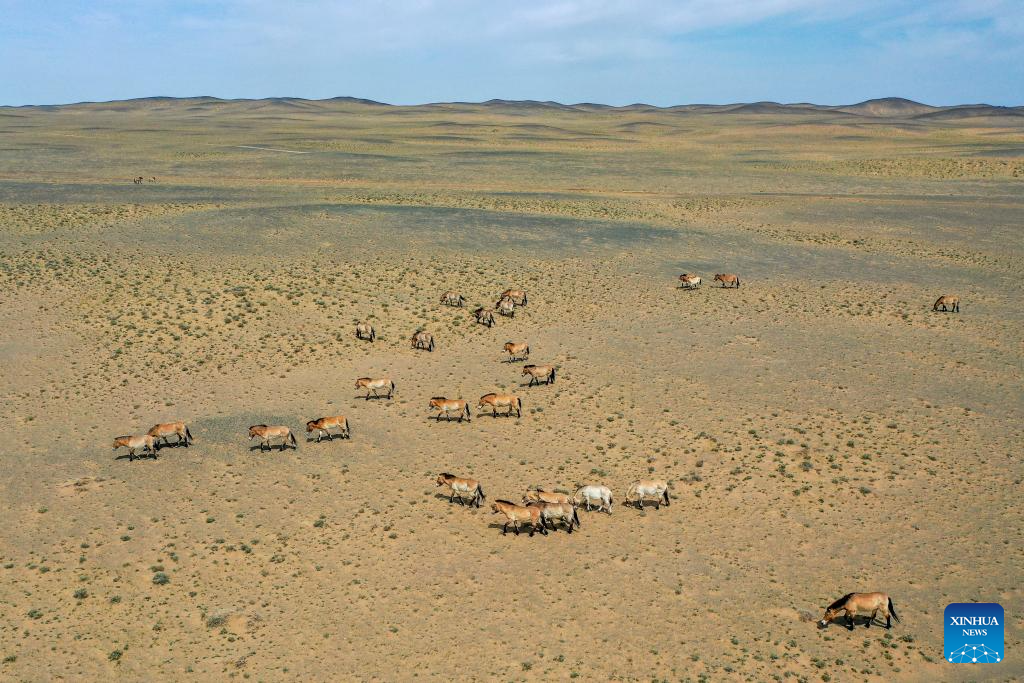
An aerial drone photo taken on April 22, 2026 shows Przewalski's horses released into the wild in the Kalamaili Mountains in northwest China's Xinjiang Uygur Autonomous Region. (Xinhua/Ding Lei)
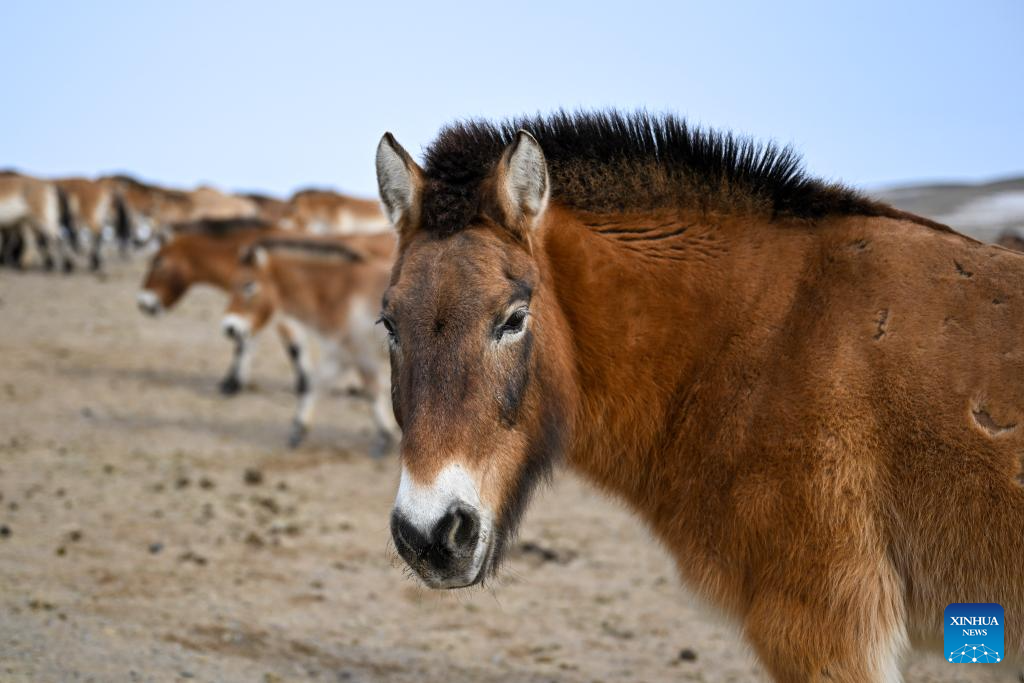
This photo taken on Feb. 4, 2026 shows Przewalski's horses at a nature reserve in the Kalamaili Mountains in northwest China's Xinjiang Uygur Autonomous Region. (Xinhua/Ding Lei)
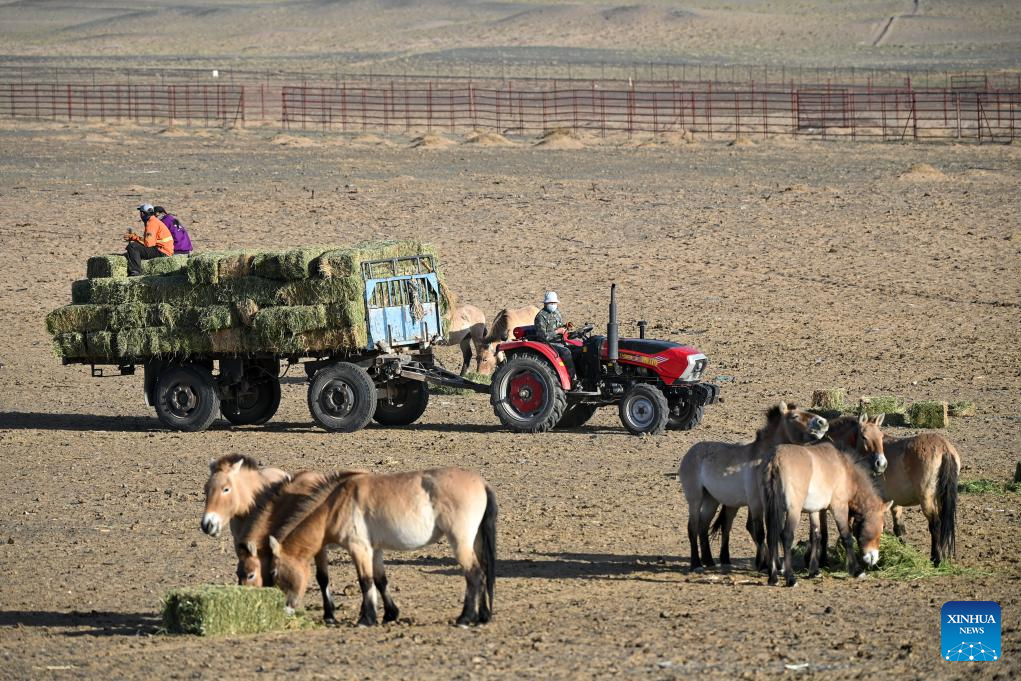
Staff members provide fodder to Przewalski's horses at a nature reserve in the Kalamaili Mountains in northwest China's Xinjiang Uygur Autonomous Region, April 21, 2026. (Xinhua/Ding Lei)


