CHONGQING, April 21 (Xinhua) -- For 72-year-old Li Qingdong, a patient from southwest China's Chongqing municipality, brain-computer interface (BCI) technology has translated his thoughts into visible muscle movement, aiding the recovery of his once immobile leg.
Li, who suffered a cerebral infarction, had been unable to lift his left leg for years.
"At first, I didn't believe it would work, but now I can move my leg a little just by thinking," he said, adding that his leg has become more responsive, and he feels more confident about recovery after several days of training.
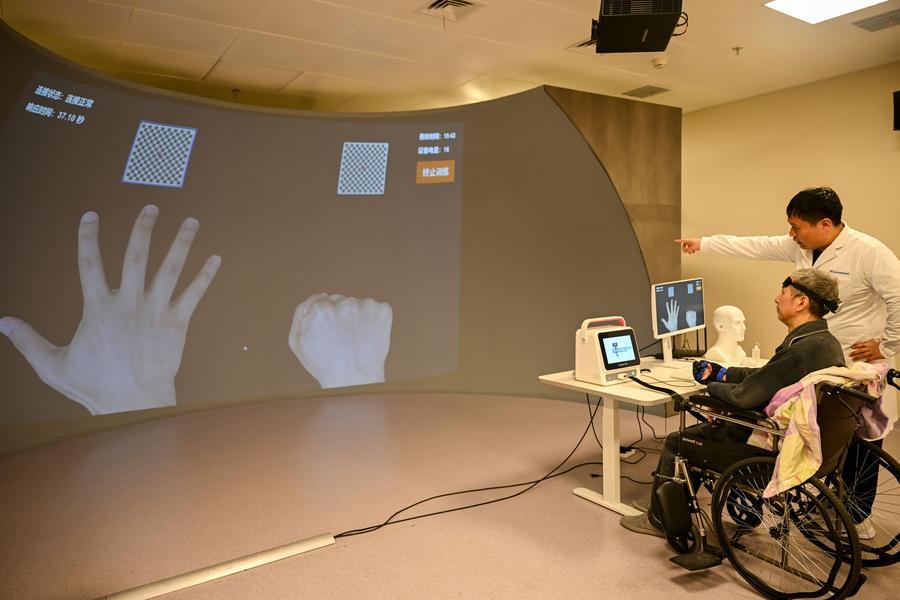
Li is receiving the innovative therapy at the Second Affiliated Hospital of Chongqing Medical University, home to southwest China's first clinical research ward dedicated to BCI technology.
The facility has been exploring how neural signals can be translated into physical actions with BCI in recent years, offering new hope for patients with neurological disorders.
According to the hospital, the therapy is based on "motor imagery," in which the brain generates signals of intended movement even when the body cannot execute it.
Relying on non-invasive BCI systems, electroencephalogram (EEG) devices would capture these signals from the scalp, which are then decoded by algorithms and converted into commands that activate external stimulation systems, and this process creates a feedback loop that helps rebuild the connection between brain and body, according to the doctors.
"Even a slight improvement in this connection can significantly enhance patients' daily lives," said Lu Wanting, a doctor at the ward.
Lu said that since its establishment last October, the facility has treated around 100 patients, many of them stroke survivors, with encouraging signs of functional improvement.
Compared with traditional one-on-one, therapist-assisted passive training, BCI-based rehabilitation can also significantly improve both training intensity and efficiency, she added.
As the number of sessions increases, patients gradually gain a stronger sense of control over their movements, with the ultimate goal of achieving independent grasping even without the device, and the clinical cases are providing data for device and therapy optimization at the same time, Lu said.
Driven by advances in artificial intelligence and neuroscience, the development of BCI technology has gained exponential momentum in recent years, with medical experts highlighting its growing potential in countering neurological diseases, such as Parkinson's disease and epilepsy.
Against the backdrop, Chongqing has introduced an action plan propelling the development of the smart medical equipment industry by the end of 2025, which lists BCI as a key sector in cultivating high-end therapeutic equipment across the municipality.
Such policy support has encouraged researchers at the hospital to work on other portable BCI devices as well, as their findings could enable real-time brain monitoring and extend rehabilitation beyond clinical settings.
China is vigorously developing its BCI technology to solve clinical problems and drive economic growth. The country aims to cultivate the BCI sector, along with other industries of the future, into new engines of growth, as outlined in its 15th Five-Year Plan (2026-2030).
On a global scale, industry data showed that the international BCI market had reached nearly 3 billion U.S. dollars in 2025, reflecting rapid growth and investment.
Although challenges remain, experts are optimistic about the development and application of BCI devices. Lu said improving signal decoding accuracy and system efficiency will be key to broader BCI applications.
"There is still a long way to go, but we are now on the right track," she added. ■