
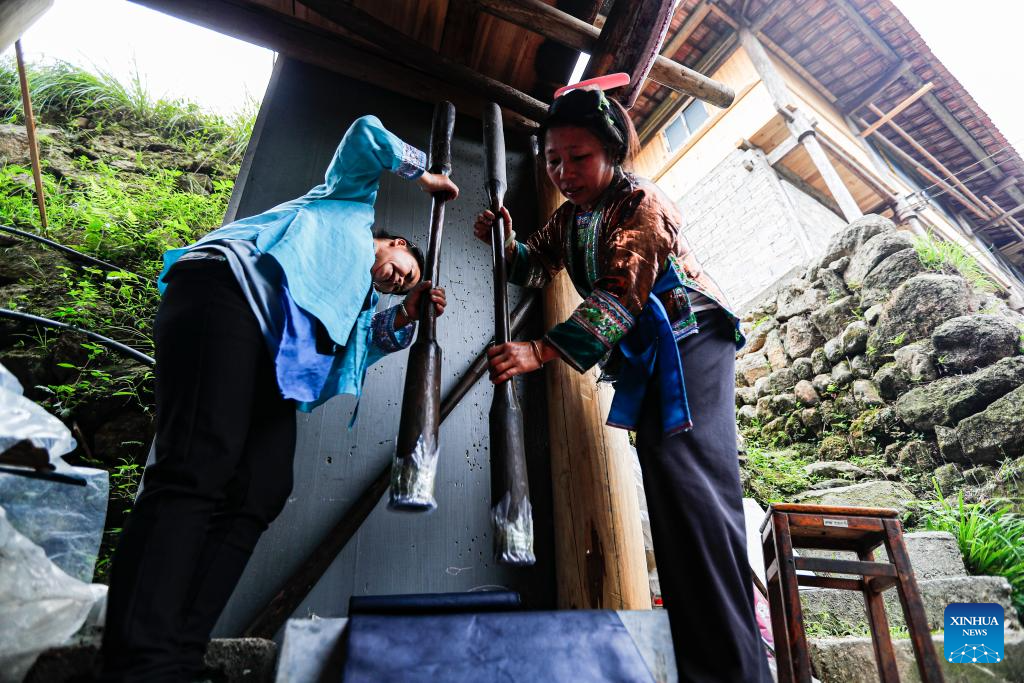
Liang Zuying (R) pounds the cloth with the traditional "Liang Bu" hammer in Wuying Village on the border between south China's Guangxi Zhuang Autonomous Region and southwest China's Guizhou Province, on Aug. 31, 2023. Wuying Village is a Miao ethnic group hamlet that nestles snugly in the towering mountains stretching across the border between Guangxi and Guizhou.
"Liang Bu", named for its glistening appearance, is a kind of traditional hand-made cloth of Miao ethnic group.
Women of Miao ethnic group in Wuying plant woad in spring and harvest it in fall. They soak woad in water for days before mixing it with materials such as lime, to make the dye for "Liang Bu". It usually takes months to make a piece of "Liang Bu" after repeated process of dip-dyeing, drying, pounding, applying egg white and steaming. The cloth gradually becomes glistening owing to tens of thousands of poundings by villagers with traditional wooden hammers. After cutting, sewing, embroidery and ironing, a set of glossy "Liang Bu" clothes is finally done with up to one year spent from the planting of woad in general.
Subject to its complicated producing techniques, "Liang Bu" was once rarely seen. In recent years, it was gradually favored again thanks to the development of local tourism and the improvement in people's awareness of traditional cultural protection. (Xinhua/Hu Xingyu)
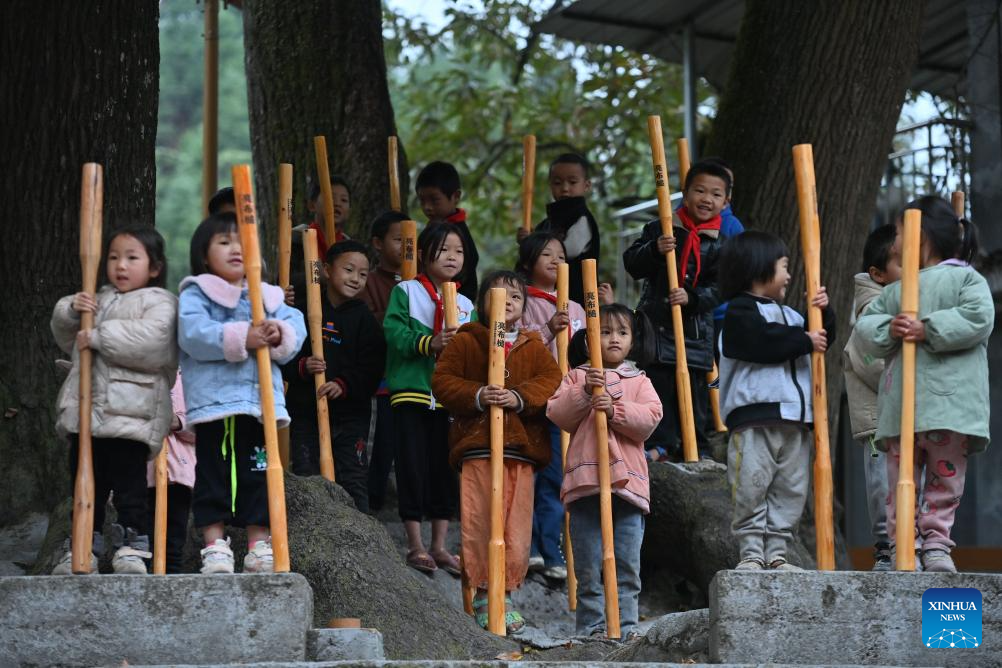
Children learn to use the traditional "Liang Bu" hammers in Wuying Village on the border between south China's Guangxi Zhuang Autonomous Region and southwest China's Guizhou Province, on Nov. 14, 2022. Wuying Village is a Miao ethnic group hamlet that nestles snugly in the towering mountains stretching across the border between Guangxi and Guizhou.
"Liang Bu", named for its glistening appearance, is a kind of traditional hand-made cloth of Miao ethnic group.
Women of Miao ethnic group in Wuying plant woad in spring and harvest it in fall. They soak woad in water for days before mixing it with materials such as lime, to make the dye for "Liang Bu". It usually takes months to make a piece of "Liang Bu" after repeated process of dip-dyeing, drying, pounding, applying egg white and steaming. The cloth gradually becomes glistening owing to tens of thousands of poundings by villagers with traditional wooden hammers. After cutting, sewing, embroidery and ironing, a set of glossy "Liang Bu" clothes is finally done with up to one year spent from the planting of woad in general.
Subject to its complicated producing techniques, "Liang Bu" was once rarely seen. In recent years, it was gradually favored again thanks to the development of local tourism and the improvement in people's awareness of traditional cultural protection. (Xinhua/Huang Xiaobang)
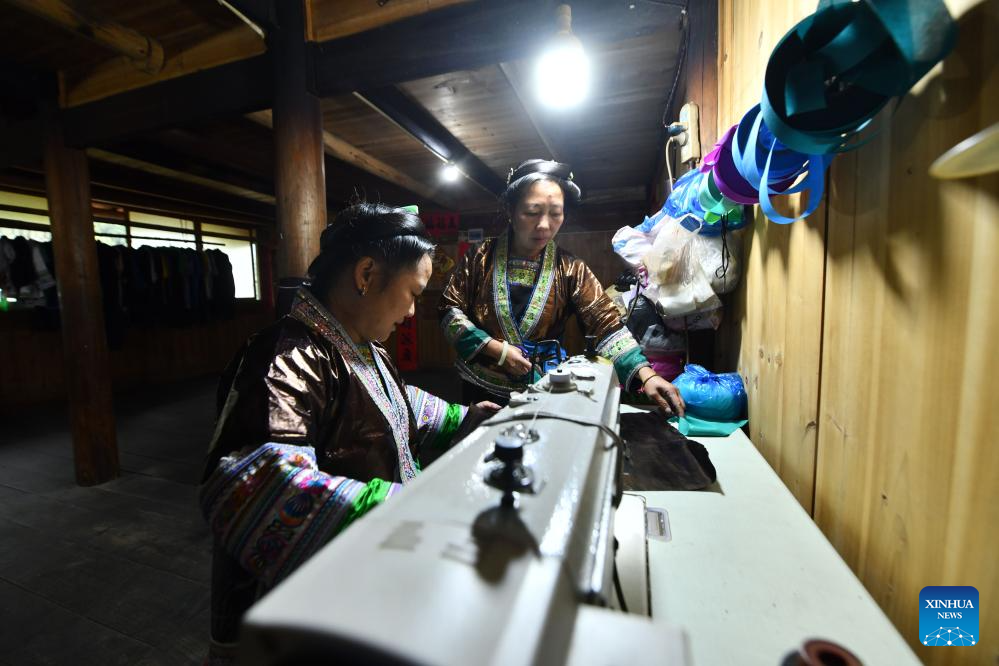
Liang Zuying (R) and Wu Meiqiu sew "Liang Bu" costumes in Wuying Village on the border between south China's Guangxi Zhuang Autonomous Region and southwest China's Guizhou Province, on Aug. 31, 2023. Wuying Village is a Miao ethnic group hamlet that nestles snugly in the towering mountains stretching across the border between Guangxi and Guizhou.
"Liang Bu", named for its glistening appearance, is a kind of traditional hand-made cloth of Miao ethnic group.
Women of Miao ethnic group in Wuying plant woad in spring and harvest it in fall. They soak woad in water for days before mixing it with materials such as lime, to make the dye for "Liang Bu". It usually takes months to make a piece of "Liang Bu" after repeated process of dip-dyeing, drying, pounding, applying egg white and steaming. The cloth gradually becomes glistening owing to tens of thousands of poundings by villagers with traditional wooden hammers. After cutting, sewing, embroidery and ironing, a set of glossy "Liang Bu" clothes is finally done with up to one year spent from the planting of woad in general.
Subject to its complicated producing techniques, "Liang Bu" was once rarely seen. In recent years, it was gradually favored again thanks to the development of local tourism and the improvement in people's awareness of traditional cultural protection. (Xinhua/Huang Xiaobang)
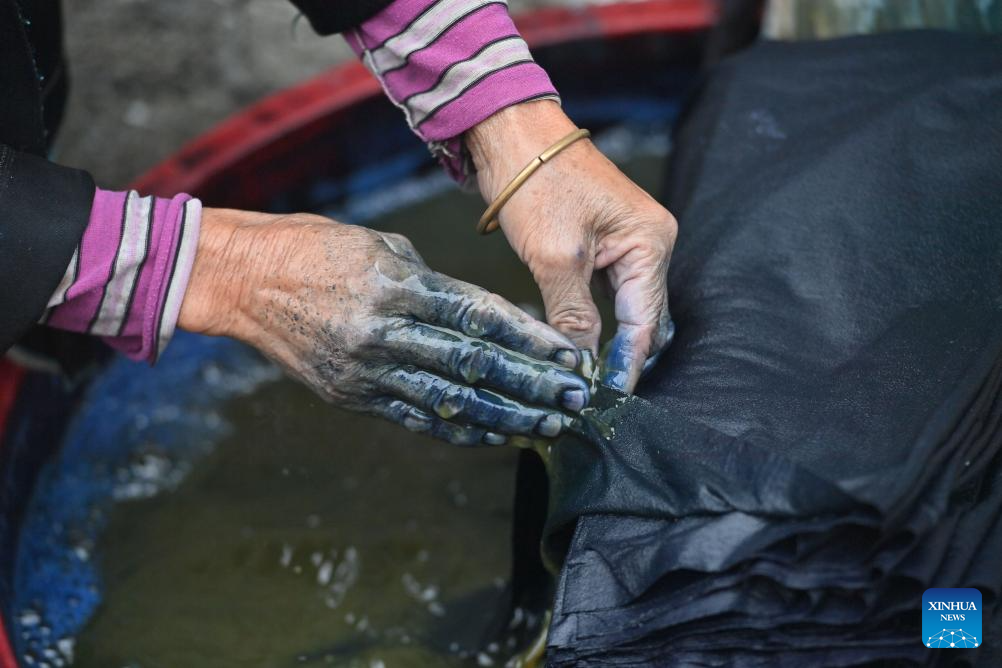
Pan Huami dyes the cloth in Wuying Village on the border between south China's Guangxi Zhuang Autonomous Region and southwest China's Guizhou Province, on Sept. 2, 2023. Wuying Village is a Miao ethnic group hamlet that nestles snugly in the towering mountains stretching across the border between Guangxi and Guizhou.
"Liang Bu", named for its glistening appearance, is a kind of traditional hand-made cloth of Miao ethnic group.
Women of Miao ethnic group in Wuying plant woad in spring and harvest it in fall. They soak woad in water for days before mixing it with materials such as lime, to make the dye for "Liang Bu". It usually takes months to make a piece of "Liang Bu" after repeated process of dip-dyeing, drying, pounding, applying egg white and steaming. The cloth gradually becomes glistening owing to tens of thousands of poundings by villagers with traditional wooden hammers. After cutting, sewing, embroidery and ironing, a set of glossy "Liang Bu" clothes is finally done with up to one year spent from the planting of woad in general.
Subject to its complicated producing techniques, "Liang Bu" was once rarely seen. In recent years, it was gradually favored again thanks to the development of local tourism and the improvement in people's awareness of traditional cultural protection. (Xinhua/Huang Xiaobang)
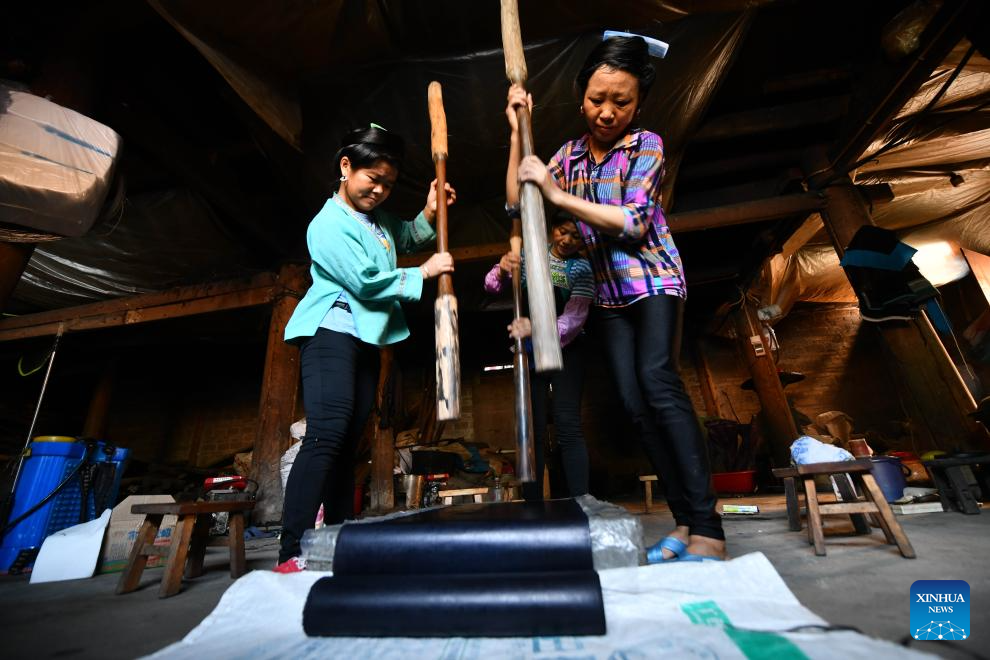
Wei Meili (R) pounds the cloth with the traditional "Liang Bu" hammer in Wuying Village on the border between south China's Guangxi Zhuang Autonomous Region and southwest China's Guizhou Province, on Sept. 2, 2020. Wuying Village is a Miao ethnic group hamlet that nestles snugly in the towering mountains stretching across the border between Guangxi and Guizhou.
"Liang Bu", named for its glistening appearance, is a kind of traditional hand-made cloth of Miao ethnic group.
Women of Miao ethnic group in Wuying plant woad in spring and harvest it in fall. They soak woad in water for days before mixing it with materials such as lime, to make the dye for "Liang Bu". It usually takes months to make a piece of "Liang Bu" after repeated process of dip-dyeing, drying, pounding, applying egg white and steaming. The cloth gradually becomes glistening owing to tens of thousands of poundings by villagers with traditional wooden hammers. After cutting, sewing, embroidery and ironing, a set of glossy "Liang Bu" clothes is finally done with up to one year spent from the planting of woad in general.
Subject to its complicated producing techniques, "Liang Bu" was once rarely seen. In recent years, it was gradually favored again thanks to the development of local tourism and the improvement in people's awareness of traditional cultural protection. (Xinhua/Huang Xiaobang)
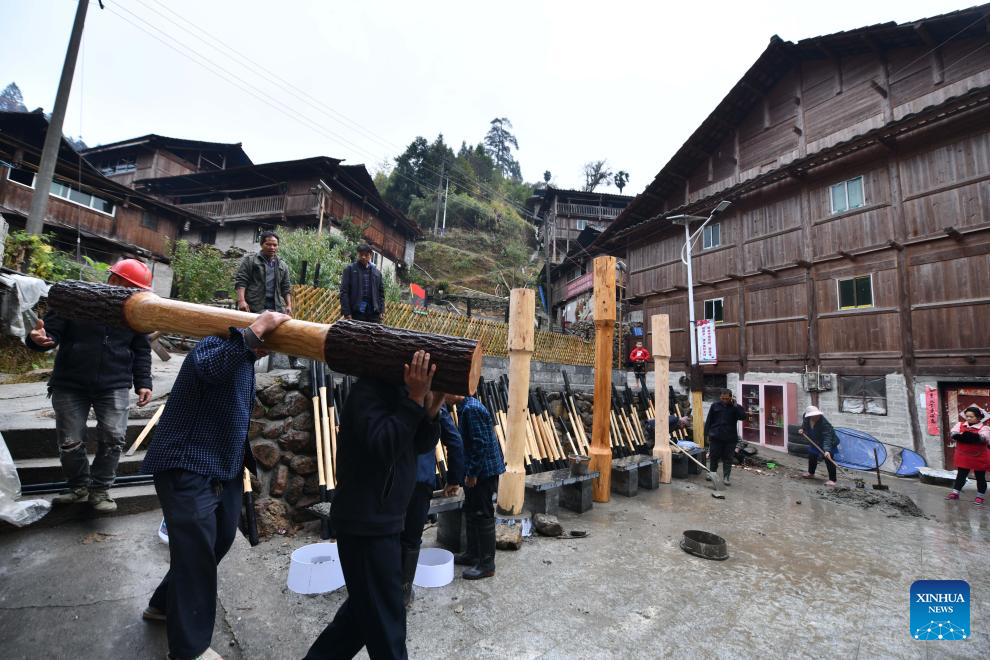
Villagers install large "Liang Bu" hammers at a square in Wuying Village on the border between south China's Guangxi Zhuang Autonomous Region and southwest China's Guizhou Province, on Nov. 19, 2022. Wuying Village is a Miao ethnic group hamlet that nestles snugly in the towering mountains stretching across the border between Guangxi and Guizhou.
"Liang Bu", named for its glistening appearance, is a kind of traditional hand-made cloth of Miao ethnic group.
Women of Miao ethnic group in Wuying plant woad in spring and harvest it in fall. They soak woad in water for days before mixing it with materials such as lime, to make the dye for "Liang Bu". It usually takes months to make a piece of "Liang Bu" after repeated process of dip-dyeing, drying, pounding, applying egg white and steaming. The cloth gradually becomes glistening owing to tens of thousands of poundings by villagers with traditional wooden hammers. After cutting, sewing, embroidery and ironing, a set of glossy "Liang Bu" clothes is finally done with up to one year spent from the planting of woad in general.
Subject to its complicated producing techniques, "Liang Bu" was once rarely seen. In recent years, it was gradually favored again thanks to the development of local tourism and the improvement in people's awareness of traditional cultural protection. (Xinhua/Huang Xiaobang)
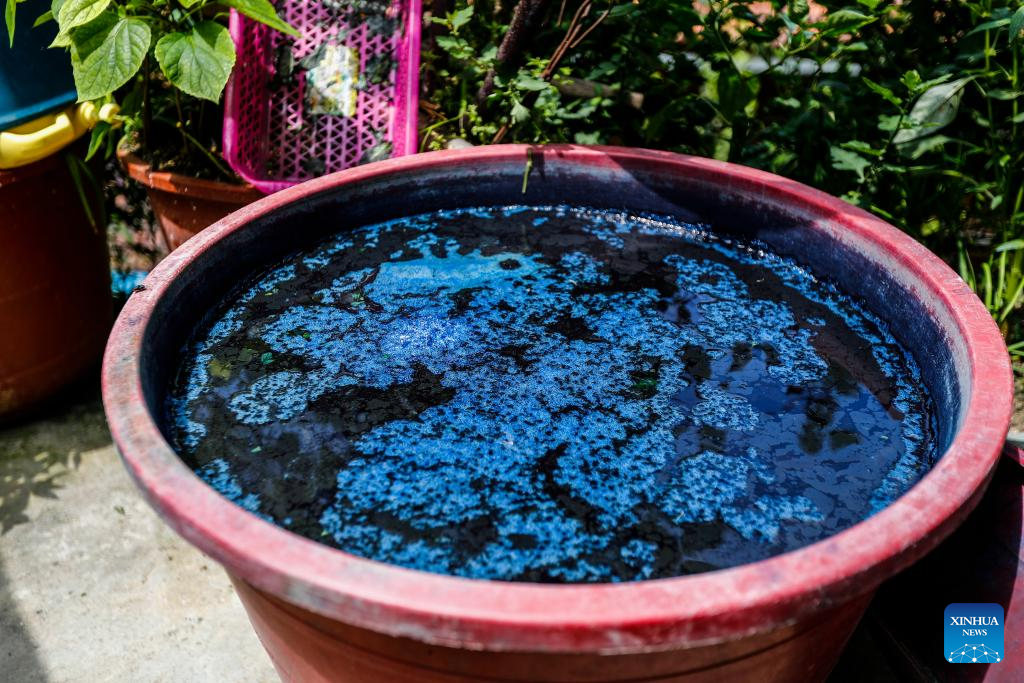
This photo shows the water after soaking woad in it for three days in Wuying Village on the border between south China's Guangxi Zhuang Autonomous Region and southwest China's Guizhou Province, on Aug. 31, 2023. Wuying Village is a Miao ethnic group hamlet that nestles snugly in the towering mountains stretching across the border between Guangxi and Guizhou.
"Liang Bu", named for its glistening appearance, is a kind of traditional hand-made cloth of Miao ethnic group.
Women of Miao ethnic group in Wuying plant woad in spring and harvest it in fall. They soak woad in water for days before mixing it with materials such as lime, to make the dye for "Liang Bu". It usually takes months to make a piece of "Liang Bu" after repeated process of dip-dyeing, drying, pounding, applying egg white and steaming. The cloth gradually becomes glistening owing to tens of thousands of poundings by villagers with traditional wooden hammers. After cutting, sewing, embroidery and ironing, a set of glossy "Liang Bu" clothes is finally done with up to one year spent from the planting of woad in general.
Subject to its complicated producing techniques, "Liang Bu" was once rarely seen. In recent years, it was gradually favored again thanks to the development of local tourism and the improvement in people's awareness of traditional cultural protection. (Xinhua/Hu Xingyu)
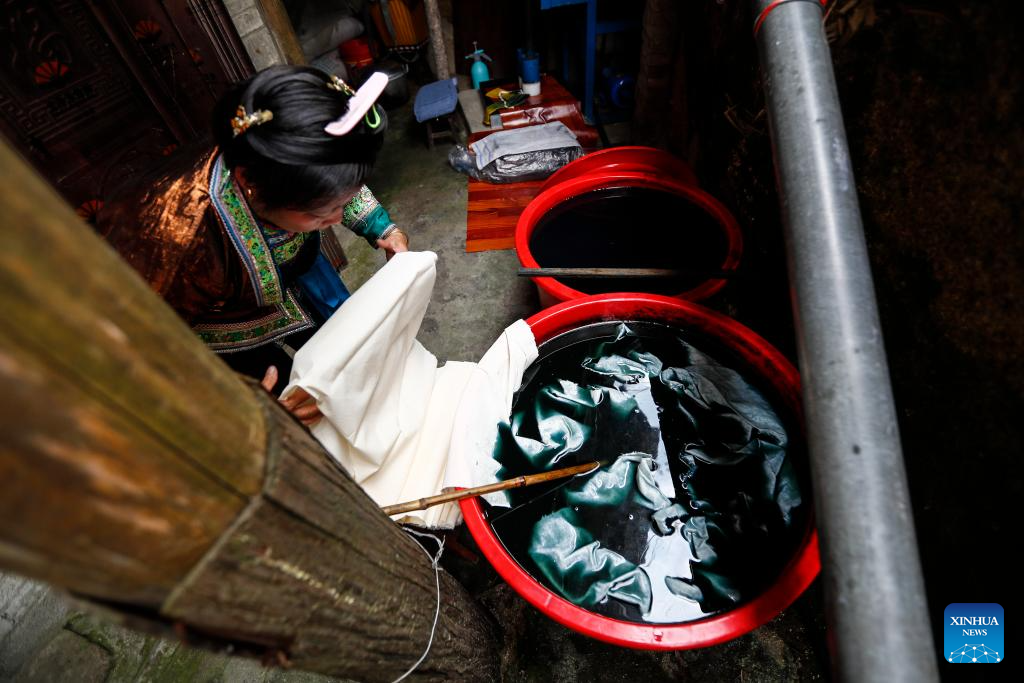
Liang Zuying dyes the white cloth in Wuying Village on the border between south China's Guangxi Zhuang Autonomous Region and southwest China's Guizhou Province, on Aug. 31, 2023. Wuying Village is a Miao ethnic group hamlet that nestles snugly in the towering mountains stretching across the border between Guangxi and Guizhou.
"Liang Bu", named for its glistening appearance, is a kind of traditional hand-made cloth of Miao ethnic group.
Women of Miao ethnic group in Wuying plant woad in spring and harvest it in fall. They soak woad in water for days before mixing it with materials such as lime, to make the dye for "Liang Bu". It usually takes months to make a piece of "Liang Bu" after repeated process of dip-dyeing, drying, pounding, applying egg white and steaming. The cloth gradually becomes glistening owing to tens of thousands of poundings by villagers with traditional wooden hammers. After cutting, sewing, embroidery and ironing, a set of glossy "Liang Bu" clothes is finally done with up to one year spent from the planting of woad in general.
Subject to its complicated producing techniques, "Liang Bu" was once rarely seen. In recent years, it was gradually favored again thanks to the development of local tourism and the improvement in people's awareness of traditional cultural protection. (Xinhua/Hu Xingyu)
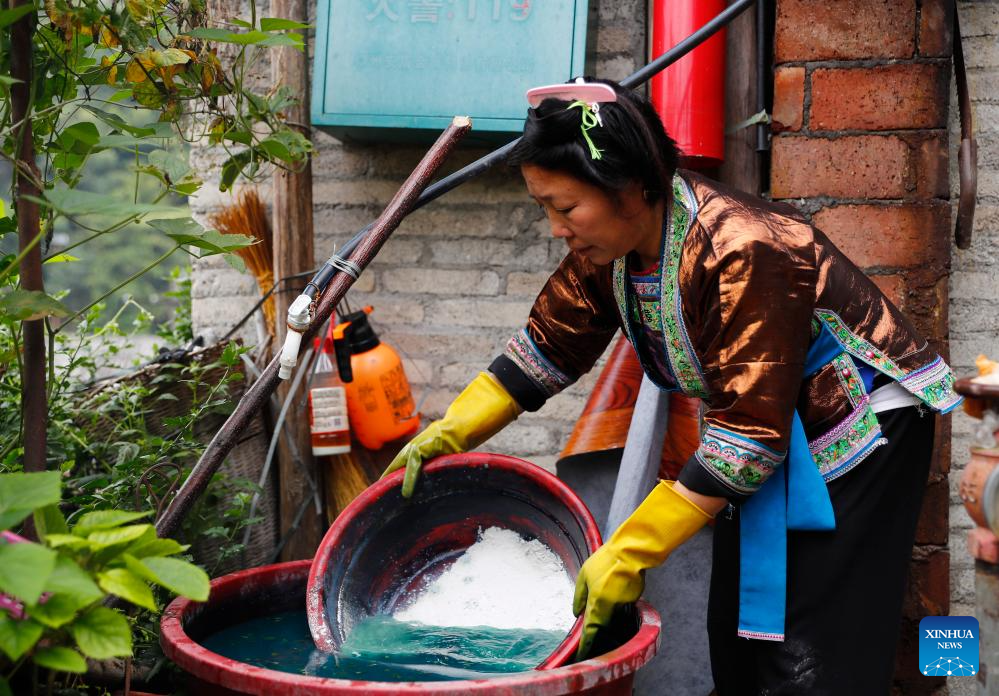
Liang Zuying adds lime into the water with woad soaked to make the dye in Wuying Village on the border between south China's Guangxi Zhuang Autonomous Region and southwest China's Guizhou Province, on Aug. 31, 2023. Wuying Village is a Miao ethnic group hamlet that nestles snugly in the towering mountains stretching across the border between Guangxi and Guizhou.
"Liang Bu", named for its glistening appearance, is a kind of traditional hand-made cloth of Miao ethnic group.
Women of Miao ethnic group in Wuying plant woad in spring and harvest it in fall. They soak woad in water for days before mixing it with materials such as lime, to make the dye for "Liang Bu". It usually takes months to make a piece of "Liang Bu" after repeated process of dip-dyeing, drying, pounding, applying egg white and steaming. The cloth gradually becomes glistening owing to tens of thousands of poundings by villagers with traditional wooden hammers. After cutting, sewing, embroidery and ironing, a set of glossy "Liang Bu" clothes is finally done with up to one year spent from the planting of woad in general.
Subject to its complicated producing techniques, "Liang Bu" was once rarely seen. In recent years, it was gradually favored again thanks to the development of local tourism and the improvement in people's awareness of traditional cultural protection. (Xinhua/Hu Xingyu)
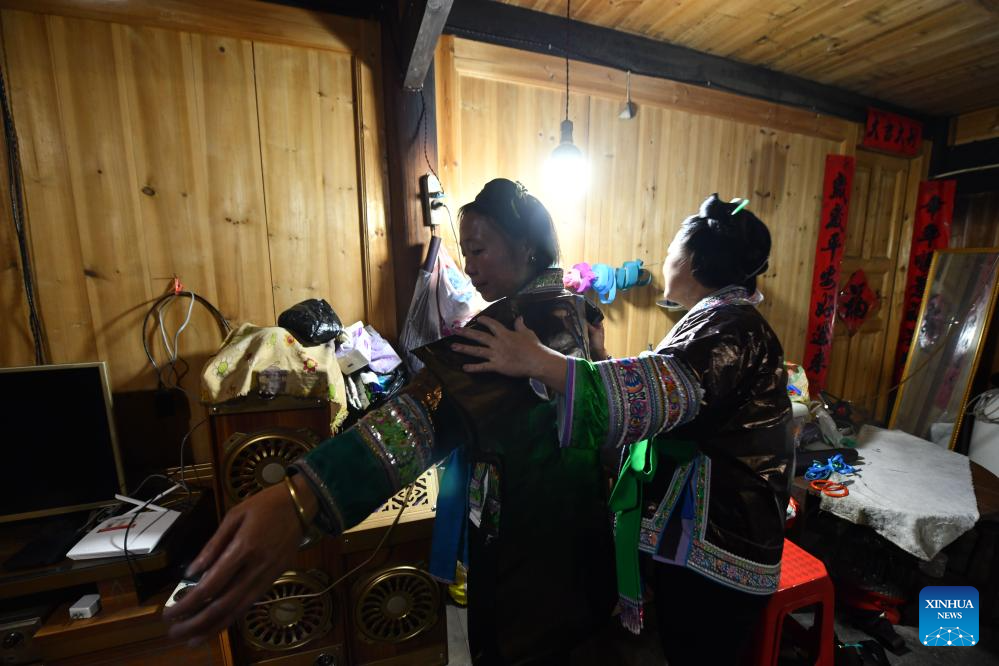
Wu Meiqiu (R) takes Liang Zuying's measurement for making "Liang Bu" costumes in Wuying Village on the border between south China's Guangxi Zhuang Autonomous Region and southwest China's Guizhou Province, on Aug. 31, 2023. Wuying Village is a Miao ethnic group hamlet that nestles snugly in the towering mountains stretching across the border between Guangxi and Guizhou.
"Liang Bu", named for its glistening appearance, is a kind of traditional hand-made cloth of Miao ethnic group.
Women of Miao ethnic group in Wuying plant woad in spring and harvest it in fall. They soak woad in water for days before mixing it with materials such as lime, to make the dye for "Liang Bu". It usually takes months to make a piece of "Liang Bu" after repeated process of dip-dyeing, drying, pounding, applying egg white and steaming. The cloth gradually becomes glistening owing to tens of thousands of poundings by villagers with traditional wooden hammers. After cutting, sewing, embroidery and ironing, a set of glossy "Liang Bu" clothes is finally done with up to one year spent from the planting of woad in general.
Subject to its complicated producing techniques, "Liang Bu" was once rarely seen. In recent years, it was gradually favored again thanks to the development of local tourism and the improvement in people's awareness of traditional cultural protection. (Xinhua/Huang Xiaobang)
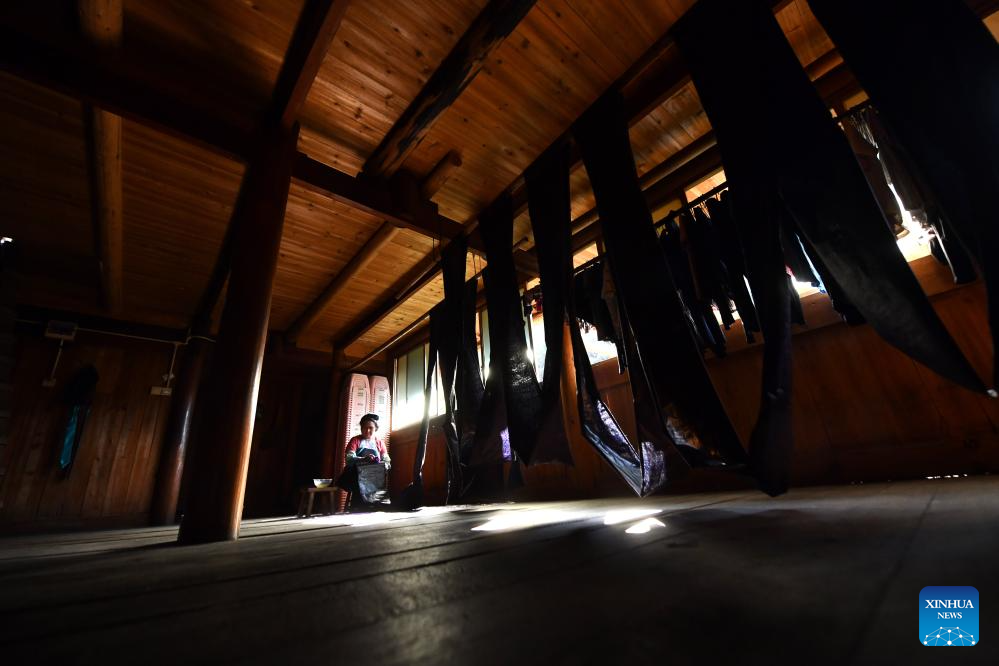
Wu Meiqiu applies egg white on a piece of "Liang Bu" in Wuying Village on the border between south China's Guangxi Zhuang Autonomous Region and southwest China's Guizhou Province, on Aug. 31, 2023. Wuying Village is a Miao ethnic group hamlet that nestles snugly in the towering mountains stretching across the border between Guangxi and Guizhou.
"Liang Bu", named for its glistening appearance, is a kind of traditional hand-made cloth of Miao ethnic group.
Women of Miao ethnic group in Wuying plant woad in spring and harvest it in fall. They soak woad in water for days before mixing it with materials such as lime, to make the dye for "Liang Bu". It usually takes months to make a piece of "Liang Bu" after repeated process of dip-dyeing, drying, pounding, applying egg white and steaming. The cloth gradually becomes glistening owing to tens of thousands of poundings by villagers with traditional wooden hammers. After cutting, sewing, embroidery and ironing, a set of glossy "Liang Bu" clothes is finally done with up to one year spent from the planting of woad in general.
Subject to its complicated producing techniques, "Liang Bu" was once rarely seen. In recent years, it was gradually favored again thanks to the development of local tourism and the improvement in people's awareness of traditional cultural protection. (Xinhua/Huang Xiaobang)
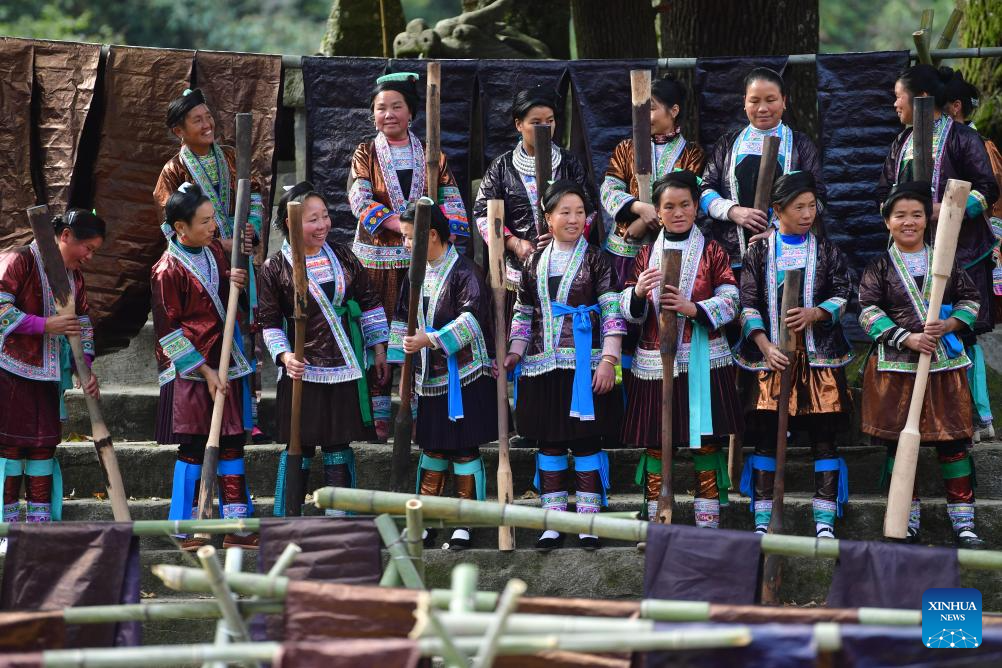
Liang Zuying (3rd L, front) displays "Liang Bu" and traditional costumes with other locals during a "Liang Bu" cultural festival in Wuying Village on the border between south China's Guangxi Zhuang Autonomous Region and southwest China's Guizhou Province, on Oct. 25, 2020. Wuying Village is a Miao ethnic group hamlet that nestles snugly in the towering mountains stretching across the border between Guangxi and Guizhou.
"Liang Bu", named for its glistening appearance, is a kind of traditional hand-made cloth of Miao ethnic group.
Women of Miao ethnic group in Wuying plant woad in spring and harvest it in fall. They soak woad in water for days before mixing it with materials such as lime, to make the dye for "Liang Bu". It usually takes months to make a piece of "Liang Bu" after repeated process of dip-dyeing, drying, pounding, applying egg white and steaming. The cloth gradually becomes glistening owing to tens of thousands of poundings by villagers with traditional wooden hammers. After cutting, sewing, embroidery and ironing, a set of glossy "Liang Bu" clothes is finally done with up to one year spent from the planting of woad in general.
Subject to its complicated producing techniques, "Liang Bu" was once rarely seen. In recent years, it was gradually favored again thanks to the development of local tourism and the improvement in people's awareness of traditional cultural protection. (Xinhua/Huang Xiaobang)
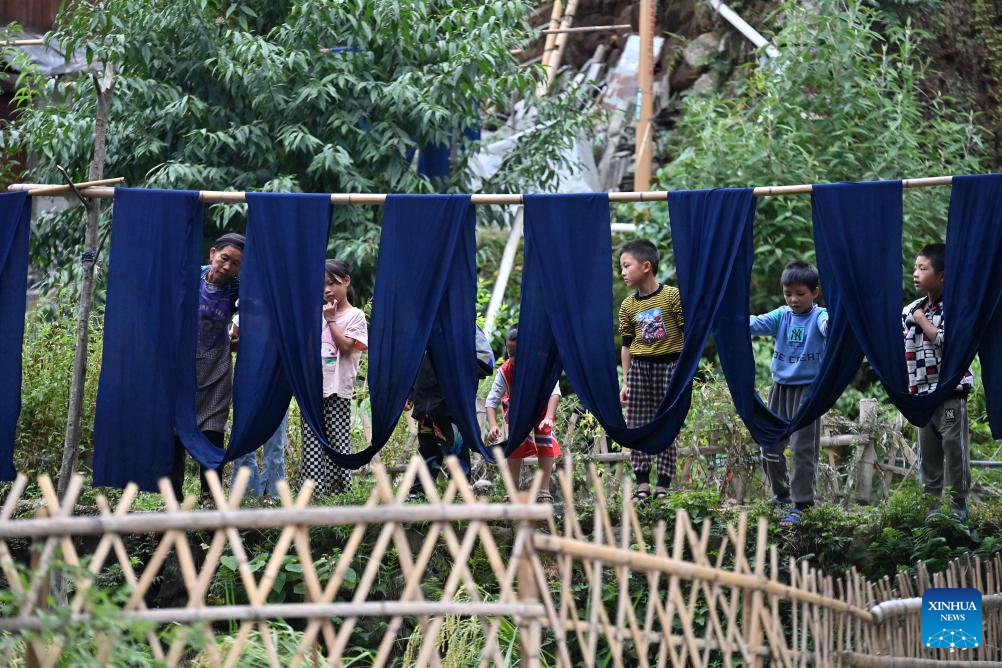
Children watch the making of "Liang Bu" in Wuying Village on the border between south China's Guangxi Zhuang Autonomous Region and southwest China's Guizhou Province, on Sept. 7, 2022. Wuying Village is a Miao ethnic group hamlet that nestles snugly in the towering mountains stretching across the border between Guangxi and Guizhou.
"Liang Bu", named for its glistening appearance, is a kind of traditional hand-made cloth of Miao ethnic group.
Women of Miao ethnic group in Wuying plant woad in spring and harvest it in fall. They soak woad in water for days before mixing it with materials such as lime, to make the dye for "Liang Bu". It usually takes months to make a piece of "Liang Bu" after repeated process of dip-dyeing, drying, pounding, applying egg white and steaming. The cloth gradually becomes glistening owing to tens of thousands of poundings by villagers with traditional wooden hammers. After cutting, sewing, embroidery and ironing, a set of glossy "Liang Bu" clothes is finally done with up to one year spent from the planting of woad in general.
Subject to its complicated producing techniques, "Liang Bu" was once rarely seen. In recent years, it was gradually favored again thanks to the development of local tourism and the improvement in people's awareness of traditional cultural protection. (Xinhua/Huang Xiaobang)
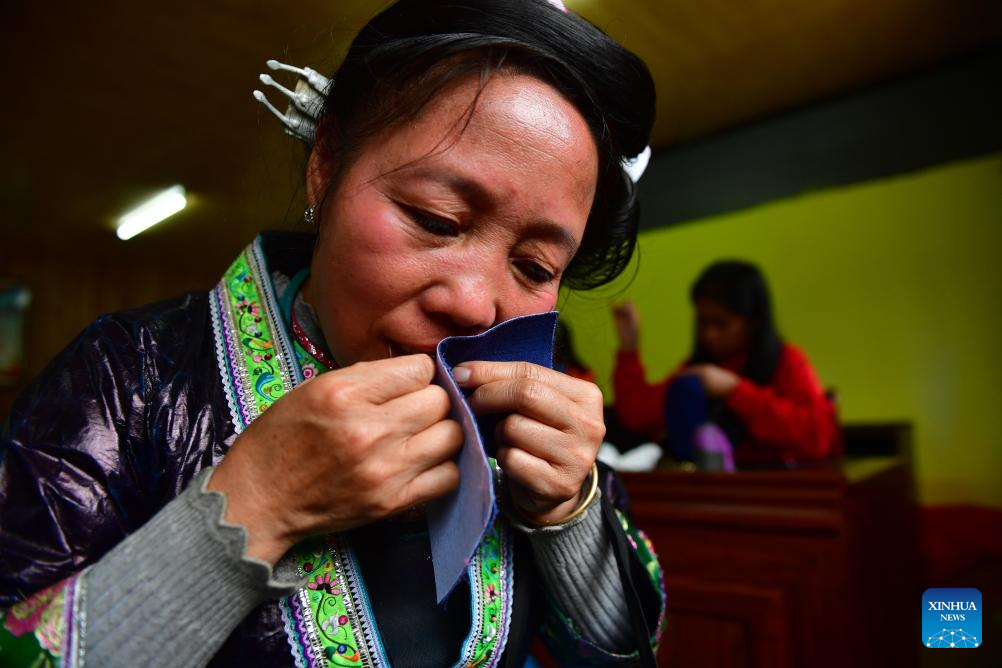
Liang Zuying makes embroidery in Wuying Village on the border between south China's Guangxi Zhuang Autonomous Region and southwest China's Guizhou Province, on Oct. 19, 2019. Wuying Village is a Miao ethnic group hamlet that nestles snugly in the towering mountains stretching across the border between Guangxi and Guizhou.
"Liang Bu", named for its glistening appearance, is a kind of traditional hand-made cloth of Miao ethnic group.
Women of Miao ethnic group in Wuying plant woad in spring and harvest it in fall. They soak woad in water for days before mixing it with materials such as lime, to make the dye for "Liang Bu". It usually takes months to make a piece of "Liang Bu" after repeated process of dip-dyeing, drying, pounding, applying egg white and steaming. The cloth gradually becomes glistening owing to tens of thousands of poundings by villagers with traditional wooden hammers. After cutting, sewing, embroidery and ironing, a set of glossy "Liang Bu" clothes is finally done with up to one year spent from the planting of woad in general.
Subject to its complicated producing techniques, "Liang Bu" was once rarely seen. In recent years, it was gradually favored again thanks to the development of local tourism and the improvement in people's awareness of traditional cultural protection. (Xinhua/Huang Xiaobang)
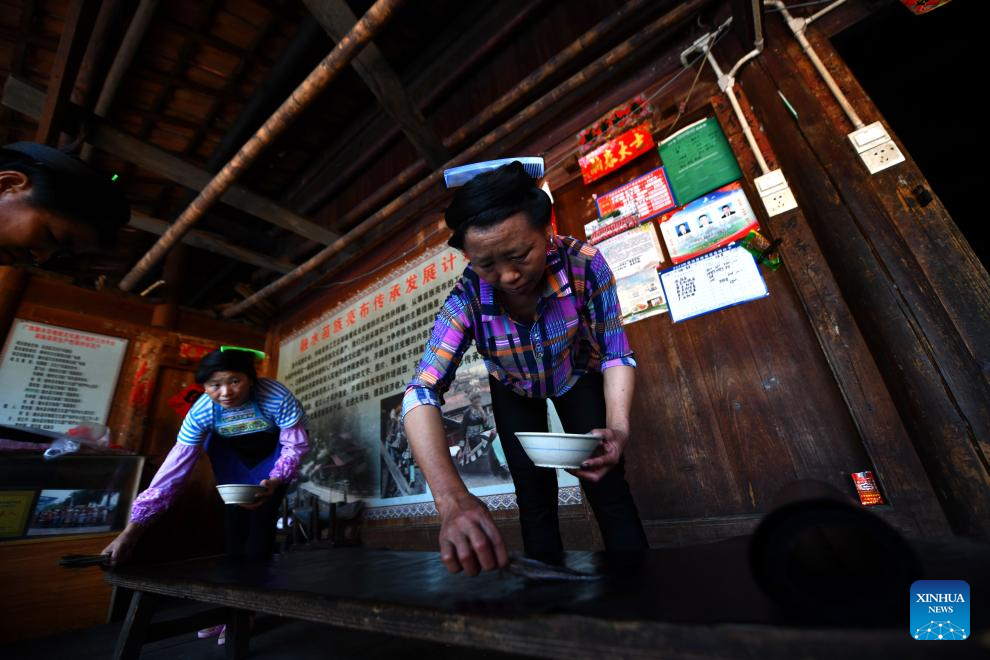
Wei Meili (R) applies egg white on a piece of "Liang Bu" in Wuying Village on the border between south China's Guangxi Zhuang Autonomous Region and southwest China's Guizhou Province, on Sept. 2, 2020. Wuying Village is a Miao ethnic group hamlet that nestles snugly in the towering mountains stretching across the border between Guangxi and Guizhou.
"Liang Bu", named for its glistening appearance, is a kind of traditional hand-made cloth of Miao ethnic group.
Women of Miao ethnic group in Wuying plant woad in spring and harvest it in fall. They soak woad in water for days before mixing it with materials such as lime, to make the dye for "Liang Bu". It usually takes months to make a piece of "Liang Bu" after repeated process of dip-dyeing, drying, pounding, applying egg white and steaming. The cloth gradually becomes glistening owing to tens of thousands of poundings by villagers with traditional wooden hammers. After cutting, sewing, embroidery and ironing, a set of glossy "Liang Bu" clothes is finally done with up to one year spent from the planting of woad in general.
Subject to its complicated producing techniques, "Liang Bu" was once rarely seen. In recent years, it was gradually favored again thanks to the development of local tourism and the improvement in people's awareness of traditional cultural protection. (Xinhua/Huang Xiaobang)
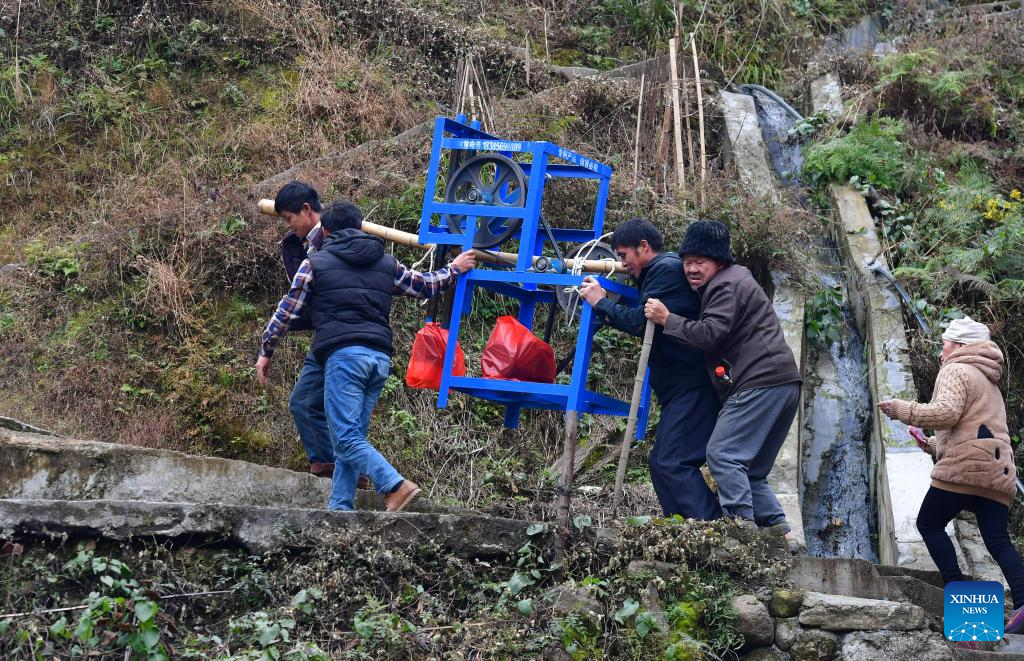
Villagers carry machines for making "Liang Bu" in Wuying Village on the border between south China's Guangxi Zhuang Autonomous Region and southwest China's Guizhou Province, on Dec. 31, 2021. The machines were donated by the women's federation and the association of women entrepreneurs of Liuzhou. Wuying Village is a Miao ethnic group hamlet that nestles snugly in the towering mountains stretching across the border between Guangxi and Guizhou.
"Liang Bu", named for its glistening appearance, is a kind of traditional hand-made cloth of Miao ethnic group.
Women of Miao ethnic group in Wuying plant woad in spring and harvest it in fall. They soak woad in water for days before mixing it with materials such as lime, to make the dye for "Liang Bu". It usually takes months to make a piece of "Liang Bu" after repeated process of dip-dyeing, drying, pounding, applying egg white and steaming. The cloth gradually becomes glistening owing to tens of thousands of poundings by villagers with traditional wooden hammers. After cutting, sewing, embroidery and ironing, a set of glossy "Liang Bu" clothes is finally done with up to one year spent from the planting of woad in general.
Subject to its complicated producing techniques, "Liang Bu" was once rarely seen. In recent years, it was gradually favored again thanks to the development of local tourism and the improvement in people's awareness of traditional cultural protection. (Xinhua/Huang Xiaobang)
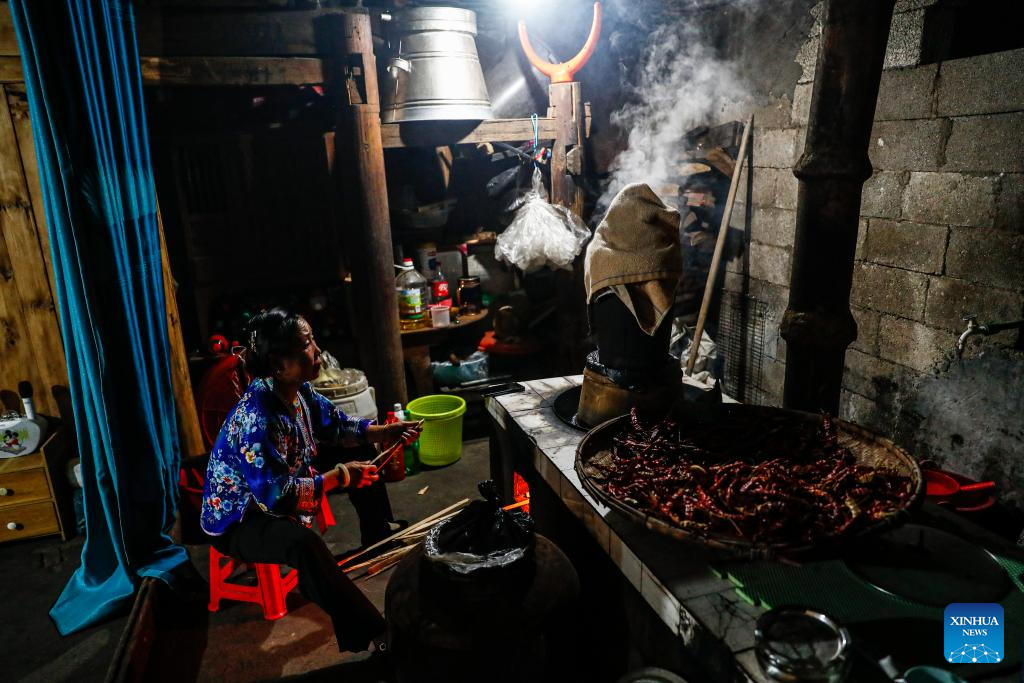
Liang Zuying steams the cloth in Wuying Village on the border between south China's Guangxi Zhuang Autonomous Region and southwest China's Guizhou Province, on Aug. 30, 2023. Wuying Village is a Miao ethnic group hamlet that nestles snugly in the towering mountains stretching across the border between Guangxi and Guizhou.
"Liang Bu", named for its glistening appearance, is a kind of traditional hand-made cloth of Miao ethnic group.
Women of Miao ethnic group in Wuying plant woad in spring and harvest it in fall. They soak woad in water for days before mixing it with materials such as lime, to make the dye for "Liang Bu". It usually takes months to make a piece of "Liang Bu" after repeated process of dip-dyeing, drying, pounding, applying egg white and steaming. The cloth gradually becomes glistening owing to tens of thousands of poundings by villagers with traditional wooden hammers. After cutting, sewing, embroidery and ironing, a set of glossy "Liang Bu" clothes is finally done with up to one year spent from the planting of woad in general.
Subject to its complicated producing techniques, "Liang Bu" was once rarely seen. In recent years, it was gradually favored again thanks to the development of local tourism and the improvement in people's awareness of traditional cultural protection. (Xinhua/Hu Xingyu)
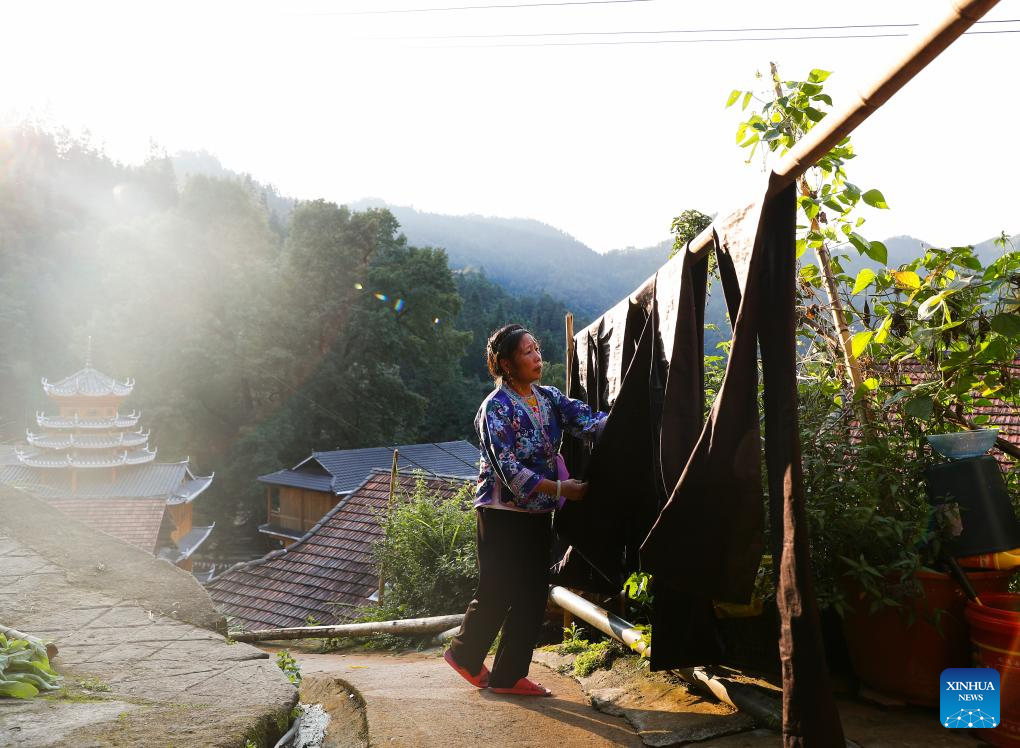
Liang Zuying dries the unfinished "Liang Bu" in Wuying Village on the border between south China's Guangxi Zhuang Autonomous Region and southwest China's Guizhou Province, on Aug. 30, 2023. Wuying Village is a Miao ethnic group hamlet that nestles snugly in the towering mountains stretching across the border between Guangxi and Guizhou.
"Liang Bu", named for its glistening appearance, is a kind of traditional hand-made cloth of Miao ethnic group.
Women of Miao ethnic group in Wuying plant woad in spring and harvest it in fall. They soak woad in water for days before mixing it with materials such as lime, to make the dye for "Liang Bu". It usually takes months to make a piece of "Liang Bu" after repeated process of dip-dyeing, drying, pounding, applying egg white and steaming. The cloth gradually becomes glistening owing to tens of thousands of poundings by villagers with traditional wooden hammers. After cutting, sewing, embroidery and ironing, a set of glossy "Liang Bu" clothes is finally done with up to one year spent from the planting of woad in general.
Subject to its complicated producing techniques, "Liang Bu" was once rarely seen. In recent years, it was gradually favored again thanks to the development of local tourism and the improvement in people's awareness of traditional cultural protection. (Xinhua/Hu Xingyu)
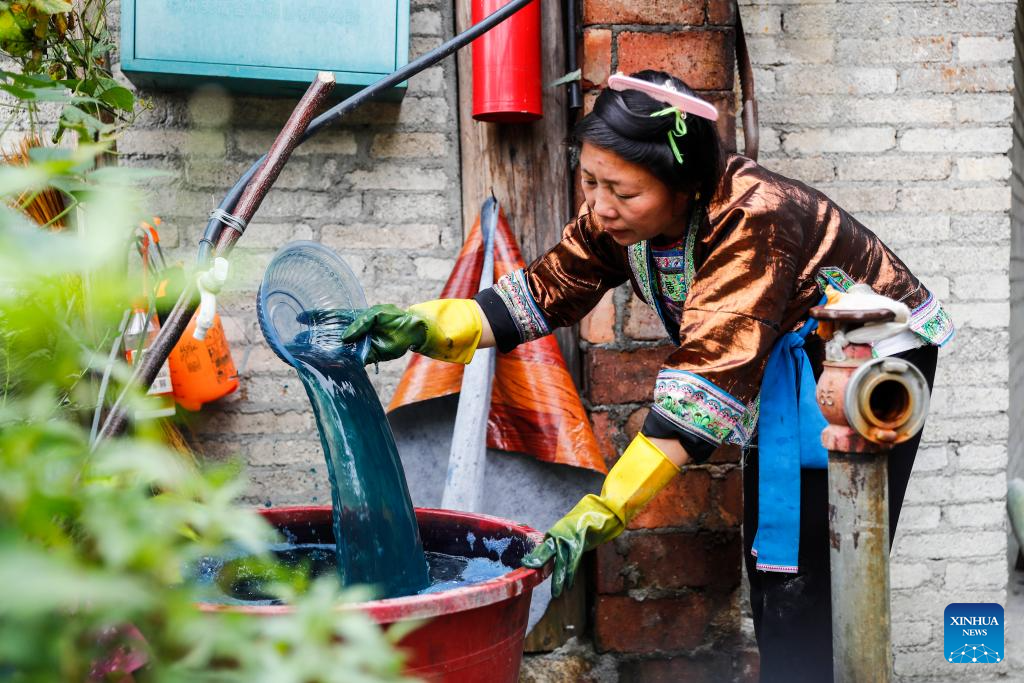
Liang Zuying adds lime into the water with woad soaked to make the dye in Wuying Village on the border between south China's Guangxi Zhuang Autonomous Region and southwest China's Guizhou Province, on Aug. 31, 2023. Wuying Village is a Miao ethnic group hamlet that nestles snugly in the towering mountains stretching across the border between Guangxi and Guizhou.
"Liang Bu", named for its glistening appearance, is a kind of traditional hand-made cloth of Miao ethnic group.
Women of Miao ethnic group in Wuying plant woad in spring and harvest it in fall. They soak woad in water for days before mixing it with materials such as lime, to make the dye for "Liang Bu". It usually takes months to make a piece of "Liang Bu" after repeated process of dip-dyeing, drying, pounding, applying egg white and steaming. The cloth gradually becomes glistening owing to tens of thousands of poundings by villagers with traditional wooden hammers. After cutting, sewing, embroidery and ironing, a set of glossy "Liang Bu" clothes is finally done with up to one year spent from the planting of woad in general.
Subject to its complicated producing techniques, "Liang Bu" was once rarely seen. In recent years, it was gradually favored again thanks to the development of local tourism and the improvement in people's awareness of traditional cultural protection. (Xinhua/Hu Xingyu)
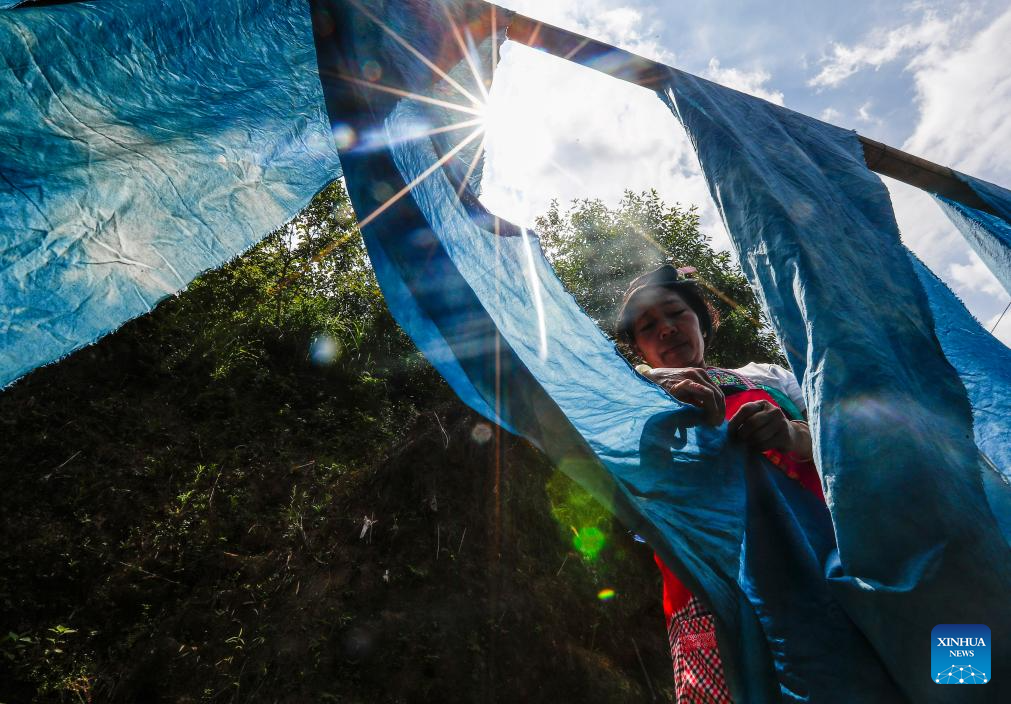
Liang Zuying dries the cloth after dip-dyeing in Wuying Village on the border between south China's Guangxi Zhuang Autonomous Region and southwest China's Guizhou Province, on Aug. 31, 2023. Wuying Village is a Miao ethnic group hamlet that nestles snugly in the towering mountains stretching across the border between Guangxi and Guizhou.
"Liang Bu", named for its glistening appearance, is a kind of traditional hand-made cloth of Miao ethnic group.
Women of Miao ethnic group in Wuying plant woad in spring and harvest it in fall. They soak woad in water for days before mixing it with materials such as lime, to make the dye for "Liang Bu". It usually takes months to make a piece of "Liang Bu" after repeated process of dip-dyeing, drying, pounding, applying egg white and steaming. The cloth gradually becomes glistening owing to tens of thousands of poundings by villagers with traditional wooden hammers. After cutting, sewing, embroidery and ironing, a set of glossy "Liang Bu" clothes is finally done with up to one year spent from the planting of woad in general.
Subject to its complicated producing techniques, "Liang Bu" was once rarely seen. In recent years, it was gradually favored again thanks to the development of local tourism and the improvement in people's awareness of traditional cultural protection. (Xinhua/Hu Xingyu)
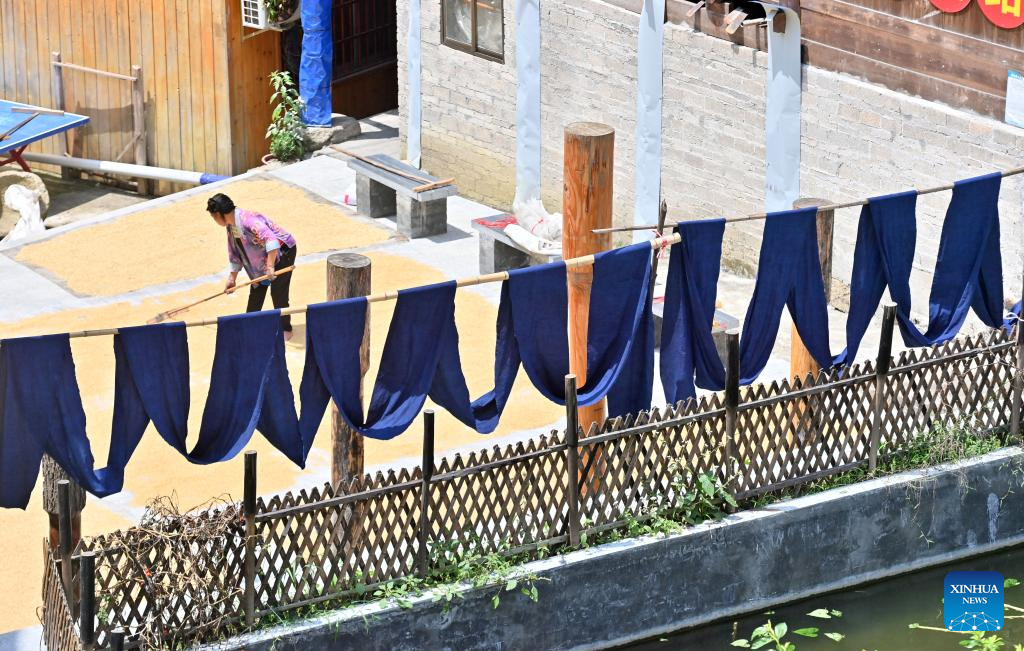
Pieces of "Liang Bu" are dried at a square in Wuying Village on the border between south China's Guangxi Zhuang Autonomous Region and southwest China's Guizhou Province, on Sept. 2, 2023. Wuying Village is a Miao ethnic group hamlet that nestles snugly in the towering mountains stretching across the border between Guangxi and Guizhou.
"Liang Bu", named for its glistening appearance, is a kind of traditional hand-made cloth of Miao ethnic group.
Women of Miao ethnic group in Wuying plant woad in spring and harvest it in fall. They soak woad in water for days before mixing it with materials such as lime, to make the dye for "Liang Bu". It usually takes months to make a piece of "Liang Bu" after repeated process of dip-dyeing, drying, pounding, applying egg white and steaming. The cloth gradually becomes glistening owing to tens of thousands of poundings by villagers with traditional wooden hammers. After cutting, sewing, embroidery and ironing, a set of glossy "Liang Bu" clothes is finally done with up to one year spent from the planting of woad in general.
Subject to its complicated producing techniques, "Liang Bu" was once rarely seen. In recent years, it was gradually favored again thanks to the development of local tourism and the improvement in people's awareness of traditional cultural protection. (Xinhua/Huang Xiaobang)
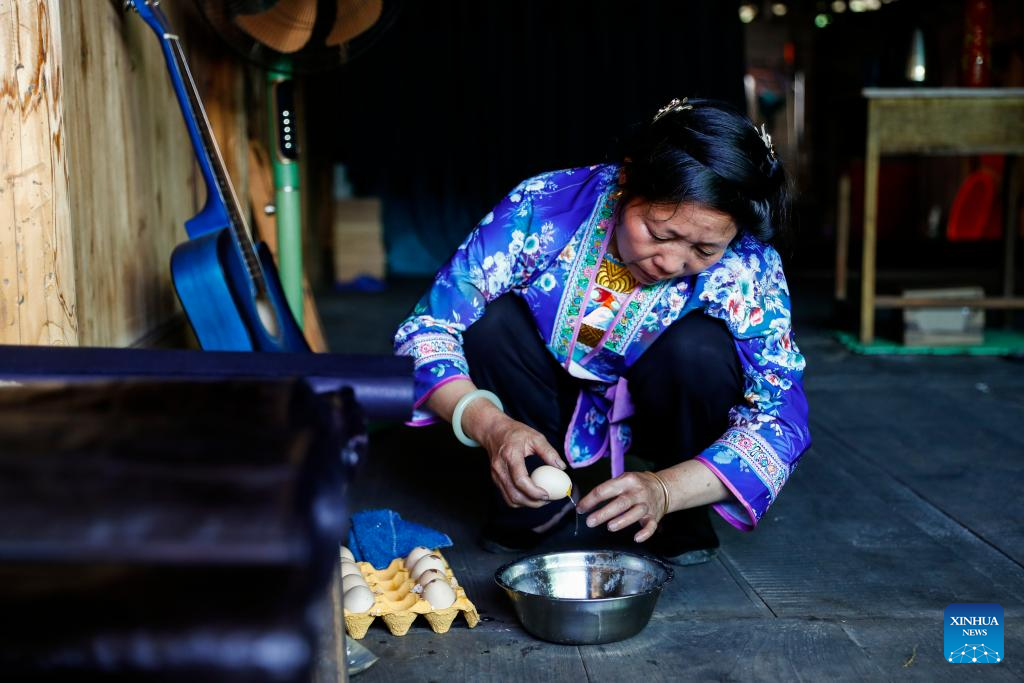
Liang Zuying takes egg white for applying on the cloth in Wuying Village on the border between south China's Guangxi Zhuang Autonomous Region and southwest China's Guizhou Province, on Aug. 30, 2023. Wuying Village is a Miao ethnic group hamlet that nestles snugly in the towering mountains stretching across the border between Guangxi and Guizhou.
"Liang Bu", named for its glistening appearance, is a kind of traditional hand-made cloth of Miao ethnic group.
Women of Miao ethnic group in Wuying plant woad in spring and harvest it in fall. They soak woad in water for days before mixing it with materials such as lime, to make the dye for "Liang Bu". It usually takes months to make a piece of "Liang Bu" after repeated process of dip-dyeing, drying, pounding, applying egg white and steaming. The cloth gradually becomes glistening owing to tens of thousands of poundings by villagers with traditional wooden hammers. After cutting, sewing, embroidery and ironing, a set of glossy "Liang Bu" clothes is finally done with up to one year spent from the planting of woad in general.
Subject to its complicated producing techniques, "Liang Bu" was once rarely seen. In recent years, it was gradually favored again thanks to the development of local tourism and the improvement in people's awareness of traditional cultural protection. (Xinhua/Hu Xingyu)
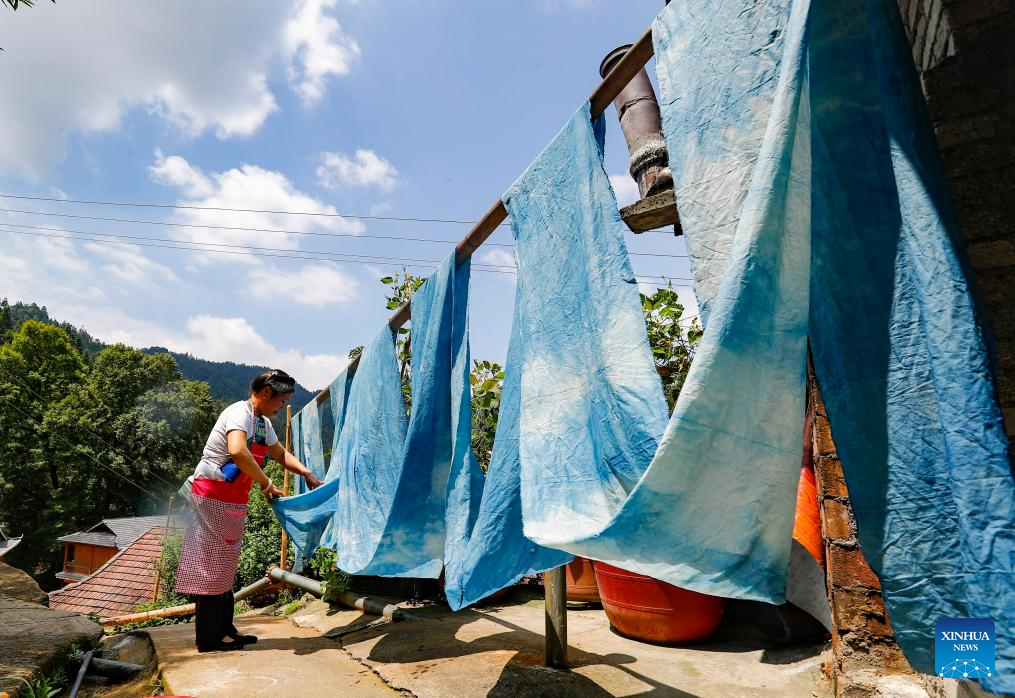
Liang Zuying dries the cloth after dip-dyeing in Wuying Village on the border between south China's Guangxi Zhuang Autonomous Region and southwest China's Guizhou Province, on Aug. 31, 2023. Wuying Village is a Miao ethnic group hamlet that nestles snugly in the towering mountains stretching across the border between Guangxi and Guizhou.
"Liang Bu", named for its glistening appearance, is a kind of traditional hand-made cloth of Miao ethnic group.
Women of Miao ethnic group in Wuying plant woad in spring and harvest it in fall. They soak woad in water for days before mixing it with materials such as lime, to make the dye for "Liang Bu". It usually takes months to make a piece of "Liang Bu" after repeated process of dip-dyeing, drying, pounding, applying egg white and steaming. The cloth gradually becomes glistening owing to tens of thousands of poundings by villagers with traditional wooden hammers. After cutting, sewing, embroidery and ironing, a set of glossy "Liang Bu" clothes is finally done with up to one year spent from the planting of woad in general.
Subject to its complicated producing techniques, "Liang Bu" was once rarely seen. In recent years, it was gradually favored again thanks to the development of local tourism and the improvement in people's awareness of traditional cultural protection. (Xinhua/Hu Xingyu)
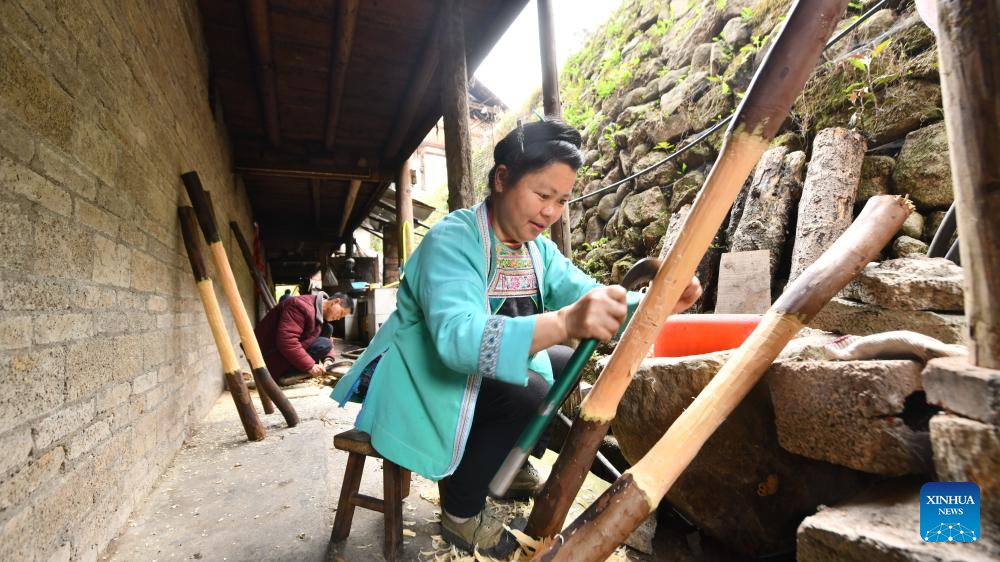
Pan Meimei and her husband make the traditional "Liang Bu" hammers in Wuying Village on the border between south China's Guangxi Zhuang Autonomous Region and southwest China's Guizhou Province, on Jan. 15, 2023. Wuying Village is a Miao ethnic group hamlet that nestles snugly in the towering mountains stretching across the border between Guangxi and Guizhou.
"Liang Bu", named for its glistening appearance, is a kind of traditional hand-made cloth of Miao ethnic group.
Women of Miao ethnic group in Wuying plant woad in spring and harvest it in fall. They soak woad in water for days before mixing it with materials such as lime, to make the dye for "Liang Bu". It usually takes months to make a piece of "Liang Bu" after repeated process of dip-dyeing, drying, pounding, applying egg white and steaming. The cloth gradually becomes glistening owing to tens of thousands of poundings by villagers with traditional wooden hammers. After cutting, sewing, embroidery and ironing, a set of glossy "Liang Bu" clothes is finally done with up to one year spent from the planting of woad in general.
Subject to its complicated producing techniques, "Liang Bu" was once rarely seen. In recent years, it was gradually favored again thanks to the development of local tourism and the improvement in people's awareness of traditional cultural protection. (Xinhua/Huang Xiaobang)
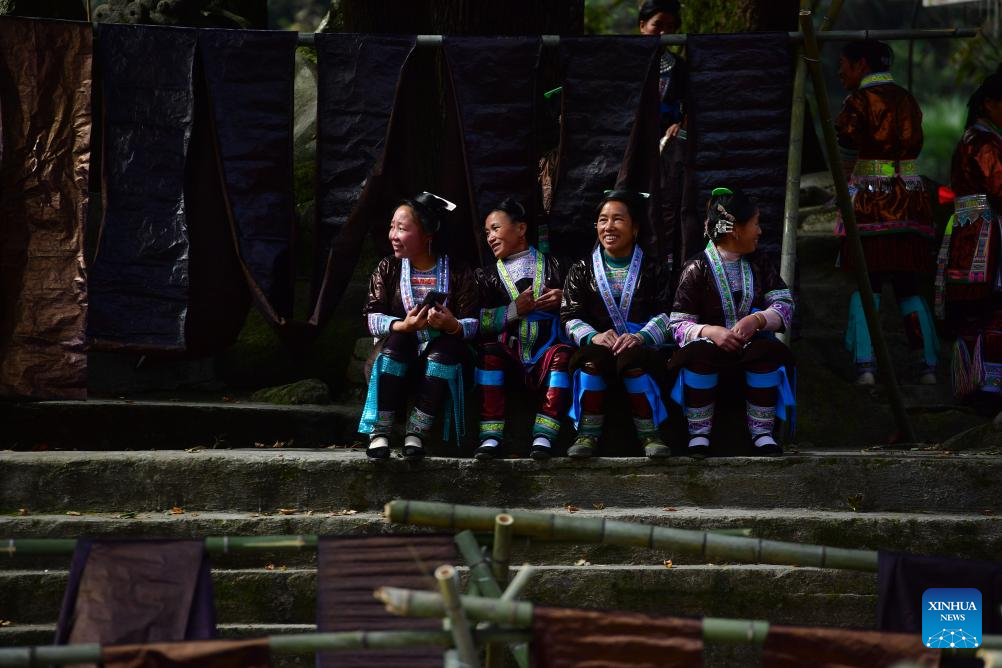
Liang Zuying (1st L) displays "Liang Bu" and traditional costumes with other locals during a "Liang Bu" cultural festival in Wuying Village on the border between south China's Guangxi Zhuang Autonomous Region and southwest China's Guizhou Province, on Oct. 25, 2020. Wuying Village is a Miao ethnic group hamlet that nestles snugly in the towering mountains stretching across the border between Guangxi and Guizhou.
"Liang Bu", named for its glistening appearance, is a kind of traditional hand-made cloth of Miao ethnic group.
Women of Miao ethnic group in Wuying plant woad in spring and harvest it in fall. They soak woad in water for days before mixing it with materials such as lime, to make the dye for "Liang Bu". It usually takes months to make a piece of "Liang Bu" after repeated process of dip-dyeing, drying, pounding, applying egg white and steaming. The cloth gradually becomes glistening owing to tens of thousands of poundings by villagers with traditional wooden hammers. After cutting, sewing, embroidery and ironing, a set of glossy "Liang Bu" clothes is finally done with up to one year spent from the planting of woad in general.
Subject to its complicated producing techniques, "Liang Bu" was once rarely seen. In recent years, it was gradually favored again thanks to the development of local tourism and the improvement in people's awareness of traditional cultural protection. (Xinhua/Huang Xiaobang)
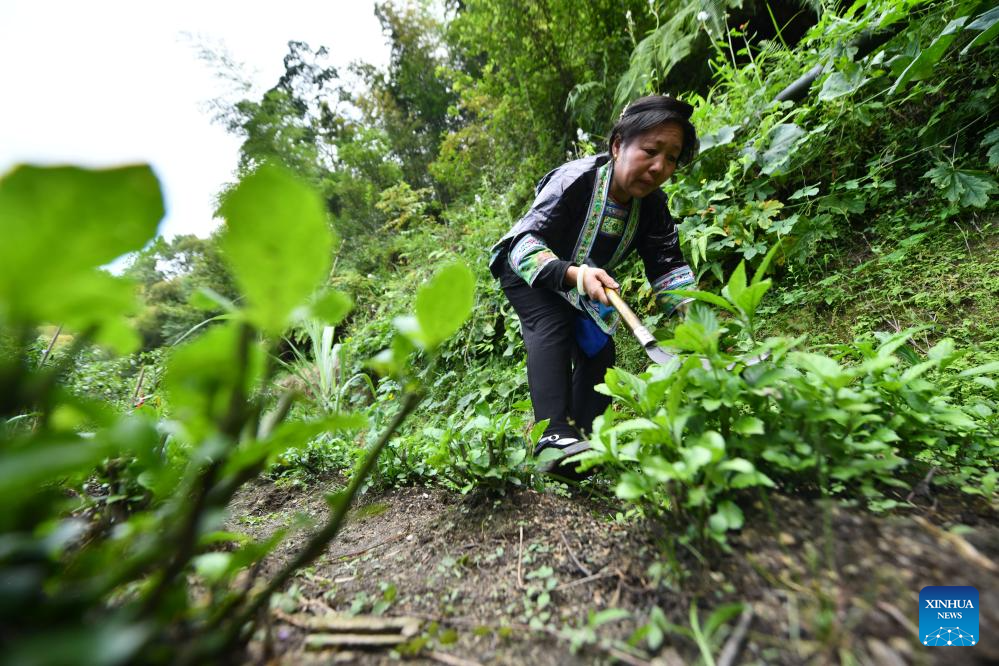
Liang Zuying harvests the woad on a mountain in Wuying Village on the border between south China's Guangxi Zhuang Autonomous Region and southwest China's Guizhou Province, on Aug. 29, 2023. Wuying Village is a Miao ethnic group hamlet that nestles snugly in the towering mountains stretching across the border between Guangxi and Guizhou.
"Liang Bu", named for its glistening appearance, is a kind of traditional hand-made cloth of Miao ethnic group.
Women of Miao ethnic group in Wuying plant woad in spring and harvest it in fall. They soak woad in water for days before mixing it with materials such as lime, to make the dye for "Liang Bu". It usually takes months to make a piece of "Liang Bu" after repeated process of dip-dyeing, drying, pounding, applying egg white and steaming. The cloth gradually becomes glistening owing to tens of thousands of poundings by villagers with traditional wooden hammers. After cutting, sewing, embroidery and ironing, a set of glossy "Liang Bu" clothes is finally done with up to one year spent from the planting of woad in general.
Subject to its complicated producing techniques, "Liang Bu" was once rarely seen. In recent years, it was gradually favored again thanks to the development of local tourism and the improvement in people's awareness of traditional cultural protection. (Xinhua/Huang Xiaobang)
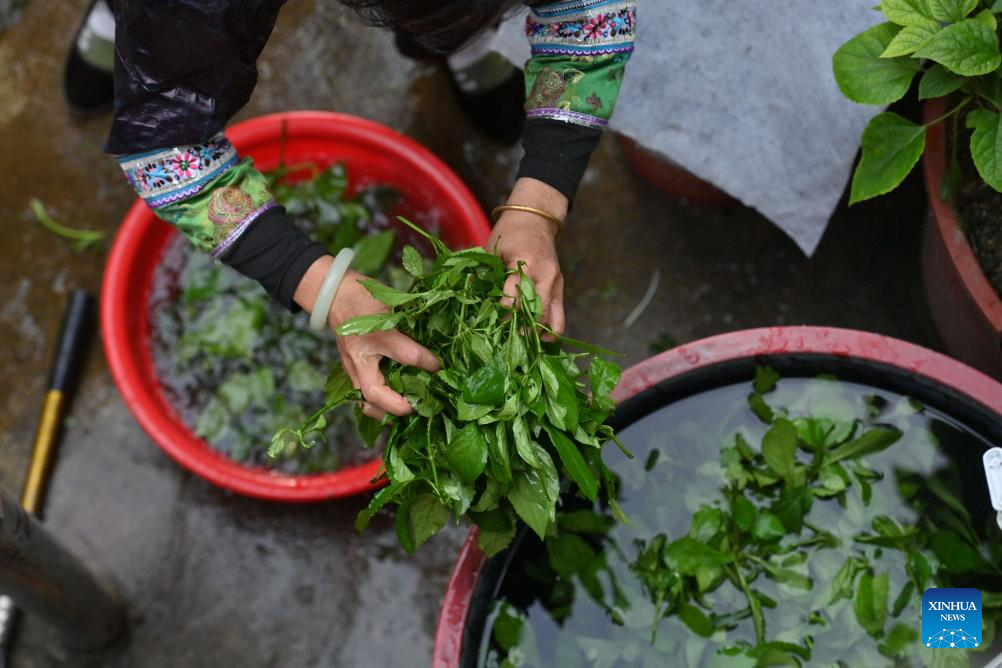
Liang Zuying soaks the newly harvested woad in water in Wuying Village on the border between south China's Guangxi Zhuang Autonomous Region and southwest China's Guizhou Province, on Aug. 29, 2023. Wuying Village is a Miao ethnic group hamlet that nestles snugly in the towering mountains stretching across the border between Guangxi and Guizhou.
"Liang Bu", named for its glistening appearance, is a kind of traditional hand-made cloth of Miao ethnic group.
Women of Miao ethnic group in Wuying plant woad in spring and harvest it in fall. They soak woad in water for days before mixing it with materials such as lime, to make the dye for "Liang Bu". It usually takes months to make a piece of "Liang Bu" after repeated process of dip-dyeing, drying, pounding, applying egg white and steaming. The cloth gradually becomes glistening owing to tens of thousands of poundings by villagers with traditional wooden hammers. After cutting, sewing, embroidery and ironing, a set of glossy "Liang Bu" clothes is finally done with up to one year spent from the planting of woad in general.
Subject to its complicated producing techniques, "Liang Bu" was once rarely seen. In recent years, it was gradually favored again thanks to the development of local tourism and the improvement in people's awareness of traditional cultural protection. (Xinhua/Huang Xiaobang)
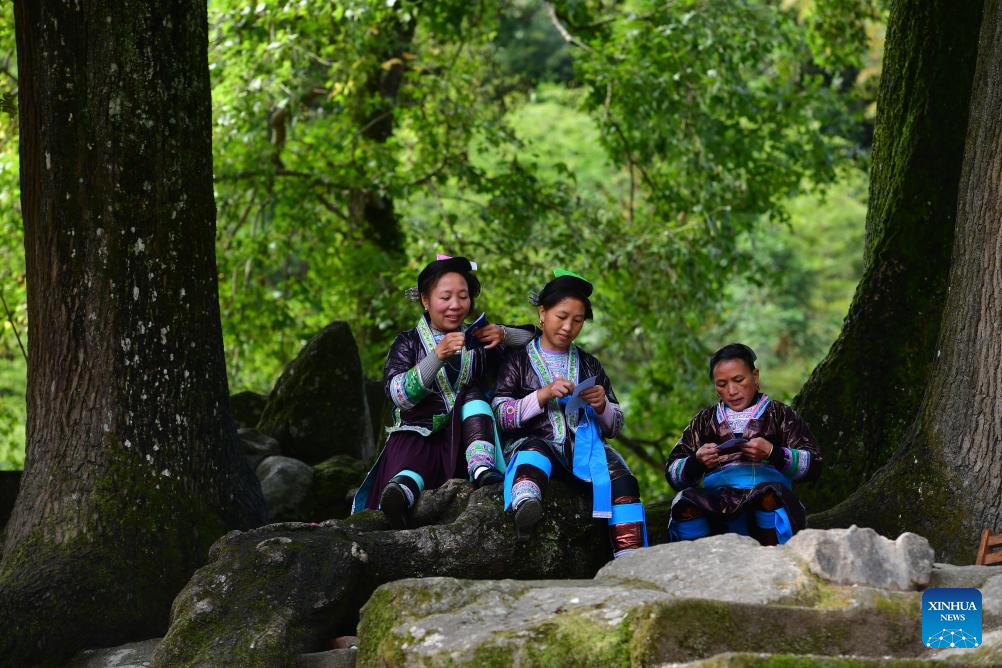
Liang Zuying (1st L) makes embroidery in Wuying Village on the border between south China's Guangxi Zhuang Autonomous Region and southwest China's Guizhou Province, on Oct. 18, 2019. Wuying Village is a Miao ethnic group hamlet that nestles snugly in the towering mountains stretching across the border between Guangxi and Guizhou.
"Liang Bu", named for its glistening appearance, is a kind of traditional hand-made cloth of Miao ethnic group.
Women of Miao ethnic group in Wuying plant woad in spring and harvest it in fall. They soak woad in water for days before mixing it with materials such as lime, to make the dye for "Liang Bu". It usually takes months to make a piece of "Liang Bu" after repeated process of dip-dyeing, drying, pounding, applying egg white and steaming. The cloth gradually becomes glistening owing to tens of thousands of poundings by villagers with traditional wooden hammers. After cutting, sewing, embroidery and ironing, a set of glossy "Liang Bu" clothes is finally done with up to one year spent from the planting of woad in general.
Subject to its complicated producing techniques, "Liang Bu" was once rarely seen. In recent years, it was gradually favored again thanks to the development of local tourism and the improvement in people's awareness of traditional cultural protection. (Xinhua/Huang Xiaobang)


