
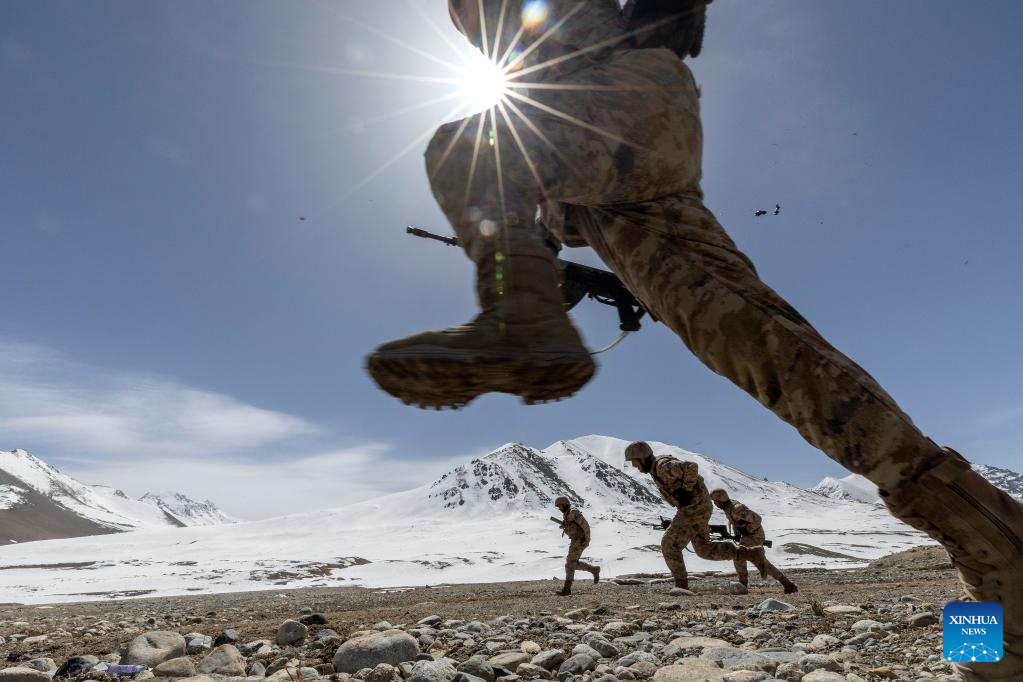
Soldiers take part in a training session in Khunjerab, northwest China's Xinjiang Uygur Autonomous Region, April 13, 2023. Gao Guanghui, a recruit who had just joined the army for 7 months, was shocked when he walked into the honor room of the border defense regiment in Khunjerab, northwest China's Xinjiang Uygur Autonomous Region.
The regiment is based on the Pamirs, guarding the China-Pakistan border and Khunjerab Port. With an average altitude of 4,700 meters, the place is a "forbidden zone" for many people, as the temperature here can drop to as low as minus 40 degrees Celsius, and the oxygen content is less than half of that in the plain area.
Gao felt even more excited when he was on patrol with his squad leader Zhou Linping to the national border for the first time and renewed the boundary monument.
"We are in a troop with glorious history. Now it's on you," Zhou said to Gao.
Zhou, a veteran who had been in the regiment for 16 years, had mixed feelings when saying this as he is going to retire at the end of the year. "When I first came here 16 years ago, life was so hard," Zhou recalled. The facilities in the barracks were poor and due to the lack of transportation means, vegetables could only be sent to the top of the mountains once a month. "So we had very few choices except for potatoes, Chinese cabbages and onions, only because they are easier to store." Other than this, the soldiers only had one generator, which could only provide electricity at night. There was no access to mobile phone signals at all.
Now, everything is different. New barracks have been built up with a basketball court, a gym, a library and a diffuse oxygen supply system, which allow soldiers to breathe more smoothly. With the greenhouse, soldiers can not only be supplied with fresh vegetables and fruits, but also have the chance to taste tropical fruits like mangosteen and mango on the snowy plateau. In addition, the emergency treatment and rescue mechanism for plateau diseases have been continuously improved.
However, what makes Zhou proud is the change in their patrol task.
"We have a guard spot at an altitude of 5,283 meters. It took us two days to get there before, " Zhou said, "Now a road has been built to a place very close to the spot. We just need to walk for an hour or two to finish the patrol task. "
"I want to patrol all the spots again before I retire. That has been my job for the last 16 years, and if it's possible I would like to do it for the rest of my life," said Zhou. (Xinhua/Fei Maohua)
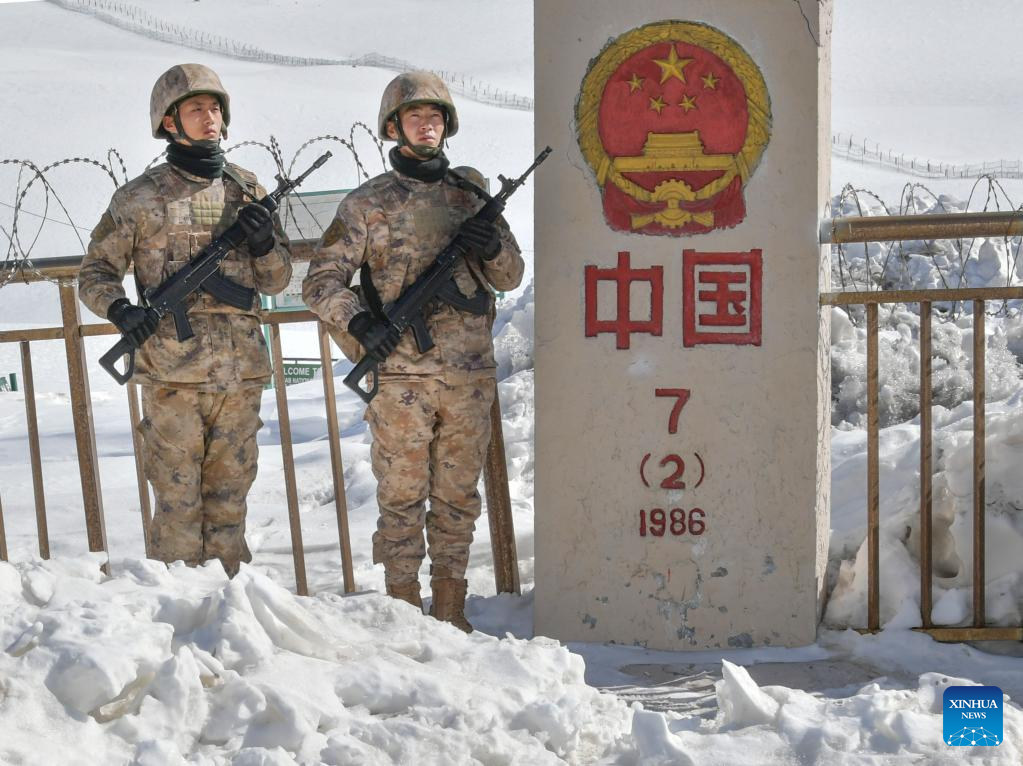
Zhou Linping (R) and Gao Guanghui stand guard in Khunjerab, northwest China's Xinjiang Uygur Autonomous Region, April 13, 2023. Gao Guanghui, a recruit who had just joined the army for 7 months, was shocked when he walked into the honor room of the border defense regiment in Khunjerab, northwest China's Xinjiang Uygur Autonomous Region.
The regiment is based on the Pamirs, guarding the China-Pakistan border and Khunjerab Port. With an average altitude of 4,700 meters, the place is a "forbidden zone" for many people, as the temperature here can drop to as low as minus 40 degrees Celsius, and the oxygen content is less than half of that in the plain area.
Gao felt even more excited when he was on patrol with his squad leader Zhou Linping to the national border for the first time and renewed the boundary monument.
"We are in a troop with glorious history. Now it's on you," Zhou said to Gao.
Zhou, a veteran who had been in the regiment for 16 years, had mixed feelings when saying this as he is going to retire at the end of the year. "When I first came here 16 years ago, life was so hard," Zhou recalled. The facilities in the barracks were poor and due to the lack of transportation means, vegetables could only be sent to the top of the mountains once a month. "So we had very few choices except for potatoes, Chinese cabbages and onions, only because they are easier to store." Other than this, the soldiers only had one generator, which could only provide electricity at night. There was no access to mobile phone signals at all.
Now, everything is different. New barracks have been built up with a basketball court, a gym, a library and a diffuse oxygen supply system, which allow soldiers to breathe more smoothly. With the greenhouse, soldiers can not only be supplied with fresh vegetables and fruits, but also have the chance to taste tropical fruits like mangosteen and mango on the snowy plateau. In addition, the emergency treatment and rescue mechanism for plateau diseases have been continuously improved.
However, what makes Zhou proud is the change in their patrol task.
"We have a guard spot at an altitude of 5,283 meters. It took us two days to get there before, " Zhou said, "Now a road has been built to a place very close to the spot. We just need to walk for an hour or two to finish the patrol task. "
"I want to patrol all the spots again before I retire. That has been my job for the last 16 years, and if it's possible I would like to do it for the rest of my life," said Zhou. (Xinhua/Wang Fei)
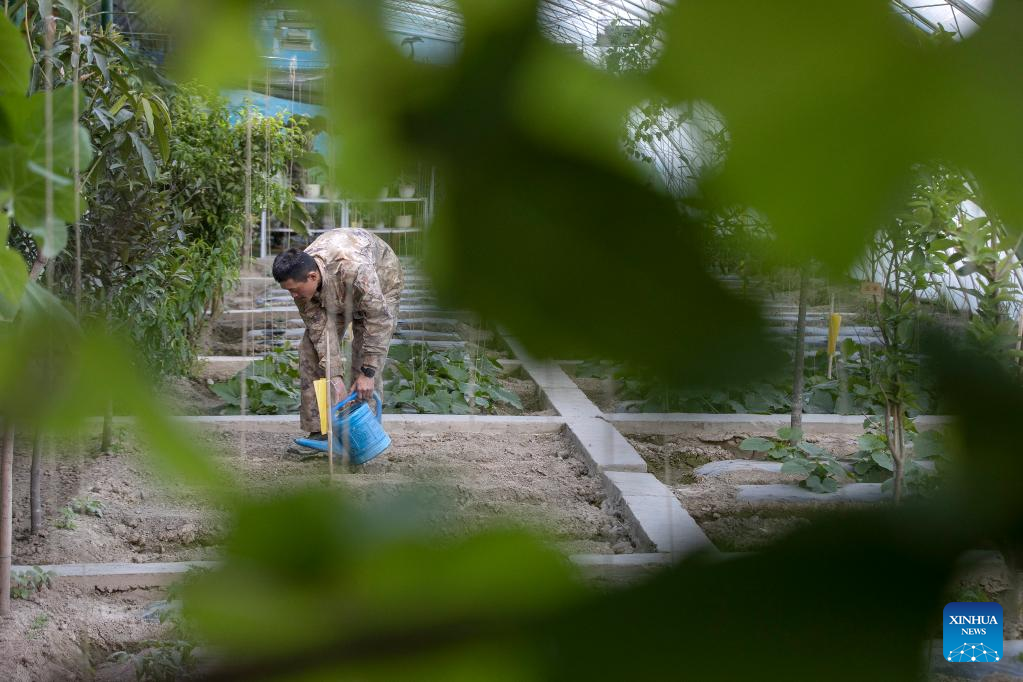
A soilder works in the greenhouse in Khunjerab, northwest China's Xinjiang Uygur Autonomous Region, April 13, 2023. Gao Guanghui, a recruit who had just joined the army for 7 months, was shocked when he walked into the honor room of the border defense regiment in Khunjerab, northwest China's Xinjiang Uygur Autonomous Region.
The regiment is based on the Pamirs, guarding the China-Pakistan border and Khunjerab Port. With an average altitude of 4,700 meters, the place is a "forbidden zone" for many people, as the temperature here can drop to as low as minus 40 degrees Celsius, and the oxygen content is less than half of that in the plain area.
Gao felt even more excited when he was on patrol with his squad leader Zhou Linping to the national border for the first time and renewed the boundary monument.
"We are in a troop with glorious history. Now it's on you," Zhou said to Gao.
Zhou, a veteran who had been in the regiment for 16 years, had mixed feelings when saying this as he is going to retire at the end of the year. "When I first came here 16 years ago, life was so hard," Zhou recalled. The facilities in the barracks were poor and due to the lack of transportation means, vegetables could only be sent to the top of the mountains once a month. "So we had very few choices except for potatoes, Chinese cabbages and onions, only because they are easier to store." Other than this, the soldiers only had one generator, which could only provide electricity at night. There was no access to mobile phone signals at all.
Now, everything is different. New barracks have been built up with a basketball court, a gym, a library and a diffuse oxygen supply system, which allow soldiers to breathe more smoothly. With the greenhouse, soldiers can not only be supplied with fresh vegetables and fruits, but also have the chance to taste tropical fruits like mangosteen and mango on the snowy plateau. In addition, the emergency treatment and rescue mechanism for plateau diseases have been continuously improved.
However, what makes Zhou proud is the change in their patrol task.
"We have a guard spot at an altitude of 5,283 meters. It took us two days to get there before, " Zhou said, "Now a road has been built to a place very close to the spot. We just need to walk for an hour or two to finish the patrol task. "
"I want to patrol all the spots again before I retire. That has been my job for the last 16 years, and if it's possible I would like to do it for the rest of my life," said Zhou. (Xinhua/Fei Maohua)
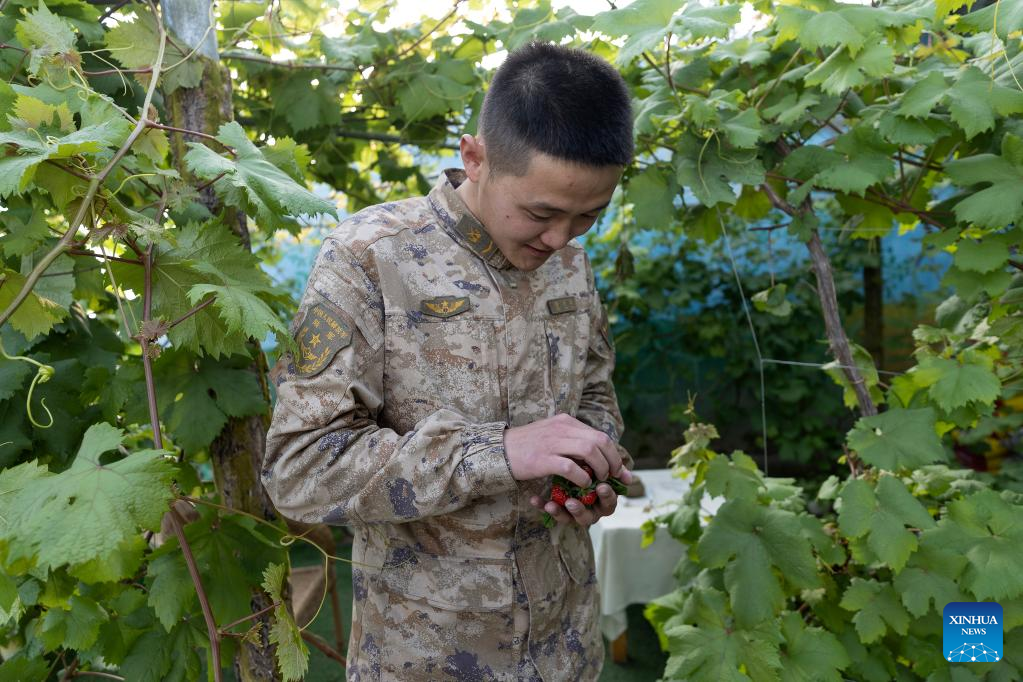
A soilder holds newly-picked strawberries in the greenhouse in Khunjerab, northwest China's Xinjiang Uygur Autonomous Region, April 13, 2023. Gao Guanghui, a recruit who had just joined the army for 7 months, was shocked when he walked into the honor room of the border defense regiment in Khunjerab, northwest China's Xinjiang Uygur Autonomous Region.
The regiment is based on the Pamirs, guarding the China-Pakistan border and Khunjerab Port. With an average altitude of 4,700 meters, the place is a "forbidden zone" for many people, as the temperature here can drop to as low as minus 40 degrees Celsius, and the oxygen content is less than half of that in the plain area.
Gao felt even more excited when he was on patrol with his squad leader Zhou Linping to the national border for the first time and renewed the boundary monument.
"We are in a troop with glorious history. Now it's on you," Zhou said to Gao.
Zhou, a veteran who had been in the regiment for 16 years, had mixed feelings when saying this as he is going to retire at the end of the year. "When I first came here 16 years ago, life was so hard," Zhou recalled. The facilities in the barracks were poor and due to the lack of transportation means, vegetables could only be sent to the top of the mountains once a month. "So we had very few choices except for potatoes, Chinese cabbages and onions, only because they are easier to store." Other than this, the soldiers only had one generator, which could only provide electricity at night. There was no access to mobile phone signals at all.
Now, everything is different. New barracks have been built up with a basketball court, a gym, a library and a diffuse oxygen supply system, which allow soldiers to breathe more smoothly. With the greenhouse, soldiers can not only be supplied with fresh vegetables and fruits, but also have the chance to taste tropical fruits like mangosteen and mango on the snowy plateau. In addition, the emergency treatment and rescue mechanism for plateau diseases have been continuously improved.
However, what makes Zhou proud is the change in their patrol task.
"We have a guard spot at an altitude of 5,283 meters. It took us two days to get there before, " Zhou said, "Now a road has been built to a place very close to the spot. We just need to walk for an hour or two to finish the patrol task. "
"I want to patrol all the spots again before I retire. That has been my job for the last 16 years, and if it's possible I would like to do it for the rest of my life," said Zhou. (Xinhua/Fei Maohua)
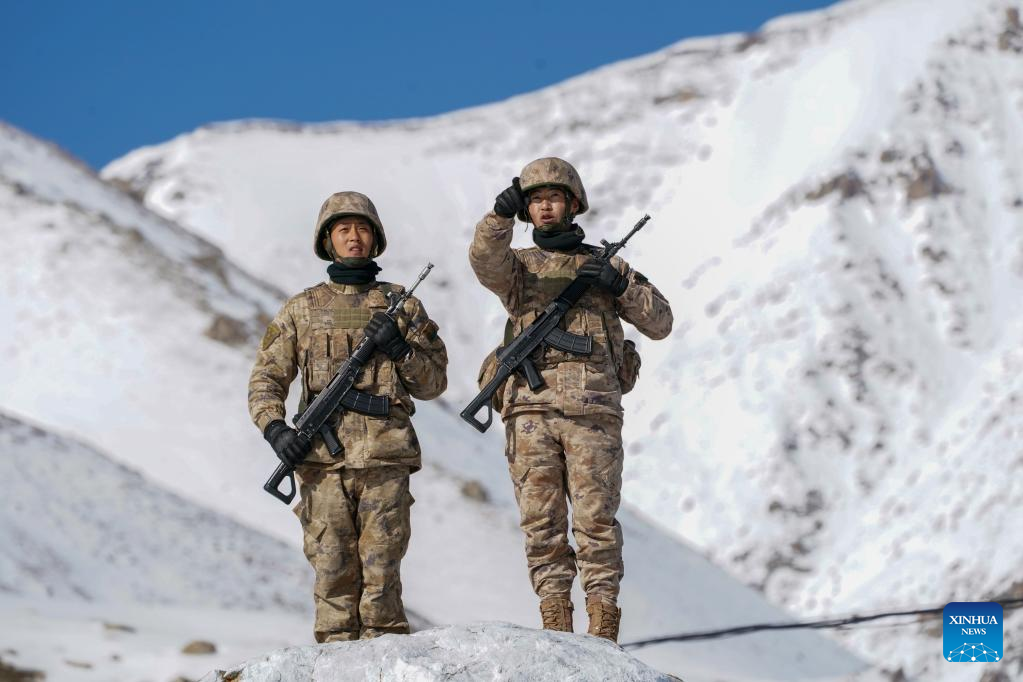
Soldiers patrol in Khunjerab, northwest China's Xinjiang Uygur Autonomous Region, April 13, 2023. Gao Guanghui, a recruit who had just joined the army for 7 months, was shocked when he walked into the honor room of the border defense regiment in Khunjerab, northwest China's Xinjiang Uygur Autonomous Region.
The regiment is based on the Pamirs, guarding the China-Pakistan border and Khunjerab Port. With an average altitude of 4,700 meters, the place is a "forbidden zone" for many people, as the temperature here can drop to as low as minus 40 degrees Celsius, and the oxygen content is less than half of that in the plain area.
Gao felt even more excited when he was on patrol with his squad leader Zhou Linping to the national border for the first time and renewed the boundary monument.
"We are in a troop with glorious history. Now it's on you," Zhou said to Gao.
Zhou, a veteran who had been in the regiment for 16 years, had mixed feelings when saying this as he is going to retire at the end of the year. "When I first came here 16 years ago, life was so hard," Zhou recalled. The facilities in the barracks were poor and due to the lack of transportation means, vegetables could only be sent to the top of the mountains once a month. "So we had very few choices except for potatoes, Chinese cabbages and onions, only because they are easier to store." Other than this, the soldiers only had one generator, which could only provide electricity at night. There was no access to mobile phone signals at all.
Now, everything is different. New barracks have been built up with a basketball court, a gym, a library and a diffuse oxygen supply system, which allow soldiers to breathe more smoothly. With the greenhouse, soldiers can not only be supplied with fresh vegetables and fruits, but also have the chance to taste tropical fruits like mangosteen and mango on the snowy plateau. In addition, the emergency treatment and rescue mechanism for plateau diseases have been continuously improved.
However, what makes Zhou proud is the change in their patrol task.
"We have a guard spot at an altitude of 5,283 meters. It took us two days to get there before, " Zhou said, "Now a road has been built to a place very close to the spot. We just need to walk for an hour or two to finish the patrol task. "
"I want to patrol all the spots again before I retire. That has been my job for the last 16 years, and if it's possible I would like to do it for the rest of my life," said Zhou. (Xinhua/Zhao Ge)
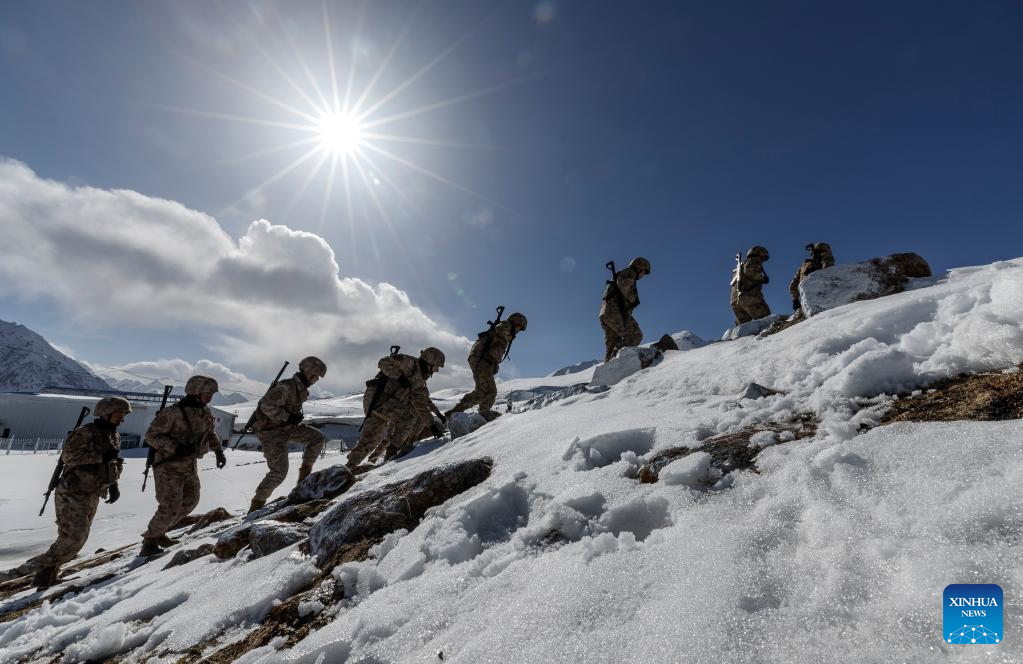
Soldiers patrol in Khunjerab, northwest China's Xinjiang Uygur Autonomous Region, April 13, 2023. Gao Guanghui, a recruit who had just joined the army for 7 months, was shocked when he walked into the honor room of the border defense regiment in Khunjerab, northwest China's Xinjiang Uygur Autonomous Region.
The regiment is based on the Pamirs, guarding the China-Pakistan border and Khunjerab Port. With an average altitude of 4,700 meters, the place is a "forbidden zone" for many people, as the temperature here can drop to as low as minus 40 degrees Celsius, and the oxygen content is less than half of that in the plain area.
Gao felt even more excited when he was on patrol with his squad leader Zhou Linping to the national border for the first time and renewed the boundary monument.
"We are in a troop with glorious history. Now it's on you," Zhou said to Gao.
Zhou, a veteran who had been in the regiment for 16 years, had mixed feelings when saying this as he is going to retire at the end of the year. "When I first came here 16 years ago, life was so hard," Zhou recalled. The facilities in the barracks were poor and due to the lack of transportation means, vegetables could only be sent to the top of the mountains once a month. "So we had very few choices except for potatoes, Chinese cabbages and onions, only because they are easier to store." Other than this, the soldiers only had one generator, which could only provide electricity at night. There was no access to mobile phone signals at all.
Now, everything is different. New barracks have been built up with a basketball court, a gym, a library and a diffuse oxygen supply system, which allow soldiers to breathe more smoothly. With the greenhouse, soldiers can not only be supplied with fresh vegetables and fruits, but also have the chance to taste tropical fruits like mangosteen and mango on the snowy plateau. In addition, the emergency treatment and rescue mechanism for plateau diseases have been continuously improved.
However, what makes Zhou proud is the change in their patrol task.
"We have a guard spot at an altitude of 5,283 meters. It took us two days to get there before, " Zhou said, "Now a road has been built to a place very close to the spot. We just need to walk for an hour or two to finish the patrol task. "
"I want to patrol all the spots again before I retire. That has been my job for the last 16 years, and if it's possible I would like to do it for the rest of my life," said Zhou. (Xinhua/Fei Maohua)
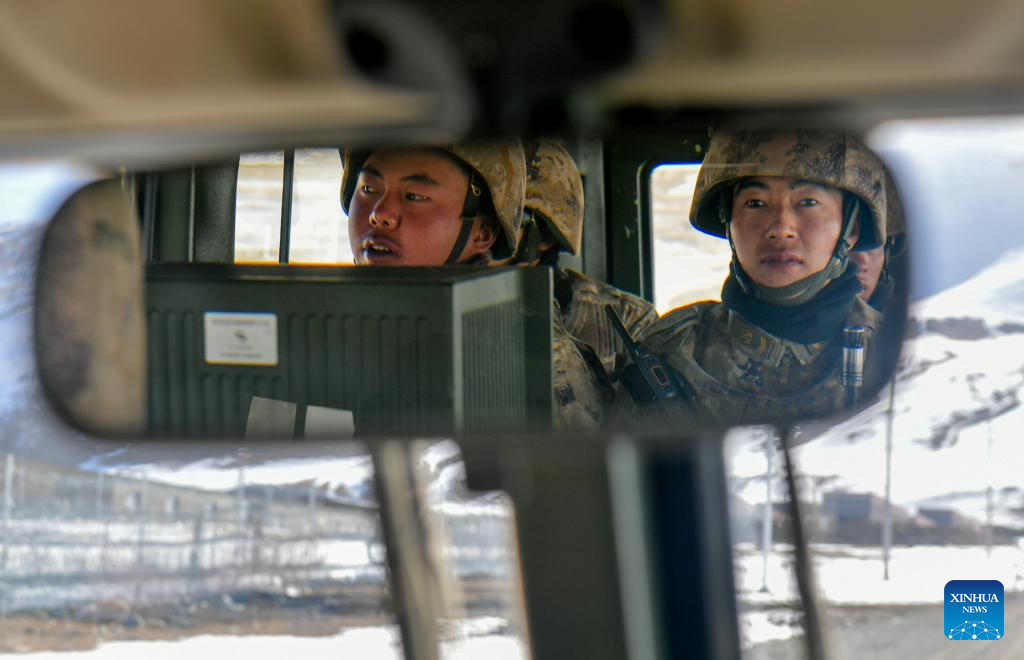
Zhou Linping (R) patrols in a car with other soldiers in Khunjerab, northwest China's Xinjiang Uygur Autonomous Region, April 14, 2023. Gao Guanghui, a recruit who had just joined the army for 7 months, was shocked when he walked into the honor room of the border defense regiment in Khunjerab, northwest China's Xinjiang Uygur Autonomous Region.
The regiment is based on the Pamirs, guarding the China-Pakistan border and Khunjerab Port. With an average altitude of 4,700 meters, the place is a "forbidden zone" for many people, as the temperature here can drop to as low as minus 40 degrees Celsius, and the oxygen content is less than half of that in the plain area.
Gao felt even more excited when he was on patrol with his squad leader Zhou Linping to the national border for the first time and renewed the boundary monument.
"We are in a troop with glorious history. Now it's on you," Zhou said to Gao.
Zhou, a veteran who had been in the regiment for 16 years, had mixed feelings when saying this as he is going to retire at the end of the year. "When I first came here 16 years ago, life was so hard," Zhou recalled. The facilities in the barracks were poor and due to the lack of transportation means, vegetables could only be sent to the top of the mountains once a month. "So we had very few choices except for potatoes, Chinese cabbages and onions, only because they are easier to store." Other than this, the soldiers only had one generator, which could only provide electricity at night. There was no access to mobile phone signals at all.
Now, everything is different. New barracks have been built up with a basketball court, a gym, a library and a diffuse oxygen supply system, which allow soldiers to breathe more smoothly. With the greenhouse, soldiers can not only be supplied with fresh vegetables and fruits, but also have the chance to taste tropical fruits like mangosteen and mango on the snowy plateau. In addition, the emergency treatment and rescue mechanism for plateau diseases have been continuously improved.
However, what makes Zhou proud is the change in their patrol task.
"We have a guard spot at an altitude of 5,283 meters. It took us two days to get there before, " Zhou said, "Now a road has been built to a place very close to the spot. We just need to walk for an hour or two to finish the patrol task. "
"I want to patrol all the spots again before I retire. That has been my job for the last 16 years, and if it's possible I would like to do it for the rest of my life," said Zhou. (Xinhua/Wang Fei)
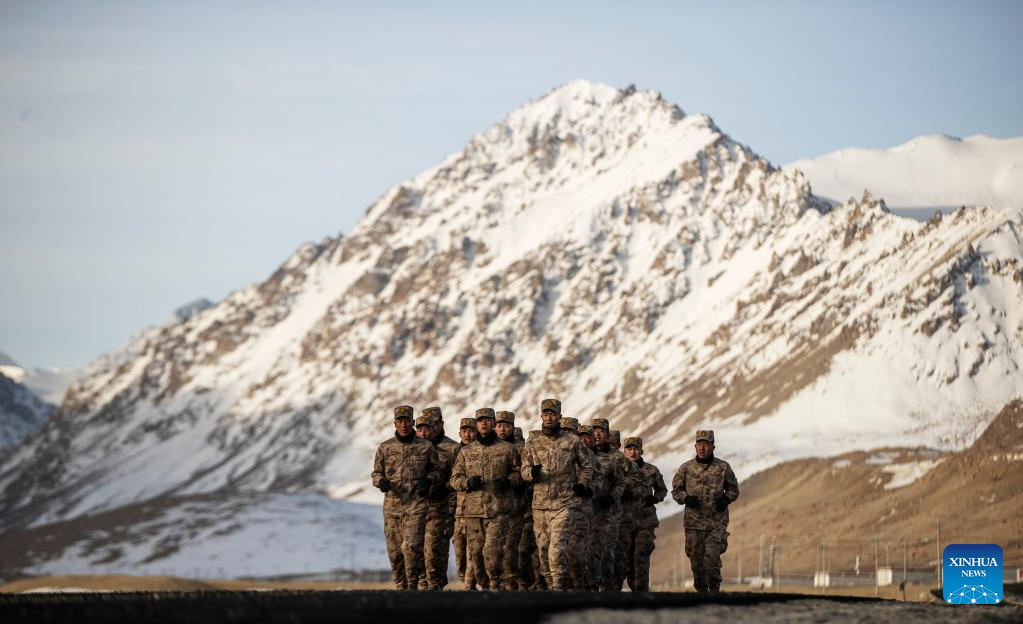
Soldiers run in a training session in Khunjerab, northwest China's Xinjiang Uygur Autonomous Region, April 13, 2023. Gao Guanghui, a recruit who had just joined the army for 7 months, was shocked when he walked into the honor room of the border defense regiment in Khunjerab, northwest China's Xinjiang Uygur Autonomous Region.
The regiment is based on the Pamirs, guarding the China-Pakistan border and Khunjerab Port. With an average altitude of 4,700 meters, the place is a "forbidden zone" for many people, as the temperature here can drop to as low as minus 40 degrees Celsius, and the oxygen content is less than half of that in the plain area.
Gao felt even more excited when he was on patrol with his squad leader Zhou Linping to the national border for the first time and renewed the boundary monument.
"We are in a troop with glorious history. Now it's on you," Zhou said to Gao.
Zhou, a veteran who had been in the regiment for 16 years, had mixed feelings when saying this as he is going to retire at the end of the year. "When I first came here 16 years ago, life was so hard," Zhou recalled. The facilities in the barracks were poor and due to the lack of transportation means, vegetables could only be sent to the top of the mountains once a month. "So we had very few choices except for potatoes, Chinese cabbages and onions, only because they are easier to store." Other than this, the soldiers only had one generator, which could only provide electricity at night. There was no access to mobile phone signals at all.
Now, everything is different. New barracks have been built up with a basketball court, a gym, a library and a diffuse oxygen supply system, which allow soldiers to breathe more smoothly. With the greenhouse, soldiers can not only be supplied with fresh vegetables and fruits, but also have the chance to taste tropical fruits like mangosteen and mango on the snowy plateau. In addition, the emergency treatment and rescue mechanism for plateau diseases have been continuously improved.
However, what makes Zhou proud is the change in their patrol task.
"We have a guard spot at an altitude of 5,283 meters. It took us two days to get there before, " Zhou said, "Now a road has been built to a place very close to the spot. We just need to walk for an hour or two to finish the patrol task. "
"I want to patrol all the spots again before I retire. That has been my job for the last 16 years, and if it's possible I would like to do it for the rest of my life," said Zhou. (Xinhua/Fei Maohua)
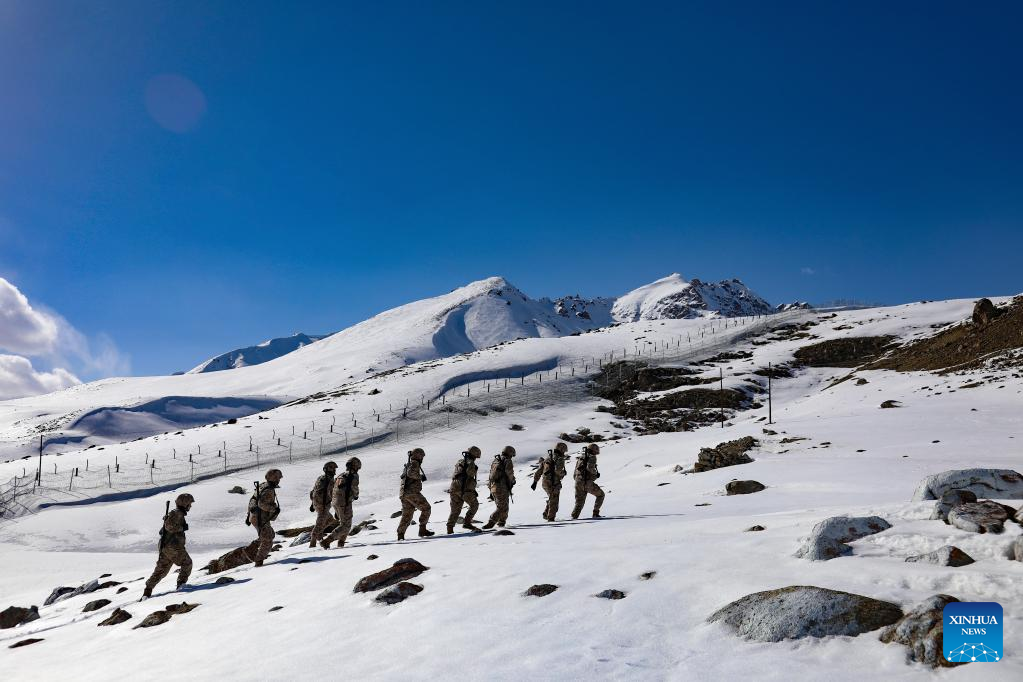
Soldiers patrol in Khunjerab, northwest China's Xinjiang Uygur Autonomous Region, April 13, 2023. Gao Guanghui, a recruit who had just joined the army for 7 months, was shocked when he walked into the honor room of the border defense regiment in Khunjerab, northwest China's Xinjiang Uygur Autonomous Region.
The regiment is based on the Pamirs, guarding the China-Pakistan border and Khunjerab Port. With an average altitude of 4,700 meters, the place is a "forbidden zone" for many people, as the temperature here can drop to as low as minus 40 degrees Celsius, and the oxygen content is less than half of that in the plain area.
Gao felt even more excited when he was on patrol with his squad leader Zhou Linping to the national border for the first time and renewed the boundary monument.
"We are in a troop with glorious history. Now it's on you," Zhou said to Gao.
Zhou, a veteran who had been in the regiment for 16 years, had mixed feelings when saying this as he is going to retire at the end of the year. "When I first came here 16 years ago, life was so hard," Zhou recalled. The facilities in the barracks were poor and due to the lack of transportation means, vegetables could only be sent to the top of the mountains once a month. "So we had very few choices except for potatoes, Chinese cabbages and onions, only because they are easier to store." Other than this, the soldiers only had one generator, which could only provide electricity at night. There was no access to mobile phone signals at all.
Now, everything is different. New barracks have been built up with a basketball court, a gym, a library and a diffuse oxygen supply system, which allow soldiers to breathe more smoothly. With the greenhouse, soldiers can not only be supplied with fresh vegetables and fruits, but also have the chance to taste tropical fruits like mangosteen and mango on the snowy plateau. In addition, the emergency treatment and rescue mechanism for plateau diseases have been continuously improved.
However, what makes Zhou proud is the change in their patrol task.
"We have a guard spot at an altitude of 5,283 meters. It took us two days to get there before, " Zhou said, "Now a road has been built to a place very close to the spot. We just need to walk for an hour or two to finish the patrol task. "
"I want to patrol all the spots again before I retire. That has been my job for the last 16 years, and if it's possible I would like to do it for the rest of my life," said Zhou. (Photo by Ji Wenzhi/Xinhua)
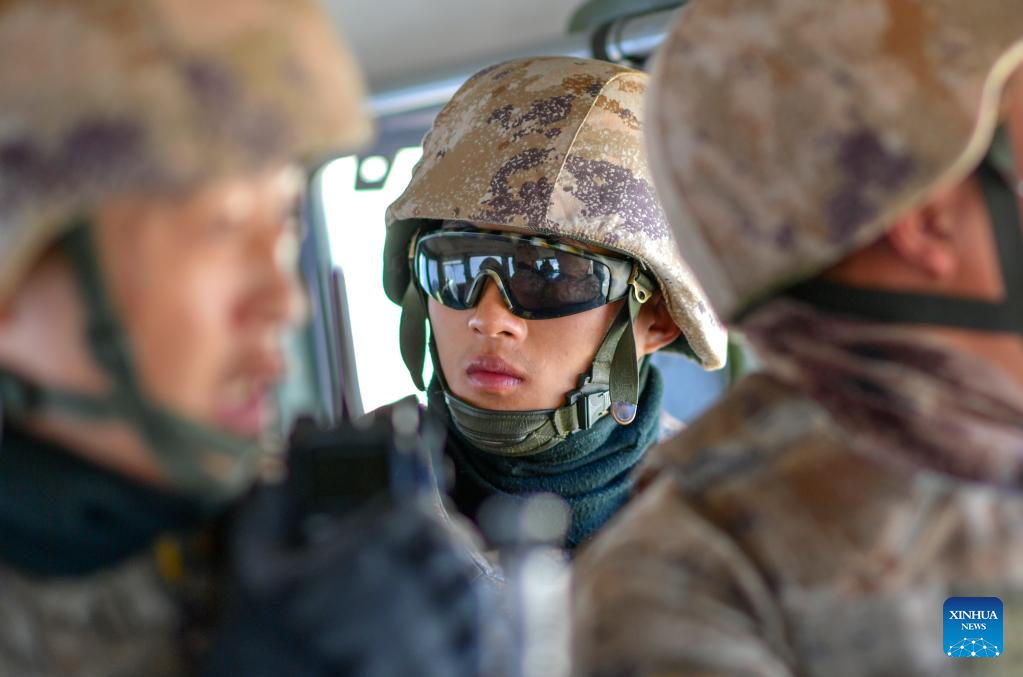
Gao Guanghui patrols in a car with other soldiers in Khunjerab, northwest China's Xinjiang Uygur Autonomous Region, April 14, 2023. Gao Guanghui, a recruit who had just joined the army for 7 months, was shocked when he walked into the honor room of the border defense regiment in Khunjerab, northwest China's Xinjiang Uygur Autonomous Region.
The regiment is based on the Pamirs, guarding the China-Pakistan border and Khunjerab Port. With an average altitude of 4,700 meters, the place is a "forbidden zone" for many people, as the temperature here can drop to as low as minus 40 degrees Celsius, and the oxygen content is less than half of that in the plain area.
Gao felt even more excited when he was on patrol with his squad leader Zhou Linping to the national border for the first time and renewed the boundary monument.
"We are in a troop with glorious history. Now it's on you," Zhou said to Gao.
Zhou, a veteran who had been in the regiment for 16 years, had mixed feelings when saying this as he is going to retire at the end of the year. "When I first came here 16 years ago, life was so hard," Zhou recalled. The facilities in the barracks were poor and due to the lack of transportation means, vegetables could only be sent to the top of the mountains once a month. "So we had very few choices except for potatoes, Chinese cabbages and onions, only because they are easier to store." Other than this, the soldiers only had one generator, which could only provide electricity at night. There was no access to mobile phone signals at all.
Now, everything is different. New barracks have been built up with a basketball court, a gym, a library and a diffuse oxygen supply system, which allow soldiers to breathe more smoothly. With the greenhouse, soldiers can not only be supplied with fresh vegetables and fruits, but also have the chance to taste tropical fruits like mangosteen and mango on the snowy plateau. In addition, the emergency treatment and rescue mechanism for plateau diseases have been continuously improved.
However, what makes Zhou proud is the change in their patrol task.
"We have a guard spot at an altitude of 5,283 meters. It took us two days to get there before, " Zhou said, "Now a road has been built to a place very close to the spot. We just need to walk for an hour or two to finish the patrol task. "
"I want to patrol all the spots again before I retire. That has been my job for the last 16 years, and if it's possible I would like to do it for the rest of my life," said Zhou. (Xinhua/Wang Fei)
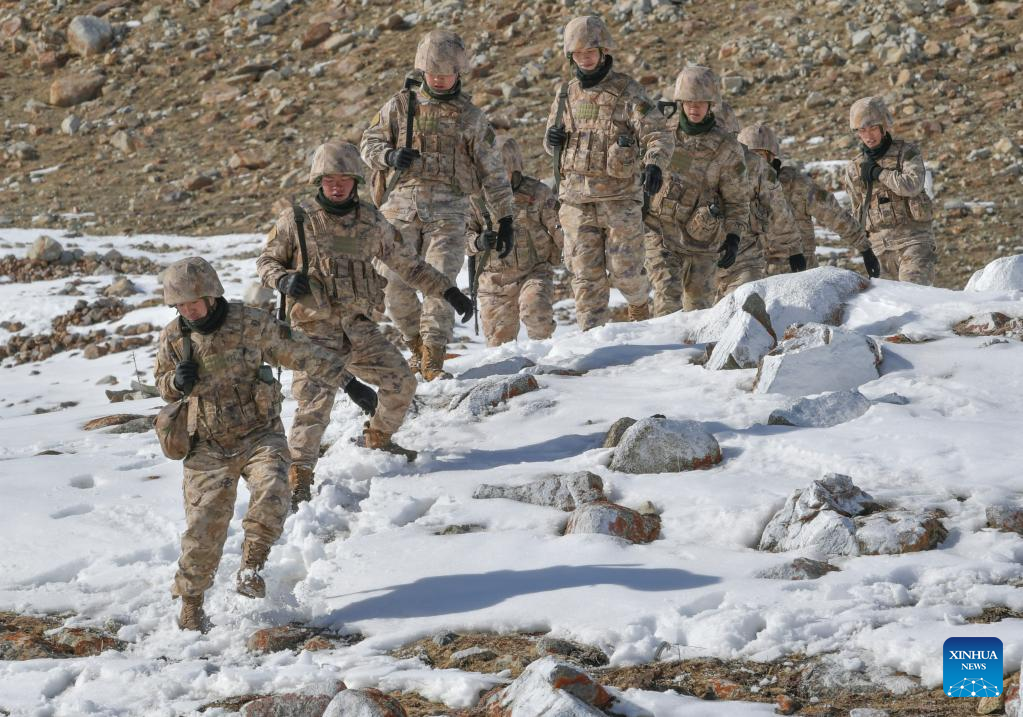
Soldiers patrol in Khunjerab, northwest China's Xinjiang Uygur Autonomous Region, April 13, 2023. Gao Guanghui, a recruit who had just joined the army for 7 months, was shocked when he walked into the honor room of the border defense regiment in Khunjerab, northwest China's Xinjiang Uygur Autonomous Region.
The regiment is based on the Pamirs, guarding the China-Pakistan border and Khunjerab Port. With an average altitude of 4,700 meters, the place is a "forbidden zone" for many people, as the temperature here can drop to as low as minus 40 degrees Celsius, and the oxygen content is less than half of that in the plain area.
Gao felt even more excited when he was on patrol with his squad leader Zhou Linping to the national border for the first time and renewed the boundary monument.
"We are in a troop with glorious history. Now it's on you," Zhou said to Gao.
Zhou, a veteran who had been in the regiment for 16 years, had mixed feelings when saying this as he is going to retire at the end of the year. "When I first came here 16 years ago, life was so hard," Zhou recalled. The facilities in the barracks were poor and due to the lack of transportation means, vegetables could only be sent to the top of the mountains once a month. "So we had very few choices except for potatoes, Chinese cabbages and onions, only because they are easier to store." Other than this, the soldiers only had one generator, which could only provide electricity at night. There was no access to mobile phone signals at all.
Now, everything is different. New barracks have been built up with a basketball court, a gym, a library and a diffuse oxygen supply system, which allow soldiers to breathe more smoothly. With the greenhouse, soldiers can not only be supplied with fresh vegetables and fruits, but also have the chance to taste tropical fruits like mangosteen and mango on the snowy plateau. In addition, the emergency treatment and rescue mechanism for plateau diseases have been continuously improved.
However, what makes Zhou proud is the change in their patrol task.
"We have a guard spot at an altitude of 5,283 meters. It took us two days to get there before, " Zhou said, "Now a road has been built to a place very close to the spot. We just need to walk for an hour or two to finish the patrol task. "
"I want to patrol all the spots again before I retire. That has been my job for the last 16 years, and if it's possible I would like to do it for the rest of my life," said Zhou. (Xinhua/Wang Fei)
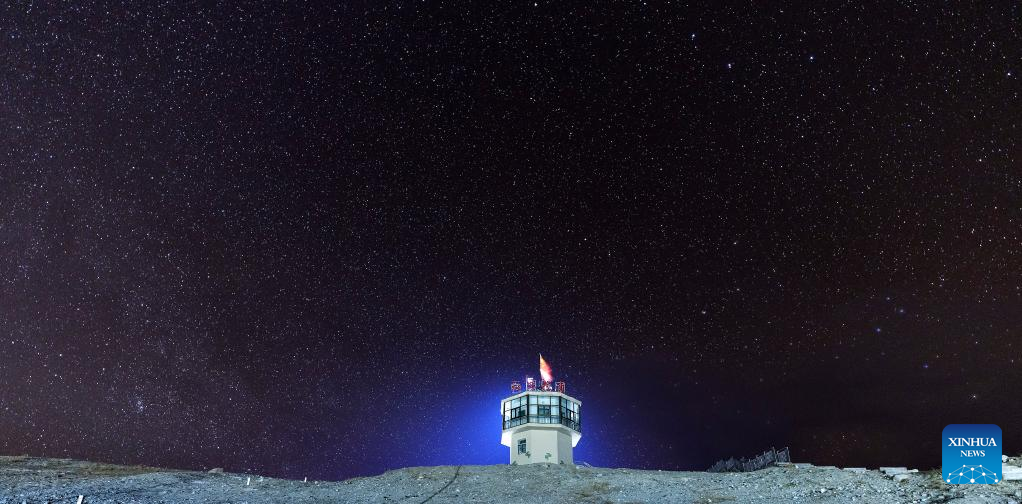
This photo taken on April 12, 2023 shows a border post in Khunjerab, northwest China's Xinjiang Uygur Autonomous Region. Gao Guanghui, a recruit who had just joined the army for 7 months, was shocked when he walked into the honor room of the border defense regiment in Khunjerab, northwest China's Xinjiang Uygur Autonomous Region.
The regiment is based on the Pamirs, guarding the China-Pakistan border and Khunjerab Port. With an average altitude of 4,700 meters, the place is a "forbidden zone" for many people, as the temperature here can drop to as low as minus 40 degrees Celsius, and the oxygen content is less than half of that in the plain area.
Gao felt even more excited when he was on patrol with his squad leader Zhou Linping to the national border for the first time and renewed the boundary monument.
"We are in a troop with glorious history. Now it's on you," Zhou said to Gao.
Zhou, a veteran who had been in the regiment for 16 years, had mixed feelings when saying this as he is going to retire at the end of the year. "When I first came here 16 years ago, life was so hard," Zhou recalled. The facilities in the barracks were poor and due to the lack of transportation means, vegetables could only be sent to the top of the mountains once a month. "So we had very few choices except for potatoes, Chinese cabbages and onions, only because they are easier to store." Other than this, the soldiers only had one generator, which could only provide electricity at night. There was no access to mobile phone signals at all.
Now, everything is different. New barracks have been built up with a basketball court, a gym, a library and a diffuse oxygen supply system, which allow soldiers to breathe more smoothly. With the greenhouse, soldiers can not only be supplied with fresh vegetables and fruits, but also have the chance to taste tropical fruits like mangosteen and mango on the snowy plateau. In addition, the emergency treatment and rescue mechanism for plateau diseases have been continuously improved.
However, what makes Zhou proud is the change in their patrol task.
"We have a guard spot at an altitude of 5,283 meters. It took us two days to get there before, " Zhou said, "Now a road has been built to a place very close to the spot. We just need to walk for an hour or two to finish the patrol task. "
"I want to patrol all the spots again before I retire. That has been my job for the last 16 years, and if it's possible I would like to do it for the rest of my life," said Zhou. (Xinhua/Fei Maohua)
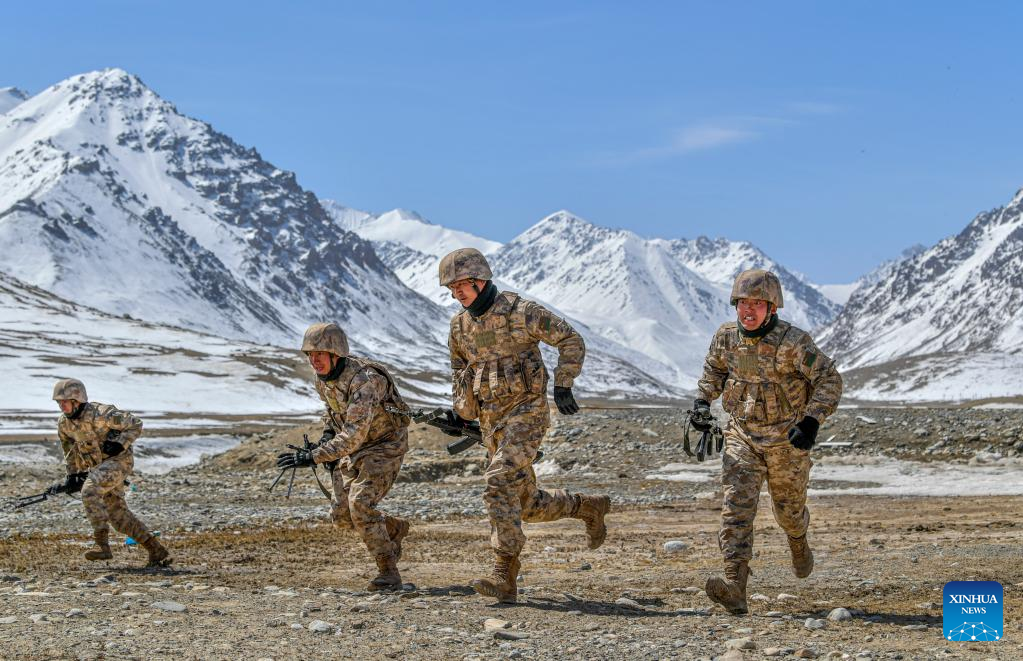
Soldiers train in Khunjerab, northwest China's Xinjiang Uygur Autonomous Region, April 13, 2023. Gao Guanghui, a recruit who had just joined the army for 7 months, was shocked when he walked into the honor room of the border defense regiment in Khunjerab, northwest China's Xinjiang Uygur Autonomous Region.
The regiment is based on the Pamirs, guarding the China-Pakistan border and Khunjerab Port. With an average altitude of 4,700 meters, the place is a "forbidden zone" for many people, as the temperature here can drop to as low as minus 40 degrees Celsius, and the oxygen content is less than half of that in the plain area.
Gao felt even more excited when he was on patrol with his squad leader Zhou Linping to the national border for the first time and renewed the boundary monument.
"We are in a troop with glorious history. Now it's on you," Zhou said to Gao.
Zhou, a veteran who had been in the regiment for 16 years, had mixed feelings when saying this as he is going to retire at the end of the year. "When I first came here 16 years ago, life was so hard," Zhou recalled. The facilities in the barracks were poor and due to the lack of transportation means, vegetables could only be sent to the top of the mountains once a month. "So we had very few choices except for potatoes, Chinese cabbages and onions, only because they are easier to store." Other than this, the soldiers only had one generator, which could only provide electricity at night. There was no access to mobile phone signals at all.
Now, everything is different. New barracks have been built up with a basketball court, a gym, a library and a diffuse oxygen supply system, which allow soldiers to breathe more smoothly. With the greenhouse, soldiers can not only be supplied with fresh vegetables and fruits, but also have the chance to taste tropical fruits like mangosteen and mango on the snowy plateau. In addition, the emergency treatment and rescue mechanism for plateau diseases have been continuously improved.
However, what makes Zhou proud is the change in their patrol task.
"We have a guard spot at an altitude of 5,283 meters. It took us two days to get there before, " Zhou said, "Now a road has been built to a place very close to the spot. We just need to walk for an hour or two to finish the patrol task. "
"I want to patrol all the spots again before I retire. That has been my job for the last 16 years, and if it's possible I would like to do it for the rest of my life," said Zhou. (Xinhua/Wang Fei)
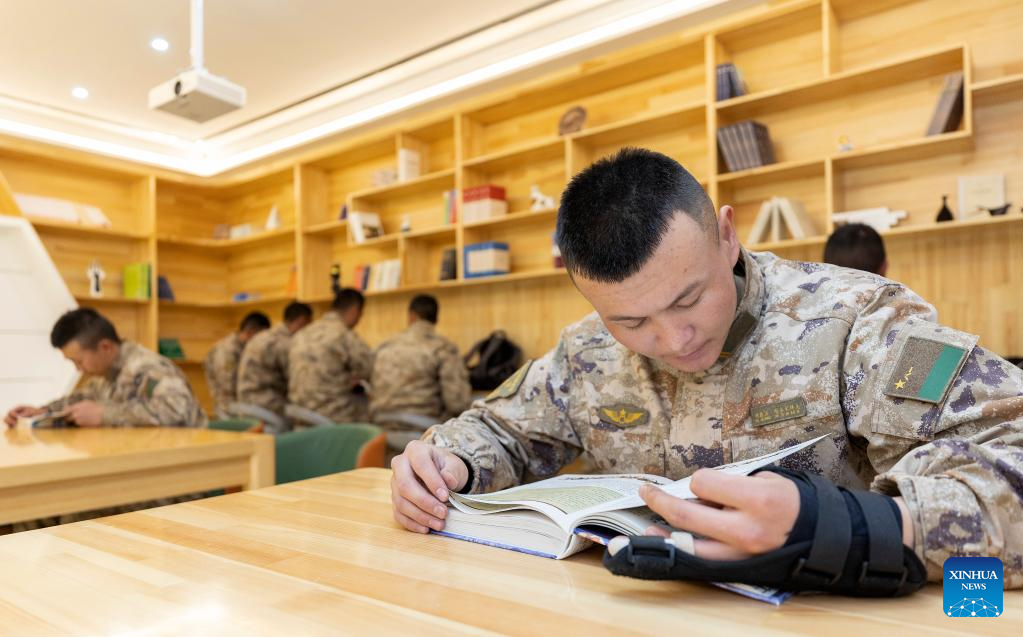
Soldiers read books in a reading room at the barrack in Khunjerab, northwest China's Xinjiang Uygur Autonomous Region, April 13, 2023. Gao Guanghui, a recruit who had just joined the army for 7 months, was shocked when he walked into the honor room of the border defense regiment in Khunjerab, northwest China's Xinjiang Uygur Autonomous Region.
The regiment is based on the Pamirs, guarding the China-Pakistan border and Khunjerab Port. With an average altitude of 4,700 meters, the place is a "forbidden zone" for many people, as the temperature here can drop to as low as minus 40 degrees Celsius, and the oxygen content is less than half of that in the plain area.
Gao felt even more excited when he was on patrol with his squad leader Zhou Linping to the national border for the first time and renewed the boundary monument.
"We are in a troop with glorious history. Now it's on you," Zhou said to Gao.
Zhou, a veteran who had been in the regiment for 16 years, had mixed feelings when saying this as he is going to retire at the end of the year. "When I first came here 16 years ago, life was so hard," Zhou recalled. The facilities in the barracks were poor and due to the lack of transportation means, vegetables could only be sent to the top of the mountains once a month. "So we had very few choices except for potatoes, Chinese cabbages and onions, only because they are easier to store." Other than this, the soldiers only had one generator, which could only provide electricity at night. There was no access to mobile phone signals at all.
Now, everything is different. New barracks have been built up with a basketball court, a gym, a library and a diffuse oxygen supply system, which allow soldiers to breathe more smoothly. With the greenhouse, soldiers can not only be supplied with fresh vegetables and fruits, but also have the chance to taste tropical fruits like mangosteen and mango on the snowy plateau. In addition, the emergency treatment and rescue mechanism for plateau diseases have been continuously improved.
However, what makes Zhou proud is the change in their patrol task.
"We have a guard spot at an altitude of 5,283 meters. It took us two days to get there before, " Zhou said, "Now a road has been built to a place very close to the spot. We just need to walk for an hour or two to finish the patrol task. "
"I want to patrol all the spots again before I retire. That has been my job for the last 16 years, and if it's possible I would like to do it for the rest of my life," said Zhou. (Xinhua/Fei Maohua)
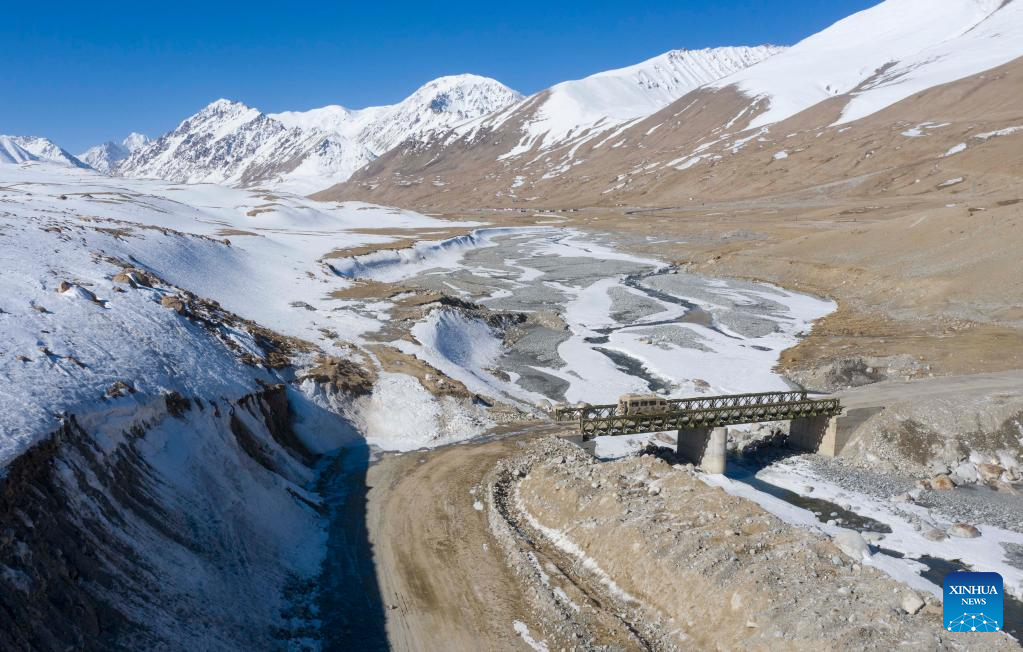
This aerial photo shows soldiers patrolling in a car in Khunjerab, northwest China's Xinjiang Uygur Autonomous Region, April 14, 2023. Gao Guanghui, a recruit who had just joined the army for 7 months, was shocked when he walked into the honor room of the border defense regiment in Khunjerab, northwest China's Xinjiang Uygur Autonomous Region.
The regiment is based on the Pamirs, guarding the China-Pakistan border and Khunjerab Port. With an average altitude of 4,700 meters, the place is a "forbidden zone" for many people, as the temperature here can drop to as low as minus 40 degrees Celsius, and the oxygen content is less than half of that in the plain area.
Gao felt even more excited when he was on patrol with his squad leader Zhou Linping to the national border for the first time and renewed the boundary monument.
"We are in a troop with glorious history. Now it's on you," Zhou said to Gao.
Zhou, a veteran who had been in the regiment for 16 years, had mixed feelings when saying this as he is going to retire at the end of the year. "When I first came here 16 years ago, life was so hard," Zhou recalled. The facilities in the barracks were poor and due to the lack of transportation means, vegetables could only be sent to the top of the mountains once a month. "So we had very few choices except for potatoes, Chinese cabbages and onions, only because they are easier to store." Other than this, the soldiers only had one generator, which could only provide electricity at night. There was no access to mobile phone signals at all.
Now, everything is different. New barracks have been built up with a basketball court, a gym, a library and a diffuse oxygen supply system, which allow soldiers to breathe more smoothly. With the greenhouse, soldiers can not only be supplied with fresh vegetables and fruits, but also have the chance to taste tropical fruits like mangosteen and mango on the snowy plateau. In addition, the emergency treatment and rescue mechanism for plateau diseases have been continuously improved.
However, what makes Zhou proud is the change in their patrol task.
"We have a guard spot at an altitude of 5,283 meters. It took us two days to get there before, " Zhou said, "Now a road has been built to a place very close to the spot. We just need to walk for an hour or two to finish the patrol task. "
"I want to patrol all the spots again before I retire. That has been my job for the last 16 years, and if it's possible I would like to do it for the rest of my life," said Zhou. (Xinhua/Yang Zhisen)
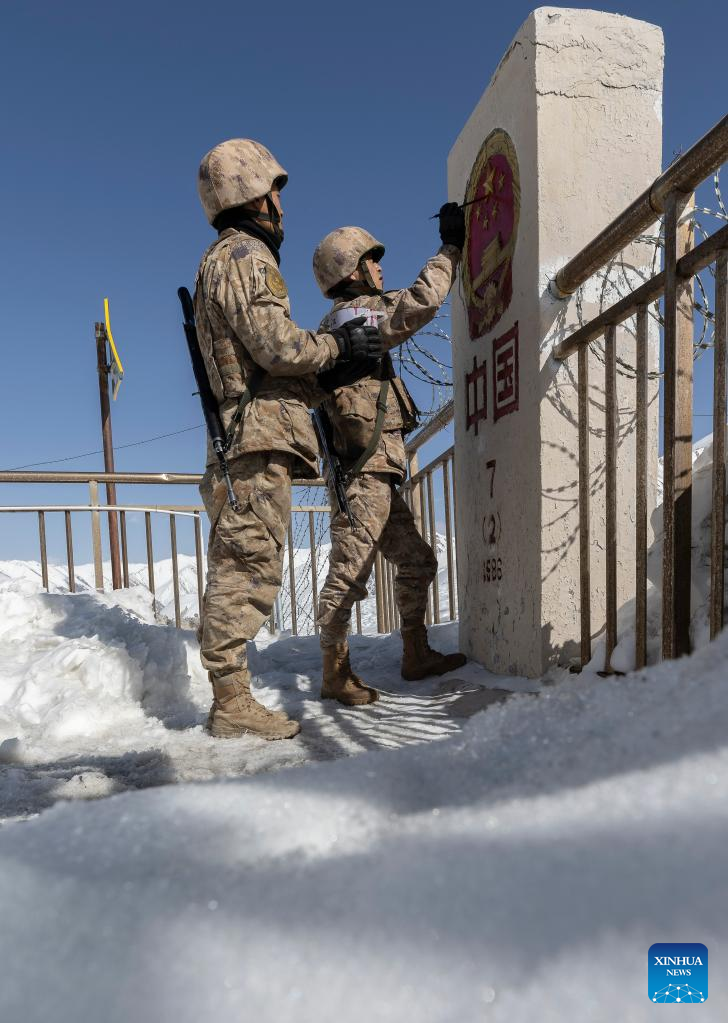
Zhou Linping (R) and Gao Guanghui apply paint as they renew a boundary monument in Khunjerab, northwest China's Xinjiang Uygur Autonomous Region, April 13, 2023. Gao Guanghui, a recruit who had just joined the army for 7 months, was shocked when he walked into the honor room of the border defense regiment in Khunjerab, northwest China's Xinjiang Uygur Autonomous Region.
The regiment is based on the Pamirs, guarding the China-Pakistan border and Khunjerab Port. With an average altitude of 4,700 meters, the place is a "forbidden zone" for many people, as the temperature here can drop to as low as minus 40 degrees Celsius, and the oxygen content is less than half of that in the plain area.
Gao felt even more excited when he was on patrol with his squad leader Zhou Linping to the national border for the first time and renewed the boundary monument.
"We are in a troop with glorious history. Now it's on you," Zhou said to Gao.
Zhou, a veteran who had been in the regiment for 16 years, had mixed feelings when saying this as he is going to retire at the end of the year. "When I first came here 16 years ago, life was so hard," Zhou recalled. The facilities in the barracks were poor and due to the lack of transportation means, vegetables could only be sent to the top of the mountains once a month. "So we had very few choices except for potatoes, Chinese cabbages and onions, only because they are easier to store." Other than this, the soldiers only had one generator, which could only provide electricity at night. There was no access to mobile phone signals at all.
Now, everything is different. New barracks have been built up with a basketball court, a gym, a library and a diffuse oxygen supply system, which allow soldiers to breathe more smoothly. With the greenhouse, soldiers can not only be supplied with fresh vegetables and fruits, but also have the chance to taste tropical fruits like mangosteen and mango on the snowy plateau. In addition, the emergency treatment and rescue mechanism for plateau diseases have been continuously improved.
However, what makes Zhou proud is the change in their patrol task.
"We have a guard spot at an altitude of 5,283 meters. It took us two days to get there before, " Zhou said, "Now a road has been built to a place very close to the spot. We just need to walk for an hour or two to finish the patrol task. "
"I want to patrol all the spots again before I retire. That has been my job for the last 16 years, and if it's possible I would like to do it for the rest of my life," said Zhou. (Xinhua/Fei Maohua)
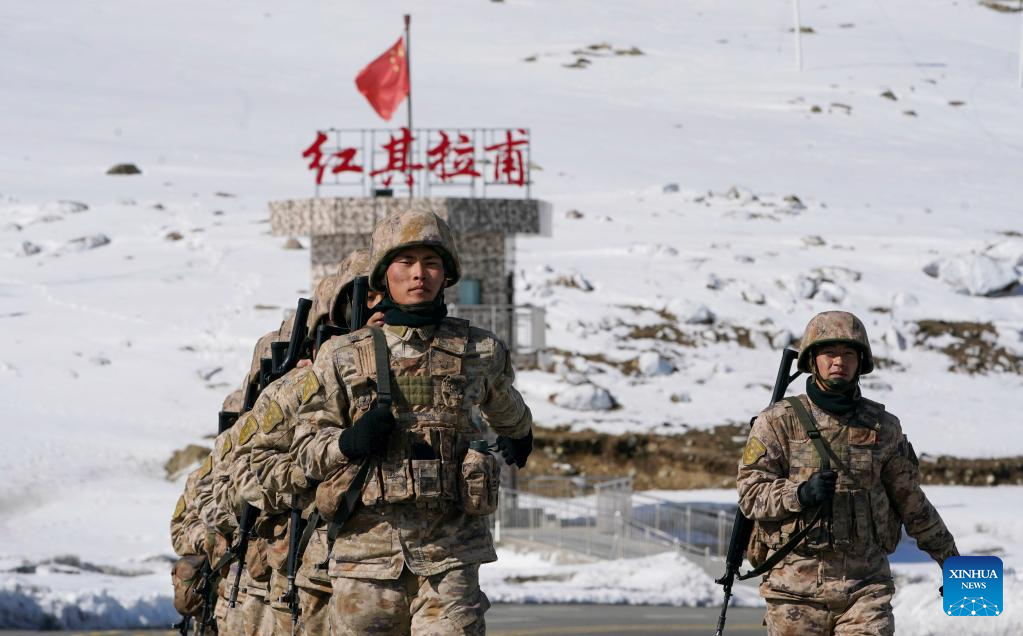
Soldiers patrol in Khunjerab, northwest China's Xinjiang Uygur Autonomous Region, April 13, 2023. Gao Guanghui, a recruit who had just joined the army for 7 months, was shocked when he walked into the honor room of the border defense regiment in Khunjerab, northwest China's Xinjiang Uygur Autonomous Region.
The regiment is based on the Pamirs, guarding the China-Pakistan border and Khunjerab Port. With an average altitude of 4,700 meters, the place is a "forbidden zone" for many people, as the temperature here can drop to as low as minus 40 degrees Celsius, and the oxygen content is less than half of that in the plain area.
Gao felt even more excited when he was on patrol with his squad leader Zhou Linping to the national border for the first time and renewed the boundary monument.
"We are in a troop with glorious history. Now it's on you," Zhou said to Gao.
Zhou, a veteran who had been in the regiment for 16 years, had mixed feelings when saying this as he is going to retire at the end of the year. "When I first came here 16 years ago, life was so hard," Zhou recalled. The facilities in the barracks were poor and due to the lack of transportation means, vegetables could only be sent to the top of the mountains once a month. "So we had very few choices except for potatoes, Chinese cabbages and onions, only because they are easier to store." Other than this, the soldiers only had one generator, which could only provide electricity at night. There was no access to mobile phone signals at all.
Now, everything is different. New barracks have been built up with a basketball court, a gym, a library and a diffuse oxygen supply system, which allow soldiers to breathe more smoothly. With the greenhouse, soldiers can not only be supplied with fresh vegetables and fruits, but also have the chance to taste tropical fruits like mangosteen and mango on the snowy plateau. In addition, the emergency treatment and rescue mechanism for plateau diseases have been continuously improved.
However, what makes Zhou proud is the change in their patrol task.
"We have a guard spot at an altitude of 5,283 meters. It took us two days to get there before, " Zhou said, "Now a road has been built to a place very close to the spot. We just need to walk for an hour or two to finish the patrol task. "
"I want to patrol all the spots again before I retire. That has been my job for the last 16 years, and if it's possible I would like to do it for the rest of my life," said Zhou. (Xinhua/Zhao Ge)
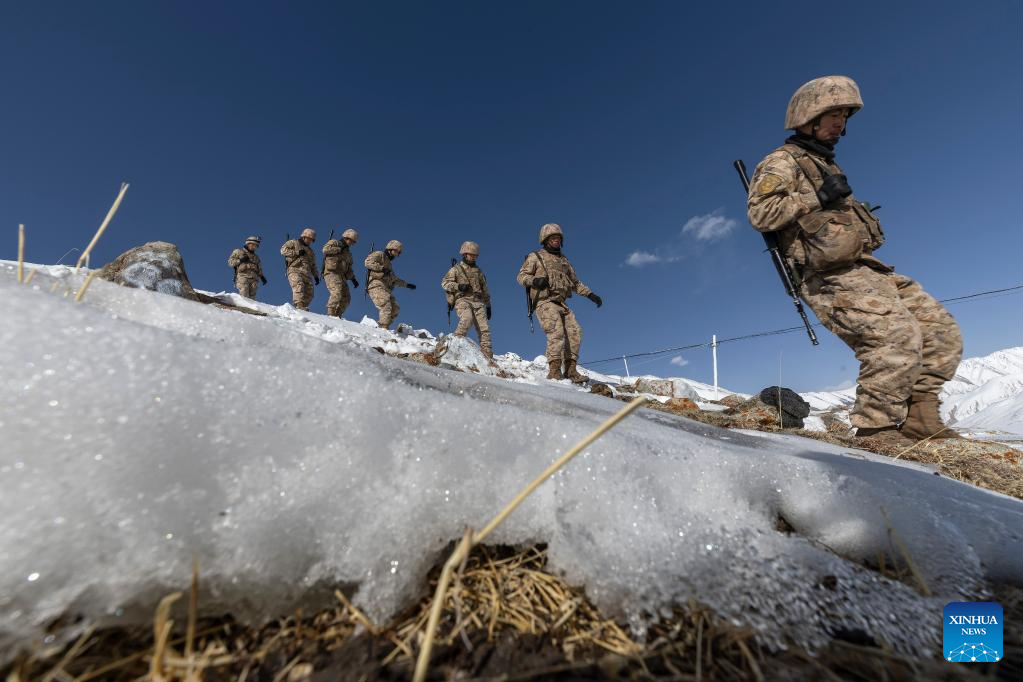
Soldiers patrol in Khunjerab, northwest China's Xinjiang Uygur Autonomous Region, April 13, 2023. Gao Guanghui, a recruit who had just joined the army for 7 months, was shocked when he walked into the honor room of the border defense regiment in Khunjerab, northwest China's Xinjiang Uygur Autonomous Region.
The regiment is based on the Pamirs, guarding the China-Pakistan border and Khunjerab Port. With an average altitude of 4,700 meters, the place is a "forbidden zone" for many people, as the temperature here can drop to as low as minus 40 degrees Celsius, and the oxygen content is less than half of that in the plain area.
Gao felt even more excited when he was on patrol with his squad leader Zhou Linping to the national border for the first time and renewed the boundary monument.
"We are in a troop with glorious history. Now it's on you," Zhou said to Gao.
Zhou, a veteran who had been in the regiment for 16 years, had mixed feelings when saying this as he is going to retire at the end of the year. "When I first came here 16 years ago, life was so hard," Zhou recalled. The facilities in the barracks were poor and due to the lack of transportation means, vegetables could only be sent to the top of the mountains once a month. "So we had very few choices except for potatoes, Chinese cabbages and onions, only because they are easier to store." Other than this, the soldiers only had one generator, which could only provide electricity at night. There was no access to mobile phone signals at all.
Now, everything is different. New barracks have been built up with a basketball court, a gym, a library and a diffuse oxygen supply system, which allow soldiers to breathe more smoothly. With the greenhouse, soldiers can not only be supplied with fresh vegetables and fruits, but also have the chance to taste tropical fruits like mangosteen and mango on the snowy plateau. In addition, the emergency treatment and rescue mechanism for plateau diseases have been continuously improved.
However, what makes Zhou proud is the change in their patrol task.
"We have a guard spot at an altitude of 5,283 meters. It took us two days to get there before, " Zhou said, "Now a road has been built to a place very close to the spot. We just need to walk for an hour or two to finish the patrol task. "
"I want to patrol all the spots again before I retire. That has been my job for the last 16 years, and if it's possible I would like to do it for the rest of my life," said Zhou. (Xinhua/Fei Maohua)
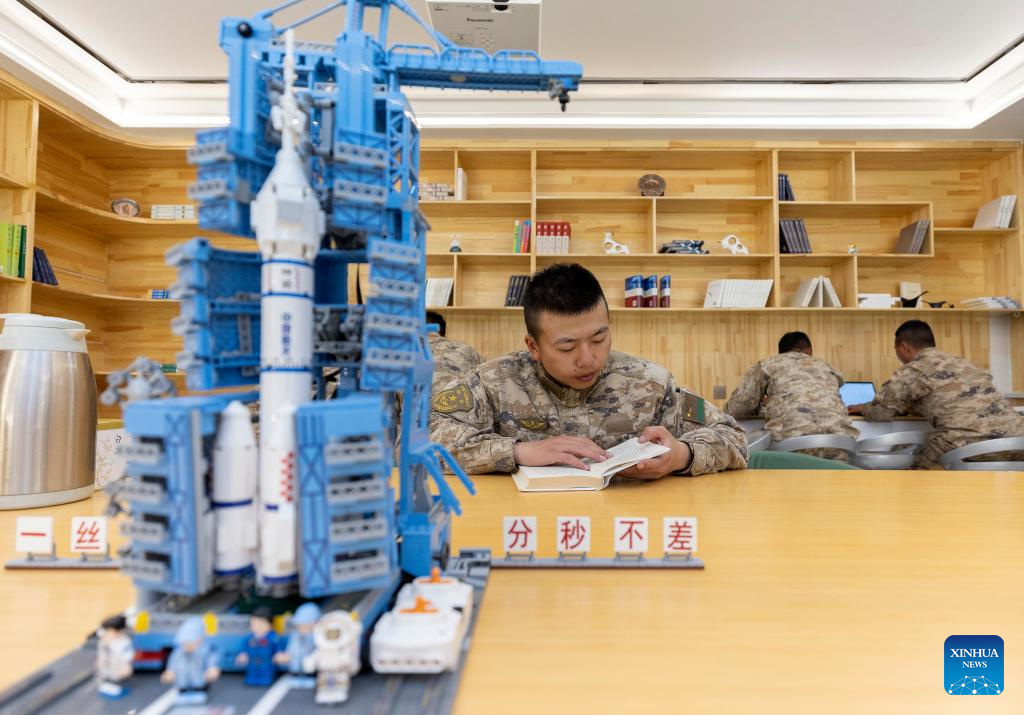
Soldiers read books in a reading room at the barrack in Khunjerab, northwest China's Xinjiang Uygur Autonomous Region, April 13, 2023. Gao Guanghui, a recruit who had just joined the army for 7 months, was shocked when he walked into the honor room of the border defense regiment in Khunjerab, northwest China's Xinjiang Uygur Autonomous Region.
The regiment is based on the Pamirs, guarding the China-Pakistan border and Khunjerab Port. With an average altitude of 4,700 meters, the place is a "forbidden zone" for many people, as the temperature here can drop to as low as minus 40 degrees Celsius, and the oxygen content is less than half of that in the plain area.
Gao felt even more excited when he was on patrol with his squad leader Zhou Linping to the national border for the first time and renewed the boundary monument.
"We are in a troop with glorious history. Now it's on you," Zhou said to Gao.
Zhou, a veteran who had been in the regiment for 16 years, had mixed feelings when saying this as he is going to retire at the end of the year. "When I first came here 16 years ago, life was so hard," Zhou recalled. The facilities in the barracks were poor and due to the lack of transportation means, vegetables could only be sent to the top of the mountains once a month. "So we had very few choices except for potatoes, Chinese cabbages and onions, only because they are easier to store." Other than this, the soldiers only had one generator, which could only provide electricity at night. There was no access to mobile phone signals at all.
Now, everything is different. New barracks have been built up with a basketball court, a gym, a library and a diffuse oxygen supply system, which allow soldiers to breathe more smoothly. With the greenhouse, soldiers can not only be supplied with fresh vegetables and fruits, but also have the chance to taste tropical fruits like mangosteen and mango on the snowy plateau. In addition, the emergency treatment and rescue mechanism for plateau diseases have been continuously improved.
However, what makes Zhou proud is the change in their patrol task.
"We have a guard spot at an altitude of 5,283 meters. It took us two days to get there before, " Zhou said, "Now a road has been built to a place very close to the spot. We just need to walk for an hour or two to finish the patrol task. "
"I want to patrol all the spots again before I retire. That has been my job for the last 16 years, and if it's possible I would like to do it for the rest of my life," said Zhou. (Xinhua/Fei Maohua)
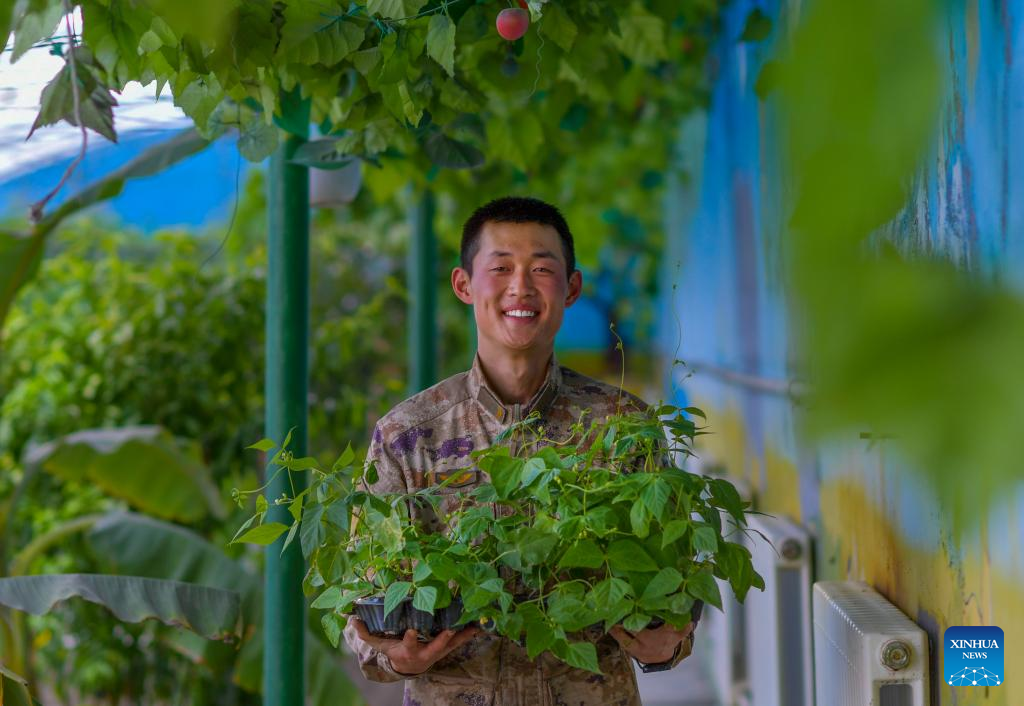
A soilder shows hot pepper plants he cultivates in the greenhouse in Khunjerab, northwest China's Xinjiang Uygur Autonomous Region, April 13, 2023. Gao Guanghui, a recruit who had just joined the army for 7 months, was shocked when he walked into the honor room of the border defense regiment in Khunjerab, northwest China's Xinjiang Uygur Autonomous Region.
The regiment is based on the Pamirs, guarding the China-Pakistan border and Khunjerab Port. With an average altitude of 4,700 meters, the place is a "forbidden zone" for many people, as the temperature here can drop to as low as minus 40 degrees Celsius, and the oxygen content is less than half of that in the plain area.
Gao felt even more excited when he was on patrol with his squad leader Zhou Linping to the national border for the first time and renewed the boundary monument.
"We are in a troop with glorious history. Now it's on you," Zhou said to Gao.
Zhou, a veteran who had been in the regiment for 16 years, had mixed feelings when saying this as he is going to retire at the end of the year. "When I first came here 16 years ago, life was so hard," Zhou recalled. The facilities in the barracks were poor and due to the lack of transportation means, vegetables could only be sent to the top of the mountains once a month. "So we had very few choices except for potatoes, Chinese cabbages and onions, only because they are easier to store." Other than this, the soldiers only had one generator, which could only provide electricity at night. There was no access to mobile phone signals at all.
Now, everything is different. New barracks have been built up with a basketball court, a gym, a library and a diffuse oxygen supply system, which allow soldiers to breathe more smoothly. With the greenhouse, soldiers can not only be supplied with fresh vegetables and fruits, but also have the chance to taste tropical fruits like mangosteen and mango on the snowy plateau. In addition, the emergency treatment and rescue mechanism for plateau diseases have been continuously improved.
However, what makes Zhou proud is the change in their patrol task.
"We have a guard spot at an altitude of 5,283 meters. It took us two days to get there before, " Zhou said, "Now a road has been built to a place very close to the spot. We just need to walk for an hour or two to finish the patrol task. "
"I want to patrol all the spots again before I retire. That has been my job for the last 16 years, and if it's possible I would like to do it for the rest of my life," said Zhou. (Xinhua/Wang Fei)
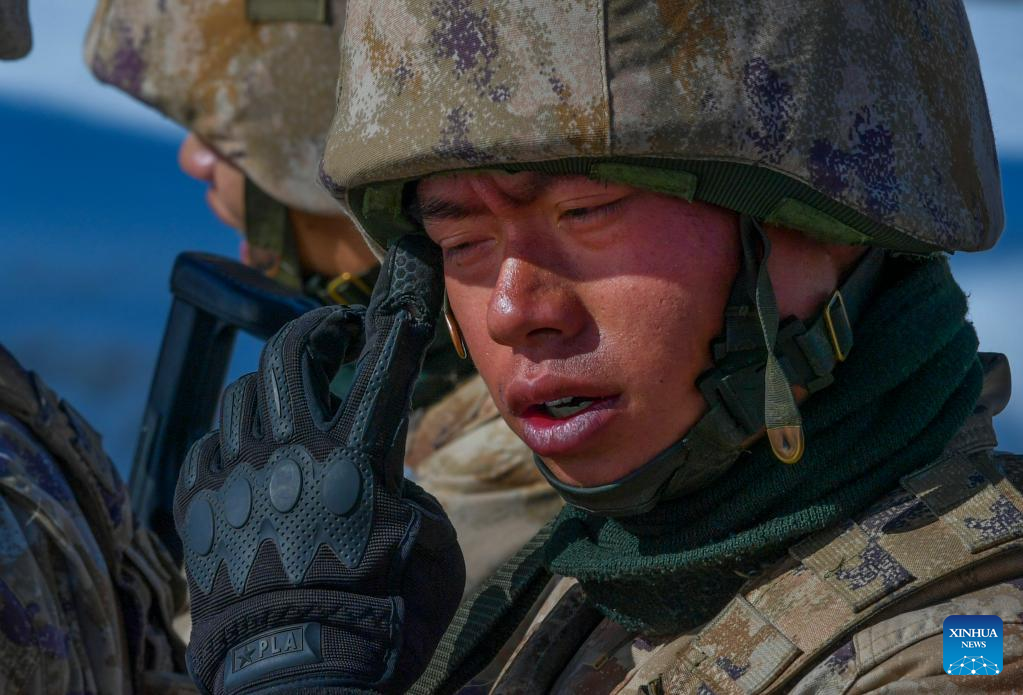
A soldier wipes sweat during a patrol in Khunjerab, northwest China's Xinjiang Uygur Autonomous Region, April 13, 2023. Gao Guanghui, a recruit who had just joined the army for 7 months, was shocked when he walked into the honor room of the border defense regiment in Khunjerab, northwest China's Xinjiang Uygur Autonomous Region.
The regiment is based on the Pamirs, guarding the China-Pakistan border and Khunjerab Port. With an average altitude of 4,700 meters, the place is a "forbidden zone" for many people, as the temperature here can drop to as low as minus 40 degrees Celsius, and the oxygen content is less than half of that in the plain area.
Gao felt even more excited when he was on patrol with his squad leader Zhou Linping to the national border for the first time and renewed the boundary monument.
"We are in a troop with glorious history. Now it's on you," Zhou said to Gao.
Zhou, a veteran who had been in the regiment for 16 years, had mixed feelings when saying this as he is going to retire at the end of the year. "When I first came here 16 years ago, life was so hard," Zhou recalled. The facilities in the barracks were poor and due to the lack of transportation means, vegetables could only be sent to the top of the mountains once a month. "So we had very few choices except for potatoes, Chinese cabbages and onions, only because they are easier to store." Other than this, the soldiers only had one generator, which could only provide electricity at night. There was no access to mobile phone signals at all.
Now, everything is different. New barracks have been built up with a basketball court, a gym, a library and a diffuse oxygen supply system, which allow soldiers to breathe more smoothly. With the greenhouse, soldiers can not only be supplied with fresh vegetables and fruits, but also have the chance to taste tropical fruits like mangosteen and mango on the snowy plateau. In addition, the emergency treatment and rescue mechanism for plateau diseases have been continuously improved.
However, what makes Zhou proud is the change in their patrol task.
"We have a guard spot at an altitude of 5,283 meters. It took us two days to get there before, " Zhou said, "Now a road has been built to a place very close to the spot. We just need to walk for an hour or two to finish the patrol task. "
"I want to patrol all the spots again before I retire. That has been my job for the last 16 years, and if it's possible I would like to do it for the rest of my life," said Zhou. (Xinhua/Wang Fei)
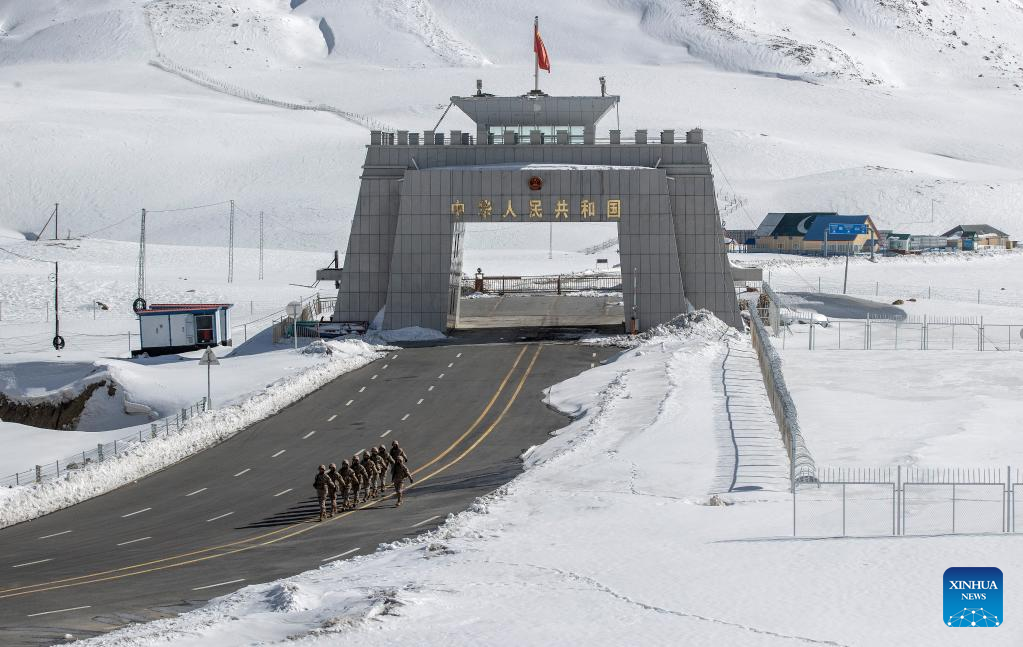
Soldiers patrol in Khunjerab, northwest China's Xinjiang Uygur Autonomous Region, April 13, 2023. Gao Guanghui, a recruit who had just joined the army for 7 months, was shocked when he walked into the honor room of the border defense regiment in Khunjerab, northwest China's Xinjiang Uygur Autonomous Region.
The regiment is based on the Pamirs, guarding the China-Pakistan border and Khunjerab Port. With an average altitude of 4,700 meters, the place is a "forbidden zone" for many people, as the temperature here can drop to as low as minus 40 degrees Celsius, and the oxygen content is less than half of that in the plain area.
Gao felt even more excited when he was on patrol with his squad leader Zhou Linping to the national border for the first time and renewed the boundary monument.
"We are in a troop with glorious history. Now it's on you," Zhou said to Gao.
Zhou, a veteran who had been in the regiment for 16 years, had mixed feelings when saying this as he is going to retire at the end of the year. "When I first came here 16 years ago, life was so hard," Zhou recalled. The facilities in the barracks were poor and due to the lack of transportation means, vegetables could only be sent to the top of the mountains once a month. "So we had very few choices except for potatoes, Chinese cabbages and onions, only because they are easier to store." Other than this, the soldiers only had one generator, which could only provide electricity at night. There was no access to mobile phone signals at all.
Now, everything is different. New barracks have been built up with a basketball court, a gym, a library and a diffuse oxygen supply system, which allow soldiers to breathe more smoothly. With the greenhouse, soldiers can not only be supplied with fresh vegetables and fruits, but also have the chance to taste tropical fruits like mangosteen and mango on the snowy plateau. In addition, the emergency treatment and rescue mechanism for plateau diseases have been continuously improved.
However, what makes Zhou proud is the change in their patrol task.
"We have a guard spot at an altitude of 5,283 meters. It took us two days to get there before, " Zhou said, "Now a road has been built to a place very close to the spot. We just need to walk for an hour or two to finish the patrol task. "
"I want to patrol all the spots again before I retire. That has been my job for the last 16 years, and if it's possible I would like to do it for the rest of my life," said Zhou. (Xinhua/Fei Maohua)
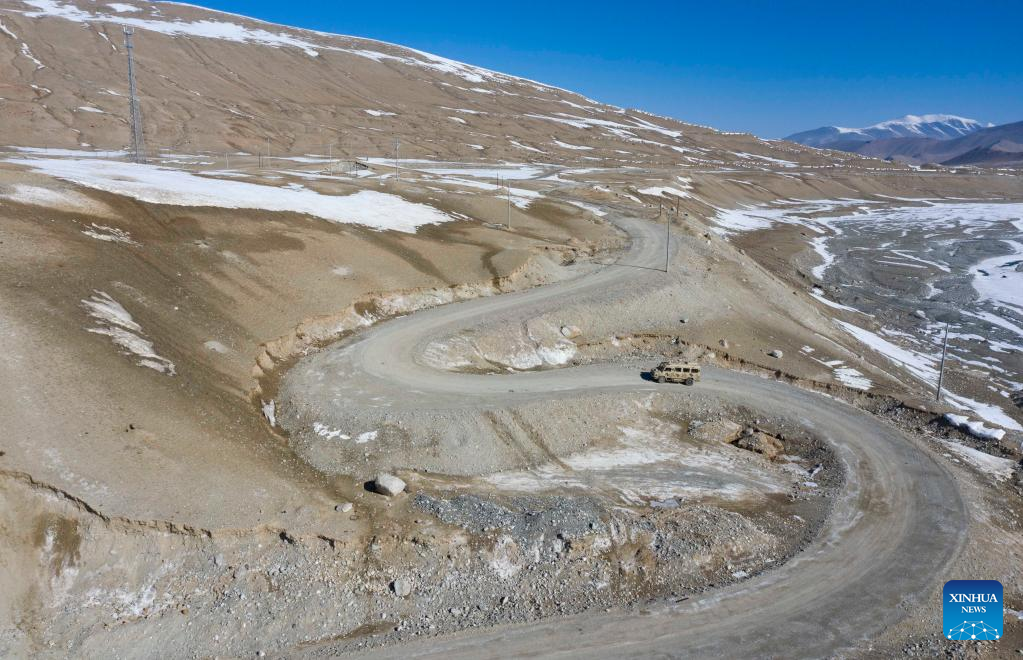
This aerial photo shows soldiers patrolling in a car in Khunjerab, northwest China's Xinjiang Uygur Autonomous Region, April 14, 2023. Gao Guanghui, a recruit who had just joined the army for 7 months, was shocked when he walked into the honor room of the border defense regiment in Khunjerab, northwest China's Xinjiang Uygur Autonomous Region.
The regiment is based on the Pamirs, guarding the China-Pakistan border and Khunjerab Port. With an average altitude of 4,700 meters, the place is a "forbidden zone" for many people, as the temperature here can drop to as low as minus 40 degrees Celsius, and the oxygen content is less than half of that in the plain area.
Gao felt even more excited when he was on patrol with his squad leader Zhou Linping to the national border for the first time and renewed the boundary monument.
"We are in a troop with glorious history. Now it's on you," Zhou said to Gao.
Zhou, a veteran who had been in the regiment for 16 years, had mixed feelings when saying this as he is going to retire at the end of the year. "When I first came here 16 years ago, life was so hard," Zhou recalled. The facilities in the barracks were poor and due to the lack of transportation means, vegetables could only be sent to the top of the mountains once a month. "So we had very few choices except for potatoes, Chinese cabbages and onions, only because they are easier to store." Other than this, the soldiers only had one generator, which could only provide electricity at night. There was no access to mobile phone signals at all.
Now, everything is different. New barracks have been built up with a basketball court, a gym, a library and a diffuse oxygen supply system, which allow soldiers to breathe more smoothly. With the greenhouse, soldiers can not only be supplied with fresh vegetables and fruits, but also have the chance to taste tropical fruits like mangosteen and mango on the snowy plateau. In addition, the emergency treatment and rescue mechanism for plateau diseases have been continuously improved.
However, what makes Zhou proud is the change in their patrol task.
"We have a guard spot at an altitude of 5,283 meters. It took us two days to get there before, " Zhou said, "Now a road has been built to a place very close to the spot. We just need to walk for an hour or two to finish the patrol task. "
"I want to patrol all the spots again before I retire. That has been my job for the last 16 years, and if it's possible I would like to do it for the rest of my life," said Zhou. (Xinhua/Yang Zhisen)
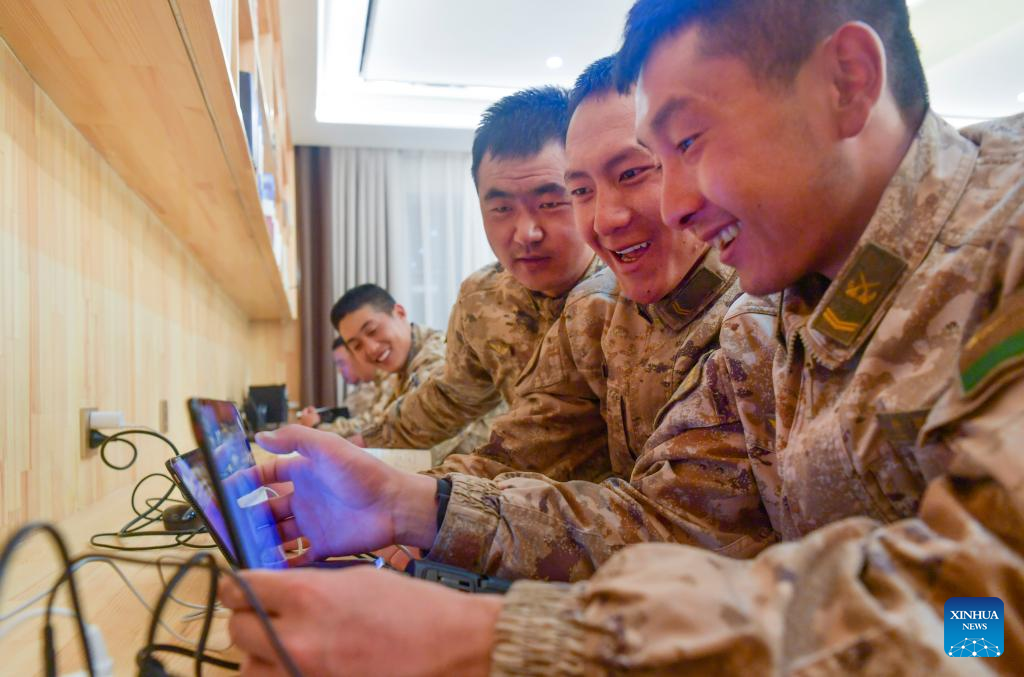
Soldiers use electronic devices in a reading room at the barrack in Khunjerab, northwest China's Xinjiang Uygur Autonomous Region, April 13, 2023. Gao Guanghui, a recruit who had just joined the army for 7 months, was shocked when he walked into the honor room of the border defense regiment in Khunjerab, northwest China's Xinjiang Uygur Autonomous Region.
The regiment is based on the Pamirs, guarding the China-Pakistan border and Khunjerab Port. With an average altitude of 4,700 meters, the place is a "forbidden zone" for many people, as the temperature here can drop to as low as minus 40 degrees Celsius, and the oxygen content is less than half of that in the plain area.
Gao felt even more excited when he was on patrol with his squad leader Zhou Linping to the national border for the first time and renewed the boundary monument.
"We are in a troop with glorious history. Now it's on you," Zhou said to Gao.
Zhou, a veteran who had been in the regiment for 16 years, had mixed feelings when saying this as he is going to retire at the end of the year. "When I first came here 16 years ago, life was so hard," Zhou recalled. The facilities in the barracks were poor and due to the lack of transportation means, vegetables could only be sent to the top of the mountains once a month. "So we had very few choices except for potatoes, Chinese cabbages and onions, only because they are easier to store." Other than this, the soldiers only had one generator, which could only provide electricity at night. There was no access to mobile phone signals at all.
Now, everything is different. New barracks have been built up with a basketball court, a gym, a library and a diffuse oxygen supply system, which allow soldiers to breathe more smoothly. With the greenhouse, soldiers can not only be supplied with fresh vegetables and fruits, but also have the chance to taste tropical fruits like mangosteen and mango on the snowy plateau. In addition, the emergency treatment and rescue mechanism for plateau diseases have been continuously improved.
However, what makes Zhou proud is the change in their patrol task.
"We have a guard spot at an altitude of 5,283 meters. It took us two days to get there before, " Zhou said, "Now a road has been built to a place very close to the spot. We just need to walk for an hour or two to finish the patrol task. "
"I want to patrol all the spots again before I retire. That has been my job for the last 16 years, and if it's possible I would like to do it for the rest of my life," said Zhou. (Xinhua/Wang Fei)
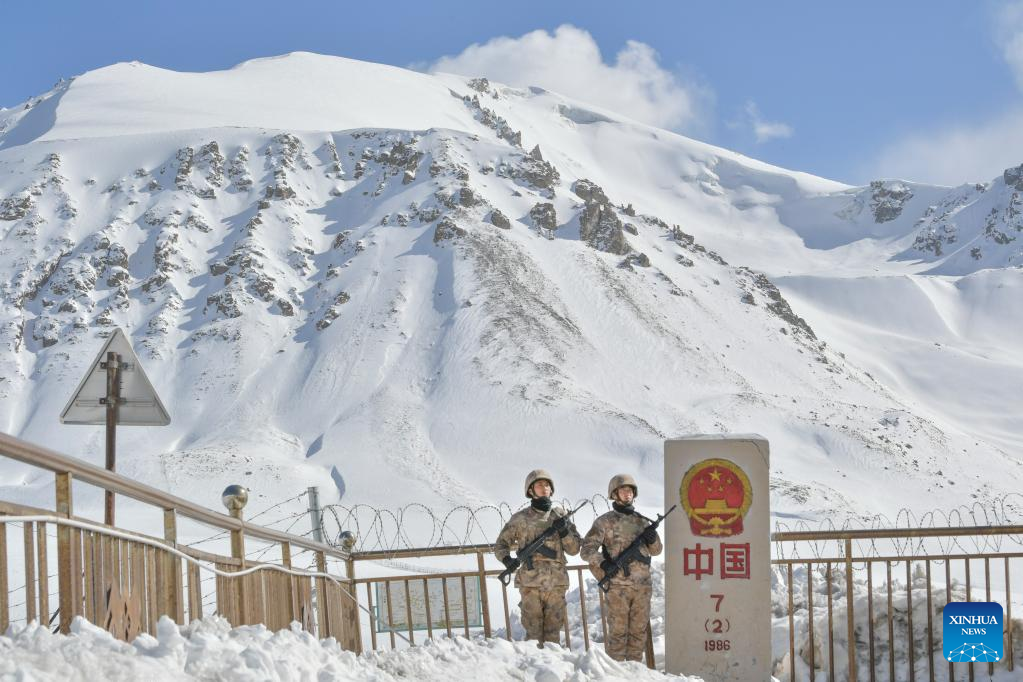
Zhou Linping (R) and Gao Guanghui stand guard in Khunjerab, northwest China's Xinjiang Uygur Autonomous Region, April 13, 2023. Gao Guanghui, a recruit who had just joined the army for 7 months, was shocked when he walked into the honor room of the border defense regiment in Khunjerab, northwest China's Xinjiang Uygur Autonomous Region.
The regiment is based on the Pamirs, guarding the China-Pakistan border and Khunjerab Port. With an average altitude of 4,700 meters, the place is a "forbidden zone" for many people, as the temperature here can drop to as low as minus 40 degrees Celsius, and the oxygen content is less than half of that in the plain area.
Gao felt even more excited when he was on patrol with his squad leader Zhou Linping to the national border for the first time and renewed the boundary monument.
"We are in a troop with glorious history. Now it's on you," Zhou said to Gao.
Zhou, a veteran who had been in the regiment for 16 years, had mixed feelings when saying this as he is going to retire at the end of the year. "When I first came here 16 years ago, life was so hard," Zhou recalled. The facilities in the barracks were poor and due to the lack of transportation means, vegetables could only be sent to the top of the mountains once a month. "So we had very few choices except for potatoes, Chinese cabbages and onions, only because they are easier to store." Other than this, the soldiers only had one generator, which could only provide electricity at night. There was no access to mobile phone signals at all.
Now, everything is different. New barracks have been built up with a basketball court, a gym, a library and a diffuse oxygen supply system, which allow soldiers to breathe more smoothly. With the greenhouse, soldiers can not only be supplied with fresh vegetables and fruits, but also have the chance to taste tropical fruits like mangosteen and mango on the snowy plateau. In addition, the emergency treatment and rescue mechanism for plateau diseases have been continuously improved.
However, what makes Zhou proud is the change in their patrol task.
"We have a guard spot at an altitude of 5,283 meters. It took us two days to get there before, " Zhou said, "Now a road has been built to a place very close to the spot. We just need to walk for an hour or two to finish the patrol task. "
"I want to patrol all the spots again before I retire. That has been my job for the last 16 years, and if it's possible I would like to do it for the rest of my life," said Zhou. (Xinhua/Wang Fei)


