
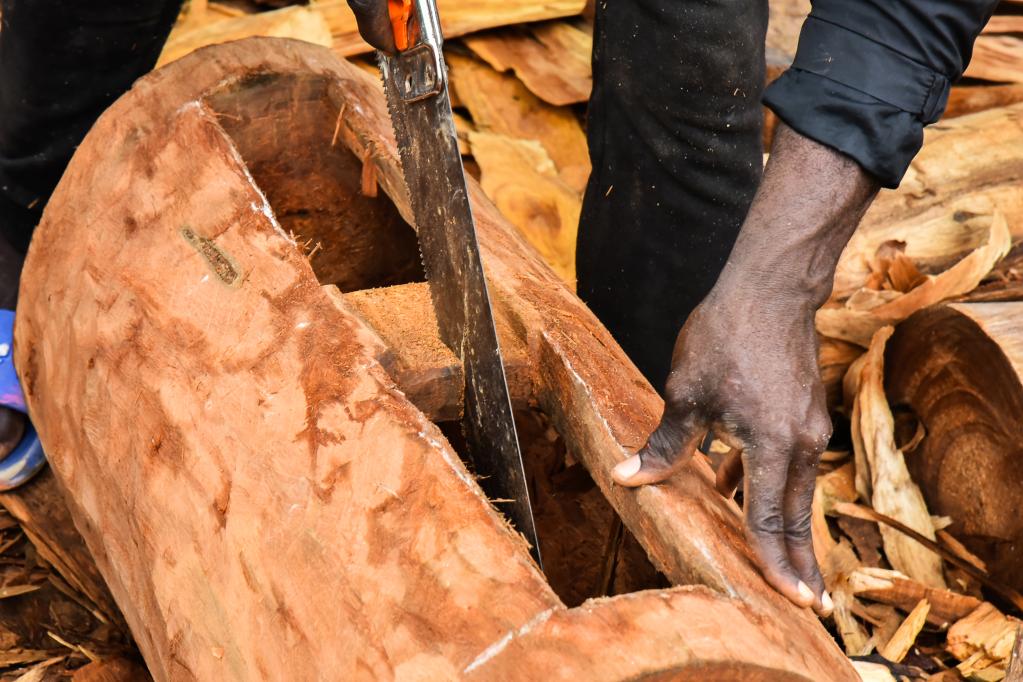
An artisan works in a tam-tam workshop in the Centre region, Cameroon, April 29, 2022. (Photo by Kepseu/Xinhua)
If really the government can take care of us, especially by providing materials such as chainsaws, machetes, and boots, it will boost the sector, said Martin Mbezele Zambo, a traditional drum maker from a village on the outskirts of Yaounde, Cameroon's capital.
YAOUNDE, May 2 (Xinhua) -- In Ekali, a village on the outskirts of Yaounde, Cameroon's capital, the rhythms of tam-tam, a centuries-old traditional drum, fill the air.
Martin Mbezele Zambo has made a name for himself in the village as one of the best tam-tam drum makers.
At 42, Zambo has spent most of his life manufacturing all sizes and colors of tam-tam and other typical African drums.
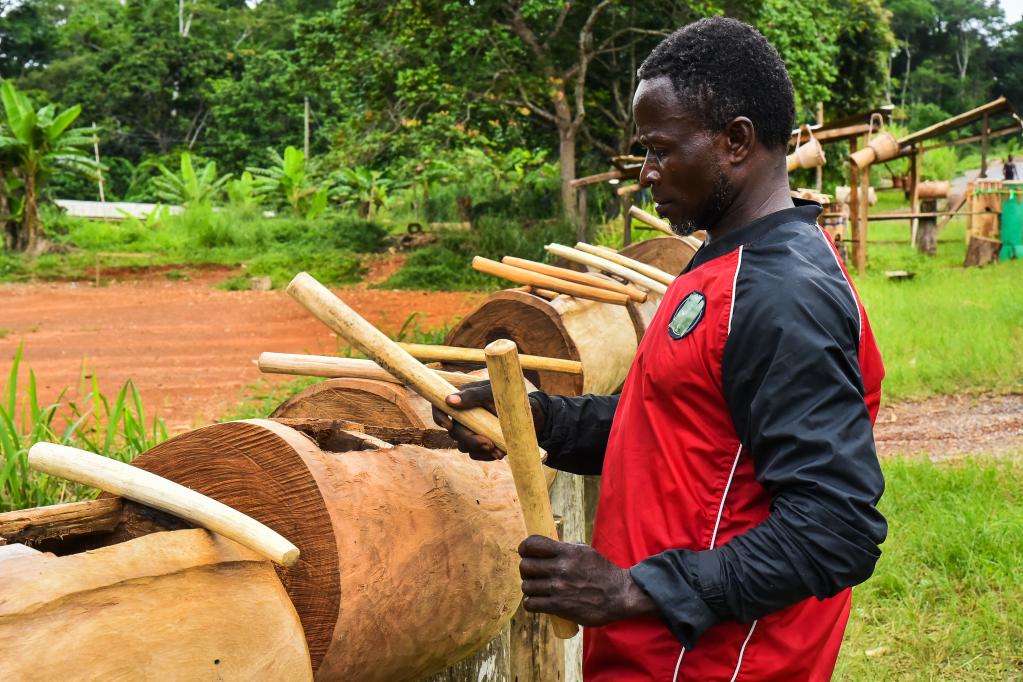
Martin Mbezele Zambo plays the drums in a tam-tam workshop in the Centre region, Cameroon, April 29, 2022. (Photo by Kepseu/Xinhua)
"I have been doing this job for 25 years," Zambo said when Xinhua visited his workshop on a working day.
It was a windy, sunny day and sunset was still a couple of hours away. The wind whistled through trees and the sound of singing birds echoed through Ekali. Zambo and six other drum makers were buried in work. They used a tree trunk that is sourced from a nearby forest, with an iron rod hollowing it into a rectangular form to produce the tam-tam.
They also produced other drums by putting an animal skin over the top of the hollowed trunk, stretching it, and tying it down, or made the Balafon instrument by using a series of wooden bars, or keys and resting them on a bamboo frame.
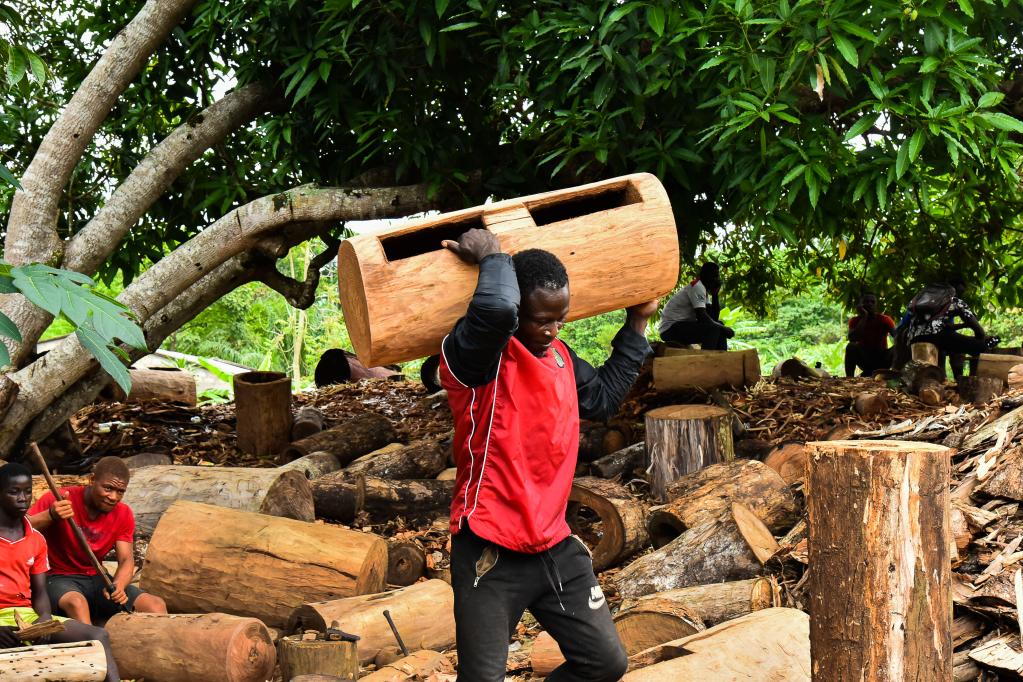
Martin Mbezele Zambo carries the tam-tam he made in a workshop in the Centre region, Cameroon, April 29, 2022. (Photo by Kepseu/Xinhua)
It is ancestral know-how that is passed on from generation to generation, said Zambo.
"I was trained (to make drums) by my big brother, who was trained by my grandfather," he said and added that in the past, their grandparents spent months making a tam-tam, now it takes two to four days. "
"My great grandfather trained my grandfather who trained my father who trained me," said Jules Atangana, Zambo's neighbor who is also an artisan.
The sound and notes of the drum vary according to the wood and the shape hollowed out of it. Tam-tam is sounded by being struck with sticks.
Drums are providing a living for young people who can make or play them.
On a good day, Zambo sells one tam-tam for 25,000 XAF (about 40 U.S. dollars), especially to foreigners who come from neighboring Gabon and Equatorial Guinea.
"This job allows me to feed my family, my children go to school, they have never been expelled from school for lack of money," said Zambo who is a father of three.
"I just bought a piece of land thanks to this work," added 35-year-old Atangana who left school early to pursue his passion.
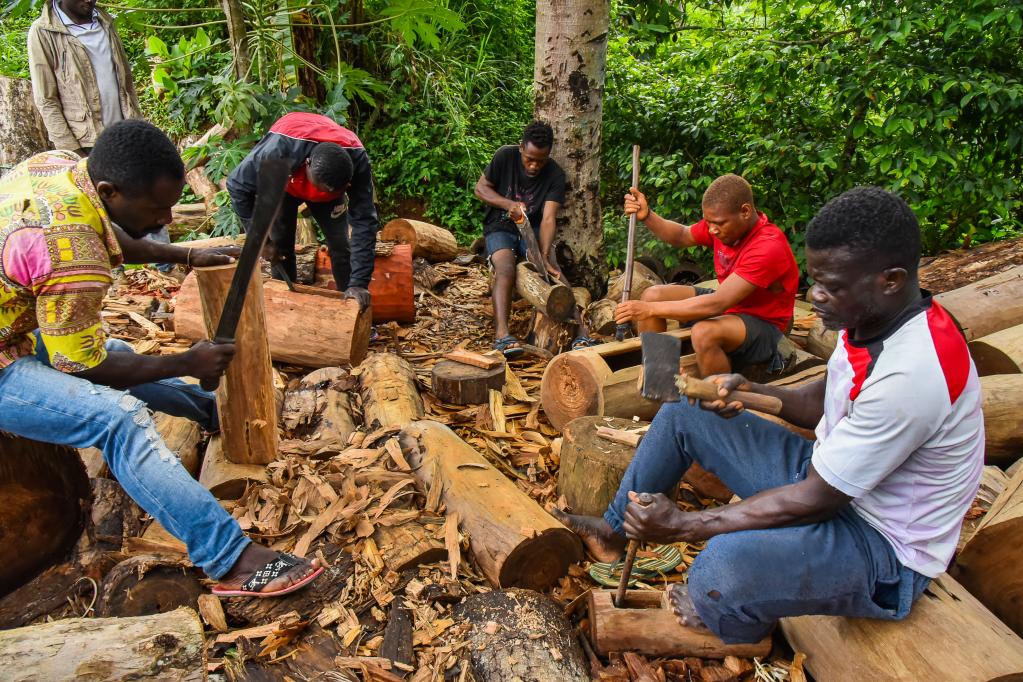
Artisans work in a tam-tam workshop in the Centre region, Cameroon, April 29, 2022. (Photo by Kepseu/Xinhua)
Tam-tam is not just an instrument that is played in church, weddings and other ceremonies, it's also an important communication tool that enhances the rich cultural diversity of Cameroon, said James Ngwang, a traditional leader in the country's Northwest region.
"At the time there were no loudspeakers or telephones, the instrument was used, and is still used in villages to pass on messages. Each sound represents a particular message and people have to listen carefully to understand the meaning," Ngwang said. "The sound could be announcing the death or enthronement of a king or the beginning of a farming season or any other major event. It is still used for that purpose in many places in Africa."
As Cameroon joined the rest of the world to commemorate International Workers' Day, which fell on Sunday this year, both Zambo and Atangana appeal to the government to support their job which they said can contribute to employment significantly.
"If really the government can take care of us, especially by providing materials such as chainsaws, machetes, and boots, it will boost the sector," said Zambo.
"COVID-19 really affected our job but we are back in business. Government can make this business become international by assisting us to attend international exhibitions in order to export our culture and sell the instrument," added Atangana. ■