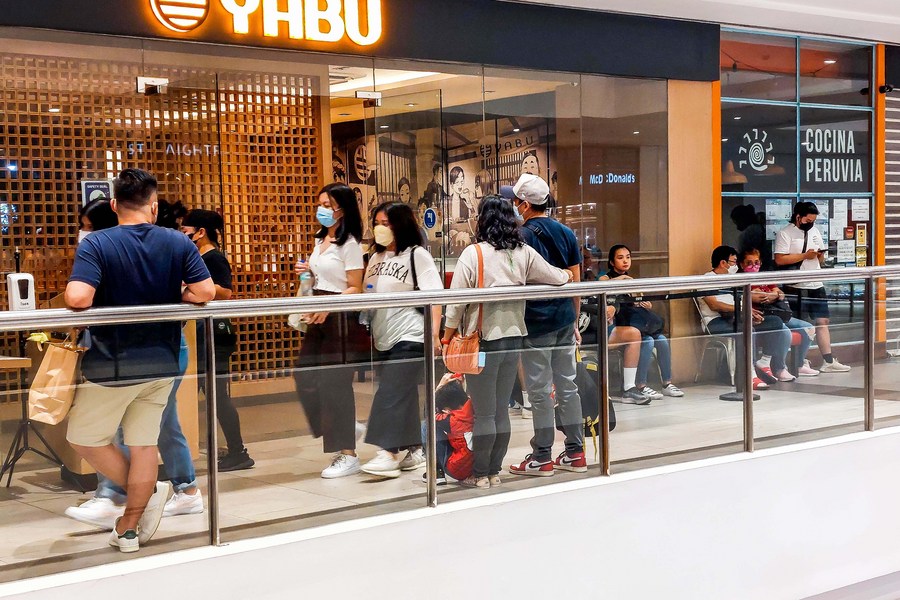
People are seen at a mall in Quezon City, the Philippines on March 7, 2022. (Xinhua/Rouelle Umali)
A recent national survey shows that controlling inflation, increasing the workers' salary, reducing poverty, curbing corruption, and creating more jobs are "the most urgent concerns" of Filipinos that their next president should address.
MANILA, March 12 (Xinhua) -- For 48-year-old passenger jeepney driver Arthur Arsenio, the most urgent task of the next Philippine president is to ensure a stable income for daily workers like him and lower the prices of food and other commodities.
Arsenio's income as a driver has been erratic since the government imposed various levels of lockdowns due to the COVID-19 threat in March 2020. The restrictions halted public transport, forcing many jeepney drivers out of work.
The elongated, flatbed passenger jeepneys are the most popular means of public transport in the Philippines. These iconic vehicles have been plying in the streets after the Second World War.
Arsenio was lucky to survive in Metro Manila, capital region, as his partner Tina, who works as a domestic helper, earns money to pay for the house rent and food.
This year, Arsenio has started plying his jeepney again after two years of uncertainty, but charged his passengers 13 pesos (about 0.25 U.S. dollar), 2 pesos (about 0.038 dollar) higher than the minimum fare, explaining that the soaring fuel prices in the Philippines forced him to raise the rate.
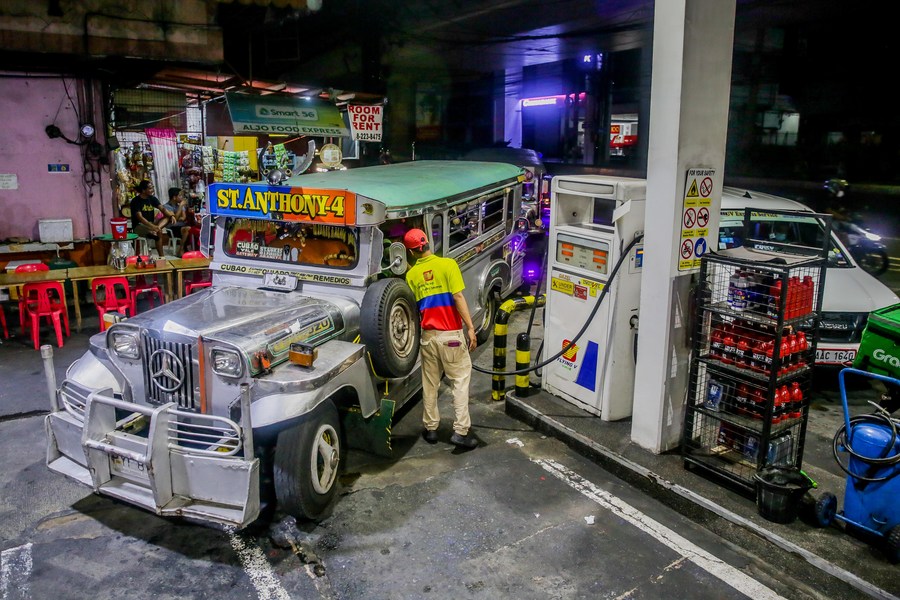
A worker refuels a jeepney at midnight in Quezon City, the Philippines, March 7, 2022. (Xinhua/Rouelle Umali)
According to the Philippine Statistics Authority, year-on-year headline inflation in the Philippines remained at 3 percent in February, while electricity, gas, and other fuels for household inflation accelerated to 12.8 percent, and private transport inflation increased to 29.8 percent.
Arsenio's concerns are shared by other Filipinos. A recent national survey shows that controlling inflation, increasing the workers' salary, reducing poverty, curbing corruption, and creating more jobs are "the most urgent concerns" of Filipinos that their next president should address.
On May 9, Filipinos will elect a new president to succeed President Rodrigo Duterte, whose six-year term ends in June.
Government data shows that around 3.27 million Filipinos were out of work in last December. The country's unemployment slightly rose in December at 6.6 percent despite the easing of COVID-19 mobility restrictions. The country's poverty rate also increased to 23.7 percent in the first half of 2021, or 26.14 million Filipinos.
"We are now in a very deep dark pit," Baguio City Mayor Benjamin Magalong said in a recent speech, warning of challenges that the new administration will face head-on to steer this Southeast Asian country of 110 million to recover from the pandemic.
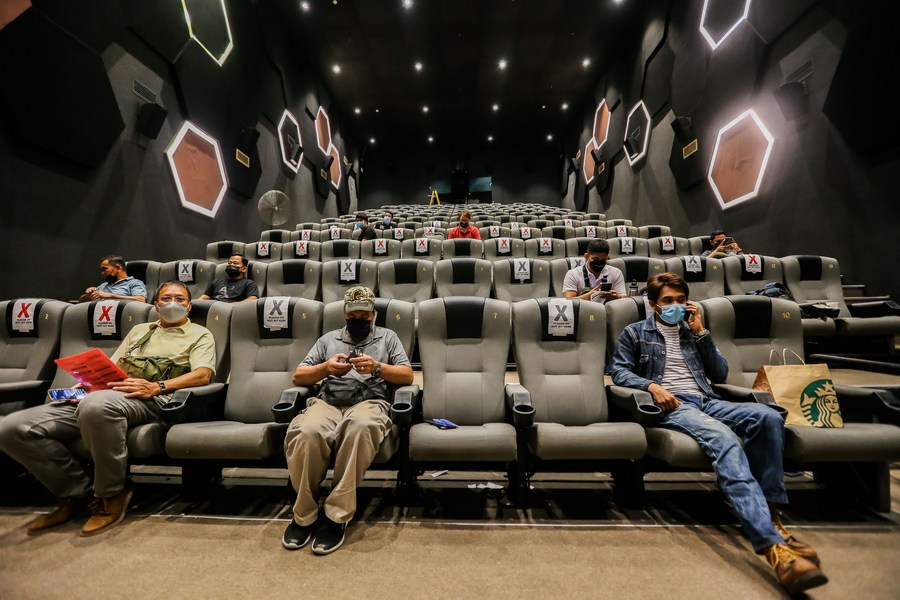
People wait to get inoculated with COVID-19 vaccine at a cinema which was turned into a vaccination area inside a mall in Pasay City, the Philippines, Dec. 16, 2021. (Xinhua/Rouelle Umali)
The COVID-19 pandemic has ravaged the Philippines for over two years now. More than 3.6 million people were infected, including over 57,000 deaths.
Fighting the lethal disease is costly. The Bureau of Treasury said the Philippines' total debt stood at 11.73 trillion pesos (around 227.95 billion U.S. dollars) as of the end of December.
The recent build-up of debt was largely in response to pandemic-related expenses, Finance Undersecretary Gil Beltran said.
Beltran said that fiscal consolidation and economic recovery would be critical in preserving fiscal stability. "The debt-GDP ratio is expected to stabilize as pandemic-related spending is wound down," he added.
Socioeconomic Planning Secretary Karl Kendrick Chua outlined the "high-level priority" strategies needed to pursue to achieve full economic recovery in 2022 and beyond, namely recovering from COVID-19, raising productivity, and mitigating and adapting to climate change.
The Philippine economy grew by 5.6 percent in 2021, reversing the recession of 9.6 percent posted in 2020. The government is working to sustain the momentum despite the virus' continued threat. "The country needs to continue managing the risks, either through pharmaceutical or non-pharmaceutical means," Chua said.
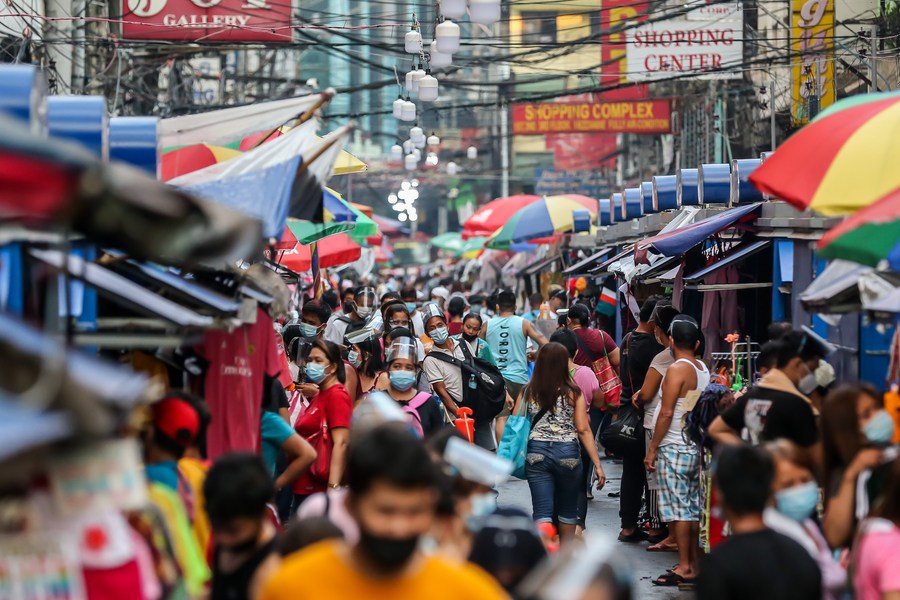
People wearing protective masks are seen at a busy street in Manila, the Philippines, March 20, 2021. (Xinhua/Rouelle Umali)
The declining COVID-19 infections and over 63 million fully vaccinated allowed the Philippines to reopen its economy. The government is already drafting the "new normal roadmap" to aid the country to exit the pandemic, presidential adviser on COVID-19 response Vivencio Dizon said.
The government has downgraded the pandemic restrictions in Metro Manila and 38 other areas to alert level 1 from March 1 to 15 as COVID-19 transmission slowed and the hospitalization rate declined.
"This will signal our move towards some semblance of normalcy after this very difficult two year," Dizon said.
Last September, the National Economic and Development Authority said that the long-run total cost of the pandemic and quarantines for present and future generations of Filipinos is estimated at 41.4 trillion pesos (roughly 280 billion U.S. dollars).
"While we will recover to the pre-pandemic level by the end of 2022 or early 2023, it will take several more years before we converge to our original growth path," Socioeconomic Planning Secretary Chua said.■